
Why Young Adults Don’t Make Friends Easily Anymore

“I’m lonely.”index

I hear it a lot.  I hear it a lot from young adults.

My armchair analysis is that the “I’m lonely” phenomenon with young adults probably has much to do with our ability to keep our childhood friends over great distances with ease.  Social media and emails have replaced the slow-and-tedious pen pal connections of our parents.

Thus our “friends quota” is largely full post college, and for some, post high school.  We go into adulthood thinking we don’t really need anymore friends (and, thus, not reall cultivating the skills to make anymore).

There are exceptions, of course.  But we have young adults coming to the church, and on the one hand they’re looking for spiritual connection with the Divine, especially the Divine seen through the lens of Jesus.

On the other hand they’re looking for friends.

If my armchair analysis were to go deeper (“let’s explore that, shall we?”) I’d also posit that many of the people who express that they are lonely do so not because they don’t have friends, but because they don’t have the deep, satisfying relationships that provide close, personal connection.

Part of this comes with the changing nature of our society.  I think my grandparent’s generation made friendships largely out of necessity.  The difficulties of war-time life, depression-era life, led to the desire to band together.  My grandparents on my father’s side never moved an they had many friends.  On my mother’s side they moved a few times for my grandfather’s work, but though my grandfather was gregarious, had very few close friends, but kept close ties to a lot of family.  Both sides never seemed too distraught about their friendships (though, granted, I never interrogated them about it either, and I won’t get the chance).

My parent’s generation, I think, made and continue to make friends for fun, and made them pretty easily.  It may differ from individual to individual, of course,  but I see this generation making connections that are pretty tenuous and relatively easy to maintain.  Some relationships are deeper than others, but it doesn’t seem to be the great expectation that depth is necessary for friendship. And those friendships that are deep have continued throughout the years becausemy parents treasured them so much they worked hard at keeping them long before the ease of social media and direct communication.

For my generation though, I’m finding an underlying unmet need for deep relationships, and the desire to make them easily. Those two don’t mix, though.  The kind of depth that forced situations, like the college dormitory or the high school track team, put on you only come through rare, intense situations.  After leaving those pressure cooker environments where strong bonds are formed, my generation is not sure how to make those loose, tenuous relationships of their parent’s generation, nor work hard at keeping really deep relationships from afar (it is work, you know).

Or, when they do make the loose friendships, they find them quaint but not enough.

Likewise, they’re not comfortable making friends for necessity’s sake because, well, they’ve been able to keep their friends from childhood!  Sure they live 800 miles away, but they’re still friends!  They “talk” almost every day over Instagram and Snapchat.

Unsurprisingly, these methods of keeping up do not satisfy a heart that needs something more than just an update.

Sidebar: I believe we can see much of the loneliness and PTSD in our veteran population being due to the fact that the close, personal relationships they formed in the service just aren’t found or easily forged in civilian society. Sidebar over.

Funny enough, I actually see this issue being more of a problem for men than for women.  It might be because I tend to work more with men on these issues, but with the changing landscape of male friendship (men are creating more intense bonds as many social stigmas over what it means to be a man who has male friends are evolving), many men don’t know exactly how to navigate the waters of loneliness.

All of this is to say that I’m finding young adults, myself included, making friends much for the same reason many from my generation get married: self-fulfillment. Hence why we want them all to be deep.

Despite the fact that that sounds very insular and narcissistic (and to a degree that can’t be denied), I think we come by it honestly, having been raised in a culture of “You can be anything you want” and “You can plot your own course.”

The trouble is that we’re becoming disillusioned by the fact that we can’t be anything we want, and that while our life trajectory has a good bit of leeway, surely more leeway than the previous two generations, we still hit walls on either side of the road despite the assurance that it’s all open range.

One of those walls is loneliness, something we thought would be abated by virtual connection.

What the fortune tellers say may eventually be true; “virtual reality” may one day just be “reality.”

But we’re not there yet.  And in the meantime I’m finding more and more people needing real rather than virtual.  I think the church can help if it’ll stop wringing it’s hands over shrinking numbers on the one side, and get off it’s hyper-fundamentalist kick on the other side.

Another sidebar about the hyper-fundamentalist kick in some areas of the church: I once heard a study (which I conveniently can’t find) where it was noted that people make more intense bonds over common dislikes rather than common affinities.  I have a working theory that one of the reasons very conservative churches grow quickly is not because everyone there loves Jesus so much and are aligned on that commonality, but because they dislike being wrong.  And the assurance of conservative churches that they have the right answers is a nice gel. We hate to think we’re wrong. Second sidebar over.

For the other side of the church, the supposedly “shrinking” part, take heart. Actually, shrinking numbers can help with this phenomenon, if attended to correctly and prayerfully.  The real connections that my generation longs for, both spiritually and physically, can be better met by a smaller more nimble group of people; a smaller more nimble church.

And I really (no, really) have hope that the church can teach my generation what it means to make and keep friends in the flesh again.  Of course some will wonder, “Well, we want those looking for Jesus, only, to sustain a religious community, right?  Is someone looking for community and not for faith really who the church wants in it’s doors?”

Of course it is.

The intensity of the Divine-human relationship is best embodied in intensely strong human-human relationships.  The one points to the other, which is why I have so much trouble with the “Jesus and me” language of so much of the evangelical world.

Look, we just don’t make friends easily anymore because we expect a lot out of our friendships these days.  Perhaps we need to let go of a bit of that as a generation.  But perhaps we don’t have to let go of all of it, and perhaps the church can be the incubator to foster such relationships with the honest purpose of helping people be more humanly whole again.

Because whenever I hear the phrase “I’m lonely,” I’m actually hearing “I’m not whole.”

And that is a spiritual problem.


The Church of the Perpetual Misogyny

This shooting in California has my heart breaking.index

Still.

The fall out has sparked some intense conversation, and it’s just heartbreaking to see some of the comments coming from the dusty corners of society where misogyny still lives and breathes.

Oh, don’t get me wrong, I think misogyny lives everywhere in our society.  But it has a hard time breathing in some places…and I thank God for that.

Unfortunately, one place it doesn’t have a hard time breathing is in the church.

People are pointing to misogynist video games, misogynist movies, and all other cultural points as contributing to this young man’s delusion that just because he has a sexual desire for women they should appease it willingly (or, even, unwillingly).

But, for my part, I’m going to let Hollywood alone.  I’m going to let video games alone, too.  They have their blame.  But, see: I’ve come to expect that from them.  Hollywood and the video game industry and marketing and the like have all used sex for gain, to force submission, to put sex on a pedestal.

But me?  I’m going to point to the church.

I’m going to point to churches who still refuse to ordain women, despite the fact that, while Paul (inconsistently) makes misogynist comments, Jesus (consistently) treated women as part of his inner circle and, indeed, entrusted them first with the news of the resurrection, the “gospel,” the “good news.”

Explain that rationale for me, please?  The men were all too chicken in their hiding places, and when the women told them about the resurrection, they didn’t trust their testimony (after all, in a court of law, women couldn’t be trusted, so why would God entrust this good news to them?).  And we look at this and wink and laugh as if it’s some sort of Laurel and Hardy episode, where the one who was supposed to “get it” doesn’t.

But I don’t think that’s it at all.  I think the women were supposed to get it.  Intentionally. Purposefully.

I’m going to point to churches who still refuse to let women vote, as if somehow their opinions are less important than the opinions of human beings with a Y chromosome.

I’m going to point to churches who still refuse to acknowledge the presence of feminine examples for God in the scripture, yet who claim to take the Bible literally.  If God is male, then God is also a hen (at least, according to Isaiah). And, for that matter, a rock.

What?  Those are metaphors?  Personifications? Which one(s)? All?  Or only the ones without male anatomy?

I’m going to point to churches who allow women preachers, but who won’t allow women preachers to lead churches by themselves.  Or who allow women preachers, but won’t allow them to preach primarily to men.  Or who allow them to preach, but as long as they tell their fellow sisters to “submit” to their male partners.

By the way, don’t ask me to preach at your wedding on any “submission” text.  Not going to happen…

But just before you mainline Protestants think you’re off the hook; no way.  I’m pointing at you, too (and, therefore, to myself).  We think that just because we ordain women that we’re free of blame?  Because I know more female pastors across all the mainline Protestant denominations without churches then I do male pastors without churches.  I know of situations where churches have rejected every female candidate received in the hopes that they would receive a male candidate eventually.  I know of churches who still feel as if their pastor is inferior or that they “weren’t good enough” for a male pastor, just because their pastor is a female.

The church should be the place where misogyny comes to die, not where it comes to life.

And, this is the thing: while I don’t hold Hollywood or the video game industry or politics or any of that fluff to a very high standard when it comes to gender stereotypes and discrimination, I do hold the church to a high standard.

I wish all the former could be held to a higher standard.  I expect the latter to be.   It’s sad, but not surprising.

And while this individual who shot up these innocent people may not have been religious (I haven’t heard either way), it doesn’t really matter.  If religion isn’t able to critique culture, to model for the wider culture a way of living that embraces the life of Jesus rather than the hate of any “ism,” we’re useless.  We can say that it’s sad that this man was violent, but on Sunday mornings many churches preach a violent, male god.  We can say that this man shouldn’t have thought of women that way, but until we acknowledge that we at least had a hand in that education, we’re speaking out of both sides of our mouths.

If we say we have no sin we deceive ourselves; the truth is not in us.

It may be interesting to think about how Mario always saving the Princess has contributed to this misogyny that resulted in such violence.  But that narrative is just part of a much larger narrative of men saving the day, tracing it’s way back through the centuries.

The church has the ability, the call, to break off from that narrative and live a different one.

If only it had a good example to follow…

“Donald Sterling Should Be an Insulation Salesman” or “Cultic Christianity is Deadly Due to Insulation”

Donald Sterling is a one-man study in insulation.fiberglass-insulation

He should be an insulation salesman; he’s his own best example.

In his interview last night with Anderson Cooper, which I only was able to see part of (but a telling part), he convincingly argues for his own ineptitude without meaning to.

To him, he’s not hated by players.  To him, he’s not hated by fans.  And while he knows that he has done wrong and has “hurt many people,” he then proceeds to prove that he does not, in fact, know this in any way that might lead to behavior change because he starts berating Magic Johnson, the black community, and basic sensibility all in one fell swoop (see link above for the spectacularly terrible soundbite).

This shows me that either he is a) going slightly mad (not out of the realm of possibility) or b) absolutely insulated from the general public.

My hunch is “b”.

There are many insulators.  I think money is probably one of his greatest insulators.  With the ability to be taken everywhere by hired car, what need do you have to interact with anyone who you don’t hire or choose to spend time with?  When you can buy anything you want, including sexual partners, why bother with real relationships (like, say, the legal wife you have)?

One of the greatest things someone who wants to live an uninsulated life can do is take public transportation.  It is grounding.  In a good way.  In a way that makes me want to raise my kids in the city and have them do it.

Another one of his insulators he has is that he’s white.  It absolutely insulates him from a whole variety of perspectives and, wrongly, gives him the appearance that he’s one of many voices.  He is in fact a privileged voice among other voices.  This is the same mistake that poor college kid made when Time magazine picked up his article.  If you haven’t run across that news tidbit yet, please check it out.  It’s a perfect example of what self-righteousness will do to the young mind if given a platform. I suspect he’ll repent of that article in five years, if his education is worth anything and he lives vulnerably enough to see how asinine he is…

To be fair to that guy, no one should have any of their Freshman papers/thoughts published.  Ever.  His thoughts aren’t fully developed (I hope).

But back to Sterling.

Sterling suffers from insulation in a way that I see cultic Christianity suffering from insulation, too.  For an example, check out your local cinema. This abhorrent move God is Not Dead is just one example of the insulation problem that much of the church has.  A philosophy professor that throws down an ultimatum to stifle thought?  A Muslim girl who gets beat up by her father for conversion?  A last-ditch confession of said professor when it comes out that he doesn’t believe in God because of personal tragedy?

It’s the same reason that I stopped believing in Santa Claus: you don’t get that G.I. Joe action figure enough Christmases in a row, and you kind of get wise…

Except that those are all straw men.  They aren’t real people.  They’re fake elaborations on attributes that might be part of the make-up of a person.  But they’re not real.  It’s the same problem I have with Christopher Hitchens’ writings.  He writes of straw men.  Insulated Christianity and insulated atheism are two sides of the same coin.

But the delusion of these things being real can continue if a person is in isolation.  That’s what I worry about. Kind of like the delusion that Sterling has of himself.  Kind of like the delusion of homosexuality being a “choice.”  Much like I choose my heterosexuality, I guess…

All of these ideas can persist in a world where you don’t actually interact with anyone outside of your insulation zone.  Sterling’s problem isn’t one of bad publicity, it’s one of insulated publicity.  And it’s a cycle that perpetuates itself.  He never sees himself clearly because he doesn’t really have anyone of worth to reflect him back on himself, and because he can’t see himself clearly he becomes more and more the monster that he is.

Cultic Christianity is the same way.  Except with Christianity it has to do with interacting with others outside of the “Christian worldview” (whatever that means).  And it’s deadly because of this.  Deadly in that it creates a spirituality that is dead to it’s own self-righteousness.

And it’s a problem.  Not just because it results in crappy movies…that has been going on for years (looking at you Kirk Cameron).  It’s mostly a problem because it prevents the abundant life, the limitless life, that Christ talks about.  It’s dead life.

It’s why I encourage people to have friends across faith lines, cultural lines, all sorts of lines.  And not in an effort to convert them; that’s disingenuous.

Can’t you just experience the other where they are and *gasp* learn from that?

Part of the problem with insulation is that it gives the appearance of certitude.  Sterling is willing to admit he made a mistake, but he can’t see that he’s messed up.  He’s messed up as a human being, as part of a larger system of affluence and influence.

Christianity is messed up.  It’s made mistakes, but it really has to come out and say “We’re messed up.”  And not in the superficial way we say, “We’re a broken vessel just like everything in this world.”  But in a legitimate way that allows it to let go of the influence grip it has over people’s hearts and minds to open hearts to the greater world and greater life that God invites us to experience as Christ-followers.

Christ is our feed box, not our fence.

I am unapologetically Christian (reluctantly).

As part of that identity, though, I feel compelled to meet others where they are.  I feel compelled to tear down the insulation around me (and have it torn down), as best I can, and move out of my comfort zone into the dangerous place outside the walls of security and meet the other.

The church, at her best, can help people do this.  If only she’ll be vulnerable enough to admit she’s part of the system…


Your Pastor Dreads Mother’s Day

depressionMother’s Day is a continual reminder to pastors that they are truly incompetent in the “make everyone happy” department.

A good lesson, I guess.

Except we’re reminded of it every day…it just intensifies on Mother’s Day, Father’s Day, when the 4th of July lands on a Sunday, Veteran’s Day, and when 9/11 marks the first day of the week.

Out of all of those, though, Mother’s Day really does take the cake because it is really intimately tied to culture in a deeply personal way.  Mother’s Day is really about sex, sexuality, procreation, choice, marriage, divorce, and choosing to raise/not raise children.

And the pastor’s hands are tied, in this case.  Especially if the pastor is accustomed to preaching with the Bible in one hand and the newspaper in the other.  You cannot mention current events and not mention the reason why so many women are wearing flowers that morning, I think.

Or maybe you can…I don’t know.  I haven’t figured out a way to do it.

It’s just, well, whatever you choose, be prepared for the emails, anonymous notes, and comments following the service.

A very popular blog post has been making it’s way around this past week.  It’s good. Really good.  It’s been around for a few years.  Like that picture your mom took of you in the bathtub when you were four, it makes it’s rounds about the same time every year just in time to make you feel really awkward.

Yes, the blog post makes me feel awkward.

As a father, it doesn’t make me feel awkward at all.

As a feminist, it makes me shout “yes!”

As someone who wasn’t always sure they wanted children, it makes me feel affirmed.

As a pastor it makes me feel awkward.

Because it’s indicative of a Catch-22 for me.  Mother’s Day isn’t a liturgical holiday, so it really doesn’t need mentioning by the church.  And yet, we lift up Mary as the theotokos, the “God-bearer,” and note her motherly care of the Christ.  We talk a lot about the “womb of creation” as being God’s womb, and make the case hard for feminine pronouns to describe God, especially pointing to God’s work in creation.

And then comes Mother’s Day.

I’m not for honoring Mother’s Day during a Sunday service.  I’m not for pretending it isn’t happening, either.  I’m sure there are ways to straddle the desire to lift up mothering in this world while also not glorifying it as the end-all and be-all of existence.  I truly get that mothers are proud of that role in their life.  I truly get that not all women want to be mothers, and don’t need the church making them feel like they should.  Society does that well enough.  And I truly get that Mother’s Day is painful for some who are grieving their mother, or who have crappy mothers, or who can’t conceive.

Hopefully your pastor isn’t glib.  Hopefully they see all of these realities and try to acknowledge them all. I try to do that…to varying degrees of success.

But it’s just yet another example of why I suck in the department of making people happy.  Pastors truly die from a thousand paper-cuts…not just on this topic.  Which might be why your pastor responded to your email of “concern” or “complaint” in that way that made you feel like they really didn’t hear you.

It’s probably the fifth email of concern they’ve gotten that day…and they’ve stopped being concerned in order to just finish out the day without feeling absolutely dejected.

But I digress. Back to Mother’s Day.

These fights between cultural holidays and Sunday morning worship sometimes make me want to skip out on church altogether.  I don’t blame the women who do on Mother’s Day.  And I don’t blame the women who feel slighted when Mother’s Day isn’t talked about at all at worship, either.  The church of the past was the place to celebrate such things; for many it still is.

But for me?  I’d really just like to say a quiet prayer on Mother’s Day in thanks for God who is mother to us all, call my mom, kiss the mother of my son, greet the young woman who doesn’t want kids where she is, thank the couple who can’t conceive for worshiping God today in our congregation, hug the grandmother who has outlived her children and buried each one with a hug that she won’t get from them, high-five little girls without assuming that they’ll be or want to be mothers, shake the hands of the two fathers who bring their children to church, and not feel like by doing any one of those actions I’m hurting someone else.

Is that too much to ask?


Why You Get Mad When Your Pastor Mentions Politics, and Why She Has To…

Let’s start with some political statements:church_state

“Jesus is Lord.”

Yes; that is a political statement.  You might think it’s pretty innocuous.  Perhaps you even think it’s a bit annoying (sometimes I find how this seems to be a catch-all answer for some annoying).  But, actually, for the ancient people in Palestine, this statement was scandalous.  Because they only had one Lord: Caesar.  And if you went around saying Jesus stands in the place of Caesar for you and your family…well…keep your politics to yourself.

“Prince of Peace.”

Yes; a political statement.  Want to hanker a guess as to who was the Prince of Peace in ancient Palestine?  If you chose Bill Murray, you were off by a few thousand years.  No, it was Caesar.  He was hailed as the one who kept the empire out of war.  He was the harbinger of peaceful times.

That is, unless, you were some of the occupied people under him.  The Roman Empire kept peace through military might and subjugation; through intimidation and economic sanctions.  Is that really “peace”?  The absence of war does not mean the presence of peace…

In fact, the opening chapters of the first three Gospels are chock full of political language.  But no need to just stick to the New Testament.  The prophets were certainly not quiet about politics, both domestic and foreign.  The whole book of Exodus was leaving one political reality for another, tackling immigration head-on.  The whole book of Leviticus was about how the people would organize themselves in the new land.

See, we have people who get pretty angry when they hear “politics” preached from the pulpit.  In fact, a colleague of mine recently noted that pastors should preach the Gospel and then shut up.

But, well, nothing happens in a vacuum.

(…I love that pun)

We aren’t people who are floating free in our own little religious world.  We must talk about politics from the pulpit.  The ancient texts compel it; the modern times call to us from the news programs and paper rags.  We are being pulled into it by the past and the present, and the preacher must put these two things together to comment on how God might be leading us into the future…

We should talk about how farm bills do or do not help feed the world.  We should talk about how, in Chicago, we are bankrupt and giving huge corporations billions in tax breaks while, just this last year, my housing tax went up, but my house value went down.  And if that’s the case for me, who lives in a pretty good neighborhood, what does that mean for my sisters and brothers who don’t?

Explain that to me, please.

We should talk about what it means to be able to carry on your person a weapon that is made only to kill other people.  What might God have to say about that?  What might the Christian world have to say about that?  Especially in Chicago where we don’t ranch cattle, but live in a concrete jungle.

See…your pastor has to talk about politics because you are enmeshed in political systems that have a spiritual dimension.  But we’ve been trained by the world to have a negative reaction to such talk because we see politics as divisive rather than unifying.

But, if there’s one thing that does unify the world, it’s that we are all under a political system of some sort.  And we should talk about it.  Your pastor should talk about it.

What she shouldn’t do, and here’s the rub, what she shouldn’t do is be partisan.

Sure, she has her own opinions.  And you might know them, too.  But her opinions aren’t the Gospel.  And you preachers…that’s important to remember.  God is not a Republican, nor is God a Democrat.  God is not in the Labour Party nor is God a Tory.

That being said, to pretend like the texts don’t say something about political issues is naive.  You follow the Prince of Peace, and yet you don’t think that God might have an opinion on war?  You say “Jesus is Lord” and yet your church is making most of it’s decisions based off of economics, putting money in the place of power?

Nothing happens in a vacuum.

Your church shouldn’t feel like a gathering of the Democratic Party.  That’s a church that would have a hard time saying “Jesus is Lord” and meaning it.  That’s a puppet platform.

Your church shouldn’t feel like a gathering of the Republican Party, either.  Or any part, for that matter.

So many do, though.

And I’ve been accused in my time of preaching politics…it’s a careful line the preacher has to walk, and hopefully it’s done with fear and trepidation.  Politics so easily turn partisan.

But let us not pretend that God might not have a word or two for the systems that surround us, for the systems we’re embedded in, for the systems we inhabit.

We can be careful how we speak, but we cannot not say anything.

Christian Ideas of “Controversial” are Screwed Up…

This poor homeless statue of Jesus is still having trouble finding a home without controversy.

Appropriate, I think.  It challenges our sensibilities in a way that I think only Jesus does.

But, here’s the thing: this is not controversial from a Biblical perspective.

index


If Jesus wasn’t actually homeless (for a dude who might have had a home, he doesn’t hang much there in scripture), he certainly was found with the homeless and destitute, probably sleeping many nights under a sheet with the sky as a roof.

But this?  This is absolutely controversial:

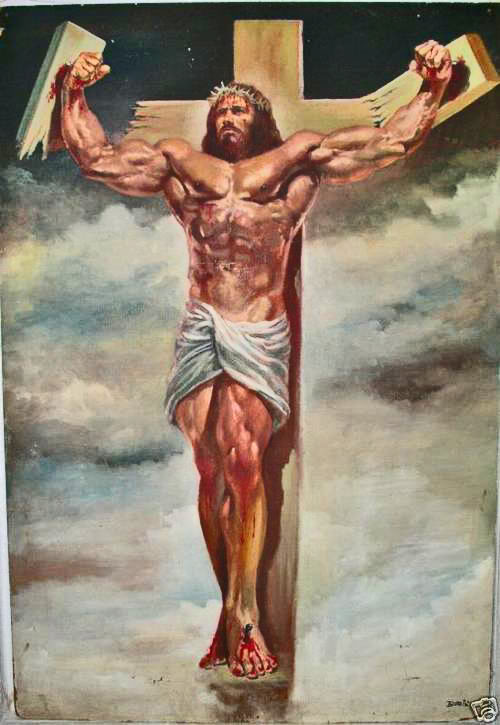
muscular-jesus-breaking-cross

OMG, Jesus! Where did you get those quads from? Biking?


I’d say it’s damn near blasphemous…and that’s coming from someone who doesn’t think much is very blasphemous.

This is pretty controversial, too:

jesusarm-wrestlingwithsatandemon

Ugh…dualisms make me want to punch someone. Exorcising them from Christianity is like arm-wrestling the devil. Wait a sec…


Look at how crazy creepy that really white Jesus is wrestling with the good-guy from the Hellboy comics…

An uproar over this statue…that’s screwed up.  We see Jesus as Jesus is and get all offended.  That’s a teachable lesson for those with eyes to see and ears to hear.  But I haven’t heard much said about those other pics or others like them that appear on bulletin covers, emails, Facebook memes, or bumper stickers…in fact, I’d dare guess that most Christians would see them and not think two things about them: their veracity, their message, their scandal.

And they’re far more scandalous…

Want to know what else doesn’t seem to cause much controversy?  The fact that people die of starvation in the city of Chicago, one of the wealthiest cities in the world.

Or the fact that farm owners are committing suicide because they can’t make a living anymore, what with our demand for everything cheap and mass produced and all.

Or the fact that $600,000 was stolen from smiley Joel Osteen’s mega church a few weeks ago, and that was just one Sunday’s offering from plate-giving. For some perspective, that is almost double my faith community’s total operating budget.

Don’t let Jesus be shown homeless, but it’s sure ’nuff OK for the imago dei to be starving and dying while hundreds of thousands are collected each week from one place…and the only thing we can say is that we can’t believe someone would have the nerve to steal that money from a “church”…

Where’s really-ripped abs Jesus when you need him?


Progressive Christians: We Need to Talk About Jesus…

Glasses on Open Bible

Please note: Not all theological progressives wear glasses.

I’m a theological progressive.

When I fell away from faith, I fell away from a faith that was absolutely confused about its identity.  I was interacting in worlds that didn’t seem to speak the same language.  One world I lived in included people I knew and loved who were of intellect and not willing to take the Bible literally, people of different sexual orientations, people of different faiths.

And I also lived in a world of religion that didn’t seem to encompass that other world very well.  Or, if it did, it marginalized the people who didn’t fit well into certain categories, namely “Bible-believing,” “straight,” and “Christian.”

For a while my solution, then, was to leave the faith…at least in spirit.  I still moved in both worlds, but my heart was with the first world and turned against the second world.

And then I came back to faith…a faith re-figured.  A faith that could encompass the first world and still remain in the second.  In fact, it merged the two worlds so completely together that now, for me, they are one cohesive world.

I came out as a theological progressive.

To me this means a couple things:

I have a heart for justice.  Sometimes people call it “social justice,” but I think that phrase is laden with all sorts of issues and assumptions.  My justice is not just for society, though.  It’s for the world in sum.  Shalom is a better Biblical term for it.  I have a heart for Shalom, God’s good balance and peace.   Ensuring that people live with dignity, that the world we live in is respected, and that we keep an eye toward balance and harmony as we all eek out our God-given existence.

-I have a sincere respect for other faith traditions. The sincerity part comes from the realization that we are all trying to navigate life in a way that bends toward not putting ourselves at the center of it all.  We’re all trying to navigate life through the lens of deeper truth.

I talk about Jesus. Yes, I do.  Sometimes I call Jesus “the Christ,” or sometimes I refer to God as “the Divine,” but I do so because different language helps, not hurts, our understanding of God.  For a long time language has boxed God in…and we need to break God out of the box.  But that doesn’t mean, though, that I don’t talk about Jesus.  In fact, I think we have a lot of Christians who are afraid to talk about Jesus because they don’t want to be “that” type of Christian.  I get that.  But our silence isn’t doing Jesus’ rep any favors.  Why?  Because the Franklin Grahams and Glenn Becks (how did he become a Christian spokesperson, btw?) of this world do talk about Jesus.  And their Jesus does not look like my Jesus…

I want to be inclusive.  Lots of people are excluded from faith communities for things they’ve done or not done, or for things other people think are “sin,” usually things they do with their bodies.  In truth: I think we sin a lot more with our checkbooks than we do with our bodies.  Funny thing about the Jesus we find in the Gospels: he doesn’t spend a lot of time making people feel guilty for their sin, real or imagined.  In fact, Jesus doesn’t really talk a whole lot about specific sin if you read carefully.  What Jesus does talk about, though, are people who think they have no sin, or that they lead sinless lives.  “Because you say, ‘I am not blind,’ your sin remains,” Jesus says to the Pharisees, these archetype characters in John’s Gospel for those who think they’re above sin.  So, in modeling Jesus, I want to be inclusive.  Of everyone.  It’s dangerous; I know.  Try it out, though.  You might just find Jesus lurking in people you never thought possible…

To me being theologically progressive doesn’t mean:

I’m politically progressive. I know plenty of theological progressives who don’t fit into political categories.  Honestly, I’ve never been able to vote with a clear conscience.  And your church shouldn’t be a para-political organization, either.  Your church’s mission shouldn’t sound like a party platform.  Sure, faith is political.  My faith certainly informs and shapes my politics.  In fact, I think that pastors can’t help but be political.  After all, in the polis we deal with money, health, life, and death…all things Jesus talked about extensively.  But if Jesus were running for office, no party would claim him.

I don’t take the Bible seriously.  Actually, I take the Bible very seriously.  So seriously, in fact, that I take into consideration its origin, its writing styles, its editing, its historical conditioning…all of it.  I would claim that anyone who just takes anything at face value doesn’t take it seriously at all!  They’re ignoring so much in their quest for simplicity.  But life isn’t simple.  The books of the Bible aren’t simple.  God isn’t simple!  Let’s stop pretending that you have to be an idiot to be a believer. The only thing someone reading the Bible at face value takes seriously is their own desire for absolute certainty at the expense of their brain.

I’m a Communist.  Again, idiocy leads to this conclusion, or any other label of fear-mongering that people come up with to keep you from actually engaging with others in this world.  The best way to combat idiocy is to remove your head from your buttocks.

I have a church that won’t grow. Our church is growing.  We need not worry that fear and false certainty are the only ways to grow faithful Christians.  And as a parent, I want to help my son hold tension with faith, not inadequately resolve tension with easy answers and cheap grace.

So, theological progressives, here’s the deal: we have to talk about Jesus more.  Especially in this time of crappy Jesus movies and headlines of Christian charities being…well…uncharitable, and mega-church pastors claiming Jesus wants them to be wealthy, and Catholic bishops getting in hot water for building million dollar mansions.  Because Jesus is getting a bad rap.  And we shouldn’t be afraid to claim that we’re people of progressive faith.

And, sure, Jesus has a quiet way about him.  This is true.  Real Godly work doesn’t sound the trumpet in the temple, but locks itself in the closet.  And God sees in secret.

But, as a parishioner of mine recently said in a conversation about this issue, “We’re not doing Jesus any favors by being quiet.”

And she’s right.

“A Response to World Vision Bullies” or “On the Backs of Children”

I found out this afternindexoon that World Vision reversed their decision to allow people in same-sex monogamous relationships to have the pleasure of being employed by the largest Christian charity in the world.

It’s taken me this long to calm down and write a response…

Look, I’m not that mad at World Vision.  If you, from a charitable perspective, were facing thousands of sponsored children losing their sponsorship (food, education, clothing, shelter, companionship, medical care…you know, basic dignity), you might also have second thoughts about retaining the policy that caused the defection.

From a charitable perspective it makes some business sense.

But one ethical dilemma gives way to another…

World Vision not only reversed their policy decision, but they’ve also “asked for forgiveness.”

And, to me, the group that needs to ask for forgiveness are the bullying bigots who forced World Vision’s reversal.

Less snark in this one.  Snark isn’t called for.

This is a come-to-Jesus moment, as a former Sunday School teacher of mine would say.  And Jesus is not to be found with the bullies.

How dare you?

You hold up the clobbering texts that tout a very ancient understanding of homosexual behavior (that hold very little in common to same-sex monogamous relationships in the modern understanding), and you forsake hundreds of other Biblical texts, texts about feeding the poor and needy, texts about loving neighbor as yourself, texts about welcoming the stranger in the name of God.

All things that World Vision, at its best, does. And all things you were willing to chuck out the homophobic window just because World Vision might hire someone in a same-sex relationship.

Any ethicist will tell you that the one wrong does not cancel out the other.

And any playground attendant will tell you that this “I’m taking my marbles and going home” stunt you pulled is nothing more or less than an old-fashioned shake-down.

You’re bullies.  Plain and simple.

Have you read Luke 17?

Let me refresh your memory

Jesus said to his disciples, “Occasions for stumbling are bound to come, but woe to anyone by whom they come! 2It would be better for you if a millstone were hung around your neck and you were thrown into the sea than for you to cause one of these little ones to stumble. 3Be on your guard! If another disciple sins, you must rebuke the offender, and if there is repentance, you must forgive. 4And if the same person sins against you seven times a day, and turns back to you seven times and says, ‘I repent,’ you must forgive.”

Bullies who withdrew support from World Vision, listen up: you just caused stumbling.

Should we now tell our children that when we don’t get our way we just get to go home no matter the consequences?  You don’t think your children are watching?  “It’s OK, Johnny, to not feed those children because first you have to hand it to that same-sex partnered person, and it’s no good coming from their hands.”

In what freaking world is that defensible?

Because it’s not in the Christian world.  That mess only works on the playground.  But, perhaps, you think this whole life thing is one big playground; one big game of tit-for-tat.

Grow the hell up.

See, I think that you don’t even realize the consequences.  Many of the people, most of them children, that World Vision helps are continents away from your theological smugness.  You can withdraw support and never feel the pinch.  It’s far away from you and your lovely privilege.

Lord, isn’t it nice to “believe” all the right things if you’re privileged enough to have the time and resources to do so?

And all the while these World Vision folks saw children losing support…you forced their hand.

Some might say “shame on them” for giving in to bullies.  Fine; we can say that.  There is some truth there.

But you want to know what I bet?

I bet the World Vision folks are betting that the theologically progressive Christians who are in support of their briefly-held new hiring policy won’t pull their support now that they reversed the decision.

And you know what?

They’re damn right.

But I’ll go to bed alright tonight, knowing that my actions, both the support of their briefly-held hiring policies and my gifts to the people they help, are as pure as possible.  I am not sinless, but I am not on the wrong side of this issue.

You who bullied them into this, on the other hand, please know that you leveraged what you called a “gospel issue” on the backs of children.

And that is never gospel.

Would be better to have a millstone thrown around your neck, so I hear.  If that’s not a literal stumbling block (have you ever tried to walk when dying of starvation?  I imagine there’s quite a bit of stumbling involved…) I don’t know what is.

But, take heart.  There is always a chance for repentance.  There is always forgiveness.  I’m serious about that.  Whether or not World Vision switches their policy back, I plead that you repent.

If anything, you’ll sleep better. And nothing is better than forgiveness.

And if you don’t go to bed a little uneasy tonight, well, that’s indicative of a whole host of other issues.

Finally, a quick word to my theologically progressive friends: don’t pull your support from World Vision.

We won’t be bullies.  Millstones don’t belong around necks.  We cannot play these games.

So we pray, we watch, we encourage, we lift our voices.

And we feed children.

Because that’s what the Christ calls us to.


“Hey, Did You Hear About the Time the Largest Christian Charity Actually Lived Into It’s Name?” or “Good Job World Vision”

stolen-scream-noam-galai

World Vision announced yesterday that they would start hiring Christians in same-sex relationships.

And then the arrows started flying from all the usual bows.  Thanks to my sister Katie Kather for alerting me to the madness…

Franklin Graham was his normal, eloquent self, offering up a response in mere hours.  Just a few weeks after claiming that Russian President Vladmir Putin has “the right idea” about gays, he burst onto the scene with this little gem of questionable scholarship.

Did you read Graham’s thoughts?  No, c’mon, click it.  It takes two minutes to read. Graham is, if anything, shallow…which means it doesn’t take long to read.

Read it? Good.  Now, let me clear some things up for you for reference sake: the Bible, throughout the Old and New Testaments, gives a variety of marriage situations, and even supports most of them, and while they usually involve men and women, the idea that all of them involve just one man and one woman is an outright lie.  Read Leviticus.  Or maybe the Abraham story where good ‘ole Abe impregnates a couple of women to make sure his family has heirs.

Most of the marriage arrangements in the Bible you probably wouldn’t recognize as “Christian” these days.  But, see, Graham thinks he can just say something and make it true.  He doesn’t think you’ll actually go do research.  Shame on him.

You’d think someone like Graham, coming from a family of such influence, would have spent the money to get a decent undergraduate education where this could be pointed out to him…

But I digress.  Enough snark.  Well, no, not enough.  Cause I’m kind of mad in this post.

World Vision notes that they’re changing the hiring policies to “unite the church,” a nod toward churches who do have Christian men and women in same-sex partnerships.  The same great work continues, it’ll just be done by people who actually represent the wide swath of the Christian landscape.

Funny how an organization called “World Vision” would actually want to cast a vision that represents the larger world.  Whoda thunk?

And now there are reports that some people and organizations are dropping their sponsorships because of this move.  I was pointed to this fact by “Rage Against the Mini Van,” a lovely little blog run by, what appears to be, an insightful writer and advocate for all things awesome.

Uhm, let me say that again because I don’t know that you sufficiently heard me.

People are deciding not to feed and clothe children because a partnered person may or may not be the middle man.

To quote MJ, “Makes me want to scream.”

What about that action, I’d like to know, do they think is Christian?  Because I hope to hell they aren’t getting a latte from Starbucks, an equal opportunity employer.  I hope they aren’t shopping at Aldi or Kroger, ordering from Amazon or buying music from iTunes…all equal opportunity employers.

I hope they’re divesting from every single organization that may or may not have partnered gay employees, forcing them to eat the food they grow in their backyard, give up all TV channels (because, well, all providers are also equal opportunity here in the States), stop buying clothes and start making them, and cancel all of their utilities.

C’mon bigots, stick to your guns.  If you’re going to divest from a charity because it hires openly partnered gay people, I want you to go ahead and divest from every organization, charity or not, Christian or not, who may or may not have a partnered gay person on the payroll.

I’m pretty sure divesting from every organization that hires partnered gay employees would leave you destitute.

And then, by the grace of God, I’d sponsor you with food and shelter and clothing.  And I mean that, literally.  By the grace of God.

Because whether or not you agree with me on this theological issue, I do not want you to die or go without.  Nay, I’m not allowed to let you die or go without.

Why?

Because the Bible tells me so.

I’m just wondering what their Bible is telling them…

You’re Married, Not Besties

So, I hear “I’m marrying my best friend”…and I cringe just a bit.

It’s said honestly, and I don’t mean to belittle the sentiment at all.  But, just in time for V-day, perhaps knowing that you don’t have to share your bed with your best friend will provide some comfort to someone.

My best friend and I would never write in the sand.  Probably.

My best friend and I would never write in the sand. Probably.little bit.

And I’m not against you and your partner being, in some ways, friends.  Or even “best __________” in many ways.

But I do not think that you must (or maybe even should) be “best friends” with the person you marry.

You need to be great partners.  You need to be great lovers.  You need to be great confidants and plan out a common trajectory.

But you need a different best friend.

See, many marriages fall into the trap of “all-needs-met.”

“All-needs-met” is the syndrome where one, or both persons, in a relationship feel that all their needs will be met by this one person, in this one relationship.

And it’s just not going to happen.

Especially needs that fall within the realm of “social needs.”

Sexual needs, deep emotional needs, partnership needs…these can be met within the marriage unit.

But many friendship needs can’t, and probably shouldn’t, be met there.

Why?

Because you need to dance well together.

There was an interesting interview last night during the Olympics where a reporter was grilling a couple competing in ice dancing.  She said, “We know you spend so much time together, and that you’re best friends…”

And the couple gave such a look to the woman and to one another, you’d have thought that lobsters were crawling out of the interviewer’s ears.

They weren’t best friends.

They had a deep bond, an emotional bond, and they spent a lot of time together working hard at their craft, laughing, joking, crying, helping one another up, and making beautiful movements gliding through this world.

But they weren’t best friends because they needed to dance together, and to do that well, they couldn’t be best friends.

The term “best friends” probably has a different meaning to most everyone, I think.  So perhaps the confusion is on my end.  I may not need to cringe when I hear it.

But, then again, perhaps it’s just a truth that needs to be named: you don’t need to be best friends to be married.  In fact, maybe you shouldn’t be.

The marriage covenant is deeper than friendship.  And your marriage cannot meet all your social needs.

It shouldn’t meet all your social needs.

Because you need to dance with intimacy and having/being a family and setting a common life trajectory and, well, a complex support system needs to surround you because those things are hard enough without trying to throw “being besties” in there.

And I think this confusion lies especially within the church who often sets marriage up as the container that holds all relational meaning.  The church has set marriage up on this pedestal, has made it the culmination of everything and all things, and doesn’t mention enough that marriage is a call that not everyone feels, and that marriage will not satisfy every human longing within the heart.

We all need friends, I would say “best friends,” outside of marriage.  And we all need to know that that is OK.  It does not make your marriage anything less to say that your spouse is not your best friend.

They are more important than that.  They are your partner.  They are your lover. They are your family.

They don’t have to be your bff even if you have covenanted to be together forever.

Because you have to dance together, and even in dancing you need a certain amount of distance between the people to do it well.

Otherwise you’re just tripping over one another…