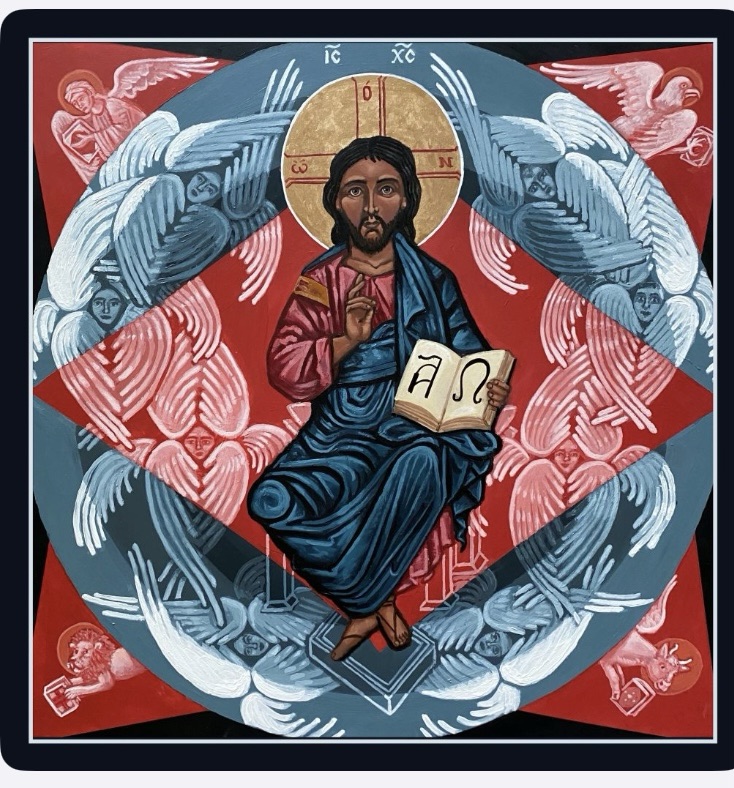
Today the church honors one of our moveable feast days, Christ the King Sunday, also known as Reign of Christ Sunday.
In 1922 the world was still reeling from World War I. Pope Pius XI, in his first official encyclical, said that while war hostilities had stopped, global tension was ever present. He decried the rise of nationalism across the globe.
Gonna say that louder for people in the back: the rise of nationalism across the world was seen as a real and present danger.
So Pope Pius XI, as a call for the church to take a stand against nationalism and extremism, instituted in 1925 that the last Sunday of the liturgical year would be a reminder for the world that our private ideologies and personal saviors will not, in the end, accomplish the peace necessary for humanity to thrive.
Only Divine peace can do that.
Now, I’m not a fan of this particular Sunday. To tag it on at the end of the liturgical year feels forced in many ways, and the readings are totally non-sequitur (though they fit with the theme of the day).
However, when seen through the lens of the original intent, especially in these days, it can be a corrective day for a humanity that is once again in the throes of nationalism, much of it housed in the pews of the church.
Nationalism is anti-Christ. There is no workaround here; it just is. It puts hope in nativist ideology and not shared peacemaking.
Christ the King Sunday is a reminder for me, and should be for the whole church, that there was a time when the church took on the rise of nationalism with a full throat.
And it could again.
-icon written by Kelly Latimore Icons and is available for purchase
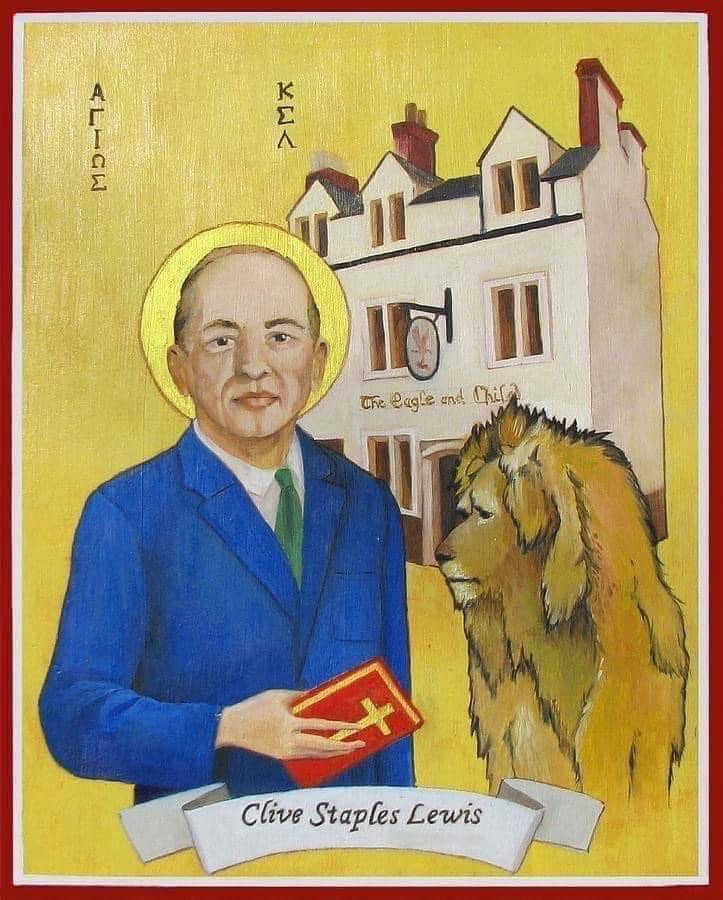
Today the church remembers a masterful storyteller who wove a tapestry of tales that continue to teach: Clive Staples Lewis, Writer and Dream Maker.
St. Lewis (you know him better as C.S. Lewis, no doubt) was born in Northern Ireland to a barrister father and mathematician mother. After years of boarding schools, he attended University College, Oxford and, after graduation, was appointed as a Tutor and Fellow there, and eventually as Professor of Medieval and Renaissance Literature a Cambridge.
At his heart, he was a writer. Scholarly works, fictional works, essays regarding the state of humanity, C.S. Lewis was born with one pen in his hand and another in his mouth.
As a youth he had rejected Christianity, probably as a rebellion around the death of his mother when he was ten years old. In 1929 he had a conversion experience that eventually led him back to the church in 1931. This journey from atheism to theism to the church was recounted in Surprised by Joy, published in 1955.
As it is with many converts, C.S. Lewis spilled a lot of ink defending the faith. The Problem of Pain, Mere Christianity, and The Screwtape Letters. In these works for art…which they are…he eloquently and imaginatively honors various human realities through the lens of faith.
Most of the world, though, knows him not for his essays, but for his works of fiction and science-fiction. The seven book Chronicles of Narnia and his lesser known Space Trilogy present for humanity a fanciful retelling of Christian faith and morals through a lion who dies yet lives, children who are awake and yet dreaming, honorable mice pirates, witches, and distant planet explorations that are right in your backyard.
It’s widely known that he and his fellow writer, JRR Tolkien, often met to discuss their works over a pint or three. He thought Tolkien was too verbose (he was), and Tolkien thought Lewis was too “on the nose” with his allegories (he was). And yet we’re all better for it all, right?
The works of Lewis that most affected me, though, weren’t any of the above, but two works separated by time yet linked in theme: The Four Loves and A Grief Observed.
In The Four Loves Lewis mines the realities of human love, seeking to make a connection between these loves and the deep feelings of the heart. English is such a limiting language. We only have one word for “love,” and yet many ways of feeling it. Lewis goes deep into analysis around this, offering some clarity to what we feel when we say “I love you.”
In A Grief Observed, though, Lewis is at his most vulnerable, most bare, most thoughtful (at least in my opinion). He wrote this reflection on grief after the death of his wife, Joy Davidman Gresham, after they had only been married four years. Here St. Lewis is less apologist for the faith and more barrister with faith and fairness of life put on slow, subtle trial. Gone is the idealism of the new convert, and in its place we find an honest conversation between C.S. Lewis and a faith that he considered an old friend that kind of let him down (though the work does end on a hopeful note).
It is real. It is honest. And, in my opinion, is required reading.
St. Lewis died on this day in 1963 at his home in Oxford.
One of my favorite notions of his, which I believe to be totally true, is found in The Screwtape Letters where the young demon being tutored by penpal is told that “God only coaxes, and cannot coerce.”
God only coaxes, and cannot coerce.
St. C.S. Lewis is a reminder for me, and should be for the whole church, that story has always been a way that we learn about the Divine.
And always will be.
-historical bits from Pfatteicher’s New Book of Festivals & Commemorations