On Wisdom

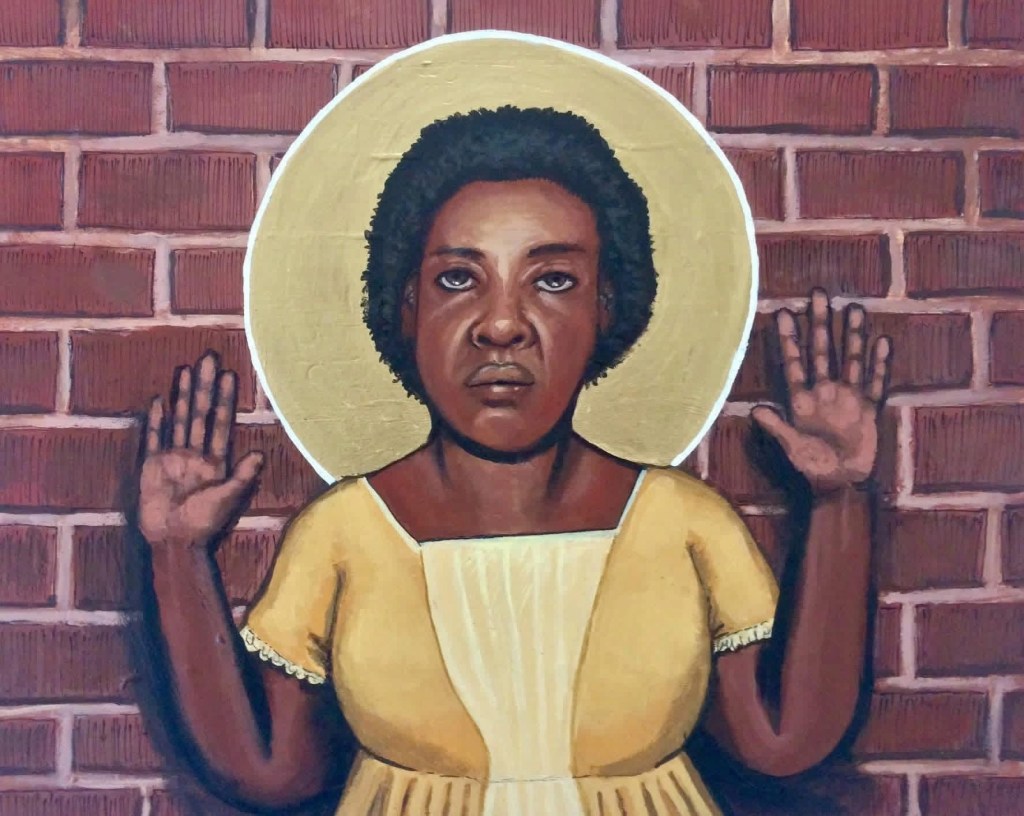
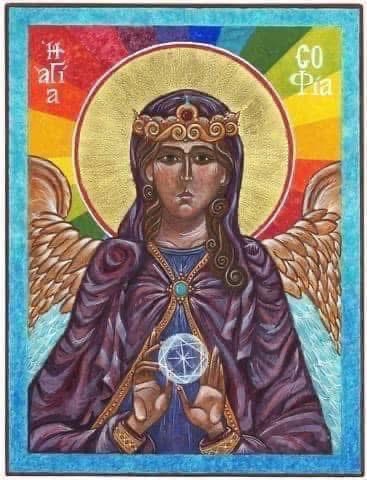
Today the church also honors something that defies explanation, other than to say “it is”: Sophia, or Holy Wisdom.

In the Hebrew scriptures Wisdom is spoken of using feminine pronouns, sometimes colloquially called “Lady Wisdom.” In the texts she attends the throne of the Divine, whispering in the Divine ear. Or, in other places, is the Divine breath breathed forth over creation.

Wind. Flame. Spirit. Inspiration. Holy Spirit. Muse.

Divine Wisdom has been called many names by humanity over the centuries. In Celtic Christianity she’s identified with the Wild Goose, flying where it makes gut-sense to go in the rhythm of the seasons, loud and untamable.

I quite like that description.

October 5th is a day to honor scholars, sages, and wise persons. Most everyone has the potential to grow old, but not everyone who grows old grows wise. And certainly some who never reach old age are wise already!

Wisdom is pursued and painstakingly won in life through observation, meditation, and experience that is analyzed. Every stumble and blessing can be, must be, a teacher.

Sophia, Lady Wisdom, Divine Insight…however you want to say it…is a reminder for me, and should be for the whole church, that though we age, becoming wise takes effort.

Let those with ears to hear, hear.

-notes about Sophia by me, though attention to the saint day was brought by Judika Illes in her work Daily Magic

-icon written by Maria-Tina Karamanlakis

The Deaconess Tradition

Today the church honors not only important saints, but an important tradition and order of service within the church: the Deaconess tradition.

Frederike, Theodor, and Karolina Fliedner are honored today, October 5th, as Renewers of Society for re-imagining the Deaconess order, a movement of the church that continues today in Deacons and Deaconesses throughout the world.

In the early church, the ancient order of Deaconesses were utilized to care for the sick, for needy women, to instruct women for the catechumenate, and to assist in the baptism of women. We find this all documented in the 3rd and 4th Century texts, the “Didascalia” and the “Apostolic Constitutions.”

When adult baptisms became rare, the role of Deaconesses declined in popularity and importance, and by the 7th Century the female diaconate nearly died out.

Until the Moravians got a hold of it.

In the early 1800’s Theodor Fliedner, a newly ordained pastor in the Lutheran church, made a tour of Holland and England to raise money for the church. There he encountered Moravian Deaconesses engaged in Christian service. The Moravian movement had revived the role in the mid 1700’s.

Inspired by their work, Fliedner went back to Kaiserswerth (where he had his little parish), and started conducting services at the prison in neighboring Dusseldorf, the first Lutheran ministry of its kind. His prison ministry grew and spread throughout the Rhineland and Westphalia, and even into the Netherlands, England, and Scotland. He eventually opened the Magdalen home for released women prisoners, and then a nursery school in Dusseldorf.

Pastor Fliedner, inspired by all this movement, decided to reinvigorate the role of Deaconess within the church, and opened a hospital and Deaconess-training institute in Kaiserwerth, a largely Catholic city. In 1836 it was officially opened, and Ms. Gertrude Reichardt, the daughter of a physician, became the first Deaconess trained there. Frederike Fliedner. Pastor Fliedner’s spouse, became the first Mother Superior of the house, and almost immediately Deaconesses were deployed to serve in the city hospital at Eberfeld.

Frederike Fliedner was wise and wonderful. She practiced simplicity, frugality, and charity toward all, and instilled these virtues in her Deaconess charges. Unfortunately, Frederike would die in 1842, leaving a large absence in the institution.

Pastor Fliedner married Karolina Bertheau about a year after Frederike’s death. Karolina had been the director of a hospital in Hamburg, and quickly proved herself to be a talented Mother Superior, following in Frederike’s footsteps.

Karolina came to be known as Mother Fliedner, and led the Deaconesses in their work for forty years, about half of which were after Pastor Fliedner’s death.

In 1849, at the invitation of William Passavant, Pastor Fliedner brought four deaconesses to Pittsburgh to staff the Infirmary that Passavant had established there. Motherhouses soon began to be founded all over the world, from the Middle East (Jerusalem, Smyrna, and Constantinople), to Paris, Strasbourg, Dresden, and Berlin.

At the time of Fliedner’s death there were 30 Motherhouses around the world and over 1600 Deaconesses, from Pittsburgh to Jerusalem.

By the late 20th Century there were over 35,000 Deaconesses on every continent and in every province where Lutheranism has a presence.

Eventually a Motherhouse was begun in Philadelphia in 1884, with the support of John Lankenau (fun fact: Lankenau is still the name of a dormitory at Valparaiso University). This was the first Motherhouse in the United States.

Today Deaconesses and Deacons from this tradition serve as pastors, teachers, doctors, youth directors, non-profit managers, and in professions of all kinds. Deaconesses and Deacons serve where and how they are called. It has always been so, and remains so.

Check out the Diaconal community at Valparaiso University at http://www.thelda.org, and the ELCA’s Diaconal roster at https://www.elca.org/Resources/Word-and-Service-Roster.

The Fliedner’s are a reminder for me, and hopefully for the whole church, that we must raise up leaders to serve in all ways, not just in the pastorate.

-historical pieces painstakingly sifted from Pfatteicher’s New Book of Festivals & Commemorations
-love and devotion for Deaconesses and Deacons everywhere by me

Less is More

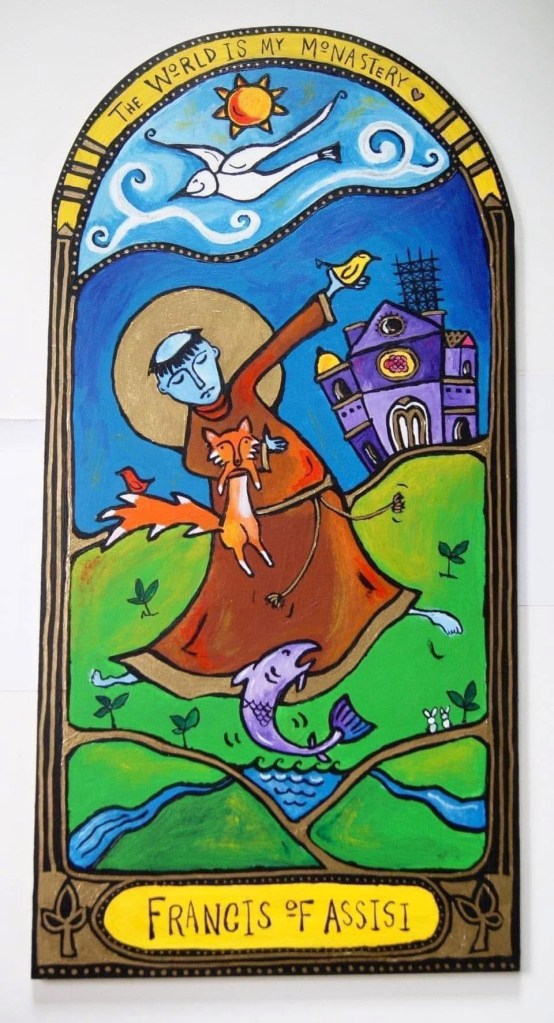
Today the church honors a saint who could arguably be the most well-known saint outside of those directly associated with Jesus, St. Francis of Assisi, Friar and Renewer of the Church.

In the late 12th Century, Giovanni Bernadone was born into wealth. He was called Francesco as a child because his father regularly traveled to France and admired the French. The name stuck. Francesco, or “Francis,” was not a popular name back then, but has since become popular due primarily to this saint.

St. Francis wanted to be a knight, and even enlisted early and participated in some skirmishes. He was captured, came down with a serious fever, and was returned home. In his illness he had time to think and reflect, and as he recovered he came in regular contact with the poor and the destitute. These experiences of self-examination and proximity to the “least of these” encouraged in him a change of heart. This slow conversion process culminated in a vision in the church of St. Damian where he heard God say to him, “Francis, go and repair my house which is falling into ruin.”

Francis took this literally, and sold a good sum of his father’s goods to repair St. Damian…which caused his father to disinherit him. Pro-tip: an easy way to lose your future fortune is to give it away before it’s yours.

Having no family now, he decided to “wed Lady poverty,” took off his clothes on St. Matthias’ Day (February 24th…perhaps the only good thing Matthias is known for is encouraging Francis from his grave, over 1,000 years later, to take on the vow of poverty), wrapped a peasant’s smock and a rope belt around himself, and began his mission.

This became the Franciscan uniform.

Soon he had many followers who also took up poverty as a calling, and they tried their best to live out the Sermon on the Mount. They took on a simple joyfulness, a comradery with one another, an appreciation for creation, and a wry sense of humor.

No, seriously, humor is part of the order…Franciscans are funny. I think you’d have to be to take on such extreme vows!

St. Francis never became a priest, though he loved the Church and the clergy. Some of his followers got oral permission from Pope Innocent III to formally establish the order, dedicating themselves to poverty, chastity, and obedience.

Franciscans went far and wide with their embodied obedience to the simple life and preaching. Francis himself tried to convert the Sultan of Egypt at one time, but was unsuccessful. A little-known fact about St. Francis is that he literally had a “martyrdom complex,” and as he walked through the armies of the Fifth Crusade he prayed he might be struck down and killed, fulfilling the dream of dying for the faith.

Not one for clerical work, St. Francis easily gave up the administration of the order, finding it too far removed from the simple life he wanted to live. He quickly left the administration to others as the order grew, and stayed on the streets of the world, claiming that his monastery was the whole world itself.

Fun fact: St. Francis was the first to set up a manger scene at Christmastide. He reconstructed the nativity story from Luke in a little cave in Greccio, Italy, and since then we’ve been doing it in our homes and in churches. The manger scene you have packed in your attic was made popular by St. Francis.

As his health and strength waned, St. Francis became more and more a mystic. He is even reported to have experienced the stigmata in his last years. He died on October 4th in 1226 singing Psalm 142 with his last breath.

The Franciscan order remains strong and resolute in the world.

Oh, and that love for animals he’s so well-known for? That comes from a genuine respect for creation that St. Francis had, and for the fact that sometimes he’d be found preaching to the birds. In his mystical visions he recounts a oneness with all creation, which is why we take this day to bless our animal companions, acknowledging our kinship with them and our shared joy in a shared life with them.

St. Francis is a reminder to me, and to the whole church, that sometimes less is more.

Less domination, more companionship with creation.

Less stuff, and more travel.

Less dogma, and more devotion to simple things.

Less administration, and more walking the way.

Less wealth, and more joy.

Less is more.

-historical bits gleaned from Pfatteicher’s New Book of Festivals & Commemorations
-icon “St. Francis Dancing Monk Icon” © artist Marcy Hall at Rabbit Room Arts
-extraneous commentary by me

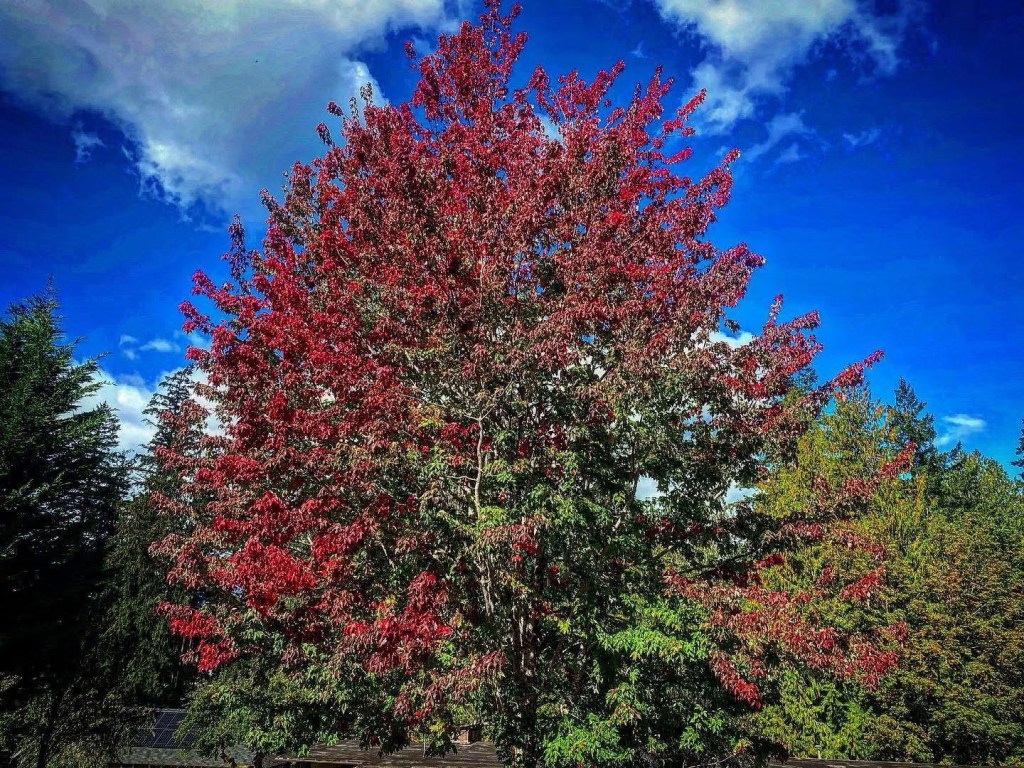
Hello October

O hushed October morning mild,
Thy leaves have ripened to the fall;
Tomorrow’s wind, if it be wild,
Should waste them all.
The crows above the forest call;
Tomorrow they may form and go.
O hushed October morning mild,
Begin the hours of this day slow.
Make the day seem to us less brief.
Hearts not averse to being beguiled,
Beguile us in the way you know.
Release one leaf at break of day;
At noon release another leaf;
One from our trees, one far away.
Retard the sun with gentle mist;
Enchant the land with amethyst.
Slow, slow!
For the grapes’ sake, if they were all,
Whose leaves already are burnt with frost,
Whose clustered fruit must else be lost—
For the grapes’ sake along the wall.

--October by Robert Frost

October Road

For the ancient Celts, October signaled the end of their Autumn and opened the door for the shadowed half of the Celtic year.

Samhain (which literally means “summer has ended”) marks the final feast day of the season, and the convergence of the shadows and the weather inclined the Celts to believe that spirits were able to walk among the living causing mischief, curses, and sometimes blessings.

Practically it meant bringing in the cattle and the sheep down from the summer hillside and into the byre and the stable, now full of the harvested hay brought in throughout August and September.

It was also the time to slaughter the animals and prep them to last as far through winter as possible with salts, cold storage, cottaging, and drying.

The very last bits of barley, wheat, turnips, and apples were picked from the now naked fields, because come November the faeries would start breathing on all the fruit, frosting them and making them inedible.

While the sun still glowed it was also time to get the wood and peat stacked and ready for use. No one wanted to chop and gather in the frigid days coming.

This was a joyous month for the Celts, as the whole family was regularly gathered in the house and the barn: baking, salting, prepping, and preserving, envisioning the coming winter feasts and the cozy days ahead.

The summer sun now became the warm, dim room, and the noisy insects would be replaced with long talks and stories from family and visiting friends.

October has come.

Ask Questions

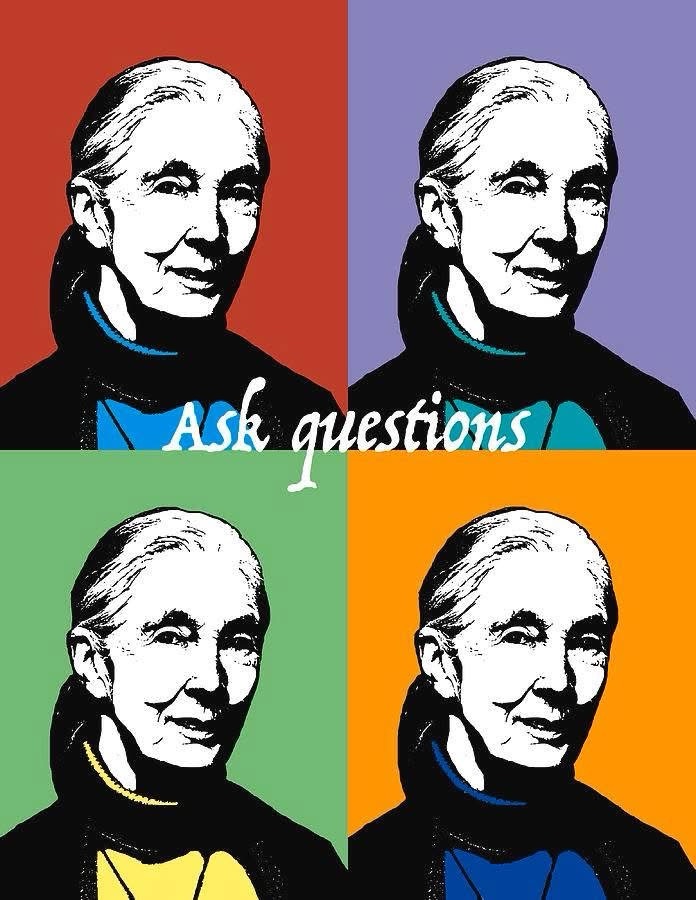
Today I would encourage the church to honor a biologist who would not only inspire us with stories of our closest evolutionary cousins, but who would also come to embody inquiry itself (even in Lego form): Saint Jane of the Goodalls.

Saint Jane was born in 1934 in Hampstead, London, England, to parents who gifted her early on with a stuffed chimpanzee as a gift.

This would prove to be providential.

Leaning into this fascination for animals and the continent of Africa, Saint Jane went to Kenya in her early 20’s to begin her study of primatology, becoming a pioneer in not only the field, but as a woman in the field.

And in a world that continues laud the male over the female, can we agree that she set the bar (and not the other way around)?

In 1962, AFTER years of study without a degree, Saint Jane was sent to Cambridge to begin her road to a Ph.D. That’s right: she started her work on her doctorate without credentials, and honestly we’re better off for it. She quickly earned a bachelors and then worked on her doctorate, observing the behaviors of chimpanzees on the Gombe reserve as a model for community relations.

She challenged our notions that only humans used tools for societal good (chimps are great at using tools). She also revealed that chimpanzees were not strictly vegetarian, which may not seem revelatory, but when mixed with our common ancestry makes a lot of sense (and evolutionary connective tissue).

She also noted that chimpanzees were aggressive toward one another, and played social games…something humans do all the time, unfortunately. She humanized the chimpanzee, and primated the human, all in the same breath.

And we learned something about both in the process.

She named the chimpanzees she observed, detailing their personalities and quirks. In 1977 she started the Jane Goodall Institute, supporting chimpanzee research. In subsequent years she would found other institutes and collaboratives to support the study, care, and rehabilitation of primates all over the world.

Saint Jane was, herself, a vegetarian, partially due to the observation that fighting over food led to violence amongst primates (of all stripes!).

Theologically, Saint Jane was convinced that there was a higher power moving the world in some form or fashion. Though most of her scientific contemporaries were convinced atheists, she chose to remain open to the possibility that there was more than she could understand. The diversity of the world compelled her to believe there was something incomprehensible about it all.

Saint Jane married twice in her life and had a son, Hugo. And though she studied primates for her work, she proclaimed her favorite animal to be those of the canine species. They are, of course, the most loyal.

Saint Jane died on this day in 2025 at the age of 91. She was on a speaking tour, advocating to the very end for the species she loved.

Saint Jane is a reminder for me, and should be for the whole church, that scientific inquiry is part of the human journey, and we shouldn’t be afraid to learn new things…even if it debunks prior thoughts.

In these days when it feels we’re going backwards where science is concerned, especially in popular thought and political support, she reminds us be curious, by God.

Stay curious. Ask questions.

-historical bits from public sources.

-painting by Dale Scott