For the ancient Celts, October signaled the end of their Autumn and opened the door for the shadowed half of the Celtic year.
Samhain (which literally means “summer has ended”) marks the final feast day of the season, and the convergence of the shadows and the weather inclined the Celts to believe that spirits were able to walk among the living causing mischief, curses, and sometimes blessings.
Practically it meant bringing in the cattle and the sheep down from the summer hillside and into the byre and the stable, now full of the harvested hay brought in throughout August and September.
It was also the time to slaughter the animals and prep them to last as far through winter as possible with salts, cold storage, cottaging, and drying.
The very last bits of barley, wheat, turnips, and apples were picked from the now naked fields, because come November the faeries would start breathing on all the fruit, frosting them and making them inedible.
While the sun still glowed it was also time to get the wood and peat stacked and ready for use. No one wanted to chop and gather in the frigid days coming.
This was a joyous month for the Celts, as the whole family was regularly gathered in the house and the barn: baking, salting, prepping, and preserving, envisioning the coming winter feasts and the cozy days ahead.
The summer sun now became the warm, dim room, and the noisy insects would be replaced with long talks and stories from family and visiting friends.
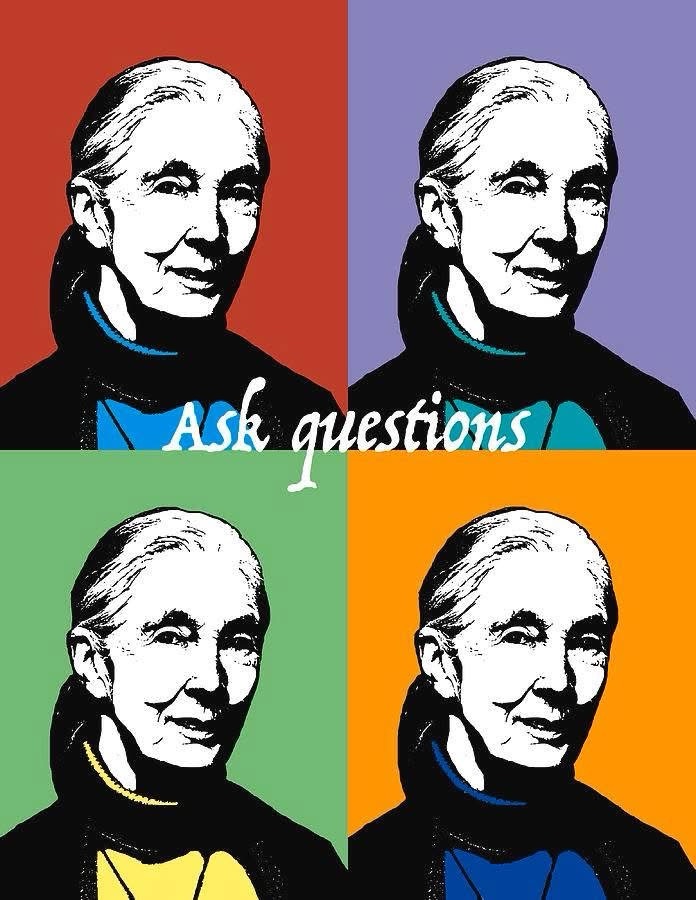
Today I would encourage the church to honor a biologist who would not only inspire us with stories of our closest evolutionary cousins, but who would also come to embody inquiry itself (even in Lego form): Saint Jane of the Goodalls.
Saint Jane was born in 1934 in Hampstead, London, England, to parents who gifted her early on with a stuffed chimpanzee as a gift.
This would prove to be providential.
Leaning into this fascination for animals and the continent of Africa, Saint Jane went to Kenya in her early 20’s to begin her study of primatology, becoming a pioneer in not only the field, but as a woman in the field.
And in a world that continues laud the male over the female, can we agree that she set the bar (and not the other way around)?
In 1962, AFTER years of study without a degree, Saint Jane was sent to Cambridge to begin her road to a Ph.D. That’s right: she started her work on her doctorate without credentials, and honestly we’re better off for it. She quickly earned a bachelors and then worked on her doctorate, observing the behaviors of chimpanzees on the Gombe reserve as a model for community relations.
She challenged our notions that only humans used tools for societal good (chimps are great at using tools). She also revealed that chimpanzees were not strictly vegetarian, which may not seem revelatory, but when mixed with our common ancestry makes a lot of sense (and evolutionary connective tissue).
She also noted that chimpanzees were aggressive toward one another, and played social games…something humans do all the time, unfortunately. She humanized the chimpanzee, and primated the human, all in the same breath.
And we learned something about both in the process.
She named the chimpanzees she observed, detailing their personalities and quirks. In 1977 she started the Jane Goodall Institute, supporting chimpanzee research. In subsequent years she would found other institutes and collaboratives to support the study, care, and rehabilitation of primates all over the world.
Saint Jane was, herself, a vegetarian, partially due to the observation that fighting over food led to violence amongst primates (of all stripes!).
Theologically, Saint Jane was convinced that there was a higher power moving the world in some form or fashion. Though most of her scientific contemporaries were convinced atheists, she chose to remain open to the possibility that there was more than she could understand. The diversity of the world compelled her to believe there was something incomprehensible about it all.
Saint Jane married twice in her life and had a son, Hugo. And though she studied primates for her work, she proclaimed her favorite animal to be those of the canine species. They are, of course, the most loyal.
Saint Jane died on this day in 2025 at the age of 91. She was on a speaking tour, advocating to the very end for the species she loved.
Saint Jane is a reminder for me, and should be for the whole church, that scientific inquiry is part of the human journey, and we shouldn’t be afraid to learn new things…even if it debunks prior thoughts.
In these days when it feels we’re going backwards where science is concerned, especially in popular thought and political support, she reminds us be curious, by God.