
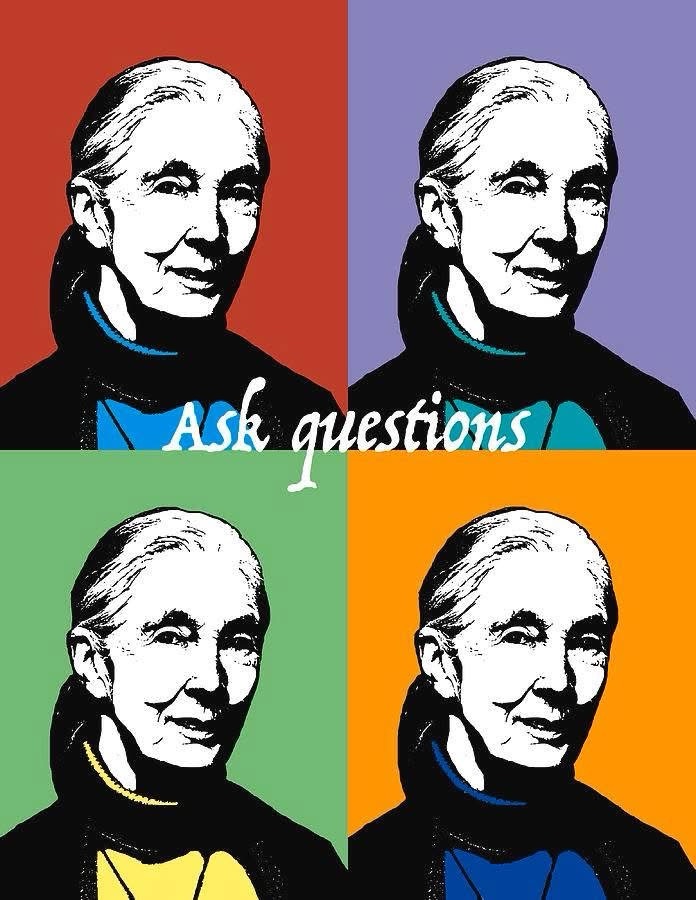
Today I would encourage the church to honor a biologist who would not only inspire us with stories of our closest evolutionary cousins, but who would also come to embody inquiry itself (even in Lego form): Saint Jane of the Goodalls.
Saint Jane was born in 1934 in Hampstead, London, England, to parents who gifted her early on with a stuffed chimpanzee as a gift.
This would prove to be providential.
Leaning into this fascination for animals and the continent of Africa, Saint Jane went to Kenya in her early 20’s to begin her study of primatology, becoming a pioneer in not only the field, but as a woman in the field.
And in a world that continues laud the male over the female, can we agree that she set the bar (and not the other way around)?
In 1962, AFTER years of study without a degree, Saint Jane was sent to Cambridge to begin her road to a Ph.D. That’s right: she started her work on her doctorate without credentials, and honestly we’re better off for it. She quickly earned a bachelors and then worked on her doctorate, observing the behaviors of chimpanzees on the Gombe reserve as a model for community relations.
She challenged our notions that only humans used tools for societal good (chimps are great at using tools). She also revealed that chimpanzees were not strictly vegetarian, which may not seem revelatory, but when mixed with our common ancestry makes a lot of sense (and evolutionary connective tissue).
She also noted that chimpanzees were aggressive toward one another, and played social games…something humans do all the time, unfortunately. She humanized the chimpanzee, and primated the human, all in the same breath.
And we learned something about both in the process.
She named the chimpanzees she observed, detailing their personalities and quirks. In 1977 she started the Jane Goodall Institute, supporting chimpanzee research. In subsequent years she would found other institutes and collaboratives to support the study, care, and rehabilitation of primates all over the world.
Saint Jane was, herself, a vegetarian, partially due to the observation that fighting over food led to violence amongst primates (of all stripes!).
Theologically, Saint Jane was convinced that there was a higher power moving the world in some form or fashion. Though most of her scientific contemporaries were convinced atheists, she chose to remain open to the possibility that there was more than she could understand. The diversity of the world compelled her to believe there was something incomprehensible about it all.
Saint Jane married twice in her life and had a son, Hugo. And though she studied primates for her work, she proclaimed her favorite animal to be those of the canine species. They are, of course, the most loyal.
Saint Jane died on this day in 2025 at the age of 91. She was on a speaking tour, advocating to the very end for the species she loved.
Saint Jane is a reminder for me, and should be for the whole church, that scientific inquiry is part of the human journey, and we shouldn’t be afraid to learn new things…even if it debunks prior thoughts.
In these days when it feels we’re going backwards where science is concerned, especially in popular thought and political support, she reminds us be curious, by God.
Stay curious. Ask questions.
-historical bits from public sources.
-painting by Dale Scott

