The First Martyr

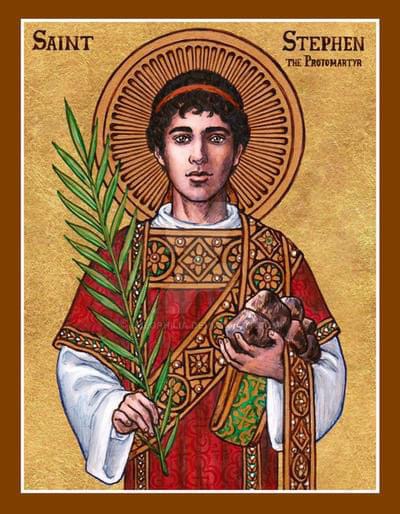
Today the church remembers St. Stephen, Deacon and Proto-Martyr.

It may seem odd to place the feast day of a martyr so close to The Nativity, but the reality is that Jesus came into a world of violence, no matter how loudly you sing “Silent Night.”

The pairing of the birth of the Messiah with the first martyr was intentional: Christ’s arrival is meant to redeem and reform our violent ways…but we’re not there yet.

St. Stephen appears in the Acts of the Apostles as a follower of Jesus whose defining characteristic is love. Even as he was being stoned to death, he prayed for his persecutors. We don’t know anything else about this disciple who apparently led a short, but noteworthy, life.

St. Stephen is joined by two other feast days directly on the heels of The Nativity: the Holy Innocents and St. John. All three will form a few days of peaks and valleys as the 12 Days of Christmastide play out. St. Stephen and the Holy Innocents will remind the us of the tragic nature of our world. St. John, the only Apostle said to have died of natural causes, will remind us that not everything is bad. This back-and-forth swing of the feasts of the church provide a rhythm that calls us to both work for justice, as not everything is well, and thank God for life and creation, because not everything is bad.

By the way, you sing of St. Stephen every year in the Christmas Carol “Good King Wenceslas” who, if you recall, “looked out on the Feast of Stephen, when the snow lay round about, clean and crisp and even…”

St. Stephen is a reminder for me, and should be for the whole church, that love is powerful, and it’s what we cling to and are held by in this life.

-icon written by Theophilia
Christ Climbed Down From His Bare Tree This Year

Christ climbed down
From his bare tree
This year
And ran away to where
There were no rootless Christmas trees
Hung with candycanes and breakable stars

Christ climbed down
From his bare tree
This year
And ran away to where
There were no gilded Christmas trees
And no tinsel Christmas trees
And no tinfoil Christmas trees
And no pink plastic Christmas trees
And no gold Christmas trees
And no black Christmas trees
And no powderblue Christmas trees
Hung with electric candles
And encircled by tin electric trains
And clever cornball relatives

Christ climbed down
From his bare tree
This year
And ran away to where
No intrepid Bible salesmen
Covered the territory
In two-toned Cadillacs
And where no Sears Roebuck creches
Complete with plastic babe in manger
Arrived by parcel post
The babe by special delivery
And where no televisioned Wise Men
Praised the Lord Calvert Whiskey

Christ climbed down
From his bare tree
This year
And ran away to where
No fat handshaking stranger
In a red flannel suit
And a fake white beard
Went around passing himself off
as some sort of North Pole saint
crossing the desert to Bethlehem
Pennsylvania
In a Volkswagen sled
Drawn by rollicking Adirondack reindeer
With German names
And bearing sacks of Humble Gifts
From Saks Fifth Avenue
For everybody’s imagined Christ child

Christ climbed down
From his bare tree
This year
And ran away to where
No Bing Crosby carolers
Groaned of a tight Christmas
And where no Radio City angels
Iceskated wingless
Thru a winter wonderland
Into a jinglebell heaven
Daily at 8:30
With Midnight Mass matinees

Christ climbed down
From his bare tree
This year
And softly stole away into
Some anonymous soul
He waits again
An unimaginable
And impossibly
Immaculate Reconception
The very craziest
Of Second Comings

-Lawrence Ferlinghetti-

O Emmanuel

Today we cry out, “O Emmanuel!”

Or, in other words, “God: be near, not distant!”

It’s as if we finally have figured out what our true heart’s desire is: to know the Divine better.

Like Aaron at the base of the mountain, when we aren’t attuned to the Divine in the world (and ourselves and others) we make golden calves like money, fame, vanity, and yes, sacred texts and religion.

Those last two are the sneakiest golden calves of all…

Today we plead that God be made known. We look to the skies to spy it in real time, all the while God arrives under the most normal, unassuming, ungodly way…which gives us insight into the Divine mind, if we pay attention.

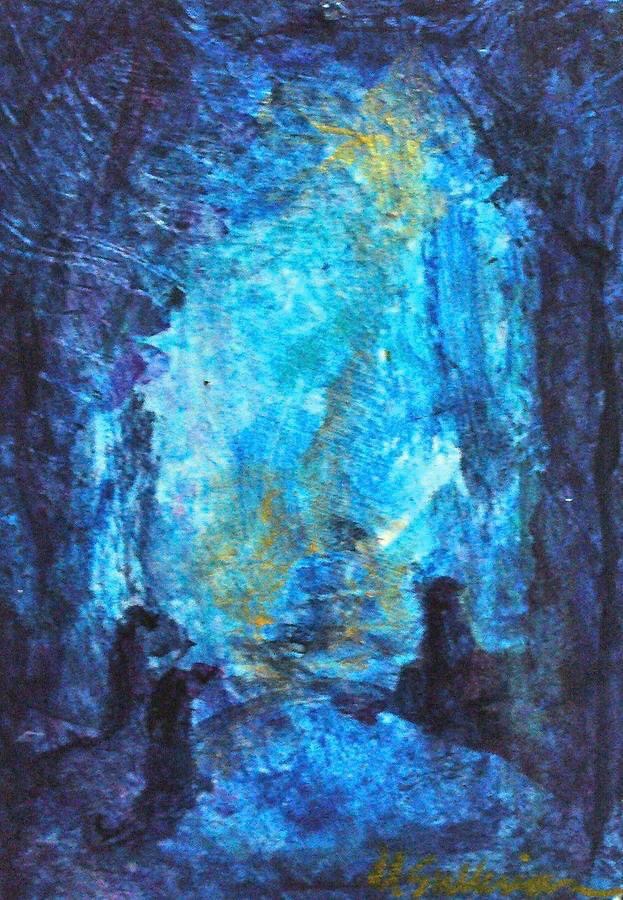
(Painting by Mary Sullivan)

O Rex

“O Ruler!” are the words sung by the church today. “O Rex!”

In our most honest moments we admit that we both like leadership, and like to rebel against it…humans are fickle.

We’re all ruled by something. Even the most unique individual allows that uniqueness to guide them to a fault. The most “don’t tread on me” flag waving person has a hook in their nose and their ideology is steering the ship.

What rules in your life?

At its best this call is a plea that our basest desires will no longer rule us, and that something more holy will do it. Perhaps peace will rule. Or love. The best of the Divine attributes!

At its worst, well, we’ve turned Jesus into just another self-styled tyrant to whom we demand others give their allegiance…

-art by Vincent Crosby

O Dawn

“O Oriens!” the church cries on the morning of the Winter Solstice. “O Dawn!” is what it literally means, both a bit ironic and exasperated on this shortest day of the year.

You know, my son Finn was born with two “true knots” in his umbilical cord. In ancient days this sign would have probably been taken as an omen of either his greatness or his mischievousness (and it would have been right on both counts!).

But living in a scientific age we have no need for these signs, right?

Well, I’d suggest the opposite. In another year with so much death, and with depression so rampant, we need reminders of our greatness, Beloved.

It’s all a reminder that, with every dawn, with every dayspring, something amazing is possible.

The dawn, the bright and morning star, is an ever-rising sign that something amazing is possible.

So stick around, Beloved. In case you didn’t know it, it’s good you exist and, well, amazing things are always possible with every dawn…

(Art by Edward Fielding)

O Key of David

“O Clavis David” or “O Key of David” is the chant the church cries today.

This is less of a plea and more of a reminder from us to God that a promise was made, long ago, that from the house of the shepherd-king David another shepherd would come and unlock the doors of God’s reality, bringing heaven to earth…or at least starting the process.

We search constantly for the keys to unlock the universe: the Secret, the right prayer, the magical path.

I wonder, though, if really the key we need isn’t one to unlock the heavens, to unlock the universe for our own gain, but rather the right key to unlock our own selfish hearts…

Maybe we’ve misunderstood this message all along.

O Root of Jesse

Today the church uses its parched tongue to cry out, “O Radix Jesse!” or “O Root of Jesse!”

The ask here is that the dead stump of a family line, scourged and ravaged by one conquering after another, eating away at the Family Tree, somehow live again.

This dead-end of a year feels very stump-ish to me.

It’s also just true that while we may have eaten from the Tree of the Knowledge of Good and Evil, we have not learned its wisdom. That ancient tree is dead in our hands as we call what is evil, good, and what is good, evil.

Come quickly, Holy One.

O Lord

On December 18th in Advent the church raises its voice to cry out, “O Adonai!” or “O Lord!”

This is, perhaps, the most honest prayer there is, Beloved. In times of trial and joy, “Oh God” or “My Lord” slips from our lips.

In the ancient context of Advent, this cry is both an invocation and a statement of political priorities. The Empire of old (and now?) would have you believe that power is Lord, that grievance is Lord, that Caesar is Lord.

In fact, all the ancient steles and decrees said just that: Caesar is Lord.

But the church, at its best, says that the Divine is Lord.

It’s a political statement. We’ve forgotten that…but we can remember. There is time.

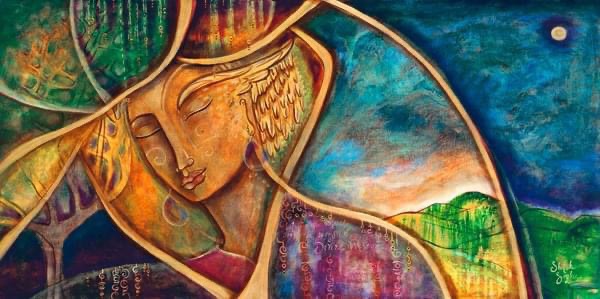
-art is by Michael Adonai, an Eritrean painter, entitled “Back to Homeland.” You can imagine crying out “O Lord” when longing to return to your mother…

O Wisdom

Today Advent takes a more persistent, pleading posture as the church begins calling for salvation using the ancient names for the Holy One.

These names are known as the O Antiphons, and true to form they are sung by all creation in chorus.

We begin, crying, “O Sapientia!” or “O Wisdom!”

It’s worth noting that Wisdom, especially in the Hebrew scriptures, is personified as female, flowing out as a part of the Divine mind.

“O come, O Wisdom from on high,
and order all things far and nigh.
To us the path of knowledge show,
and teach us in her ways to go.

Rejoice, rejoice, Emmanuel,
Shall come to you, O Israel.”

The Most Despised are Sometimes the Wises

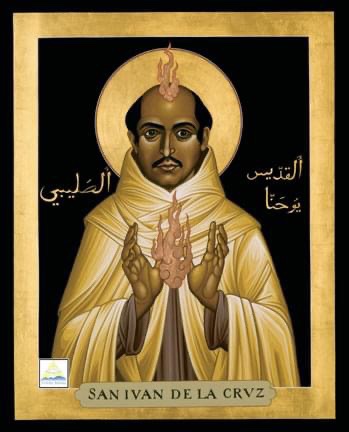
Today the church celebrates one of the great mystics of history, St. Juan de Yepes y Alvarez, but you know him better as St. John of the Cross, Renewer of the Church and Visionary.

St. Juan was born in Fontiveros Spain, the third son of a Jewish silk merchant. His father died shortly after he was born, and his family placed little Juan in an institution for the poor.

St. Juan was extremely short of stature, even for his day, but showed great skill in craftsmanship from early on, and apprenticed at many places. He enrolled in college and worked his way through school striving to become an exemplary monk.

He was entranced in the Order of the Blessed Virgin (Carmelites), and was ordained. Soon after met St. Teresa of Avila, his spiritual cousin. She had begun to implement her reforms of the Carmelite order, and St. John promised himself to these reforms, adopting the name St. John of the Cross to embody his minimalist and mystic piety.

St. Teresa eventually helped get St. John appointed as Confessor to the Convent of the Incarnation, where she was a sister.

St. Teresa’s reforms were causing division within the Carmelite Order, and some monastics came and seized St. John, imprisoned him in a six foot by ten foot cell, beat him, and attempted to force him to renounce the austere reforms.

St. John refused and after nine months was able to escape, fleeing to a safe monastery in southern Spain.

This is where he began writing down his mystical visions and dreams, having had them in the confinement of his prison cell. His deeply spiritual writings often took the form of poetry. Most notable are The Ascent of Mt. Carmel-the Dark Night, and Living Flame of Love (which is more song than pure poetry).

In 1591 the controversy over the austere reforms rose again, and St. John was banished further south in Spain. It was there that he caught a fever and, though he sought medical care, was poorly treated because the prior of the monastery didn’t want the burden of another monk.

He died uttering the Psalms, saying, “Into your hands, O Lord, I commend my Spirit.” He was deeply beloved by the people, though he was rejected by much of the Church at the time, and was immediately heralded as a Saint.

You may not be too familiar with St. John of the Cross, but you’re certainly familiar with art that is based off of his mystical visions. Salvador Dali’s unique painting of the crucifixion was based on one of St. John’s poems.

St. John of the Cross is a reminder to me, and should be for the whole church, that sometimes the most despised in our midst are the wisest.

Let those with ears to hear, hear.

-historical notes from Pfatteicher’s New Book of Festivals & Commemorations

-icon written by Br. Robert Lentz