For the ancient Celts, June was a time of herb collecting. Used in medicine, dyes, cooking, cosmetics, and floor coverings (they would cover their floors with the herbs for a fragrant and hygienic carpeting), herbs were considered a healing gift.
At this time of year they’d incorporate herbs into most every dish, creating lilac teas and treating fish both steamed and pan fried with plenty of dill, parsley, and chives.
As they headed toward the Solstice and St.John the Baptist’s feast day, using all of the given daylight was paramount. Waste nothing, especially daylight, and do those things appropriate with the season.
For June this meant herb gathering, freshening things up, and preserving the harvest for cooking and healing in the year to come.
In May the Celts would turn their sights toward the land and the seeds to be buried in hope and prayer.
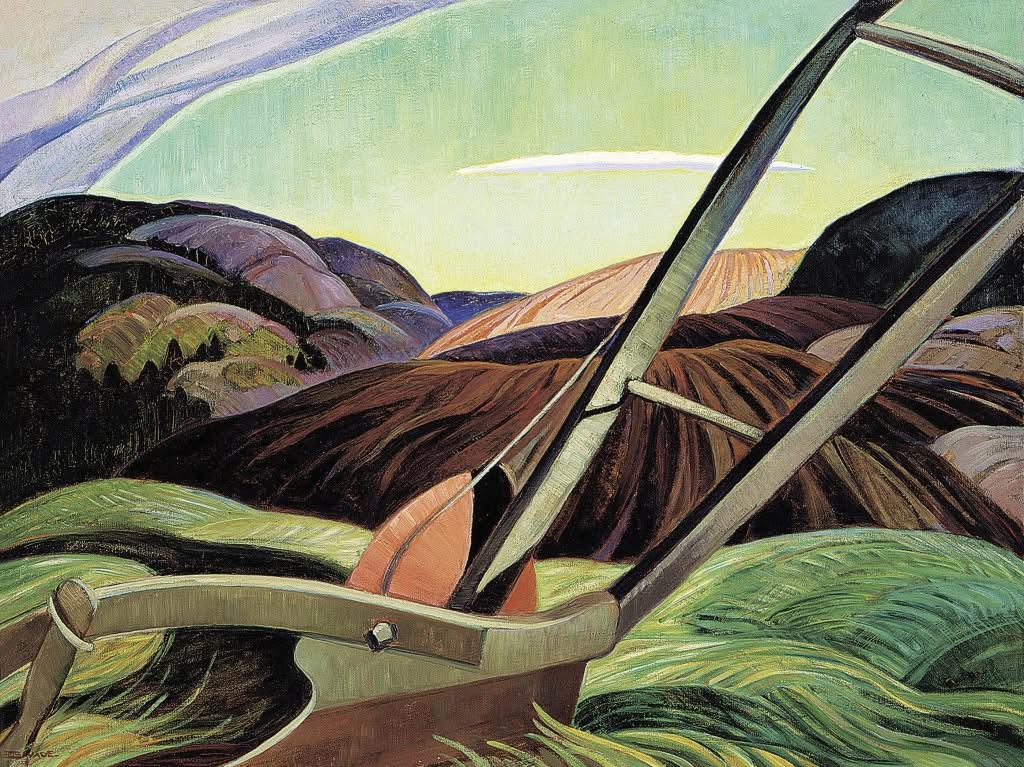
They’d pull out their ploughs and pray these instruments be sturdy to do the good work ahead of them, keeping their promise to help produce life-giving food for the land.
Here’s a modern Blessing of the Plough adapted from an ancient blessing (and also happens to be a nice one for those prepping for Holy Trinity Sunday):
Blessed be, God of all creation. Give softness to the land. Give us skill to work the land. This plough is sign to us of Your blessing. Give us softness of heart. Give us skill to serve You. Blessed be God–Creator, Christ, and Spirit, Three of Glory, Three of Light, Three of Life. Blessed be the Bright Three forever. God speed the plough. God speed the plough.
-prayer from Llewellyn’s The Celtic Wheel of the Year
The Celts would, in mid-May, honor the warrior queen Maeve of Connacht. She was often depicted dressed in red with a pet bird perched on one shoulder, and a pet squirrel on the other.
She was known for having three criteria in the men she would consider for marriage: they couldn’t be stingy, they couldn’t be jealous, and they couldn’t have any fear.
She was half lore and half reality, like all interesting people, and her name came from the pre-Christian Celtic goddess, Sovereignty, who was said to be the one who would approve a royal’s right to rule. Should a royal be overthrown, it was because Sovereignty had deemed them unworthy (stingy, jealous, or afraid).
For the ancient Celtic Christians, May was the first month of summer. It may feel strange to think of the rhythm of the year in this way, mostly because we’ve been conditioned by society to see May as still part of “spring,” but for those Celts who paid attention to how things look and feel, rather than acquiescing to what others told them to feel, they knew that the change of May meant the beginning of summer.
Their wheel for the year was:
November-December-January: Winter (the cold would set in, ground would freeze, and things took a dormant nature…which is why in the middle of December you’d celebrate the undying light of Christ, reminding yourself that the sun/Son always shines)
February-March-April: Spring (things start to break through the ground, thaws happen, tulips push up and animals stir and mate…which is why Easter is the capstone to the season, the eternal “emergence”)
May-June-July: Summer (heat sets in, you start to do all things out-of-doors, you plant and tend, and the midpoint is the celebration of John the Baptizer/Summer Solstice where you remember that St. John the Baptizer said, “I must decrease so that Christ may increase”…and the sun starts setting a little earlier each day)
August-September-October: Autumn (you celebrate the waning heat, you harvest, you prep and store, and prepare for the winter, with the capstone of the season being All Hallow’s Eve where you give thanks for the harvest and the faithfully departed, knowing winter is coming where nature reminds us that all things die)
This cycle was the year life, but imbued into all of this was the sense of death and regeneration. It was an Easter life.
In our modern days where we’re so tossed back and forth between this event and that event, seeing so much of it all as isolated incidences that rock our boats, we forget the golden thread, the rhythm, or as the ancient Celts would call it, the “heartbeat of the Divine” running through it all.
If we tilt at every windmill, we never stand up straight. The ancient Celts understood this, and so they were able to weather most any storm knowing what season it was.
Now? Now is the start of summer. The season of “out-of-doors.” Take advantage, live into the newness around you, and breathe deeply into the now.
All the sweetness of nature was buried in winter’s grave, and the wind sings a sad lament with its cold plaintive cry; but oh, the teeming summer will come bringing life in its arms, and will strew rosy flowers on the face of hill and dale.
In lovely harmony the wood has put on its green mantle, and summer is on its throne, playing its string-music; the willow, whose harp hung silent when it was withered in winter, now gives forth its melody. Hush! Listen! The world is alive!
Today the ancient Celts would celebrate the festival of Beltaine, welcoming May as a month where the increasingly hot sun (the “tene” part of the word above) would warm the greenery enough to produce harvest. The “bel” portion of the word is a mystery, as it could stand for an ancient Celtic sun-god, Belanos, or could just be a form of the ancient word for “brilliant”
At dusk, having let their own hearth fires die out (which they only let happen once a year), the whole clan would ascend a nearby hill to get as close to the setting sun as possible. They’d set up huge poles and dance around them with flowers in their hair. They’d drink, and feast, and sing. They’d create flower garlands to adorn their doors or trees near their houses.
They’d create huge fires which they believed would help warm the sun, and they’d jump over the fires as a way of emboldening themselves for summer work, and if you were planning to be married soon, you’d do it three times for good measure. The elderly would circle the flames reciting prayers, and mothers would carry newly born infants near the coals as a way to ensure they’d be protected in childhood.
Fire, for them, purified the air of disease, and they believed that a bit of the hair from the same dog could be the cure, as they hoped setting these fires now would protect the unborn harvest from lightening strikes or other natural fires in the hot days.
As the fires smoldered each family would take a coal home to start their new hearth fire, and the rest was scattered throughout the crops for good luck.
If you stayed up all night on May-day, those who observed the sun rise would swear it danced for joy three times upon the horizon before jumping up in summer glory.
For Spring, some Celtic wisdom on stewardship from a medieval Irish tale:
“A very old man went out one day on the land beside his house, and began planting fruit trees.
A young man walked by. “What are you doing?” the young man asked.
“Planting fruit trees,” the old man replied.
“But you will not see fruit in your lifetime,” the youth said.
“The fruit that I have enjoyed in my lifetime,” the old man answered, “has been from trees that people before me have planted. So to express my gratitude of them, I am planting trees to give fruit to those who come after me.”
For the ancient Celts, April was the month of new life long before the Christians invaded their lands. They saw the blossoming of the ground and understood deep in their bones that resurrection was not only possible, but probable in this life (and others).
One of the things they took the time to do in these days was connect with trees. They imagined that the trees had their own kingdom, and their own way of communicating (which they do…Google the latest science on the matter!). Tolkien understood this, which is why the Ents played a lovely part in his fantasy world.
Here is the suggestion for deepening your relationship with trees (honestly, they would do this):
-Wander through different groves. Quiet your mind. Touch the trunk of a tree or two and pay attention to it.
-Take a leaf from a tree and rub it between your fingers.
-Sit against a trunk and imagine in gratitude that it gives you shade and fruit (whatever kind it gives) and life.
-Fall into a state of peace and just be with it for a while.
As trees awaken in these April days, the Celts believed humanity, the ground, and the animals would follow that energy and awaken, too.
As March breathes those final breaths, I’m recalling how this month was the one where the Celts would go in search of “sweet water,” those springs that have sloughed off their mostly frozen nature and gush forth with intensity.
They knew that the end of March meant leaning more into life than into stasis, and they would bodily take the pilgrimage to different waters around their land to pull from the pools. Wisdom was in the water, or so they thought. Life was in the water.
When a babe was born in the Scottish isles, or even in the Highlands on the mainland, a midwife would take a bit of this water gathered from various sources (or, sometimes, from the main local source that fed the village) and would say this nine-fold blessing over the child, dotting the head of the infant with a drop of the water with each line:
A small wave for thy form, A small wave for thy voice, A small wave for thy sweet speech;
A small wave for thy luck, A small wave for thy good, A small wave for thy health;
A small wave for thy throat, A small wave for thy pluck, A small wave for thy graciousness; Nine waves for thy graciousness.
As we begin to open our windows to greet the coming April, I’m thinking that we’re leaning into life, too.
In Celtic tradition, the month of March is associated with the great ash tree. The ash tree is one of three trees that the pre-Christian Celts held sacred (ash, oak, and thorn), and according to tradition, Yggdrasil, the “world tree” was an ash tree from which all life was birthed.
Because ash trees are so tall, they were seen as the connection between the heavens and the earth, and therefore were understood to be powerful symbols of good in the world. In fact, it was rumored in ancient times that snakes were so afraid of the ash tree that they wouldn’t even slither over its shadow.
Snakes are an interesting evil symbol, too, until you remember that in the ancient world the snake was very scary: quiet and often venomous. It would attack you in your sleep, often looking for warmth in the bed of a person. Or it might strike you in the field, shaded by the grass.
Our modern zoological minds may wonder at this ancient symbol of evil, but our pre-modern ancestors just knew “stay away!” This, and its unusual form, is why it’s often a representation of evil in the ancient world. After all, snakes are not bad creatures, just misunderstood by humans who think they have to understand everything.
Celts would often carry ash leaves in their pockets to ward off evil, and would sometimes put ash leaves in their shoes to help with foot problems.
Beyond the magical and practical, though, the metaphorical can speak to our lives today. The ash tree can be a reminder for all of us to tap into our strengths in this month of March, trying to balance our lives a bit, bridging the heavens (ideals) and the earth (reality) of our being.