Today the church celebrates one of our calendar-contingent feast days: The Feast of the Ascension.
Or, in German, Himmelfahrt (which is much more fun to say).
In Norwegian it’s Himmelfartsdag (even more fun to say).
But, I digress…
The Feast of the Ascension follows the Biblical pattern of 40, and finds itself a square 40 days after Easter. That Biblical pattern of 40 is meant to be a touchstone for those who pay attention.
40 days and 40 nights of the floating ark.
40 years of wandering for Israel.
40 days of temptation in the desert for Jesus.
This is not coincidence, Beloved, but rather a repeating tracer by Biblical writers to say, in a concise way, that 40 is “when you’re at your wit’s end” and you can’t take anymore.
When it comes to the Ascension, though, it’s flipped. The Biblical account notes that Jesus appeared to the disciples, and a few random folx, for 40 days and then exited stage left. It’s kind of like the Divine has “had enough.”
Why?
Because if Jesus had stuck around, the disciples never would have. We love to get attached to things and then depend on them for the hard lifting, right?
If Jesus had stuck around, the church would never learn to lean on one another (I mean…they’re still struggling to do that 2000 years later, right?).
Just like birds are kicking the chicks out of the nest in these May days, saying, “You’re made for this!” the Ascension is a way to explain that Jesus isn’t showing up in the same way anymore.
So you, Beloved, have to.
In fact: you’re made for this.
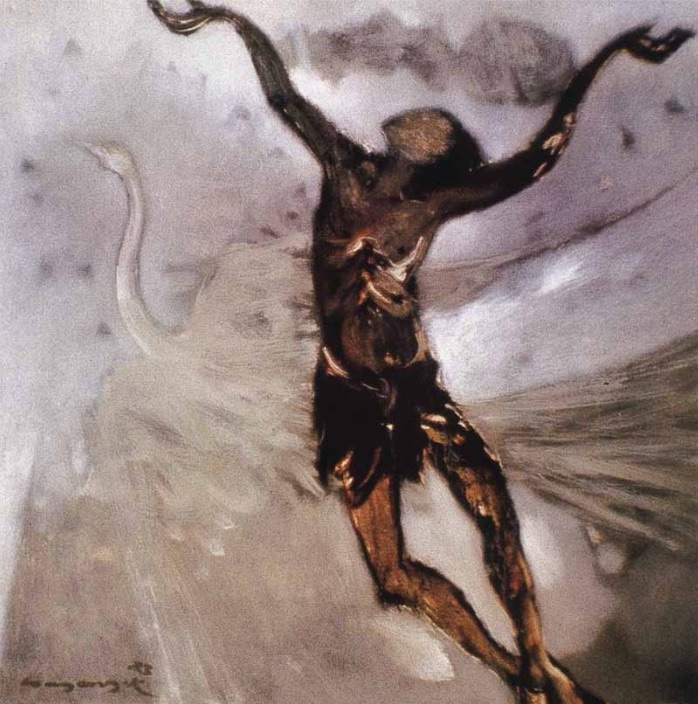
-art by Bagong Kussudiardja (Indonesian, 1928–2004), Ascension, 1983