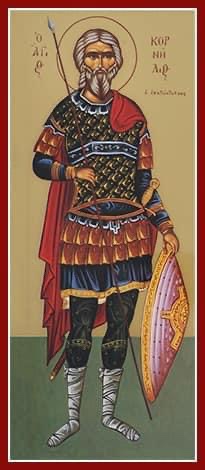
Today the church remembers a 1st Century Saint whose mention in Acts of the Apostles (chapters 10 and 11) is indicative of an event much more important than it might first seem: St. Cornelius, Centurion and Bishop of Caesarea.
We know scant about Cornelius other than he was a Gentile convert who heard St. Peter’s preaching, and had his heart “strangely warmed” to borrow a phrase from John Wesley. His conversion, and that of his household, led to a second Pentecost of sorts, as St. Peter, the leader of the Jewish-Christian arm of the early church, began to accept Gentiles into the fold.
This was a huge deal for that early church. It started the domino effect of honoring the missional work of St. Paul and the admission of Gentile-Christians as equal members of the fledgling apocalyptic community.
St. Cornelius, as a Centurion, was a commander of one hundred soldiers. As a full Roman citizen of rank, he was well paid for his work and undoubtedly wealthy and influential.
Lore has him becoming the second Bishop of Caesarea, leaning into his conversion and leading the early church in service.
St. Cornelius is a reminder to me that the church has, at it’s inception, been forced to wrestle with inclusion and, from the outset, chose to have open doors rather than closed ones.
Perhaps that’s a history the church should re-learn in some corners.
-historical bits from Pfatteicher’s New Book of Festivals & Commemorations
Today the church honors a Saint whose work was like a fine wine taking time to develop: St. Ansgar, Bishop of Hamburg and Apostle of the North.
9th Century St. Ansgar was, on the face of his work, not very accomplished. In all of his missionary zeal he was only able to establish two churches on the border of Denmark and appoint one priest in Sweden.
But the small seeds that St. Ansgar scattered across the frozen north eventually took root, settling and snuggling in with the Viking and Celtic practices found there.
At the beginning of the 9th Century the church was seeing Scandinavia as the next frontier for the faith. A few prominent nobles had embraced Christianity, including King Harald (cool spelling of that name, no?) of Denmark who sought to regain his throne from a pagan usurper. In response to some of these hospitable events, the church began sending missionaries to the Viking lands. The seafaring people they met there were hearty and quite sophisticated in their own way, and though they tolerated (sometimes) these missionaries, they mostly saw them as useful for creating trading markets.
Still, the message these missionaries carried did take hold, especially amongst the slaves that had been brought north who were eager to hear the stories of their childhood faith offering hope in a weary land.
In 829 AD a group of these merchants asked Emperor Louis the Pious (who’d want to be remembered like that?) to send a Christian mission to Sweden to help establish a regular trading route, and Ansgar was chosen.
Ansgar and his small party set out and were attacked by Vikings who took all of their possessions and money. Arriving at their destination penniless, King Bjorn (the local prelate) gave them food, shelter, and allowed them to preach their Gospel. Though they had few converts, King Bjorn’s bailiff took the faith to heart and, with his own capital, erected the first church in Sweden.
In 831 St. Ansgar was appointed Archbishop of Hamburg, seeing that as a good place from which to continue sending missions to the north. St. Ansgar was blessed with an organizational mind (probably an Enneagram One) and was able to create community systems to preach and gather small pockets of apocalyptic people together to practice the faith.
In 845 Vikings saw Hamburg as a growing site of wealth and organization and decided they wanted in on the action, so they pillaged it and burned it to the ground. Undeterred, St. Ansgar continued to rebuild after the destruction of the city, patiently working and restoring those missional pathways throughout Denmark and Sweden. He worked at this until his death in 865 AD.
St. Ansgar is now roundly regarded as a Patron Saint of Scandinavia having tilled the soil and planted seeds that, true to the agrarian reality of the frigid north, took a while to take root. He is usually depicted in a fur collar and holding a mini-church, a nod to his life’s work.
St. Ansgar is a reminder for me, and should be for the whole church, that sometimes you don’t see the fruits of your labor, but you stick at it, by God.
-historical bits gleaned from Pfatteicher’s New Book of Festivals & Commemorations
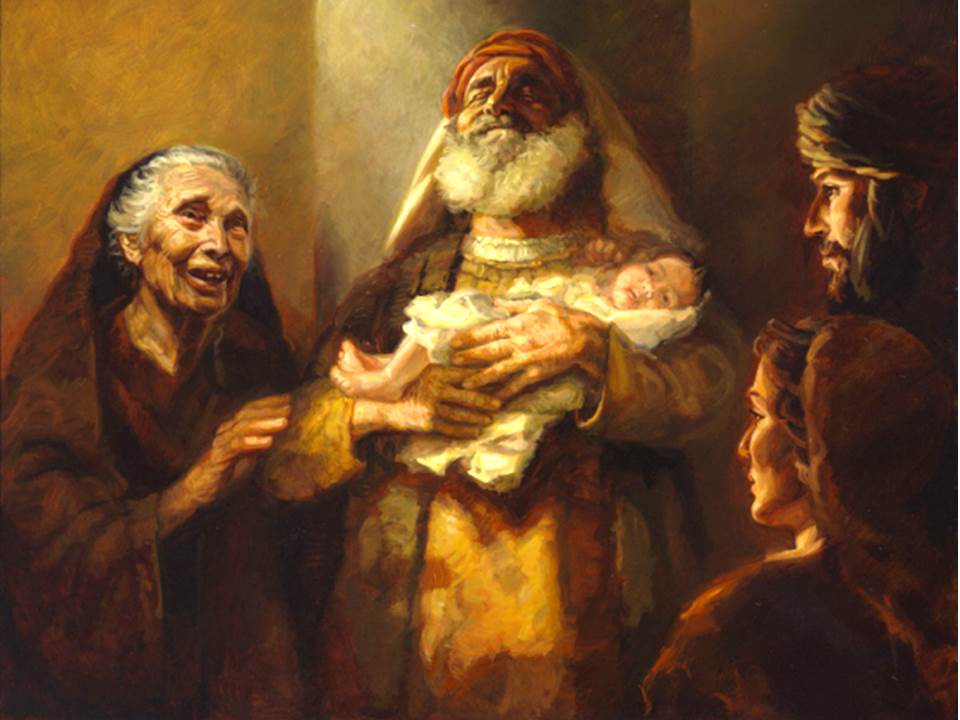
Today the church honors The Presentation of Jesus, a minor feast day that mentions two major saints of the faith: St. Simeon and St. Anna, Elders and Prophets.
Yes, we don’t know much about these saints (noted at the end of Luke 2) except to say that their patience and wisdom is instructive for a humanity that too easily leans toward immediacy and easy answers.
They hold up the Christ child in all his potential, declaring Jesus a special one. Imagine what could happen if we lifted up all children this way, not just those born in privilege.
It could change the world. It has before.
Christians bless candles today, making the metaphorical shift that the Christ is also the light of the world.
The Celts, more practical, would haul out new candles today because it is the midpoint between the solstice and the equinox, and the early winter candles are now spent as we are in the belly of the snow season.
But light daily grows, Beloved.
Anna and Simeon knew this.
St. Simeon and St. Anna are a reminder for me, and should be for all of the church, that all who are fortunate become old, but not all become elders.
Becoming an elder takes time, intention, patience, and a wisdom that comes from trusting promises in the face of scoffers and opposition.
In America this may be Groundhog’s Day, but in Celtic spirituality these days are known as Imbolc, or “in the belly,” because you’re at the halfway point between the equinox and the solstice, and you’re emerging into spring.
Christians celebrate Candlemas today, where new candles are blessed, as the ones lit at the Solstice are now spent. And in services many will hear about the Presentation of Christ, where the ancient prophets Simeon and Anna lift him up and bless him as the light of the world.
The symmetry is stunning and intentional.
These hinge days between seasons are worth paying attention to, as our mothers and fathers did.
So bless your new candles, because you’ve spent the old ones in these winter days, and start opening the shades.
It’s time to wake from our hibernation, blink, and live again.
Her song is, “Lift every voice and sing, till Earth and Heaven ring…”
Her song is, “Lift high the cross, the love of Christ proclaim…”
Her song is the Psalm Jesus uttered from the cross. Her song is the cries of anger and desperation and pain on the streets of Memphis, of Minneapolis, of St. Louis, of the girls in Iran, of children in our schools, of the teenage Mary predicting that the world was about to turn.
Is about to turn. About to turn, turn, turn, to every season turn, turn, turn…
Justice is not the Gospel, but the Gospel calls for justice, forgiveness, and a powerless love triumphing over loveless power.
We are all empowered to sing the Gospel song of powerless love triumphing over loveless power that we hear and know and have written on our heads, our tender hands, our hearts as this Jesus is presented to us over and over again in the face of the stranger, in the face in the mirror, in the face of those the world refuses to look in the face…”
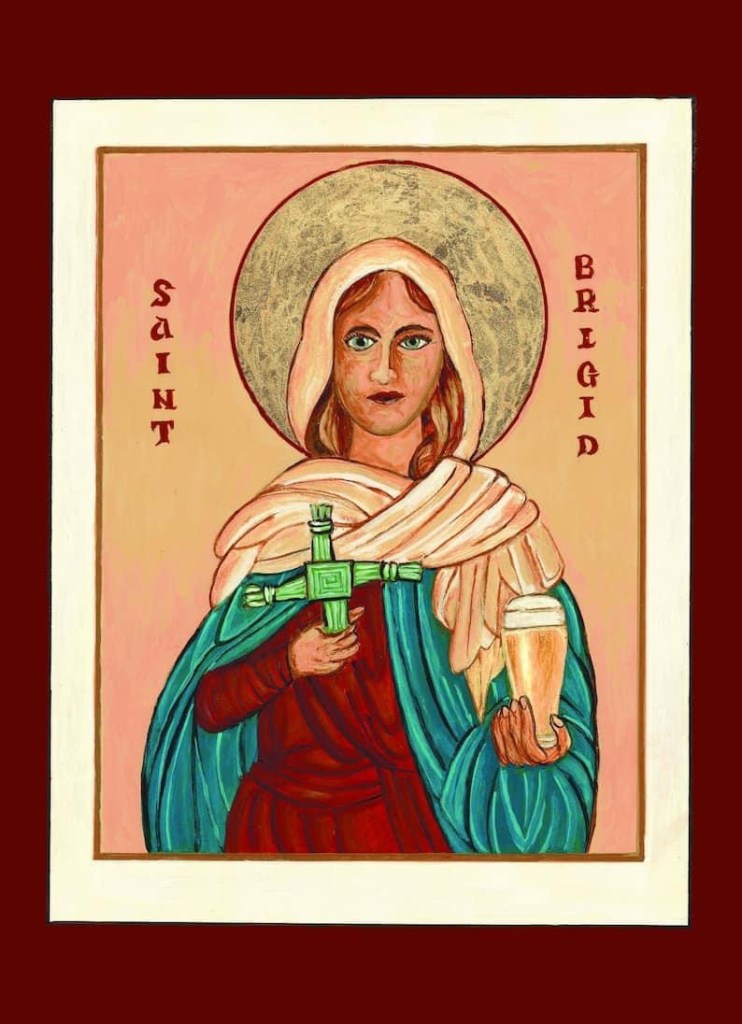
Today the church remembers a Celtic Saint (which makes her close to my heart): Saint Brigid (commonly called St.Bride in Scotland), Abbess and Protector of Ireland.
Sometimes called “the Mary of the Gael,” not much historically verifiable is known about St. Brigid’s early life, though legend and lore abound. On the island of Ireland she is revered as much as St. Patrick in most places, and her story is a mix of Christian and pre-Christian wonder. The daughter of a druid who had a vision from the Divine that his offspring would protect and change Ireland, St. Brigid was said to have been born at sunrise while her mother was walking over a threshold (a point of significance for the ancient Celts, because it meant that she was neither “in nor out” when St. Brigid arrived).
St. Brigid would live into this “neither here nor there” nature throughout her life. She was a peace-loving monastic, but also a fierce warrior. She was both wise and approachable. She was both Christian and pagan in her outlook.
She was known as a strong, happy, and compassionate woman who started a community of women at Kildare in the late 5th-early 6th Century. St. Brigid was said to be wise, and was sought out in life by many for counsel, and admired in death by poets, story-tellers and song-writers who used her as inspiration, many quite fanciful.
Lore has it that it was St. Brigid who spread out her green mantle over all of Ireland to make shine like an emerald.
In Ireland today more than a few rivers bear her name.
In addition to being a wise spiritual leader and community builder. St. Brigid was said to have been the protector of the land, officially the guardian of the pagan king Torc Triath of what is now West Tipperary. In a time when Ireland was a destination for all seafaring people, the need for protection was great. St. Brigid was an accomplished warrior. In ancient Celtic culture women were seen not only as capable leaders, but in many areas superior.
St. Brigid died in the early 6th Century, and her following grew to the point that her relics were prized possessions that had to be continually moved and hidden from invading marauders who sought to steal them as a trophy.
The most remarkable thing about St. Brigid, though, is not her historical self, but the part she now plays in Celtic Christianity. St. Brigid’s day comes in the “dead months” (marbh mhios) of winter when humanity in the northern hemisphere finds itself “Imbolc” or “in the belly” of winter. Her feast day is a reminder for the Celtic Christians that winter doesn’t last forever, and though you now might see only shadows, the sun is growing stronger every day, by God.
This reminder of St. Brigid, woman of wisdom and strength, works for the winter of the seasons, and in all the metaphorical winters of your life, Beloved.
St. Brigid is a reminder for me, and should be for the whole church, at least three things:
First: live in such a way that people write wonderful stories about your wisdom and strength.
Secondly: the intermingling of Christian and non-Christian sensibilities has helped the faith to develop, and this can be seen in no better place than in Celtic Christianity.
Finally: though we must live with winter, it never lasts forever.
Let those with ears to hear, hear.
-historical bits gleaned from Pfatteicher’s New Book of Festivals and Commemorations
-Celtic lore found from stories of my ancestors as well as Freeman’s Kindling the Celtic Spirit
-icon written by Larry at IconWriterArtist on Etsy
Today the church remembers a saint who, though she could have easily lived in luxury, chose a different way: Marcella of Rome, Widow and Model of Generosity.
St. Marcella grew up with everything someone in the 5th Century might want. Her family was powerful and prominent. She married young, and married wealthy. She lacked nothing.
But shortly after her marriage her husband unexpectedly died. Quickly on the heels of his death, another suitor, Cerealis, cousin of Caesar himself, proposed to her.
She said, “Bye, boy,” and rebuffed his advances.
Seeing this as an opportunity for a different kind of life, she converted her mansion into a communal house for other women interested in living a charitable life. In this converted home/convent, she and other noblewomen used their wealth to help the poor and destitute. It was from this home, too, that she taught other young women in the ways of intentional poverty (chosen, not forced), most notably her favorite pupil Principia.
St. Marcella was known to have said, “I prefer to store my money in the stomachs of the needy than hide it in a purse.”
We know about her and her life through the letters of the prolific St. Jerome, who wrote to Principia. St. Jerome even notes that he learned much about God and the scriptures directly from St. Marcella, making her an early (though under-the-radar) teacher of the church.
In 410 Rome was invaded by the Goths. They stormed St. Marcella’s mansion and, when they had ransacked the place and found she had (as she had told them) given all her wealth away, they tortured and beat her.
Not long after this abuse, St. Marcella died, purportedly in the arms of her dear Principia.
St. Marcella is a reminder for me, and should be for the whole church, that there is, indeed, a choice to make when it comes to how we live in this world.
-historical bits from Clairborne and Wilson-Hartgrove’s, Common Prayer: A Liturgy for Ordinary Radicals
-icon hangs at Holy Transfiguration Monastery, Brookline, MA.
Today the church remembers a martyr who called God by a different name: Gandhi, Peace Activist and Spiritual Leader.
Though one could certainly write a tome on Gandhi’s life (and many have been written!), I do not have enough knowledge of his background to do it justice. What I do know is he threw off the shackles of privilege and, though not a perfect person by any means (he fell into the trappings of the systems around him at times), he adopted a way of life that advocated for the liberation of his people from colonial rule.
He became a political leader. He became a spiritual leader. And he became a world teacher, showing us all how peaceful, nonviolent resistance can move mountains.
On this day in 1948 he was assassinated on his way to prayer (as most religious revolutionaries are…it’s usually on their way to prayer). Though the assassin took the actor, the production continues even today, and many in the quest for justice name Gandhi as an inspiration in nonviolent civil disobedience.
Gandhi is a reminder for me, and should be for the whole church, that nonviolent disobedience, though costly, can change the world. And, don’t we regularly hear something about losing one’s life to gain it?
Gandhi knew something about that. Perhaps he was more Christian than many who wear crosses in that regard…
-icon written by Br. Lentz (purchase at trinitystores.com)
“What’s going to happen?” she wondered. “There has to be a bigger purpose…”
“Why?” he asked honesty.
“Because I need it all to mean something,” she replied, tears welling up in her eyes.
“We all want things to mean something in some bigger plan,” he said, “but what if they don’t? What if the map is being drawn one second at a time? Does that mean it’s all…well..meaningless?” he countered.
“Well, no…” she said. “I would just like some assurances.”
“I’m not sure life gives you those,” he said. “What if the larger point is for us to embrace that things have meaning not because there’s some ‘larger plan,’ but because our small, little plans are beautiful enough? And the mistakes? They don’t need to fit in some larger scheme to be redeemed. They’re redeemed because we learn from them, heal them as best we can, and move forward just a little bit on this ever-evolving, ever-scrolling map we make.”
“Significance,” he went on, “is not assigned from above. It’s assigned from within. Things mean something because they’re important to us, to you, to him. Or her. It’s subjective, by God. And that’s OK. It doesn’t make it less. It probably makes it more.”
“More?” She closed her eyes trying to wrap her head around it all.
“So, my quest for certainty is a fool’s errand?” she wondered.
“No,” he said, “because you’re not a fool. It’s the most human thing in the world, I think. But what if we just got used to embracing the idea that there is no certainty?”
Today the church begins to set its collective eyes toward Candlemas (February 2nd), which comes on the heels of St. Brigid’s Day (February 1st).
On the wheel of the Celtic year, spring begins in February. They call it “Imbolc” which means “in the belly,” a sign that we’re in the belly of the cold time and emerging into warmer climes. It’s not over, but it’s beginning to change.
To mark this change they looked toward nature and the animals, seeing if they’d emerge from their dens or remain dormant. In America we call this “Groundhog’s Day,” but it all began with the Celts.
It was also the season where they’d haul out their new candles, as the old ones were spent, and would bless them for new service. These new candles would last longer, possibly the rest of the year. The church coopted this practice and Christianized it into Candlemas.
But we’re not there yet.
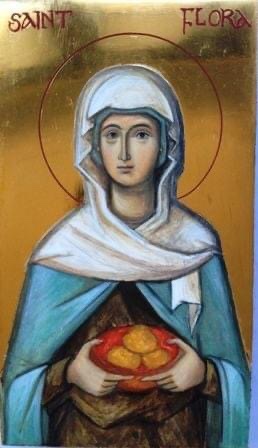
So, to prepare for St. Brigid’s Day/Candlemas, the ancient church honored St. Brigid’s cook at Kildare: St. Blath, Patron Saint of Cooks, Cafeteria Workers, and Volunteer Food Servers.
St. Blath, also known as St. Flora (because “Blath” in Gaelic means “Flower”) was St. Brigid’s convent cook. While we don’t know much about her, she was rumored to be a tireless worker, faithful in good times and in bad times, knowing that full bellies helped bolster spirits.
Which, I think we can agree, is a universal truth with all animals, especially humans.
St. Blath’s work takes on new and urgent meaning when we imagine that those early 6th Century sisters at Kildare, having taken a vow of poverty, would regularly give away their food to the poor. St. Blath was constantly prepping and serving, then, not only the sisters, but also those to whom they offered their meals.
It was said of St. Blath that her bread and bacon were the best in the land, a high honor if you know anything about Celtic culture.
Saint Blath died in the year 523AD, but her legacy of service lives on.
St. Blath is a reminder to me, and should be for the whole church, that it does no good to have faithful people if their other needs, especially their stomachs, aren’t attended.