On this Leap Day, on which no official saint is commemorated, I would (jokingly) lobby with indefatigable yet imaginary fortitude that the church remember a beloved saint: Saint Elmo of the Fire, Muppet and Delighter of Children.
Saint Elmo of the Fire has been known to dance and jiggle to the delight of many, usually brought on by tickle matches and the shocking current of more batteries than should be necessary for a muppet of their size.
More than curious, Saint Elmo of the Fire has been known to ask the right question at the right time for a humanity that, while valuing answers more than questions, really wants someone (or some muppet) to care, you know?! Saint Elmo of the Fire cares.
With high voice and red fuzz, Saint Elmo of the Fire has engaged screen watchers and toy buyers for over 43 years with joyful jaunts through imagination and inspiring messaging. More cautious than Grover and yet as loving as Big Bird, Saint Elmo of the Fires bridges the muppet opinion divide by bringing all sides together in a furry-crimson embrace that all souls need but so few acknowledge.
Saint Elmo’s of the Fire is also a weather phenomenon of plasmic proportions. And an endearing 80’s movie that has a seriously underrated soundtrack.
Saint Elmo’s of the Fire is a reminder for me, and should be for the whole church, that though we pine for answers, sometimes all we truly want is to have someone curious about our lives…even if that someone is fuzzy and has no discernible feet.
In Celtic spirituality, February is associated with the rowan tree. Its red berries were thought to guard against all sorts of bad things.
They’d put rowan branches on their cattle sheds and dairy barns to keep the meat and milk fresh and free of disease, and across Celtic lands crosses of rowan twigs were tied with red thread and carried in pockets or sewn into the linings of coats for traveling mercies.
Since the saint of the month, Saint Brigid, was associated with flame and fire, the blazing red berries were thought to be little glimpses of her favor.
I found a modern Celtic prayer to say under the Rowan Moon (February’s moon). And since it’s the almost the last day one can say it, I thought I’d throw it out there.
What I love about this prayer is that, while images of Christ/love and the sun are really common, we don’t get many images of Christ/love being seen in the moon. But in the month where the moon still outshines the sun, it makes sense to have a prayer that highlights this truth, right?
Bright glory, bright moon, the moon that shines on Brigid, lamp of the poor, love, light, illumined by God. Bright moon of glory, teach me good purpose toward all creation. Bright moon of grace, teach me good prayer in accord with Christ’s heart.
Fiery moon of great light, be in my heart be in my deeds be in my wishes. Teach me your grace. Bright moon over Brigid, your light my hope, your light on my purpose here, in accord with God’s satisfaction.
Bright fire, bright moon, point my heart to God’s repose. Point me to my rest, with the Son of Tranquility.
As morning dawns on February 27th, I would lobby hard that the church remember a modern saint who saw everyone as his neighbor, and therefore loved his neighbor as himself (and even more-so) without even trying, while teaching others to do the same: Saint Fred McFeely Rogers, Friend of Humanity and Muse of Young Ones.
Fred McFeely (yes, you read that correctly) Rogers was born in 1928 just as the American landscape was about to take a turn for the worst. Born in Latrobe, PA, Saint Fred was a shy child, spending much of his spare time with puppets he made or who were given to him. He was tormented and bullied at school because of his quiet way, and was called “Fat Freddy” by classmates because he was overweight.
These early experiences no doubt sent him on a spiritual quest for true friendship.
He overcame his shyness in High School through trial and error, finding out what true friendship looked like, and eventually gained a University degree in music. On one of his summers home from college he encountered a new box in his parent’s house: a television. He was intrigued and disgusted.
Saint Fred was not in love with television at first, but saw that it had potential to shape the people who tuned in. He went to work for NBC, and then his local Pittsburgh affiliate, trying his hand at children’s shows and production. While doing all of this he also answered a call from the church and graduated from Pittsburgh Theological Seminary. But rather than finding his parish within sacred halls sitting in pews, he cultivated his parish within living rooms across vast distances who sat on couches, floors, or on their knees with their small hands pressed against the screen.
Freddy had found the friends his childhood self desired, but never could make.
Saint Fred had a number of different children’s programs in different markets through the early ’60’s. He worked with child psychologists to understand best how children not only developed, but also how they learned best. He was tireless in trying to make the medium a good for children.
In 1968 Mr. Roger’s Neighborhood began airing nationally on what would become PBS. Over almost 900 episodes children learned how to make and keep friends, sing songs together, use their imaginations, and be curious. When the last episode aired in 2001, Saint Fred had not only left his mark on the television industry, he had left his mark on so many of our hearts, me included.
Fun fact: he taught me what house shoes are…always being sure to change into them when he came in the door.
Alongside his care for children and their education, Saint Fred was a tireless advocate within the halls of power for educational opportunities and children’s rights. He spoke before congress, used politics for the betterment of humans, and gave scores of commencement speeches to eager young minds wanting to change the world like he did.
As if all of the above didn’t keep him busy enough, he also married and had two sons, appropriately named James and John. He kept his license as a Presbyterian minister his many years, and reportedly had a deep spiritual life that also studied mysticism, Buddhism, and many other faiths. He never spoke about religion overtly on the air, but believed his example said volumes about his core convictions.
He was eloquent and honest and earnest. But I think his deep secret to changing the world had very little to do with what he said and most to do with who he was: he was a very good friend.
And that made all the difference.
He died on this day in 2003.
Saint Fred McFeely Rogers is a reminder for me, and should be for the whole church, that sometimes evangelism isn’t done by saying anything about your faith, but rather by simply living it and being a darn good friend in the process.
Let those with ears to hear, hear.
-historical bits from public sources
-icon written by Kelly Latimore (and is available for purchase from him!)
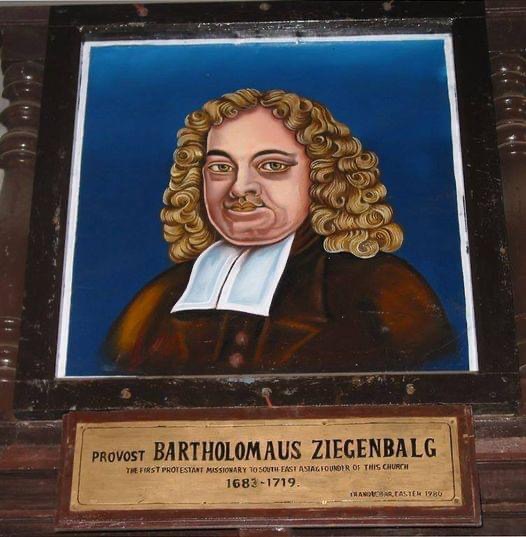
Today the church remembers a little 17th Century known missionary who deserves more nods than he gets: Saint Bartholomaus Ziegenbalg, Missionary to India and Defender of the People.
Born in Puslnitz, a small town in Saxony at the tail end of the 17th Century, Saint Bartholomaus (Bart) was born into poverty but gifted with a wonderful intellect, a combination that time after time has proven to be powerful when the world gives it a chance, no? He studied hard, was raised in a pietistic Lutheran home, and upon graduation “said yes to the (ad)dress” that the King of Denmark gave, imploring folks to go and preach in southeast India.
So, in 1706 St. Bart and his associate, Heinrich Plutschau set out for Tranquebar, India with hopes and dreams.
They were met with much hostility when they arrived, both by the ruling Dutch who didn’t look kindly on visitors, and by local Hindu religious leaders who didn’t love these zealous missionaries stirring things up amongst the masses. But St. Bart wasn’t just interested in converting folks (despite what the Danish church wanted him to do). He set up a printing press and became enamored with the locals, their customs, their religious culture, and their language. He wrote and published volumes on Tamil, sending his writings and thoughts back to Halle where they were shoved away without publication. He translated the whole New Testament into Tamil, a translation that has had a few revisions over the years, but that is largely the authoritative one still in use. In fact, the church dedicated to St. Bart, the Church of the New Jerusalem, organized in 1718, is still an active parish today!
But St. Bart did not have it easy, both from the outside and on the inside. The Danish Church didn’t like that he advocated for the physical and mental health of those he served, and wished he would just “save them”…an ongoing issue in the church writ large today, I’m afraid. In addition, he was often sick himself with undiagnosed ailments both physical and psychological.
As the year 1708 came to a close you would find St. Bart in a local prison, charged with inciting rebellion amonst the people.
That would not be the end of his story, however.
St. Bart forged on, continued to make partnerships with the local people and other mission work in the area. He married in 1716, finally published that New Testament he’d been translating for so long, and founded a local seminary to train clergy from India so that the church wouldn’t just be a replica of Eurpean institutions, but be contextual to the people. He also began translating the Hebrew Scriptures into Tamil, and got as far as the book of Ruth before he fell ill for one final time.
He died on February 23, 1719 at the young age of 36, and his commemoration was moved to today to make space in the calendar to honor his life.
St. Bart had a direct influence on the flourishing of the Tamil-speaking Lutheran Churches in India today.
St. Ziegenbalg is a reminder for me, and should be for the whole church, that caring for the entire person is necessary. Indeed, Jesus cared about bodies (why else would he be resurrected in one?!), so the church needs to care about bodies, too, not just “souls.”
Let those with ears to hear, hear.
-historical bits from Pfatteicher’s New Book of Festivals & Commemorations
-plaque from Tamil Evangelical Lutheran Church in Tranquebar, India
Today the church remembers a saint who was a victor (or victim?) of chance: Saint Matthias, Apostle and Patron Saint of One-Hit Wonders.
We know absolutely nothing about St. Matthias except for the brief account in Luke’s Acts of the Apostles where he is chosen by throwing dice as a replacement for Judas in the pantheon of Apostles. The early church felt it was necessary to restore the ranks to twelve, mirroring the tribes of ancient Israel. One wonders why they didn’t just incorporate Mary Magdalene into that position, as she was already performing the duties and fulfilled Peter’s qualifications for the role as a “witness to the resurrection,” but whatever. Patriarchy wins again, I guess.
When considering who should replace Judas, two disciples were put forth that supposedly fit the bill: Joseph Barsabbas and Matthias, both who were supposedly part of the seventy sent out by Jesus when he was alive. The dice landed on Matthias.
And that, Beloved, is all we know about him.
There is apocryphal lore regarding Matthias, though there is some confusion as to whether the authors of these stories meant to reference the Apostle Matthew instead. St. Clement quotes a second-century Gospel of Matthias, though we have no text of this Gospel book. Other works from the 6th Century and later expand upon the lore, often pairing Matthias (or is it Matthew?) with the Apostle Andrew in spreading the Gospel in hostile lands.
The one thing all the tales do agree on is that he was a martyr for the faith in the end. His crest exemplifies this thought, often depicting a double-headed axe resting on the scriptures.
It’s unknown why today was chosen as his feast day back in the eleventh century. Rome has him commemorated on May 14th to avoid the feast falling in the season of Lent, but Lutherans have no qualms lifting up a martyr in the penitential season. After all, though he witnessed the resurrection, he did so with his life on the line, which seems to fit both Lent and Easter sensibilities.
St. Matthias is a reminder for me, and should be for the whole church, that sometimes things just happen and they don’t need a Divine reason behind it to be significant. I’m not one to say the Holy Spirit plays dice, and in all honesty I’d rather have had Mary rightfully acknowledged as the true Apostle she was, but I’m happy to give Matthias a nod today because, whether he wanted it or not, the lot fell to him.
-historical bits from Pfatteicher’s New Book of Festivals & Commemorations
Today the church remembers and mourns Executive Order 9066.
By executive order of President Roosevelt, Japanese Americans, two-thirds of whom were United States Citizens, were forced into internment camps on this day, February 19th, in 1942.
It is estimated that, at the time of the attack on Pearl Harbor, 112,000 of the 127,000 Japanese American residents lived on the West Coast. Of those American residents, around 80,000 of them were second and third generation citizens, never having spent any time in Japan.
Forced from their homes, schools, and places of business, anyone with Japanese heritage (in California they exacted it to 1/16th of Japanese lineage) were placed in regional concentration camps. What was trumpeted as a “security measure” in case any of them were sympathetic to Japan, was actually legalized racism. Such measures were not taken for German or Italian residents in the United States, many more of whom were not legalized citizens (though a small number of people of German and Italian heritage were also forced into these camps on the West Coast).
By this order all people of Japanese heritage were forced to leave Alaska, as well as many areas of California, Oregon, Arizona, and Washington State.
In 1944 a legal challenge to 9066 came to a close, and though its constitutionality was upheld on technicalities (another instance where the small print delayed justice, and it didn’t even opine on the concentration camps themselves), it was affirmed by the court that “loyal citizens cannot be detained.”
The day before the results of this legal ruling would be made public, 9066 was rescinded, an implicit admission of purposeful wrongdoing in my book.
In 1980 Japanese Americans lobbied forcefully to have Executive Order 9066 investigated. President Carter initiated the investigation and in 1983 the commission reported that little evidence of disloyalty was found in the Japanese-American community of the day, and that the internment process was blatant racism. In 1988 President Reagan signed the Civil Liberties Act of 1988 and officially apologized on behalf of the United States government, authorizing monetary settlements for everyone still alive who had been held in a camp.
In other words: the US government gave reparations. It’s not unprecedented…
The larger question for me, though, is: where was the church?
Why wasn’t the church lobbying hard to have these fellow sisters and brothers released?
Additional studies have shown that religious prejudice also played a part in the justification for these internment camps. In a largely “Christian America,” these often Buddhist, Taoist, and Shinto practicing Japanese residents were seen with much more suspicion (which is probably why the German and Italian residents, also largely thought to be “Christian,” were not rounded up).
The church failed to protect a vulnerable population. The church held hands with the politics of the day in ignoring at best, and aiding at worst, the abuse of other humans.
Today we remember, mourn, and are honest about this failure.
This commemoration is a reminder for me, and should be for the whole church, that when religion holds hands with politics we end up on the wrong side of history.
-historical bits gleaned from Clairborne and Wilson-Hartgrove’s Common Prayer: A Liturgy for Ordinary Radicals as well as common source news
-art by Norman Takeuchi with his piece, “Interior Revisited,” stated that “Interior and ‘internment’ are synonymous for many of Japanese-American lineage,” because they moved people from the coast to “the interior” of the United States for these camps.
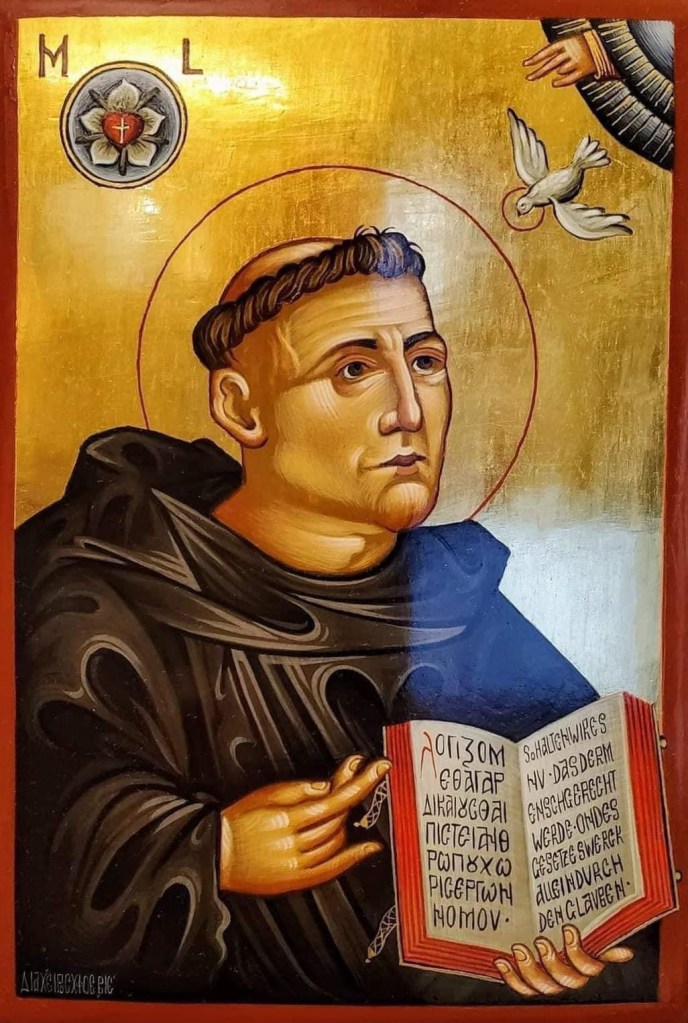
Today the church remembers the reformer and cranky theologian, Martin Luther. He’d wince at being called a saint, but welcomed the title of “baptized.”
Luther was as imperfect as he was ingenious. As the most prolific and public author of his day, his opinions on matters mundane (a homemade remedy for skin rashes) to mighty (Freedom of a Christian) are well-documented and well known by all students of history. He wrote beautiful theological treatises and stirring hymnody. He was a pioneer for women and children in his day.
Yet, he was a person of his era in many ways, and lamentably was unable to rightfully wrestle with his own prejudices, especially toward those of the Jewish faith.
His anti-Semitic writings have been totally and fully condemned by the Lutheran church.
With both his flaws and his fortitude he embodies one of his central theological discoveries: that we are all both sinner and saint, simultaneously. We are both perfectly imperfect, and perfectly loved by a God who has a tender spot for broken things.
One of his more poetic thoughts about the “now-and-not-yetness” of our human existence:
“This life therefore is not righteousness, but growth in righteousness, not health, but healing, not being but becoming, not rest but exercise. We are not yet what we shall be, but we are growing toward it, the process is not yet finished, but it is going on, this is not the end, but it is the road.“
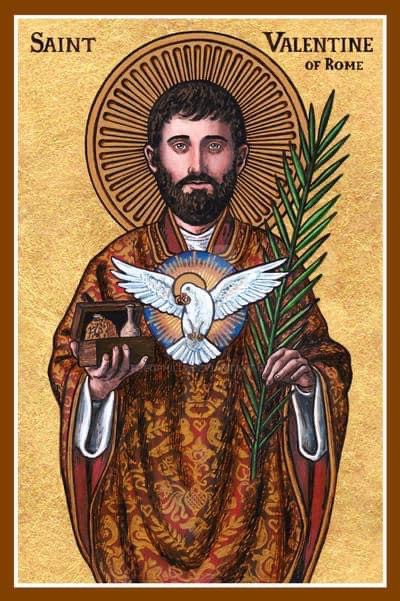
Why doesn’t the church honor St. Valentine on Valentine’s Day?
Answer:
Nothing historically verifiable at all is known about St. Valentine other than someone with that name was buried in Rome on February 14th. Legends grew, of course, including legends of a gruesome death (kind of an ancient “tongue-wagging” tactic for a church that liked drama), but none of it is thought to be true. In 1969 the Roman church removed him from the calendar of saints for “lack of evidence for existence.”
It is thought, though, that the emergence of this day as a romantic holiday was a way that the church overshadowed a Roman festival, Lupercalia, held on February 15th.
Lupercalia was the celebration of the wolf that rescued the legendary founders of Rome, Romulus and Remus, and nursed and raised them (“Luper” from the Latin root “lupus” for “wolf”). For this reason the celebration was associated with child-birth and fertility, making the Church’s institution of Saint Valentine’s Day in 496 a natural Christianization of the holiday (though it became known more for love than fertility in the end).
Lupercalia honored the wild energies of creation intended for romance and reproduction. Valentine’s Day was a more modest variation of that theme…something the church could stomach.
Btw: Ever notice that the heart icons commonly used look nothing like an anatomical heart? The shape of that icon (all over everything Valentine’s Day) is thought to have been an artistic representation of voluptuous buttocks, the epitome of beauty in Roman times.
A competing thought is that the icon is derived from the fig leaves used as modesty covers in Pagan statuary.
Whatever the origin, though, it’s been used for a very long time and, despite it’s now common place and mild application, was pretty risque!
Today the church holds a somber fast traditionally known as Ash Wednesday which dates back to the 11th Century.
In a number of places in the Hebrew scriptures ashes were associated with penance and remorse. The books of Jonah, Amos, and Daniel all note the practice of heaping ashes upon your head as an outward display of how guilt and penitence feel inside.
As the church year begins to ponder the death of the Christ in anticipation for resurrection, a more introspective, prayerful, and yes, honest tone is kept. Ash Wednesday is the start of that long road to Calvary.
While some might consider the practice to be sad or even scary (after all, who likes considering their mortality?!), the wise mystics of all faiths remind us that we must ever keep death before our eyes if we are to truly live.
You cannot outrun mortality, Beloved.
You cannot out-diet, out-exercise, out-supplement, out-buy, or out-smart the quiet, pervasive truth that all creation is indeed, dust at our core (beautiful stardust, to be exact), and we will all one day return to that dust.
There is no out.
And yet, as is true with all paradox, there is a certain amount of freedom that comes with embracing this hard truth. Being Wonder Woman and Superman for too long weighs on us all, and we’re really not meant to fly anyway.
We’re meant to walk, which means we stumble like all walking beings do from time to time. The reality of our imperfection is, too, a gift of grace.
Today the world honors St. Valentine, but the church kind of shrugs toward that saint, and instead dedicates the day to two Greek biological brothers: St. Cyril and St. Methodius, both 9th Century missionaries to the Slavs.
Cyril, in an effort to translate the Gospels and the liturgy into the Slavonic language, created a whole new alphabet. Modern Russian is based on this Cyrillic alphabet.
After Cyril’s death, Methodius took up the missionary mantle and continued the work. Cyril and Methodius met great opposition within the church for their novel way of using the common vernacular to spread the Gospel. Their followers likewise faced oppression, and found themselves scattered…which actually helped the language, and the mission, spread throughout Eastern Europe.
The Slavic tradition in Lutheranism is still very strong, with a whole non-geographical Synod (Slovak-Zion Synod) representing the tradition in the ELCA yet today.
The brothers believed in a deeply contextual approach to engagement with those they were living with, even deconstructing and reconstructing their own systems (alphabet and liturgy) in order to communicate with clarity. They were transformed in the process, even as they transformed the information, and are still deeply revered in Slovak, Czech, Croat, Serb, and Bulgar traditions.
Those with ears let them hear.
-historical bits adapted from Pfatteicher’s _New Book of Festivals and Commemorations








 Reluctant Xtian