The ancient Celts called the first full moon of January the “Wolf Moon.” It was traditional to give a good howl at it, thanking it for its beauty as it kept the night watch.
We may or may not have done that tonight…
The ancient Celts called the first full moon of January the “Wolf Moon.” It was traditional to give a good howl at it, thanking it for its beauty as it kept the night watch.
We may or may not have done that tonight…

Today the Church celebrates the Feast of the Epiphany.
This is much more than just a story of Magi visiting the Christ child.
This day is all about awe and wonder. It is about recognizing the cosmic impact that the Divine incarnation has, as even the heavenly bodies testify to the greatness of God through the stars.
It is about the global impact that the embodiment of the Word of God would have, as people from the far corners of the Earth are embraced by God’s holy in-breaking, compelled to seek it out.
It is about Christ’s nature: precious as gold, fragrant as frankincense, and self-giving as the myrrh used to wrap the dead in that final act of love.
The journey of the Magi will be echoed by the journey of those women who walk with spices to the empty tomb on Easter morning.
The symmetry is striking. The whole arc fills you with awe.
In these days between Epiphany and Transfiguration the church will continually ask, “Who is this Jesus?” And with story after story we’ll hear a variety of answers to that question.
But today we just get this one answer: the embodied Word is worth searching for, worth giving things up for, and worth defying the powers of this world for.
The Magi, like Jesus himself, will practice civil disobedience in an effort to keep their conscience intact, by God.
That truly is awesome.
-icon written by Puerto Rican artist Fernan Mora

On the 12th Day of Christmas I will now list for you the 12 most horrible, and obscure, Christmas songs…that I still love to listen to:
-“Our Love is Like a Holiday,” by Michael Bolton.
Terrible chorus:
“I’ve been to Paris, London, L.A.
I feel the tropical sun in my face
This Christmas we don’t need to get away
Cause our love is like a holiday”
-“Christmas Through Your Eyes,” by Gloria Estefan.
Notable lyrics: “I see the rain, you see the rainbow
Hiding in the clouds
Never afraid to let your love show
Won’t you show me how
Wanna learn how to believe again”
-“Jingle Bell Rock,” by Hall and Oats.
Please note: theirs is the worst version of this song…and the video is, literally, the worst. I’m obsessed.
-“8 Days of Christmas,” by Destiny’s Child.
This modern take on the 12 Days not only gets the number of days wrong, but also includes this gem: “On the eighth day of Christmas my baby gave to me/A pair of Chloe shades and a diamond belly ring”
-“Hard Candy Christmas,” by Dolly Parton.
This is my favorite on this list. Killer verse? “Hey, maybe I’ll learn to sew
Maybe I’ll just lie low
Maybe I’ll hit the bars
Maybe I’ll count the stars until dawn
Me, I will go on”
-“Go Power at Christmas Time,” by James Brown.
If you ever needed proof he was often high, look no further…
-“This Christmas (Could Be the One),” by Ledisi
Never heard of this one? Consider yourself amongst the lucky…
-“Christmas Wrapping,” by The Waitresses.
This mono-tone little ditty exemplifies all the reasons why you’ve never heard of this group.
-“Go Tell it on the Mountain,” by Andy Griffith.
This is normally a great song. You didn’t know Andy Griffith sings, you say? He doesn’t.
-“Christmases When You Were Mine,” by Taylor Swift.
Tay Tay, what are you doing?!
-“Christmas for You and Me,” by Brian McKnight and Vince Gill.
Looking for that special song that mentions cheese this Christmas? Here you go!
“It’s 11 o’clock and I’m almost home
I’m just calling to let you know
Leave on the light for me
Soon we’ll make us some brie”
-“Candy Cane Christmas,” by Darius Rucker.
Vomit along to these lyrics:
“Angels sittin’ high upon a tree
Watchin’ over presents patiently
Milk and cookies on a plate
Santa Clause is on his way
The kids should be fast asleep”


The Celtic calendar was built on a wheel, an ancient wisdom of spirals and turning on which they trusted all life to be built upon. It was a dance that humanity participated in along with everything else cosmic to microscopic.
There were two halves, the “Sam” (summer) and the “Gam” (winter), and those were divided again with Samhain in October (the start of winter) and Beltaine in May (the start of summer), and further divided by Imbolc in February and Lughnasadh in August. In between all of those were the celestial markers of equinoxes and solstices, further providing some guidance as to what rhythm the Celts would be adopting at a particular time of year.
This is the eightfold pattern of their year, spinning round and round.
And each day itself was said to mirror this pattern with dusk (wintering) and dawn (summering) and noon and midnight. In other words: each day held a year.
A similar wisdom is seen in the ancient creation stories (Genesis follows this pattern), and also the eschatalogical understanding that each day holds the liturgical year (waiting, celebration, mourning, growing, etc.).
All of this is ancient, cycling wisdom at play, if we’re willing to pay attention.
In a modern Celtic understanding, January affords us the opportunity to focus in on thresholds (liminal spaces from the Latin “limen” which literally means “threshold”). Though it was not the ancient New Year for the Celts (which was probably Samhain), the mentality of the people was one of adaptation and so we find it has shifted to enfold the Gregorian calendar into its thoughtful rhythm.
January is our modern threshold month. It is the doorway, the threshold, to a new year. For the ancient Celts thresholds were holy places in the home, the barrier between the world and the family, a portal through which humans, as well, as other spirits traversed. It was neither here nor there. The dirt of thresholds was seen as holy ground, good for repairing relationships and cleansing the soul (haven’t you ever said, “it is good to be home!”?).
When entering an ancient Celtic home you’d say a quick blessing just inside the doorway called “The Welcome of the Door.” This is mirrored in many religions, but specifically for Western Christians we see this practice adopted on January 6th as doorways are blessed in honor of the Epiphany and the Magi crossing the threshold of the home of Mary and Joseph to see the Christ child.
January, as our modern threshold, provides us a similar opportunity for blessing and newness, is what I’m saying. The wheel is spinning, but there are important markers throughout, and now we are at the threshold of 2023 and a “Welcome of the Door” is in order.
What will be the blessing you say here?
Sometimes Writing
“Sometimes writing sits in you
like a wild animal. Maybe
you see its eyes.
Maybe you don’t see it at all,
but the hair on the back of your neck
knows it is there
where the deepest shadows lie.
Often the shadows lie
about what’s hiding in them.
The panther that has stalked you
since you were a child
is old now. No longer wild,
and tired of guarding the treasure
you yourself left behind–
blind and deaf, she will give it all to you
if you just let her go.
But how are you to know
whether the fox on the hill
in the cemetery carries your mother’s name
or is the same fox you saw
crossing your back yard in the snow
unless you put your pen to paper
and use it to release the animal
that hides in the shadow of your hand.”
-Pat Schneider-

He: It’s a new year…so what? Why expect anything different?!
Him: Did everything today play out exactly like yesterday?
He: Well, no…
Him: And did you—think deeply now—learn anything new from yesterday?
He: Well, I guess so…
Him: Sounds like things are different already if you’re willing to see it.
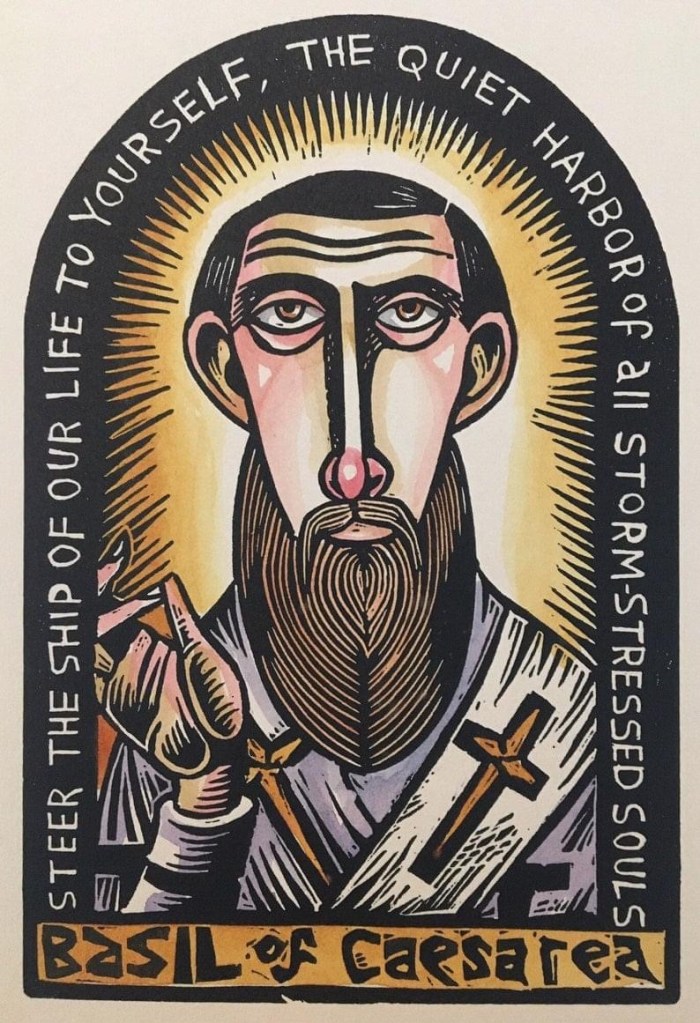
Today the church remembers a chatty 4th Century saint who, despite his best efforts, was terrible at living alone: St. Basil the Great, Bishop and Patron Saint of Extroverts.
St. Basil was born into a wealthy Greek family around the year 330AD. He was raised by his grandmother and pious parents, was well educated, and was influenced in early adulthood by a charismatic Bishop of the church, Eustathius of Sebaste. This influence compelled him to be baptized and spurred a spiritual awaking.
Feeling a call to the ministry, he left his practice of law and education to go where the monastics roam. Traveling to Palestine, Egypt, and Syria, studying the ascetics and the monastic life, he mindfully distributed his wealth to the poor and tried his hand at living the life of a hermit.
He was terrible at it.
He missed talking to people, and found his brain to be a poor conversationalist.
So, he decided to gather around himself a group of like-minded people, thereby effectively creating the first intentional monastic community of the church. His writings and reflections of this time became formative for Eastern Monasticism, and he’s generally thought of as the founder of the first monastic settlement.
As his stature and practice grew, and as his writings were circulated, St. Basil became a respected theologian and practitioner of the faith. He attended the Council of Nicaea and was a strong voice for Orthodoxy.
In 362AD St. Basil was ordained a Deacon in the church, and then a presbyter as his influence grew. He joined with St. Gregory in full-throated repudiation of Arianism (an ancient heresy), and eventually became the administrator of the Diocese of Caesarea.
In 370AD he succeeded Eusebius as Bishop of Caesarea. Though he had some bad blood with a few neighboring priests and bishops (if you think we have theological squabbles today, read some of the stuff coming out of the 4th Century church!), St. Basil was also known to see the best in people, even his opponents. He was also exceedingly generous with his money (he barely kept any) and his time, known for being on the front lines of the local soup kitchen in times of famine.
St. Basil’s writings, especially those regarding care for the poor and the sick, continue to confront Christians today. He did not mince words.
My favorite Basil line has him writing in a pastoral missal, “The shoes left unworn and rotting in your closet are meant for those without shoes, as is the food in your pantry and the unused coat.” And he was known for living this out, not just preaching about it.
The date of his death is unknown, probably sometime in the late 4th Century of liver disease and poor health probably brought on by leading an extremely ascetic lifestyle, but his memory lives on.
St. Basil the Great (as he is now known) is a reminder for me, and should be for the whole church, that proximity is primary. You must be around the people you serve to know them, and you must engage with others, even if you disagree with them.
-icon written by Kreg Yingst

Today, as most of the world celebrates New Year’s Day, the church officially honors an odd festival (which was created in opposition to the New Year’s Day revelries): The Holy Name of Jesus.
To understand why we have this feast day at all you have to go back, way back, to when there were differing calendars, and therefore differing ideas of when a new year actually begins.
For much of secular recorded history, the new year began on March 1st (or at least in March) with the ushering in of meteorological Spring (note: this is not astronomical Spring, but rather just the date when Spring starts to show off in many places). The names of the later months of our current calendar, September, October, November, and December still harken back to this reality, as September is the seventh month (Sept), and October the eighth (Oct), etc. if you start the year in March.
If you care nothing else about this festival or this day, the above is a feather in your cap for 2022. Bet you learned something new.
There was, at the same time, a persistent thought that January 1st marked the beginning of the year, as it honored the god Janus who looked forward and backward and immediately followed the Winter Solstice.
When Julius Caesar reorganized the calendar for Rome, he made it the beginning of the year, and it made sense because the Roman Senate convened in January. The first day of that month became the official “Saturnalia” celebration day, though the weeks prior and weeks after were included in the festivities.
This date as the start of the new year began to spread throughout the centuries, and eventually landed in England and the American colonies who were late adopters to the idea (it took them until 1752).
But, as the Church was birthed in Rome and the Saturnalia festivities were in full swing with drunken parties and dancing and theater tournaments, influential clergy (like Augustine), though they would have rather have had no part in marking the day at all, decided that worship and fasting would be good practices to keep the Christians from the pagan celebrations.
This practice, btw, is still held in some parishes on New Year’s Eve until the wee hours of New Year’s Day, and is called “Night Watch.”
So the church, feeling it needed to keep Christians from getting too boozy and too happy around the pagan feast, went with a more Biblical understanding of the day. Using Christmas Day as a marker (which, again, was reluctantly placed on the calendar…Christmas wasn’t a thing for Christians in that early church) they saw that eight days later would be the circumcision and name-day of Jesus, and they decided, “Yup! That’s what we’ll call it.”
And so, this feast day was born as a reaction to the outside world and a coopting of other feasts at the time. In this way the church showed great ingenuity, in my opinion. After all, people don’t like it when you take things away from them, for whatever reason, so they’d much rather you add or shift things for them.
The above is interesting, but for those of us who are more interested in seeing these holy/holidays differently rather than understanding them as purely a reaction to the outside world (which makes me not want to honor them at all, to be honest!), I present to you this idea:
The Feast of the Holy Name of Jesus presents for the church, and for all of us, an opportunity to honor the importance of names for humans.
I remember one time as a young, smart-mouthed kid, that at a Cuban restaurant in Hialeah, Florida, I forgot to note something that I wanted to order and said, “Get Jose back here! I forgot something.”
My grandfather looked at me with a mixture of anger and disappointment and said, “Tim, that is not his name. He is proud of his name. You cannot change it without his permission, and you need to respect it.”
I was obviously (and rightfully!) put in my place. Indeed it was not his name, and I was making a terrible, racist joke that attempted to take that away from him.
Names are important.
This is why it is, in fact, racist to not learn how to pronounce the names of people of color (this tactic has long been used as a way to degrade people). This was recently seen in a prominent Georgia Senate election a few years ago.
It is racist to deny people job interviews because they have names that are not “traditional” or are specifically ethnic.
Names are given in love, usually in honor, and mean something.
This is also why when our trans brothers and sisters offer to the world a name that best fits them, we need to honor it.
This day is a reminder for me, and can be for the church, that names matter, by God.
-historical bits from Pfatteicher’s New Book of Festivals & Commemorations
-icon of Our Lady of Czestochowa
-editorials by me

Tonight the church honors not a saint, but an event: Watch Night, remembering the Emancipation Proclaimation of 1863.
Traditions surrounding a “night of watching” on New Year’s Eve can be found in Moravian and Methodist American history through the 1800’s. The practice may have begun almost a century earlier in Bohemian regions of Europe, however, as families marked endings and beginnings.
In America these vigils were taken as an opportunity to reflect on the past year and make resolutions for the coming one. Often held in churches and surrounded by prayer and music, these gatherings usually started in the evening and lasted past midnight.
In 1863, however, the tradition took on new life and a new focus in America as slaves in formerly Confederate States gathered in churches, homes, and rooms in the waning hours of 1862 awaiting President Lincoln’s signature on the Emancipation Proclaimation to take effect.
Watch Night continues to be an annual gathering, especially in communities of color, as a way to both remember what has happened and gather strength for continuing to work for the freedoms still to come. 2020 and 2021 have been stark reminders that the Emancipation Proclaimation was not, and has never been, enough in the struggle for all in this country to live in peace and enjoy prosperity. Indeed, that first proclamation didn’t “free all slaves” in the United States…that would take acts of individual legislation in many border states and territories over time.
We need to remember that racism and prejudice still influence our civic and religious lives, Beloved.
Watch Night is an invitation for us all to reflect and resolve to partner together to do more.

