Unsung and Largely Unknown

Today the church honors two unsung, and largely unknown, first Apostles: St. Simon and St. Jude, Companions of Jesus.

St. Simon the Zealot (sometimes called “Simon the Less” to distinguish him from Simon-Peter) and St. Jude (sometimes called “Jude the Obscure” because he is largely known for not being Judas Iscariot) were numbered in those first twelve apostles, saw Jesus post-resurrection, ate with him, and were sent out to preach the Gospel.

But that’s all we really know about them.

Luke is the writer who calls Simon a “Zealot,” which could mean that he was a member of the Zealot party in ancient Palestine, a radically “anti-Roman rule” faction. It’s worth highlighting that, if Simon was a Zealot, then it meant he walked with Matthew the Tax Collector in shared mission…an anti-Roman activist and pro-Roman bureaucrat working together in Jesus’ inner-circle.

Let that sink in…Jesus’ inner circle had people with diametrically opposing viewpoints…

St. Jude (who some think wrote the epistle of Jude) is sometimes called Thaddaeus or Lebbaeus in Matthew, perhaps to distinguish him from Judas Iscariot.

There is a little-known apocryphal book called “The Passion of Simon and Jude” that says that St. Jude preached for a decade in Mesopotamia and that he and Simon labored in Persia together where they were martyred in tandem (hence why they are commemorated together today).

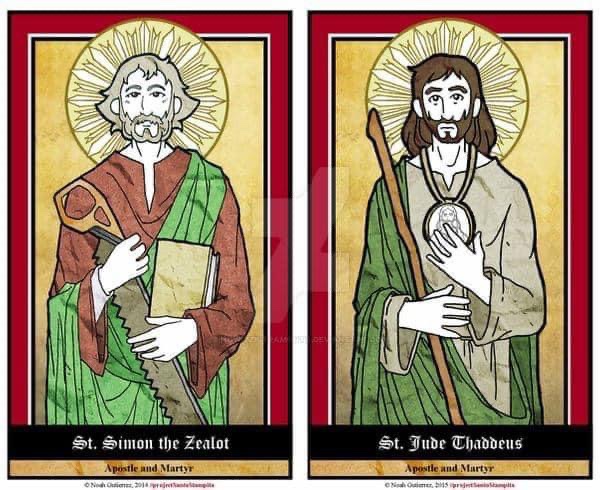
St. Simon is rumored to have been sawn in half…which is why he’s often depicted with a saw. St. Jude is often depicted with an ax because…well…you get the picture.

There is also a little fun legend about St. Jude healing the King of Edessa, and other stories about them fighting against Zoroastrianism in the ancient world.

Today, St. Jude is probably best known as being the namesake of hospitals and organizations that provide care to the most critical causes. In fact, in Roman Catholicism St. Jude is the patron saint of “hopeless causes.”

Why, you might ask?

Well, because St. Jude is so obscure and had no cultic following, Roman Catholic theologians thought that perhaps he might welcome and be attentive to the most desperate prayers.

St. Simon the Zealot is a reminder for me that the church has always had radicals within its walls, and was political from its very inception.

St. Jude is a reminder for me that sometimes the people who seem forgettable and least important become the ones we lean on the most in our most desperate hours.

-Pfatteicher’s New Book of Festivals & Commemorations helped with the historical pieces of the saints

-icons by Nowitzki Tramonto

Mild October

A fitting October evening meditation:

O hushed October morning mild,
Thy leaves have ripened to the fall;
Tomorrow’s wind, if it be wild,
Should waste them all.
The crows above the forest call;
Tomorrow they may form and go.
O hushed October morning mild,
Begin the hours of this day slow.
Make the day seem to us less brief.
Hearts not averse to being beguiled,
Beguile us in the way you know.
Release one leaf at break of day;
At noon release another leaf;
One from our trees, one far away.
Retard the sun with gentle mist;
Enchant the land with amethyst.
Slow, slow!
For the grapes’ sake, if they were all,
Whose leaves already are burnt with frost,
Whose clustered fruit must else be lost—
For the grapes’ sake along the wall.

-St. Robert of the Frost-

The Island of Apples

In reading up about Samhain in Celtic tradition, it’s believed that apple bobbing (called “apple dookin'” in Scotland) is a reminder of the journey across the seas that the ancestors took to find fresh fruit.

There was thought to be a magical land, Emhain Ablach, known as the “Island of Apples” that had wonderful apples that imparted wisdom to those lucky enough to find one.

It was also believed that the festival of Samhain taught humans about their “shadow-sides,” all the fears, misgivings, negativity, and unresolved issues within them that should be recognized, accepted, and reclaimed. Celtic wisdom taught that no person could be fully whole without their shadow side, and that ignoring or fighting against your shadow in such a way that you buried it created fragile beings who were easily broken by their ego, by other warriors, and by the hardships of the world.

Samhain, rather than insisting that you ignore the ugly side of your human nature, took you down into the depths of the fear (literally, tons of tales about descent into the pits of the world were told at Samhain) so that you could wrestle with yourself and wake up whole.

It sounds very Jungian, right?

It’s actually just ancient wisdom that we keep forgetting and “discovering” again and again…

The Greatest Lutheran Hymnwriter (IMHO)

Today the church honors three 17th Century musicians for the ages: Philipp Nicolai, Johan Heermann, and Paul Gerhardt.

This year I’m going to focus just a bit on Paul Gerhardt because he is, in my estimation, not only the best Lutheran hymnwriter to date, but a superb theologian.

St. Gerhardt was born in 1607 near Wittenberg, and he studied theology there in the mid 17th Century even while the Thirty Year’s War was a plague upon the land. He got work out of University as a tutor, and ended up marrying one of the daughters of the family he taught (kind of a no-no today, but back then was not unheard of).

Being of great skill both in writing and composing, St. Paul’s hymns appeared in a music publication of the day compiled by the cantor at St. Nicholas’ Church in Berlin, one Johann Cruger.

At the ripe old age of forty five, Gerhardt finally formally used that theology degree, was ordained, and entered the pulpit as the Senior Pastor at Middenwalde, near Berlin. From there he moved on to St. Nicholas in Berlin as an associate pastor, but quickly became the congregational favorite because his sermons were wise, witty, and relatively short.

Pastors: take note.

Unfortunately Reformation strife was continuing throughout Germany, and in-fighting and back-biting were common as the theologians tried to figure out what was, and wasn’t, orthodox from the Lutheran lens. To his credit, Paul refused to sign a pledge not to discuss controversial things from the pulpit.

The Gospel is often controversial. Congregation members: take note!

Because he refused to promise not to say tough things from the pulpit or bring up doctrinal issues, he was removed from St. Nicholas and went without a parish for some years.

Side note: lots of pastors find themselves in a similar situation today, no?

To add tragedy to tragedy, during this tough period his wife and a son died (three previous children had already died). He only had one son left.

In May of 1669 he was appointed as archdeacon of Lubben, a really harsh parish who didn’t really care for how wonderful he was, and he lived there with his only remaining son for a few years until he died in 1676.

Saint Paul Gerhardt wrote 113 hymns in his day, translating difficult doctrines for the modern ear with modern (for his day) melody.

Finally, I want to reinforce what I said in that first thought: that all three were not just hymnwriters, they were theologians. The theology we sing affects the theology we trust, Beloved. The tune is the hook, but the words are the bait, the thing we swallow, the thing we start to subconsciously believe.

In other words: be careful what you sing because it will become what you say you believe.

Out of the three of these hymnwriters, Paul Gerhardt is the one you’ll know the best if you grew up in a Lutheran church. While we sing the works of all three of these giants of the hymnic faith, Gerhardt is no doubt the greatest Lutheran hymnwriter.

He also, no doubt, had the most unusual facial hair.

Want to look up some of their tunes?

In your Evangelical Lutheran Worship you’ll find Nicolai on hymn 308 (“O Morning Star, How Fair and Bright!” sung at Epiphany), 436 (“Wake, Awake, for Night is Flying” sung at Advent), and 786 (“O Holy Spirit, Enter In” Nicolai only wrote the tune for this one, and I’ve rarely sung it).

Heeraman’s work can be found on 349 (“Ah, Holy Jesus” sung every Lent), 675 (“O Christ, Our Light, O Radiance True” sung in Ordinary Time), and 806 (“O God, My Faithful God” sung in times of crisis).

And the seminal Gerhardt tunes can be enjoyed on 241 (“O Lord, How Shall I Meet You” sung at Advent), 273 (“All My Heart Again Rejoices” sung at Christmas), 340 (“A Lamb Goes Uncomplaining Forth” sung during Lent), 351 and 352 (“O Sacred Head, Now Wounded” sung during Holy Week…a favorite of mine!), 378 (“Awake, My Heart, with Gladness” an underappreciated Easter hymn), 568 (“Now Rest Beneath Night’s Shadows” a very sweet evening hymn), 761 (“Evening and Morning” a lovely song on trust), and 788 (“If God My Lord Be for Me”…sung in times of trial).

-historical bits from Pfatteicher’s New Book of Festivals & Commemorations

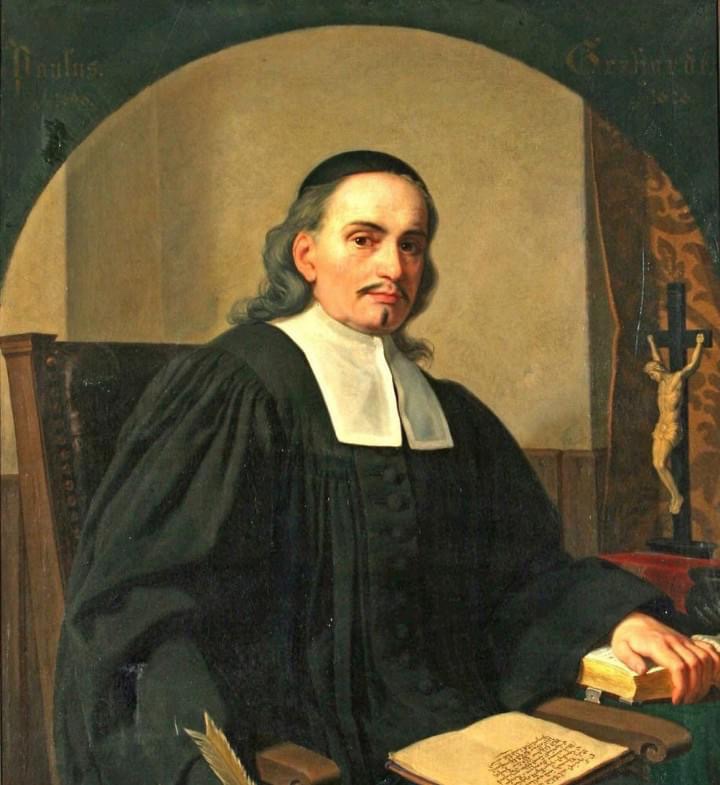
-painting of Paul Gerhardt by Herrmann Schwender

Standing Tall While Seated

Today I would lobby hard for the church to remember and honor a modern saint who was able to stand tall while still being seated: Rosa Parks, Activist and Inspiration.

Rosa Parks was born in 1913 in Tuskegee, Alabama to a teacher and a carpenter, and at a young age learned how to work well with her hands, making quilts and dresses on her own. She attended some secondary school, but primarily worked to help care for ill family members. One of her earliest memories was having to walk to school, because the school bus was reserved for white children, and how when the KKK marched down her street in front of her house, her grandfather took up post at the front door with a shotgun.

These memories left a mark.

Rosa married Raymond, a barber and NAACP member in 1932. At her husband’s urging, she finished her High School studies, and in 1943 was elected secretary of their local NAACP chapter, having become an active member herself. Even within the NAACP chapter in Alabama she was a trailblazer, being the only woman in active leadership. In her work there she aided investigations on rape, unlawful incarceration, and discrimination. She eventually was trained at the famous Highlander Folk School on Monteagle, Tennessee, and was able to successfully register to vote on her third attempt.

Her third attempt.

Louder for folx in the back because we continue to see voter intimidation and racially-tinged roadblocks put in place still today…the issue has morphed, it hasn’t disappeared.

To get around Montgomery, Parks walked or took the bus. Now, in 1900 Alabama had passed a law that bus segregation was up to the discretion of the driver. They could assign certain rows as “colored” rows, and increase or decrease the rows depending on their whims.

They could even just remove the sign altogether, making the whole bus for white people only.

Rosa boarded a bus one day, paid the same as the rest of the passengers, but was told by the driver, a James F. Blake, that she had to exit and enter from the rear door. When she exited to enter from the rear door, Blake put the bus in gear and took off before she could board, robbing her of her fare and leaving her in a downpour.

He could take her fare, but she vowed that he would never again rob her of her dignity.

On December 1st in 1955 after working a full day, Rosa Parks got on a bus at 6pm and sat in the first row reserved for people of color. It was the 11th row in a long bus, the first ten rows being reserved for white passengers. As the bus went on its route, the first ten rows began to fill. The driver that day was familiar to Rosa…it was James F. Blake, and at the third stop he moved the segregation sign three rows back, telling a number of passengers that they had to give up their seats for white patrons.

Three of her fellow passengers moved, but Rosa just scooted toward the window, freeing up space but refusing to relocate toward the back of the bus. Blake noticed Rosa refused to stand and relocate and said that, if she did not, he would call the authorities to have her arrested.

“You may do that,” Rosa said plainly.

Now, some try to soften this story by saying that Rosa was “tired,” and didn’t want to give up her seat due to fatigue. But in her own account she refutes that softening noting that she wasn’t physically tired, but rather that she was tired of being treated as a second class citizen, and tired of having her humanity stripped away.

“I was tired of giving in,” she said.

Parks was arrested, and the incident effectively kicked off the Montgomery bus boycott. In rain or shine, the black community banded together and refused to give a nickel to the unjust system for 381 days as the official case slowly worked through a cumbersome courts system. It was eventually deemed unconstitutional to segregate the buses in this way.

Parks became an icon in the Civil Rights movement working to elect black leaders (John Conyers), fought for women’s rights (serving on the board of Planned Parenthood), and lobbying for those unjustly incarcerated. All the while she received death threats and continual persecution, even having to leave Montgomery directly after her arrest because she could not find work due to her national standing.

Yet, she persisted.

In 1987 she co-founded the Rosa and Raymond Parks Institute for Self Development (note the name order!) which helps to teach young people about the importance of Black history and the Civil Rights movement (which continues on).

She died on this day in 2005 at the age of 92.

Rosa Parks is a reminder for me, and should be for everyone, that the fact that something is legal does not make it just, and sometimes you have to stand tall in a situation even if it means keeping your seat.

-historical bits from public sources

-icon “Rosa Parks Iron Man” written by Bart Cooper, an ode to her fortitude

It’s Ok To Do Different

On this day the church honors a saint with a familiar name, but one who is often confused with other similarly-named apostles. Today is the feast day of St. James of Jerusalem, Brother of Our Lord.

St. James is noted in the books of Matthew and Mark as one of the brothers of Jesus. In the book of Galatians, St. Paul wrote that he met St. James on his first visit to the city.

In the same way that St. Peter led the church in Rome, St. James was the leader of the church in Jerusalem and, with such a distinct role, you’d think we’d hear more about him in the scriptures…but we just don’t.

At question is his actual kinship with Jesus. In trying to highlight how singularly significant Jesus is in history, many Christian writers have struggled to let any siblings be a part of the story. But it’s worth noting that it would have been quite unusual for Mary and Joseph to have only had one child. In the ancient world that was not common family-planning. At the heart of this speculation, though, is not even really Jesus, but rather Mary. In an effort to keep her singularly virginal, all sorts of stories cropped up about a first marriage for Joseph in which he sired other children, making St. James the step-sibling of Jesus.

This is all fancy family footwork without any substance.

To add to the confusion, some historians of the early church suggest that this James is the same “James the Less” who was one of Jesus’ disciples with a different parentage altogether. The thought is that St. James was the son of Mary of Clopas, the younger sister of Mary, Mother of Our Lord. While it is true that the same word for “brother” can also mean “cousin” in the ancient world, this, too, seems far fetched and an attempt to solve a problem that is not really there.

Jesus had siblings. It’s OK. We can all get over it.

St. James of Jerusalem really first comes on the scene post-resurrection when he is met by the risen Jesus. The early church considered him an important piece in the first stories of the church, perhaps as a replacement for St. James, Son of Zebedee (who was martyred early on).

In the same way that St. Paul felt a special calling to the Gentile-Christians, St. James of Jerusalem spent his ministry with the Jewish-Christians. It is believed he was martyred sometime in the early 60’s, right around the composition of the first Gospels. Some early church historians even claim it was the priest Annas who ordered his stoning, though this is more lore than anything.

Today is an especially appropriate day to lift up prayers for the church in Jerusalem.

St. James of Jerusalem is a reminder for me, and should be for the whole church, of two important things:

First, when we attempt to make Jesus so “special” we actually rob him of the most relatable parts of his being. The idea that he had siblings is kind of neat to me because, as someone who knows what it’s like to juggle family relationships, he knows a bit of my experience…our human experience. I mean, isn’t a central thought of the church that we are all the siblings of Jesus? Why must it be correct theologically, but not biologically?

Religious folks struggle with biology…

Secondly, the church has always struggled with niche ministry, worried that it would rub too much against the norm. St. Paul felt a calling to the Gentiles, and St. James of Jerusalem to the Jewish-Christians. Today some pastors feel a call to ministry on the streets, or to marginalized communities, or even to Wall Street Brokers. Some pastors don’t feel a call to the pulpit, but rather to the pavement. Some leaders don’t even feel a call to the priesthood, but are feeling a push to live as prophets.

From the early church, specialized ministry was already happening, and yet we still struggle so much with those who want to “do something different” with their call or want to start communities that don’t look a lot like conventional “church” communities.

Why?

-most historical bits, with the exception of some of the commentary around controversies, aided by Pfatteicher’s New Book of Festivals & Commemorations

-Icon by Tobias Haller, BSG

On the Forms We Fill

He asked me to fill out the form.

He wanted his child to go to a very conservative Christian school, and the school required that their pastor fill out a form.

Two of the questions had to do with an eternal hell for unbelievers. Another had to do with the exclusiveness of Christianity as whole truth.

I filled it out honestly. It came back with “red flags.” I was asked to fill it out differently…which I would not.

A month later they left the congregation and joined one where the pastor could fill out the form without any “red flags.” No reason given. No goodbye.

Just gone.

We Are Not Object Lessons

“I think this is part of how God shows us to be grateful, you know? For what we have. For our health. To teach us.”

This was the response that someone gave me after I was lamenting about the unfairness of disease and catastrophe.

The idea that people are sick in order to be object lessons for people who are not is one of the many problems that we have with narcissistic religion and a form of Christianity that is totally devoid of deep spirituality.

It becomes cruel.

People are not sick in order to teach you a lesson.

Lean Into the Shadows and Learn from Them

For the ancient Celts, October was a special month. All hinge points in the wheel of the year were seen as an opening into the next phrase.

January is Winter’s portal into Spring. April is Spring’s portal into Summer. July is Summer’s portal into Autumn, and October is the Autumn portal into Winter.

But within those four portals there was seen to be two great portals: the invitation into the light, and the invitation into the shadows.

April, with it’s growing light as our star decided to hang around longer and longer each day, was an invitation into the light half of the year.

October, with it’s lingering moon, was an invitation into the shadow half of the year, and was known as the “season of frost and firelight.” Indeed: we’ve lit a fire the past few mornings in our own house.

The Celts called the festival at the end of October “Samhain” (pronounced “sow-wen” in Gaelic). It literally means “summer’s end.” This festival was Christianized around the 7th Century as Hallowmas (or All Hallow’s Eve) and, on November 1st, All Hallow’s Day (All Saints’ Day).

That phrase continued to evolve and is now colloquially Halloween.

Rather than some sort of time to celebrate evil or goblins or whatnot, Samhain was actually a time where the Celts explored and ushered in the gifts and mysteries of the shadow-half of the year.

Why do things seem to “go bump” in the night?

Why do we take fire for granted until we can’t see anything anymore?

What does it mean to take seriously the idea that rest and fallowness are necessary for life?

How does family time change when we’re all stuck inside, and what does that mean for us? Could it be possible that, in these intense family times, dead family members join us around the fire (as specters or ghosts)?

Why, in the shadows, are we more tempted to do what we should not? How do we ward off such tempters? (One solution was the Jack-o-lantern)

The shadow-side of the year, like our own shadow-sides, is not to be feared but, as the Celts did, explored and held and learned from.

Like all good mysteries.

Care for the Margins

Today the church honors the Feast Day of St. Luke, the Evangelist.

We believe Luke was a Greek, and a Gentile, but we’re not really sure where he’s from or much about his life, other than he was a physician. He was a disciple of St. Paul and worked alongside him in missionary endeavors.

In Luke’s Gospel (which has a sequel in the Book of Acts) we learn that Luke was not an eyewitness to anything Jesus did or said. According to early lore Luke wrote his Gospel in Greece and preached in Bithynia, though we can’t verify any of that. Lore also has him reaching the ripe old age of eighty-four, a bachelor all those years.

Again, none of that is really more than speculation.

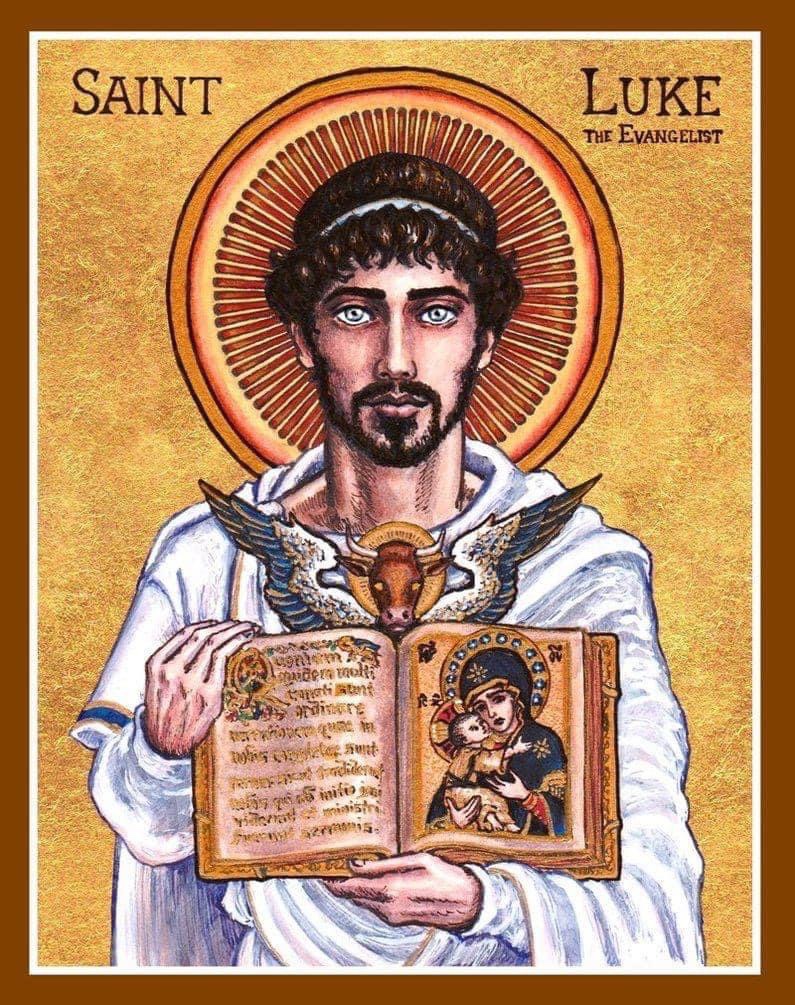
There is also an obviously dubious claim that he painted the first picture of Mary, Mother of Our Lord. For this reason many icons have him holding a painting of her.

The observance of this day as his feast day is quite old in the Eastern Church, and may be closely associated with the actual day of his death. On this day in many places people will make special donations to hospitals and nursing homes, an homage to this physician-evangelist, and there may have even been some “healing services” or anointing services happening in some churches (though, in the midst of a prolonged pandemic, I imagine this physician would rather churches limit gathering in person again this year).

Luke’s spiritual sign is the patient ox, because he plods along in his story, slowly, recounting in detail much about Jesus and the life of the early church.

Luke’s Gospel is marked by special attention to women, the sick, and the marginalized communities in general in the ancient world. For this reason it is the favorite Gospel of many. Luke, for instance, has Jesus giving his main sermon not on a mountain, but on a plain…a sign of equality (and, also, a reminder that the Gospels don’t all match up). Luke also notes that “Blessed are the poor” in his recounting of the Beatitudes includes an economic element. Matthew changed it to “poor in spirit,” but Luke has it as “those who are in poverty.”

Luke, and in his recounting, Jesus, cares deeply for the poor, the sick, and the marginalized.

He is a reminder for me, and for the whole church, that the church, too, has a duty first and foremost not to the powerful, but to those Jesus felt a duty toward: the poor, the sick, and the marginalized.

-icon written by Theophilia