Patron Saints of A Topic We Tend to Ignore

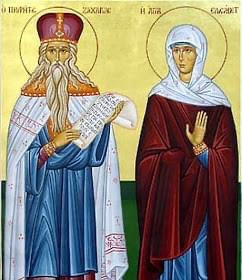
Today the church honors two ancient saints of the faith, perhaps the “Patron Saints of Waiting,” St. Elizabeth and Zechariah, the Parents of St. John the Baptizer.

This feast is honored in Palestine on this date, and honoring them begins to turn our collective faces toward the season of Advent, the season of hope and patience.

Zechariah is the pious priest in the line of Abijah, noted by St. Luke in his first chapter. Elizabeth, whose namesake is the wife of Aaron (the brother of Moses), was also of priestly lineage. This makes it, at least in the ancient world, an ideal marriage: pure and priestly.

By the time of Jesus, there were so many of priestly lineage alive that the duties of the temple were afforded by lot, as not all could participate. One day this privilege fell to Zechariah, as the story goes, and he was ordered to light incense in the Temple. As he was performing his priestly duty, an angel appeared to him and announced that he and Elizabeth would, in their old age, have a child.

By the way, if your Biblical mind isn’t brought back to the aged Abram and Sarai and their son Isaac at the mention of this story, you’re not paying attention…these stories are meant to invoke one another, Beloved.

If your Biblical mind isn’t brought back to Hannah and her son Samuel in the telling of this story, you’re not paying attention, Beloved.

Luke, in writing his Gospel, knew what he was doing with these lovely saints…

Elizabeth, that dear saint, did not, for whatever reason, have any children in her young age. In this way, she followed in the footsteps of Sarah and Hannah before her.

By the way, I note “for whatever reason,” because contrary to popular belief at that time (and even today), we have no biological indicators that note that anything was amiss with Elizabeth’s ability to conceive. Indeed, Zechariah could have had an ailment that prevented him from parenting. But, as with all history written by men, for some reason the fault falls on Elizabeth.

I love Saint Elizabeth, and St. Zechariah, too, because their struggle is so relatable to so many today.

Zechariah had a hard time believing that they could have a child, and for this reason he became both deaf and mute for a time being. This is a strange biological development…much like having a child in your old age would be…but the theological development is pretty clear: some things that the Divine makes possible are hard to talk about and hard to listen to.

Zechariah and Elizabeth named their dear child John, defying tradition. At the naming of their child (Zechariah wrote it down for those present), his voice was restored, and immediately he was blessed with a song that we still sing in the church today during the season of Advent, the Benedictus Dominus Deus. It is a song about promise fulfillment and echoes the Magnificat of Mary and the Hebrew Scripture song of Hannah in 1 Samuel.

St. Elizabeth and St. Zechariah are a reminder for me, and should be for the whole church, that sometimes Diving things take a little while to happen, and that patience and hope must continually hold hands in this life.

They are also a reminder for me that the church needs to openly and honestly talk about the difficulty of conception, a topic so few want to discuss because of its delicate nature. But, Beloved, this is such an important and wide-spread issue, the church must talk about infertility with honesty, and forget with the nonsense of “in God’s time” or any such mess that can be hurtful for those who want to be parents but have difficulty for whatever reason.

Let those with ears to hear, hear.
Magic

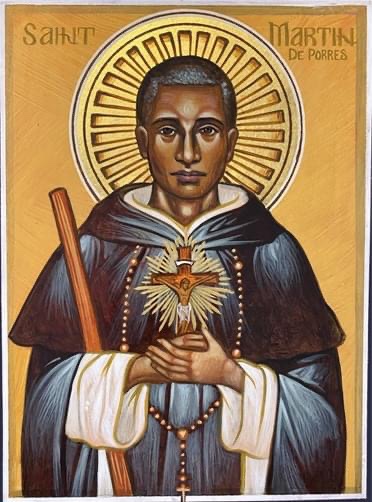
Today, which is the day after election day in the United States this year, is also a special day in the church that deserves a nod: The Feast of St. Martin de Porres, Defender of the Poor and Renewer of Society.

St. Martin was born in the late 16th Century in Lima, Peru. His mother was an herbal healer, and his father was a Spanish knight (Don Juan de Porres…I kid you not). Since Don Juan had not married Martin’s mother, Ana, he refused to acknowledge that Martin was his son.

St. Martin, raised by his mother, became well versed in both herbal healing and the teachings of the spreading Catholic faith in Peru. He married the two together in his head, heart, and practice, and became a physician-monk, continuing to heal people using herbal remedies and folk-magic while living in the Dominican friary (he entered the order at 15).

He was known for caring for the poor and the sick who came seeking him at the friary gates, especially those who were refused medical help because they were black, too poor to pay, or seriously ill. He became known as a friend of those everyone else forgot and laughed at.

He also became known for his delicate care for animals, both domesticated and wild. There are many wild tales of how he befriended rats and rodents, much to the dismay of those around him.

Finally, St. Martin was a congenial and wise mediator, helping to solve marriage problems, finding ways to help the poor pay dowries, and coming to the defense of those without anyone to defend them.

Many say he had magical powers, but in reading about him, I’d suggest that his real magic was being the embodied Divine for people and animals the world tried to throw away.

He once wrote, “Compassion, my dear Brothers, is preferable to cleanliness. Reflect that with a little soap I can easily clean my bed covers, but even with a torrent of tears I would never wash from my soul the stain that my harshness toward the unfortunate would create.”

He was canonized in 1962 as the patron saint of racial justice and harmony, and good grief if that doesn’t speak loudly on this day, this year.

St. Martin is a reminder to me, and should be for the church, that healing comes in many forms and through many people, and that the ailments of the physical body and the body politic both need attending to by people of faith.

-historical notes from Pfatteicher’s New Book of Festivals & Commemorations

-icon written by Britta Prinzivalli

-opinions mine

For the Rest of Us

Today the church commemorates All Soul’s Day, or “The Day of the Faithfully Departed.”

This festival day is a product of the evolution of the church and its understanding of the departed and how they play into the eschatological and cosmological understanding of all things.

If saints were those who led extraordinary lives, what about the rest of us?

All Souls Day is an answer to that question. Indeed, many people who aren’t technically “saints” in the narrow definition of the term have led wonderfully beautiful and impactful lives. All Souls attempts to honor that fact. It became common practice, for instance, to lift up particular benefactors of parishes on this day, giving a nod to those who made the physical (and spiritual) structures of the faith possible.

In a more pedestrian sense, All Souls Day is, at least for me, a day where we can all embrace the reality that, saint or not, people deserve to be remembered.

In my first parish we had these magnificent stained glass windows put in decades earlier. In them you could see glimpses of not only the artistry of the day, but you could also feel a sort of timelessness that was pervasive, connecting those who had first stared into and through those windows with me and my own children who looked at them now.

Good art does that: it creates connective tissue between the past and the ever-expanding future.

But All Souls Day is a reminder that good theology does that, too. We stand upon the beliefs of the past, hauling some of them with us, and leaving some on the path behind us as signs and markers of thoughts discarded and avenues that were dead-ends.

All Souls Day lifts up the very practical, very pious, and very pedestrian people on whose shoulders we stand. In this way it is even more meaningful than the pomp and circumstance of All Saints Day.

If All Saints Day is the fine-dining establishment in your city, All Souls Day is the little cafe you frequent where you know the owner, have a favorite booth, and don’t need to glance at the menu because you know it by heart.

In other words, All Souls Day is really where most of us will find ourselves: in the ordinary annals of a life that tried its best, did some great things, fell short quite a bit, but is remembered by a small, but faithful, group of loved ones who know our names.

See That Host All Dressed in White

Today the church celebrates All Saints Day, the day in which the formal saints of the church (those canonized) are recognized and remembered as examples of the faith.

This celebration is very old, perhaps dating back to the 4th Century, though it is clear that earlier commemorations of this feast day were held in the spring, sometime between Easter and Pentecost. It was originally intended to celebrate not just any saints, but the martyrs of the faith.

The focus and the date of the day shifted sometime just before or in the early 7th Century. In the British aisles it had already been honored on November 1st, probably in response to the pagan autumn festivals that culminated at the end of October (which many of you participated in last night with ghosts and goblins socially-distancing at your door!). The date stuck for the whole church within the century, and came to have a deeper connection not only with the seasonal cycle on display in the northern hemisphere, but also with pre-Christian sensibilities. One example is this Celtic idea that the arrival of mists and frosts around this time were examples of ghostly/faery visitors, so it made sense to have a day remembering them when they started to make their presence known again.

In the 7th Century the date came to commemorate non-martyrs as well, probably in response to the fact that Christianity became dominant and was less-oppressed…resulting in fewer martyrs of the faith. The faithful who died both naturally and by martyrdom were recognized on this date every year, especially if they had died in that calendar year.

Today Orthodox, Roman Catholic, and Anglican branches of liturgical Christianity still keep this day to honor those canonized saints of the church, reserving the non-canonized dead to be remembered tomorrow on All Souls Day (more on that tomorrow). Lutherans, with our penchant for comingling the idea of “sinner and saint,” usually don’t make such a distinction, and just honor all those who have died in the faith, regardless of status, on this day.

Whatever your proclivity, today is a powerful day when honored with intention, even for those of you who don’t find yourself in any faith tradition. Honoring our ancestors, learning from their stories, embracing their goodness and foibles, is an important part of the human experience in my estimation. We all are, after all, an unwilling product of those who came before us, but we continually have a choice in deciding what we’re going to carry with us from those past ancestors, and what we’re not going to let continue into the next generation.

All Saints Day is a reminder for me, and should be for the whole church, that those who came before still speak into our present, and that the Divine who seems in love with continual creation also seems in love with some measure of continual, constant, though hidden and obscure (like through a mirror darkly?) preservation.

-historical bits from Pfatteicher’s New Book of Festivals & Commemorations

-icon from St. Gregory of Nyssa in San Francisco

-opinions and Celtic reflections mine

A Day of Red

Churches around the world are honoring Reformation Sunday this Sabbath, a rare treat in that the Sunday and the actual Festival Day align.

It’s important to note that each liturgical denomination has a day that honors a formative experience in the life of their particular vein of Christianity. The Eastern Orthodox church celebrates “The Triumph of Orthodoxy” to usher in Lent. The Roman Catholic Church has the Feast of the Chair of St. Peter (February 22nd), emphasizing the founding of the church on Peter’s shoulders. The Anglican Church honors the day the Book of Common Prayer was published, uniting the communion into one.

For Lutherans, it is Reformation Day, when we sing “A Mighty Fortress” and “Lord Keep Us Steadfast in Your Word” and dress in red, the color of both the martyrs and the fire of the Holy Spirit.

At its worst the Reformation is celebrated as a triumph. At its best it is a feast day that is simply a continuation of the perpetual change and shift that must happen in a church that is wedded to a God who is known and revealed inside of time.

Historically it does mark a time in history when a break, for better and for worse, happened in the church. This break deserves an autopsy every year in an effort to remember, reaffirm, and repair as much as a possible the schisms that arose from it.

The date of the Reformation, the 31st of October, comes from the lore that Luther nailed his 95 Theses on the Castle Church door in Wittenberg, intending for it to be widely read by everyone who attended the All Saints Sunday mass the following day. We’re not sure this is historically accurate, but because it is so much a part of the narrative around the events of autumn in 1517, we give a nod to its church-changing truth, if not its actual veracity.

A better date to honor the Reformation might actually be June 25th, the date that the Augsburg Confession was presented. Like the Anglican Church with the Book of Common Prayer, the Confession is the binding document of all the reformation churches.

Regardless, tradition compels us to keep the date, to wear red, to remember, and to continue to reform.

-historical bits from Pfatteicher’s New Book of Festivals & Commemorations

-opinions mine

Saints of Famous Obscurity

Today the church honors two unsung, and largely unknown, first Apostles: St. Simon and St. Jude, Companions of Jesus.

St. Simon the Zealot (sometimes called “Simon the Less” to distinguish him from Simon-Peter) and St. Jude (sometimes called “Jude the Obscure” because he is largely known for not being Judas Iscariot) were numbered in those first twelve apostles, saw Jesus post-resurrection, ate with him, and were sent out to preach the Gospel.

But that’s all we really know about them.

Luke is the writer who calls Simon a “Zealot,” which could mean that he was a member of the Zealot party in ancient Palestine, a radically “anti-Roman rule” faction. It’s worth highlighting that, if Simon was a Zealot, then it meant he walked with Matthew the Tax Collector in shared mission…an anti-Roman activist and pro-Roman bureaucrat working together in Jesus inner-circle.

Let that sink in…Jesus’ inner circle had people with diametrically opposing viewpoints…

St. Jude (who some think wrote the epistle of Jude) is sometimes called Thaddaeus or Lebbaeus in Matthew, perhaps to distinguish him from Judas Iscariot.

There is a little-known apocryphal book called “The Passion of Simon and Jude” that says that St. Jude preached for a decade in Mesopotamia and that he and Simon labored in Persia together where they were martyred in tandem (hence why they are commemorated together today).

St. Simon is rumored to have been sawn in half…which is why he’s often depicted with a saw. St. Jude is often depicted with an ax because…well…you get the picture.

There is also a little fun legend about St. Jude healing the King of Edessa, and other stories about them fighting against Zoroastrianism in the ancient world.

Today, St. Jude is probably best known as being the namesake of hospitals and organizations that provide care to the most critical causes. In fact, in Roman Catholicism St. Jude is the patron saint of “hopeless causes.”

Why, you might ask?

Well, because St. Jude is so obscure and had no cultic following, Roman Catholic theologians thought that perhaps he might welcome and be attentive to the most desperate prayers.

St. Simon the Zealot is a reminder for me that the church has always had radicals within its walls, and was political from its very inception.

St. Jude is a reminder for me that sometimes the people who seem forgettable and least important become the ones we lean on the most in our most desperate hours.

-Pfatteicher’s New Book of Festivals & Commemorations helped with the historical pieces of the saints

-icons by Nowitzki Tramonto

Music is Theology

Today the church honors three 17th Century musicians for the ages: Philipp Nicolai, Johan Heermann, and Paul Gerhardt.

To go into depth on each of these musicians would be to go on too long for a simple social media post. A cursory search of the Google machine will lead you to some interesting background on each.

What I’d rather do, though, is note that all three were not just hymnwriters, they were theologians. The theology we sing affects the theology we trust, Beloved. The tune is the hook, but the words are the bait, the thing we swallow, the thing we start to subconsciously believe.

In other words: be careful what you sing because it will become what you say you believe.

Out of the three of these, Paul Gerhardt is the one you’ll know the best if you grew up in a Lutheran church. While we sing the works of all three of these giants of the hymnic faith, Gerhardt is no doubt the greatest Lutheran hymnwriter.

He also, no doubt, had the most unusual facial hair.

Want to look up some of their tunes?

In your Evangelical Lutheran Worship you’ll find Nicolai on hymn 308 (“O Morning Star, How Fair and Bright!” sung at Epiphany), 436 (“Wake, Awake, for Night is Flying” sung at Advent), and 786 (“O Holy Spirit, Enter In” Nicolai only wrote the tune for this one, and I’ve rarely sung it).

Heeraman’s work can be found on 349 (“Ah, Holy Jesus” sung every Lent), 675 (“O Christ, Our Light, O Radiance True” sung in Ordinary Time), and 806 (“O God, My Faithful God” sung in times of crisis).

And the seminal Gerhardt tunes can be enjoyed on 241 (“O Lord, How Shall I Meet You” sung at Advent), 273 (“All My Heart Again Rejoices” sung at Christmas), 340 (“A Lamb Goes Uncomplaining Forth” sung during Lent), 351 and 352 (“O Sacred Head, Now Wounded” sung during Holy Week…a favorite of mine!), 378 (“Awake, My Heart, with Gladness” an underappreciated Easter hymn), 568 (“Now Rest Beneath Night’s Shadows” a very sweet evening hymn), 761 (“Evening and Morning” a lovely song on trust), and 788 (“If God My Lord Be for Me”…sung in times of trial).

Do some searches, sit back, and learn the faith.

James of Jerusalem

On this day the church honors a saint with a familiar name, but one who is often confused with other similarly-named apostles. Today is the feast day of St. James of Jerusalem, Brother of Our Lord.

St. James is noted in the books of Matthew and Mark as one of the brothers of Jesus. In the book of Galatians, St. Paul wrote that he met St. James on his first visit to the city.

In the same way that St. Peter led the church in Rome, St. James was the leader of the church in Jerusalem and, with such a distinct role, you’d think we’d hear more about him in the scriptures…but we just don’t.

At question is his actual kinship with Jesus. In trying to highlight how singularly significant Jesus is in history, many Christian writers have struggled to let any siblings be a part of the story. But it’s worth noting that it would have been quite unusual for Mary and Joseph to have only had one child. In the ancient world that was not common family-planning. At the heart of this speculation, though, is not even really Jesus, but rather Mary. In an effort to keep her singularly virginal, all sorts of stories cropped up about a first marriage for Joseph in which he sired other children, making St. James the step-sibling of Jesus.

This is all fancy family footwork without any substance.

To add to the confusion, some historians of the early church suggest that this James is the same “James the Less” who was one of Jesus’ disciples with a different parentage altogether. The thought is that St. James was the son of Mary of Clopas, the younger sister of Mary, Mother of Our Lord. While it is true that the same word for “brother” can also mean “cousin” in the ancient world, this, too, seems far fetched and an attempt to solve a problem that is not really there.

Jesus had siblings. It’s OK. We can all get over it.

St. James of Jerusalem really first comes on the scene post-resurrection when he is met by the risen Jesus. The early church considered him an important piece in the first stories of the church, perhaps as a replacement for St. James, Son of Zebedee (who was martyred early on).

In the same way that St. Paul felt a special calling to the Gentile-Christians, St. James of Jerusalem spent his ministry with the Jewish-Christians. It is believed he was martyred sometime in the early 60’s, right around the composition of the first Gospels. Some early church historians even claim it was the priest Annas who ordered his stoning, though this is more lore than anything.

Today is an especially appropriate day to lift up prayers for the church in Jerusalem.

St. James of Jerusalem is a reminder for me, and should be for the whole church, of two important things:

First, when we attempt to make Jesus so “special” we actually rob him of the most relatable parts of his being. The idea that he had siblings is kind of neat to me because, as someone who knows what it’s like to juggle family relationships, he knows a bit of my experience…our human experience. I mean, isn’t a central thought of the church that we are all the siblings of Jesus? Why must it be correct theologically, but not biologically?

Religious folks struggle with biology…

Secondly, the church has always struggled with niche ministry, worried that it would rub too much against the norm. St. Paul felt a calling to the Gentiles, and St. James of Jerusalem to the Jewish-Christians. Today some pastors feel a call to ministry on the streets, or to marginalized communities, or even to Wall Street Brokers. Some pastors don’t feel a call to the pulpit, but rather to the pavement. Some leaders don’t even feel a call to the priesthood, but are feeling a push to live as prophets.

From the early church, specialized ministry was already happening, and yet we still struggle so much with those who want to “do something different” with their call or want to start communities that don’t look a lot like conventional “church” communities.

Why?

-most historical bits, with the exception of some of the commentary around controversies, aided by Pfatteicher’s New Book of Festivals & Commemorations

-Icon by Tobias Haller, BSG

Guiding Principle: Anam Cara will Name Things

In the second creation story from the book of Genesis (yes, there are two…at least two), the Divine brings creatures to the Adam (dust-ling) to see what they would name them (Genesis 2:19). In this creation story it is arguably the first instance of human agency that the Divine invites the human into without any stipulations. Whatever the human names the thing, that is its name. It’s a wonderful instance of human-Divine cooperation in the ordering of the world.

Names are important, Beloved.

They help us understand ourselves. They help others understand us. Names connect us to our past, and are offered on those we love and cherish as a blessing for the future. In these ways names are beautiful, wonderful, and helpful.

Names are important, Beloved…because they matter.

And because they matter, we must also recognize that they can be damaging.

Names that stigmatize drive wedges between humans.

Names that belittle cast people, places, and things in a light that can steal their dignity and cloud their inherent goodness.

Names wrongly applied, like the insistence of some to identify our siblings in the trans community by anything other than their preferred pronouns or chosen first names, harm others with intention.

In these ways names are weapons of cruelty.

Names matter, Beloved.

In thinking about our Guiding Principles, the curation team at Anam Cara believes we must be a community that names things. Taking our cues from that second creation story, we trust that the Divine intends us to be cooperators and even co-conspirators (in the most positive way) in naming what we see around us.

Acts of racism must be named as racist (looking at you school boards banning books that talk about race).

Acts of homophobia must be named as harmful (again, looking at you school boards who ban books talking about sexuality).

Acts of indignity, injustice, and ones that rob others of their imago Dei must be named with honesty and unflinching courage.

And, while we’re naming things, we’ll intentionally be keen to remind others (and ourselves) that they are loved in their imperfection, are beautiful with scars, have the right to be called what they want to be called, and don’t deserve many of the labels the world puts on them.

And the world is excellent at misnaming things.

Imagine if a neighborhood didn’t have to be labeled “up and coming” to be attractive to investors.

Imagine if a child didn’t have to be “free lunch” labeled at school, because everyone got free lunch (this works, by the way, to cut stigma…it’s working in Raleigh right now!).

Imagine if no one ever worried about Critical Race Theory being taught in schools because it’s understood that teaching about racism isn’t demeaning, but rather not teaching about it, is.

In fact: it is literally critical.

Imagine if kids didn’t grow up thinking sex is a bad word, but rather a powerful one. Imagine if adults didn’t have to live thinking that putting a check next to the “married” box made you whole, or that mental health was a scarlet letter, or that popular media didn’t run the table on what counts as beautiful, successful, or powerful.

Jesus was big on naming things: the religious elites were called hypocrites, the last were called first (and the first, last), the outcast was called favored, the child was called a spiritual sage…Jesus named things all the time!

It’s almost like Jesus knew that names were important.

Names are important, Beloved…and we intend to honor that truth.

Care for Those on the Margins

Today the church honors the Feast Day of St. Luke, the Evangelist.

We believe Luke was a Greek, and a Gentile, but we’re not really sure where he’s from or much about his life, other than he was a physician. He was a disciple of St. Paul and worked alongside him in missionary endeavors.

In Luke’s Gospel (which has a sequel in the Book of Acts) we learn that Luke was not an eyewitness to anything Jesus did or said. According to early lore Luke wrote his Gospel in Greece and preached in Bithynia, though we can’t verify any of that. Lore also has him reaching the ripe old age of eighty-four, a bachelor all those years.

Again, none of that is really more than speculation.

There is also an obviously dubious claim that he painted the first picture of Mary, Mother of Our Lord. For this reason many icons have him holding a painting of her.

The observance of this day as his feast day is quite old in the Eastern Church, and may be closely associated with the actual day of his death. On this day in many places people will make special donations to hospitals and nursing homes, an homage to this physician-evangelist, and there may have even been some “healing services” or anointing services happening in some churches (though, in the midst of a pandemic, I imagine this physician would rather churches not gather in person this year).

Luke’s spiritual sign is the patient ox, because he plods along in his story, slowly, recounting in detail much about Jesus and the life of the early church.

Luke’s Gospel is marked by special attention to women, the sick, and the marginalized communities in general in the ancient world. For this reason it is the favorite Gospel of many. Luke, for instance, has Jesus giving his main sermon not on a mountain, but on a plain…a sign of equality (and, also, a reminder that the Gospels don’t all match up). Luke also notes that “Blessed are the poor” in his recounting of the Beatitudes includes an economic element. Matthew changed it to “poor in spirit,” but Luke has it as “those who are in poverty.”

Luke, and in his recounting, Jesus, cares deeply for the poor, the sick, and the marginalized.

He is a reminder for me, and for the whole church, that the church, too, has a duty first and foremost not to the powerful, but to those Jesus felt a duty toward: the poor, the sick, and the marginalized.

-icon written by Theophilia