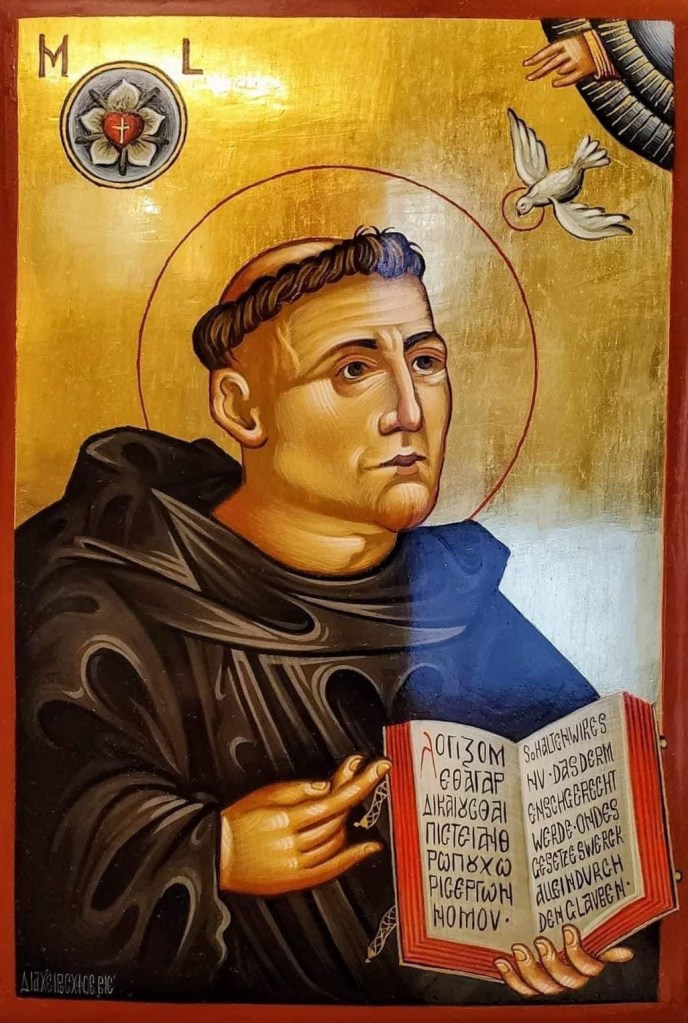
Today the church remembers the reformer and cranky theologian, Martin Luther. He’d wince at being called a saint, but welcomed the title of “baptized.”
Luther was as imperfect as he was ingenious. As the most prolific and public author of his day, his opinions on matters mundane (a homemade remedy for skin rashes) to mighty (Freedom of a Christian) are well-documented and well known by all students of history. He wrote beautiful theological treatises and stirring hymnody. He was a pioneer for women and children in his day.
Yet, he was a person of his era in many ways, and lamentably was unable to rightfully wrestle with his own prejudices, especially toward those of the Jewish faith.
His anti-Semitic writings have been totally and fully condemned by the Lutheran church.
With both his flaws and his fortitude he embodies one of his central theological discoveries: that we are all both sinner and saint, simultaneously. We are both perfectly imperfect, and perfectly loved by a God who has a tender spot for broken things.
One of his more poetic thoughts about the “now-and-not-yetness” of our human existence:
“This life therefore is not righteousness, but growth in righteousness, not health, but healing, not being but becoming, not rest but exercise. We are not yet what we shall be, but we are growing toward it, the process is not yet finished, but it is going on, this is not the end, but it is the road.“
Today the world honors St. Valentine, but the church kind of shrugs toward that saint, and instead dedicates the day to two Greek biological brothers: St. Cyril and St. Methodius, both 9th Century missionaries to the Slavs.
Cyril, in an effort to translate the Gospels and the liturgy into the Slavonic language, created a whole new alphabet. Modern Russian is based on this Cyrillic alphabet.
After Cyril’s death, Methodius took up the missionary mantle and continued the work. Cyril and Methodius met great opposition within the church for their novel way of using the common vernacular to spread the Gospel. Their followers likewise faced oppression, and found themselves scattered…which actually helped the language, and the mission, spread throughout Eastern Europe. The Slavic tradition in Lutheranism is still very strong, with a whole non-geographical Synod (Slovak-Zion Synod) representing the tradition in the ELCA yet today.
The brothers believed in a deeply contextual approach to engagement with those they were living with, even deconstructing and reconstructing their own systems (alphabet and liturgy) in order to communicate with clarity. They were transformed in the process, even as they transformed the information, and are still deeply revered in Slovak, Czech, Croat, Serb, and Bulgar traditions. Those with ears let them hear.
-historical bits adapted from Pfatteicher’s _New Book of Festivals and Commemorations
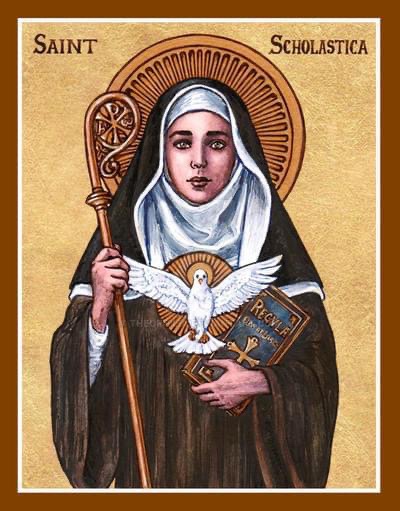
Today the church remembers an often overshadowed 5th Century saint who dared to dare: Saint Scholastica, Monastic and Patron Saint of Overlooked Twin Sisters.
Saint Scholastica is the twin sister of Saint Benedict, born to noble Romans around the year 480 CE. Her mother died in childbirth, and Saint Scholastica was known, literally from her birth, to be both a blessing from the Divine and wholeheartedly dedicated to the Divine.
Her brother noted this often. He was in awe of his sister. So often we find this when one sibling overshadows the other: the one with the long shadow greatly admires the other one.
When Saint Benedict left to enter the ministry, Saint Scholastica stayed with the family home and business, tending to the practical needs of the moment. Yet, her heart called her to a monastic life, and she eventually heeded that call.
Saint Scholastica founded a community of sisters about five miles from her brother’s hermitage. Following the Benedictine rule of life, they gathered around prayer, contemplation, and service. She visited her brother once a year, meeting in a half-way house between the two communities, discussing spiritual matters and praying together.
On February 10th in 543 Saint Scholastica breathed her last. That night, long before he had heard of his sister’s passing, Saint Benedict had a vision where his sister’s soul, in the form of a dove, visited him and flew into the heavens.
Perhaps there is something to that idea that twins are connected in special ways, no?
The details of most of Saint Scholastica’s life are lost to memory, blotted out by the eclipse of her brother. Yet we know a few important things: Saint Benedict revered her, respected her, listened to her, and sought her spiritual guidance.
That’s a pretty good endorsement if you ask me.
Saint Scholastica is a reminder for me, and should be for the whole church, that often the brightest sun is hiding a wise planet in another orbit. The pastors with the most prestigious pulpits aren’t always the stars they appear to be. Indeed: the best sermons on any given Sunday are preached to fewer than fifty people, in my opinion.
Let those with ears to hear, hear.
-historical bits gleaned from public access information
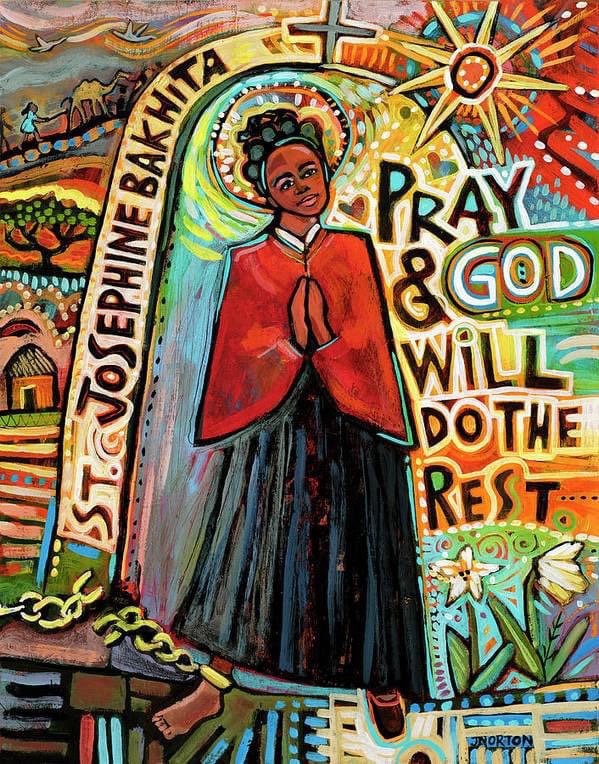
Today the church remembers a 20th Century Sudanese saint remembered for her fierce bravery and gentleness: Saint Josephine Bakhita, Patron Saint of Those Caught in Human Trafficking.
Saint Bakhita (not her given name at birth…the trauma of her story prevented her from remembering her birth name) was raised in Darfur by her loving family until the age of eight. At this young age, she and her sisters were captured and forced into slavery, sold a number of times throughout Africa and the Middle East. It was then that she was given the name Bakhita, which means “fortunate.”
In slavery she was tortured, whipped, scarred and tattooed, and forced to care for children though she herself was still only a child.
When the Suakin region of Sudan, where her captors were living, was besieged by war, Saint Bakhita and her charges were placed under the care of Italian Canossian Sisters in Venice, Italy (because she had recently been “bought” by an Italian diplomat). When it came time to return to Suakin, St. Bakhita refused to leave the convent. Her captors appealed to the Italian courts, but so did the Sisters.
The courts ruled that, since slavery was not a legal thing in Italy, her captors had no rights to her whatsoever. In their eyes she had never been a slave.
It’s nice to hear a legal case where justice prevailed, no?
St. Bakhita, who claimed that the Sisters had exposed her “to the God she had known in her heart since her birth,” entered the process to become a Canossian Sister. She was assigned a place at the convent in Schio, and remained there the rest of her life as the chef, sacristan, and doorkeeper of the convent, putting her in direct contact with the people of her city.
She was remembered for being gentle, kind, and for “having her mind on God, and her heart in Africa.”
She died on February 8th in 1947. Her body lay in repose, and thousands from the city and across the church came to honor her legacy and memory.
Saint Bakhita is a reminder for me, and should be for the whole church, that the church is a place of sanctuary and, in the face of systems that seek to chip away at the dignity of humanity, must speak out forcefully with both our words and our actions.
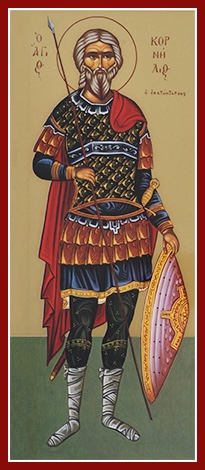
Today the church remembers a 1st Century Saint whose mention in Acts of the Apostles (chapters 10 and 11) is indicative of an event much more important than it might first seem: St. Cornelius, Centurion and Bishop of Caesarea.
We know scant about Cornelius other than he was a Gentile convert who heard St. Peter’s preaching, and had his heart “strangely warmed” to borrow a phrase from John Wesley. His conversion, and that of his household, led to a second Pentecost of sorts, as St. Peter, the leader of the Jewish-Christian arm of the early church, began to accept Gentiles into the fold.
This was a huge deal for that early church. It started the domino effect of honoring the missional work of St. Paul and the admission of Gentile-Christians as equal members of the fledgling apocalyptic community.
St. Cornelius, as a Centurion, was a commander of one hundred soldiers. As a full Roman citizen of rank, he was well paid for his work and undoubtedly wealthy and influential.
Lore has him becoming the second Bishop of Caesarea, leaning into his conversion and leading the early church in service.
St. Cornelius is a reminder to me that the church has, at it’s inception, been forced to wrestle with inclusion and, from the outset, chose to have open doors rather than closed ones.
Perhaps that’s a history the church should re-learn in some corners.
-historical bits from Pfatteicher’s New Book of Festivals & Commemorations
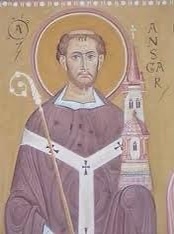
Today the church honors a Saint whose work was like a fine wine taking time to develop: St. Ansgar, Bishop of Hamburg and Apostle of the North.
9th Century St. Ansgar was, on the face of his work, not very accomplished. In all of his missionary zeal he was only able to establish two churches on the border of Denmark and appoint one priest in Sweden.
But the small seeds that St. Ansgar scattered across the frozen north eventually took root, settling and snuggling in with the Viking and Celtic practices found there.
At the beginning of the 9th Century the church was seeing Scandinavia as the next frontier for the faith. A few prominent nobles had embraced Christianity, including King Harald (cool spelling of that name, no?) of Denmark who sought to regain his throne from a pagan usurper. In response to some of these hospitable events, the church began sending missionaries to the Viking lands. The seafaring people they met there were hearty and quite sophisticated in their own way, and though they tolerated (sometimes) these missionaries, they mostly saw them as useful for creating trading markets.
Still, the message these missionaries carried did take hold, especially amongst the slaves that had been brought north who were eager to hear the stories of their childhood faith offering hope in a weary land.
In 829 AD a group of these merchants asked Emperor Louis the Pious (who’d want to be remembered like that?) to send a Christian mission to Sweden to help establish a regular trading route, and Ansgar was chosen.
Ansgar and his small party set out and were attacked by Vikings who took all of their possessions and money. Arriving at their destination penniless, King Bjorn (the local prelate) gave them food, shelter, and allowed them to preach their Gospel. Though they had few converts, King Bjorn’s bailiff took the faith to heart and, with his own capital, erected the first church in Sweden.
In 831 St. Ansgar was appointed Archbishop of Hamburg, seeing that as a good place from which to continue sending missions to the north. St. Ansgar was blessed with an organizational mind (probably an Enneagram One) and was able to create community systems to preach and gather small pockets of apocalyptic people together to practice the faith.
In 845 Vikings saw Hamburg as a growing site of wealth and organization and decided they wanted in on the action, so they pillaged it and burned it to the ground. Undeterred, St. Ansgar continued to rebuild after the destruction of the city, patiently working and restoring those missional pathways throughout Denmark and Sweden. He worked at this until his death in 865 AD.
St. Ansgar is now roundly regarded as a Patron Saint of Scandinavia having tilled the soil and planted seeds that, true to the agrarian reality of the frigid north, took a while to take root. He is usually depicted in a fur collar and holding a mini-church, a nod to his life’s work.
St. Ansgar is a reminder for me, and should be for the whole church, that sometimes you don’t see the fruits of your labor, but you stick at it, by God.
-historical bits gleaned from Pfatteicher’s New Book of Festivals & Commemorations
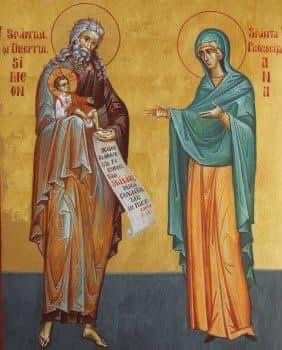
Today the church honors The Presentation of Jesus, a minor feast day that mentions two major saints of the faith: St. Simeon and St. Anna, Elders and Prophets.
Yes, we don’t know much about these saints (noted at the end of Luke 2) except to say that their patience and wisdom is instructive for a humanity that too easily leans toward immediacy and easy answers.
They hold up the Christ child in all his potential, declaring Jesus a special one. Imagine what could happen if we lifted up all children this way, not just those born in privilege.
It could change the world. It has before.
Christians bless candles today, making the metaphorical shift that the Christ is also the light of the world.
The Celts, more practical, would haul out new candles today because it is the midpoint between the solstice and the equinox, and the early winter candles are now spent as we are in the belly of the snow season.
But light daily grows, Beloved.
Anna and Simeon knew this.
St. Simeon and St. Anna are a reminder for me, and should be for all of the church, that all who are fortunate become old, but not all become elders.
Becoming an elder takes time, intention, patience, and a wisdom that comes from trusting promises in the face of scoffers and opposition.
Today the church remembers a Celtic Saint (which makes her close to my heart): Saint Brigid (commonly called St.Bride in Scotland), Abbess and Protector of Ireland.
Sometimes called “the Mary of the Gael,” not much historically verifiable is known about St. Brigid’s early life, though legend and lore abound. On the island of Ireland she is revered as much as St. Patrick in most places, and her story is a mix of Christian and pre-Christian wonder. The daughter of a druid who had a vision from the Divine that his offspring would protect and change Ireland, St. Brigid was said to have been born at sunrise while her mother was walking over a threshold (a point of significance for the ancient Celts, because it meant that she was neither “in nor out” when St. Brigid arrived).
St. Brigid would live into this “neither here nor there” nature throughout her life. She was a peace-loving monastic, but also a fierce warrior. She was both wise and approachable. She was both Christian and pagan in her outlook.
She was known as a strong, happy, and compassionate woman who started a community of women at Kildare in the late 5th-early 6th Century. St. Brigid was said to be wise, and was sought out in life by many for counsel, and admired in death by poets, story-tellers and song-writers who used her as inspiration, many quite fanciful.
Lore has it that it was St. Brigid who spread out her green mantle over all of Ireland to make shine like an emerald.
In Ireland today more than a few rivers bear her name.
In addition to being a wise spiritual leader and community builder. St. Brigid was said to have been the protector of the land, officially the guardian of the pagan king Torc Triath of what is now West Tipperary. In a time when Ireland was a destination for all seafaring people, the need for protection was great. St. Brigid was an accomplished warrior. In ancient Celtic culture women were seen not only as capable leaders, but in many areas superior.
St. Brigid died in the early 6th Century, and her following grew to the point that her relics were prized possessions that had to be continually moved and hidden from invading marauders who sought to steal them as a trophy.
The most remarkable thing about St. Brigid, though, is not her historical self, but the part she now plays in Celtic Christianity. St. Brigid’s day comes in the “dead months” (marbh mhios) of winter when humanity in the northern hemisphere finds itself “Imbolc” or “in the belly” of winter. Her feast day is a reminder for the Celtic Christians that winter doesn’t last forever, and though you now might see only shadows, the sun is growing stronger every day, by God.
This reminder of St. Brigid, woman of wisdom and strength, works for the winter of the seasons, and in all the metaphorical winters of your life, Beloved.
St. Brigid is a reminder for me, and should be for the whole church, at least three things:
First: live in such a way that people write wonderful stories about your wisdom and strength.
Secondly: the intermingling of Christian and non-Christian sensibilities has helped the faith to develop, and this can be seen in no better place than in Celtic Christianity.
Finally: though we must live with winter, it never lasts forever.
Let those with ears to hear, hear.
-historical bits gleaned from Pfatteicher’s New Book of Festivals and Commemorations
-Celtic lore found from stories of my ancestors as well as Freeman’s Kindling the Celtic Spirit
-icon written by Larry at IconWriterArtist on Etsy
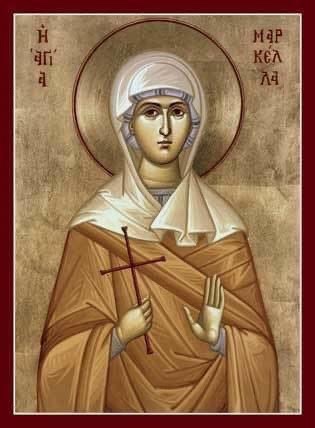
Today the church remembers a saint who, though she could have easily lived in luxury, chose a different way: Marcella of Rome, Widow and Model of Generosity.
St. Marcella grew up with everything someone in the 5th Century might want. Her family was powerful and prominent. She married young, and married wealthy. She lacked nothing.
But shortly after her marriage her husband unexpectedly died. Quickly on the heels of his death, another suitor, Cerealis, cousin of Caesar himself, proposed to her.
She said, “Bye, boy,” and rebuffed his advances.
Seeing this as an opportunity for a different kind of life, she converted her mansion into a communal house for other women interested in living a charitable life. In this converted home/convent, she and other noblewomen used their wealth to help the poor and destitute. It was from this home, too, that she taught other young women in the ways of intentional poverty (chosen, not forced), most notably her favorite pupil Principia.
St. Marcella was known to have said, “I prefer to store my money in the stomachs of the needy than hide it in a purse.”
We know about her and her life through the letters of the prolific St. Jerome, who wrote to Principia. St. Jerome even notes that he learned much about God and the scriptures directly from St. Marcella, making her an early (though under-the-radar) teacher of the church.
In 410 Rome was invaded by the Goths. They stormed St. Marcella’s mansion and, when they had ransacked the place and found she had (as she had told them) given all her wealth away, they tortured and beat her.
Not long after this abuse, St. Marcella died, purportedly in the arms of her dear Principia.
St. Marcella is a reminder for me, and should be for the whole church, that there is, indeed, a choice to make when it comes to how we live in this world.
-historical bits from Clairborne and Wilson-Hartgrove’s, Common Prayer: A Liturgy for Ordinary Radicals
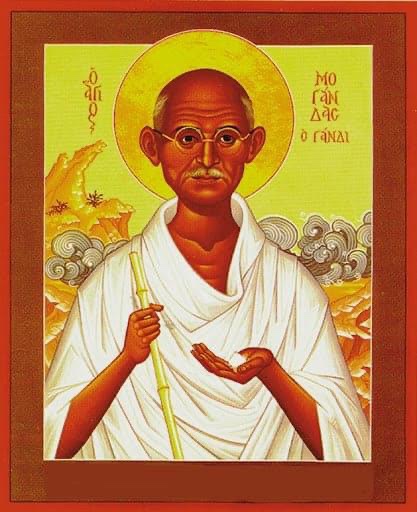
Today the church remembers a martyr who called God by a different name: Gandhi, Peace Activist and Spiritual Leader.
Though one could certainly write a tome on Gandhi’s life (and many have been written!), I do not have enough knowledge of his background to do it justice. What I do know is he threw off the shackles of privilege and, though not a perfect person by any means (he fell into the trappings of the systems around him at times), he adopted a way of life that advocated for the liberation of his people from colonial rule.
He became a political leader. He became a spiritual leader. And he became a world teacher, showing us all how peaceful, nonviolent resistance can move mountains.
On this day in 1948 he was assassinated on his way to prayer (as most religious revolutionaries are…it’s usually on their way to prayer). Though the assassin took the actor, the production continues even today, and many in the quest for justice name Gandhi as an inspiration in nonviolent civil disobedience.
Gandhi is a reminder for me, and should be for the whole church, that nonviolent disobedience, though costly, can change the world. And, don’t we regularly hear something about losing one’s life to gain it?
Gandhi knew something about that. Perhaps he was more Christian than many who wear crosses in that regard…
-icon written by Br. Lentz (purchase at trinitystores.com)