Today I would propose that the church honor two 4th Century saints who loved one another and died together: Saint Sergius and Saint Bacchus, Soldiers, Martyrs, and LGTBQ Icons.
Some calendars honor Saint Sergius and Saint Bacchus on October 7th, but because the Lutheran Church honors St. Muhlenburg on that day, I would offer that today, a day when no particular saint is lifted up, would be a great day to remember these two trailblazers.
Sts. Sergius and Bacchus were young nobles and high ranking legionnaires in the Roman army under Galerius. They were secretly Christian, and when this was exposed, they were arrested and told to make a sacrifice to Jupiter.
When Sts. Sergius and Bacchus refused, they were tortured.
It is reported that Sts. Sergius and Bacchus had pledged themselves to one another in love, and that in that same breath they pledged themselves to Christ, claiming that in their union they had also become one with Christ.
This oathtaking sounds very much like vows.
In the medieval era this oath was considered an act of “brotherly love,” but that moniker over their devotion to one another falls flat when compared to the sincerity of their words.
Sts. Sergius and Bacchus died at the hands of their torturers. It is reported that Bacchus died first and appeared in a vision to Sergius, saying, “My crown of justice is for you, and yours for me.” It’s interesting to note that “crowning ceremonies” were one of the ways same-gendered couples were formally joined in union in ancient Rome.
They are a reminder for me, and should be for the whole church, that LGBTQ Christians are not only not recent, but have always been, from the very beginning of the movement.
Let those with ears to hear, hear.
-icon written by Br. Robert Lenz and was first displayed at the Chicago Pride Parade in 1994
-historical bits gathered from memory and a number of sites
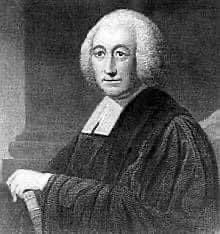
Today the church honors the person considered to be the founder of the Lutheran Church in America, Henry Melchior Muhlenberg, Missionary to United States.
Born in the early 18th Century, Henry was the seventh of nine children raised in Hannover, Germany. He started his professional life as a school master after graduating from studying at Gottingen and Halle, but soon felt a different stirring.
The Lutheran presence in America was scattered and disorganized. Three disparate congregations in Pennsylvania (Philadelphia, New Hanover, and New Providence) sent a joint delegation to London and Halle in search of a pastor who would unite the Lutherans together in the colonies.
Muhlenberg was chosen and sent in 1742. On his way he spent some time in London to learn about America, and while there adopted a new clerical garment that would be used by Lutherans in the colonies.
Henry arrived in Fall of 1742 and gained the trust of both the German-speaking and Swedish-speaking clergy…no small feat! Muhlenberg struggled mightily to unite the many churches that were so ethnic-specific. He traveled incessantly, wrote constantly, preached in German, Dutch, in English, and became known for his powerful voice.
He established the first Lutheran synod in America, the Ministerium of Pennsylvania, in August of 1748. The delegates met together and ratified a modern liturgy that remained the only authorized American Lutheran liturgy for forty years, and is still sometimes revived for use to this day and can be found in all the Lutheran hymnals up through the Lutheran Book of Worship (1978). Muhlenberg had a dream of “one church, one book,” and he didn’t mean the Bible…that was already done…he meant a liturgy book.
Lutherans in this frontier land struggled with authority issues as it moved from a state-supported church in Europe to congregational-led communities in the colonies. Muhlenberg worked mightily with churches on both stewardship and education, two practices that could use a little reviving today. He even wrote a model congregational constitution, never needed in Europe, that helped to organize the disorganized faithful.
Muhlenberg was in favor of a distinct church in America, noting that local practices must hold hands with local customs. Despite this belief, he was quite pietistic, and had a low tolerance for chicanery or shenanigans from clergy or laity.
Muhlenberg and his children were leaders in American public life as well. His son John Peter dramatically left the parish to serve in the Revolution, becoming a brigadier general under George Washington. Another son, Frederick (also a pastor), became a member of the Continental Congress and the first Speaker of the House of Representatives…much to his father’s disappointment. Muhlenberg believed he would have made a much better pastor and should have remained in the parish.
Another son, Henry Ernst was both a pastor and the president of Franklin College where he excelled as an administrator and a botanist.
Where did he find the time?
And Muhlenberg’s great grandson? He became an Episcopal priest who is honored on April 8th. Maybe that’s why Lutherans and Episcopalians in America love one another so much…
Henry Melchior Muhlenberg died in Pennsylvania on October 7th, 1787. You’ll find his remains under a monument where, inscribed in Latin, is this simple phrase, “Who and what he was future ages will know without a stone.”
Muhlenberg is a reminder for me, and for the church, that sometimes you can get a different calling in life (he and all of his children and a couple of vocations under the belts), and that listening carefully to that still, small voice can enable one to do much for the world.
-historical pieces from Pfatteicher’s _New Book of Festivals & Commemorations
As we part ways with September the church honors a saint you know about, but you don’t know you know about: St. Jerome, Priest and Monk of Bethlehem.
Italian Eusebius Hieronymus Sophronius…but you can call him Jerome…was born in 345 in northeast Italy. His family was Christian, and he was tutored at home until the age of 12 largely because his family made just enough money to afford a teacher.
At the age of 12 he was sent to Rome to study under Donatus, the famous grammarian, where he excelled as a student and acquired a reputation…both for his studiousness and for his out-of-class shenanigans.
St. Jerome was no, well, saint…at least behaviorally, but he remained close to his faith heritage and was baptized at the age of 19. The interesting thing about Jerome is that he notes that he experienced a conversion after his baptism, not before, as he traveled East toward Antioch where he would spend a good deal of his life.
It was there in Antioch that he had a vision where God encouraged him to take time away from studying the classics and focus more on the scriptures. In response to this vision, Jerome withdrew to the desert to lead the life of a hermit…lugging his books along with him. These books became the springboard for his own writings, detailing the joys and temptations of the hermit life.
When Jerome returned to Antioch he was ordained a priest, though he never desired the ordination, and he never fully took up the duties of a priest, feeling it wasn’t truly his calling. St. Jerome knew his calling was to be a secretary, a historian, a student of the words of the day, recording a legacy of thoughts and reports for the world to read.
He revised the Latin version of the Gospels. He revised the Latin Psalter. He wrote scathing pieces on the unethical and luxurious living of wealthy Christians and some clergy…which ensured he’d never be elected Bishop, by the way. He encouraged a growing ascetic movement amongst the elite, making a notable friend with a woman known as Lady Paula and her daughters. Lady Paula would come to join Jerome when he established a monastery in Bethlehem, and she would become the abbess of a community nearby.
St. Jerome visited all of the major cities of the empire before retiring to Bethlehem: Rome, Antioch, Constantinople, and Alexandria. This gave him a wide lens and a foundation of experience that would serve his writing and reflections well.
After settling in Bethlehem, Jerome carved out for himself a home…literally. In a rock. He lived there as a hermit, and opened a school for boys, translating historical, philosophical, and theological works into Latin. He also wrote an early “history of notable Christians,” expounding upon early Christian lore. He wrote letter after letter, involving himself in theological arguments.
Now, you’ve read all this, and you’re wondering, “Yeah, OK…but how do I know him?”
You know him, Beloved, because he wrote the Latin translation of the Bible that remained the standard Latin version for 16 Centuries.
You know him because you’ve read his work.
Or, more precisely, translations of his work. And translations of translations of his work.
Toward the end of his life, Jerome was besieged by trouble. Bethlehem was rocked by an influx of refugees as political problems plagued the empire. His reputation was soiled by theological opponents. His friend Paula died, and his monastery was burned.
In 420 on September 30th Jerome died and was buried next to his companion Paula in the Church of the Nativity.
St. Jerome is still considered one of the most brilliant Biblical scholars. He was a bit brash, and was not always theologically on the mark (I personally have strong issues with his remarks on Origen), but he is probably the most influential Christian of his day, and remains one of the most to this day.
St. Jerome is a reminder for me, and for the whole church, that they who wield the pen do indeed shape history. And yes, we need all sorts of STEM education in schools…I’m all for that. But if we don’t have some good writers in the world, all the advancements we make and the stories that surround them could, indeed, be lost in the endless stream of time.
We need writers, in the church and in the world.
-historical pieces from Pfatteicher’s New Book of Festivals & Commemorations
At their best, angels are symbols of the vast creativity of the Divine.
At their worst, they’ve been turned into demi-gods and good luck charms.
Judaism, Christianity, and Islam all speak of heavenly creatures that convey messages from God. They play a significant part in the Hebrew scriptures, the Gospels, and the Epistles, even if their presence and activity is a bit ethereal and hard to pin down…probably by design, right?
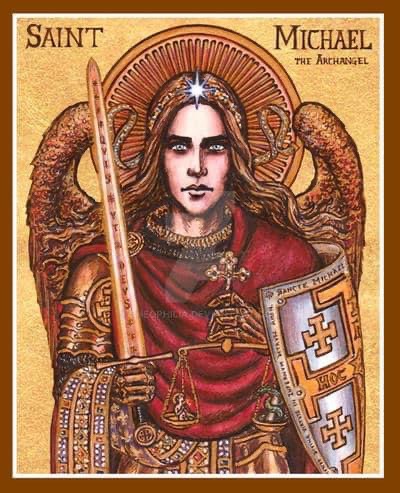
Michael the Archangel is mentioned in the books of Daniel, Jude, and Revelation specifically, and in the apocryphal literature he plays a significant role in the struggle of goodness over wickedness.
In the Roman calendar of saints, three Archangels are commemorated on this day: Michael, Gabriel, and Raphael. Lutherans go for brevity and just lump them all together, probably so as not to pay them undue attention. Angelic beings have a tendency to gain cultic followings among the faithful hoping for Divine favors…something that really doesn’t make much sense for Lutherans.
God favors all people…though Mary is greeted as “Blessed.”
Honestly, you probably don’t want a visit from an angelic being…they sound terrifying. This is why they always begin their address with “Fear not!” because, well, there’s probably much to be feared when they’re in the room.
I’m honestly unsure what to make of this sort of thing, this idea of angels, other than to say that there is much in this world that we don’t really understand very well. And sometimes humans need miracles with legs on…and wings, I guess, and so angels tickle the imagination and tend the fires of hope when not much else will.
Maybe thinking of them as “messages on fire” is helpful…
This feast day is a reminder for me that there are things in this world that I just can’t grasp, really don’t understand, and even struggle to wrap my head and heart around…even good things.
And that’s OK, I think.
It always makes me search for more, for better, for understanding, and hopefully, for a humble stance in the face of the unknown.
-some historical pieces from Pfatteicher’s New Book of Festivals & Commemorations
Today the church honors a revolutionary figure in the life of Lutheranism, Saint Jehu Jones, Pastor, Reformer, and Trailblazer.
St. Jehu was born in 1786 in South Carolina. His father was the proprietor of a hotel, and had purchased the freedom of a number of slaves. They attended St. John’s Church in Charleston, where Jones owned a pew.
Jehu felt a call to ministry and desired to be a missionary in Liberia, but knew that the Lutheran church in the South would not ordain him. In this way he mirrored many contemporary call stories of people on the margins of society who feel a call to serve, but know that the church writ-large won’t accept that call as legitimate…
St. Jones traveled north to New York City bearing a letter from the pastor of St. John’s testifying to his character and acumen. He was ordained the first official African American Lutheran pastor into the Ministerium of New York on October 24th, 1832, and headed back to South Carolina to prepare for ministry across the seas…until he was jailed under the Negro Seaman’s Act. This barbarous act prohibited free black persons from re-entering South Carolina and directed that they be put on the auction block.
He was freed on the condition that he’d never set foot in South Carolina again. It is unknown if the church took any formal steps to protect him…but it is unlikely.
He left his whole family behind and returned to New York City, and then landed in Philadelphia with his wife and nine children where he organized St. Paul’s Church.
When the Ministerium of Pennsylvania came on hard times, they took the title of the building away from St. Jehu, and refused to offer him payment. St. Jehu turned to the Ministerium of New York, his ordaining body, for financial help…and they refused him, too.
Despite his success as a pastor and evangelist, St. Jehu was met with roadblock after roadblock in his struggle to minister in the church. He died on this day in 1852.
Though there are incidents of advocacy and solidarity, and individuals throughout Lutheran history who have stood on the side of the oppressed, especially in the abolitionist movement (Henry Melchior Muhlenberg comes to mind), the church as a whole has historically had a difficult time speaking with one voice against systemic oppression, especially when reputation and finances were on the line.
This must change.
St. Jehu Jones, Jr. is a reminder for me, and should be for the whole church, that it was not so long ago that American Lutheranism formally rejected the gifts of our black sisters and brothers, and indeed continues to wrestle with full-throated endorsements even today.
It is no secret that black and brown seminarians wait considerably longer for calls in the church, especially female people of color.
It is no secret that systems of oppression still operate in the cathedral halls of America, across all denominations.
It is no secret that, though strides have been made and continue to be made, equity lags in the church across race, gender, and orientation lines.
St. Jehu Jones, Jr. calls to us from the past and encourages us to continue the struggle.
Let those with ears to hear, hear.
-historical notes from Pfatteicher’s New Book of Festivals & Commemorations
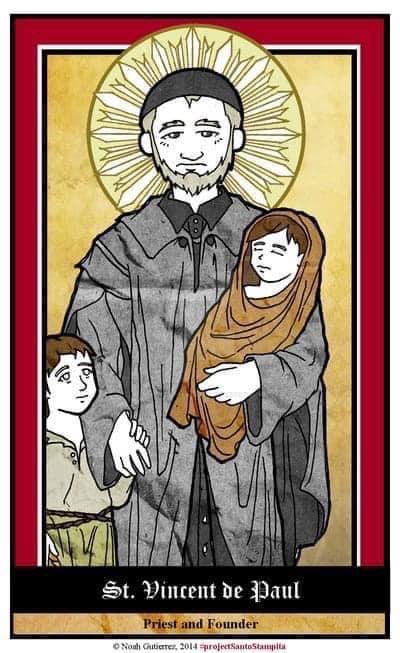
Today, at the tail end of September, the church turns its attention to a saint who spent his entire life attending to society’s poor, Saint Vincent de Paul, Priest and Friend of the Outcast.
In the late 16th Century, Saint de Paul was born a peasant in southwest France. He was an attentive student, and was ordained at the young age of 20, having come under the tutelage of Fr. Peter de Berulle, who would eventually become a Cardinal.
Having grown up in poverty, Saint Vincent dedicated his life to his people: the poor and the outcast.
He made his home in the galleys of slaves imprisoned in Paris, and even is said to have taken the place of one of them for some time. That, Beloved, is walking in the shoes of the other.
He founded communities of both men and women who took up the causes of the impoverished, and took his message into the rural areas of France, reforming how priests were trained and therefore related to the destitute in the fields around Paris.
He founded the Congregation of Mission, later called Lazarists. He founded the Daughters of Charity, the first congregation of women not enclosed in a convent, who took no perpetual vows but rather entirely devoted themselves to the care of the sick and the poor.
This was their solemn vow.
He said to these servants, “Your convent is the sick room, your chapel the local parish, and your cloister is the streets of the city.”
Wow. Read that again. Let it be written on your head, on your hands, and on your hearts, Beloved.
He spurred others to generous living, even as he himself had little to give other than himself. And though a male, he is reputed to have related to females with no condescension or contentiousness. They were co-workers in the field of the world.
St. Vincent died on September 27th in 1660, and is a reminder for me and the whole church that, well, when we’re at our best…
Our convent is the sick room.
Our Cathedral is the local gathering of folks dedicating themselves to public good.
Our cloister, our sisters and brothers in service, are the streets of our cities, our dirt roads, and our back alleys.
-historical bits from Pfatteicher’s _New Book of Festivals & Commemorations
-Icon by one of my favorite icon writers, Nowitzki Tramonto
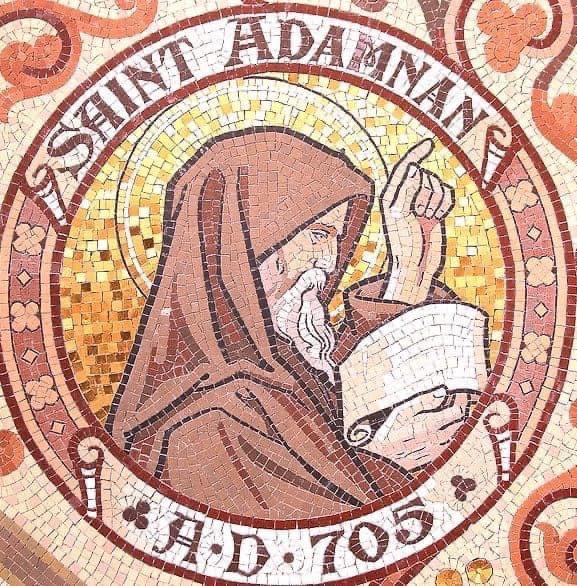
Today the church remembers a Celtic saint who, while kind of obscure, had an impact for generations to come: Saint Adamnan of Iona, Abbot, Law Writer, and Arranger of Calendars.
Saint Adamnan was born in the early 7th century in what is now County Donegal in Ireland, and was related to Saint Columba on his father’s side. He grew up in the Celtic expression of Christianity and was schooled far beyond most any Celt, average or noble, in his day.
Eventually, after entering the priesthood, ordination, and extensive education, he ended up at the famed Abbey of Iona, begun by his ancestor Columba himself. It was there that he eventually took over as Abbot and penned the most extensive work on Saint Columba, as well as the most in-depth work on the ancient Scots (the Picts) that we have today, The Life of Columba.
But that wasn’t all that he wrote.
He was very interested in justice and human rights, and proposed what came to be called, “The Rule of Adamnan,” essentially an argument that, in warring times, women and children should be spared, and that non-combatants should not be held prisoner. His “rule” sounds very similar to modern Geneva Convention rules of war.
In his role as Abbot, he traveled around what is now the British Isles, visiting different parishes as good Abbots do. In South Briton (Britain) he encountered a strict Roman adherence to custom and calendar, which chaffed a bit against his Celtic understanding of the faith. Nevertheless, he believed the church should be one, and while he was unwilling to give up much of his Celtic Christian practices, he argued that one thing the church should agree on was a common Easter festival.
See, the Roman expression of the faith celebrated Easter on 21 Nissan, but the Celtic expression had continued with the ancient way of celebrating Eoster, the “spring festival,” on 14 Nissan. Intermingled with the empty tomb they put their ancient symbols of spring and new life: eggs (often painted), hares, and sweet rolls (often a gift to the goddess of spring). These symbols were also seen in the spring festivals of many ancient peoples.
Those sweet rolls, by the way, became hot cross buns in the hands of the church…
So while the eggs, rabbits, and rolls could remain, St. Adamnan argued mightily that the Celtic Christian expression should adopt the same date for Easter that the Roman expression was using, further unifying the faith.
In time, his argument won out, and the festival date changed (though the Celtic traditions remain to this day!).
St. Adamnan is a reminder for me, and should be for all people, that compromise is not only possible, but often an important step in unity.
Unity does not mean uniformity, and we’ve forgotten that.
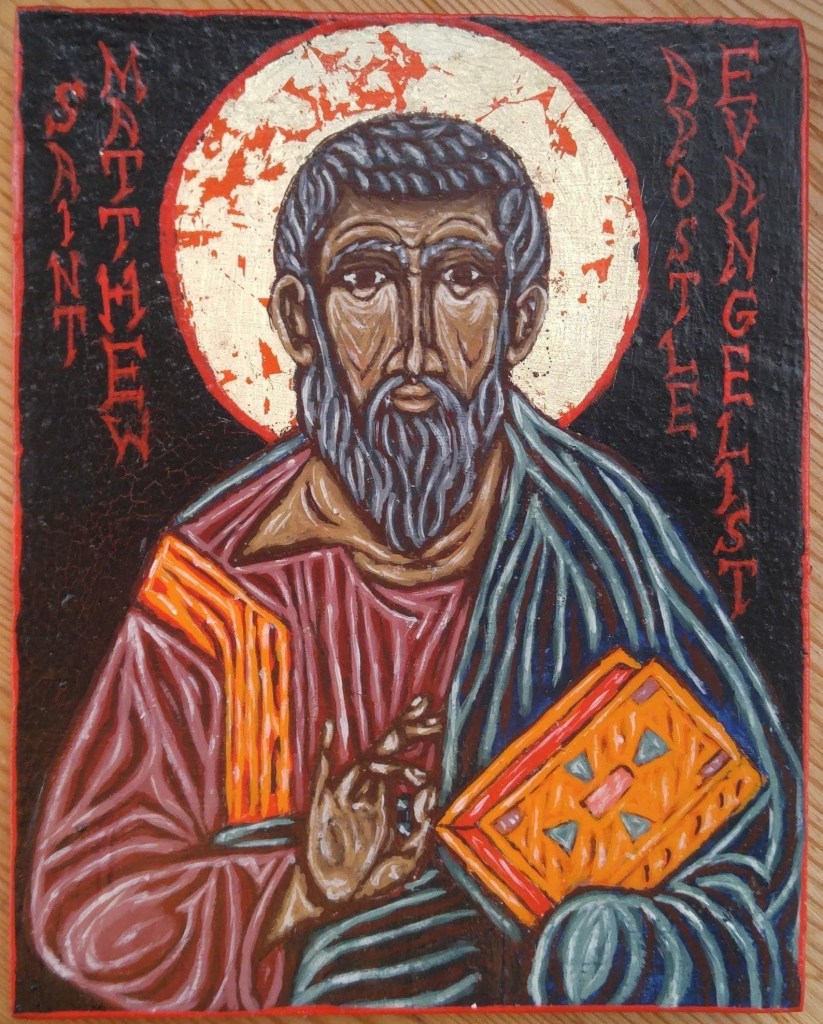
On September 21st the Church honors St. Matthew, Evangelist and Apostle.
Here’s the thing about St. Matthew: while this person appears in all of the Gospels, in Mark and Luke it is Levi, not Matthew, that is called into discipleship.
Oh, what’s in a name?
Well, quite a bit, actually. Some ancient scholars took these two people to be the same person, with “Matthew” being the name Levi was given after he started following Jesus (Jesus had a habit of giving nicknames, after all). Some regarded them as distinct individuals.
Regardless, two things are known about this person named Matthew: the ancient church knew him as a tax collector, and his name in Hebrew means “gift from God.”
Now, the above information is only ironic if you know how tax collectors were regarded in ancient Judaism and ancient Palestine. Often tax collectors were seen as puppets of the state, and were cut out of Jewish activities. But it’s worth repeating that Jesus had a tax collector in his trusted circle, this one whom others considered suspicious and untrustworthy.
Jesus was “big tent” before it was en vogue.
We don’t know much about St. Matthew. Tradition ties him to being the writer of the first Gospel, which we have no proof of and, because of when the Gospel was written, seems generally unlikely. Tradition also considered him, generally, as the oldest apostle…which makes it even less likely that he wrote the Gospel text.
Some legends have Matthew preaching throughout Judea after the ascension. Some have him going as far as Ethiopia with the Gospel. Some even claim he was a vegetarian (why this is important, I’m not sure, but no other apostle gets to claim this distinction).
We’re not even sure how Matthew died. Some say by old age, and some claim it was by martyrdom.
With all this confusion, I think it’s important to point out a key thing about Matthew: he was disliked in the ancient world, and yet he was in the inner circle.
Think on this: Jesus had St. Matthew and St. Simon in his inner circle. Matthew was a tax collector, a government agent. Simon was called “the Zealot,” and was a radical antigovernment activist. And both were in the Jesus camp. And both, we must imagine, had to give up some of their ideological purity to be there, right? And both had to give up some of their prejudices to entertain the presence of the other, right?
St. Matthew is a reminder for me, and for the church, that Divine work is larger than the small ideological crevices we hew out for ourselves in this life.
Let those with ears, hear.
-historical bits gleaned from Pfatteicher’s New Book of Feativals & Commemorations
Today the church honors a contemporary saint and scholar, one whose genius in theology and mysticism was only discovered after his untimely death: Dag Hammarskjold, Peacemaker and Mystic.
Dag was born in 1905 as the son of Sweden’s prime minister. He studied law and economics, and was a professor of economics in Stockholm for about three years. He soon joined the Swedish civil service in the Ministry of Finance, and became the president of the board of the Bank of Sweden.
As his popularity in the circles of government began to rise, so did his mystical leanings and visions…though in secret. He served in the Ministry of Foreign Affairs, and was responsible for dealing with international trade. This position well situated him to eventually be appointed as Minister of State as the deputy prime minister.
At that same time he was chosen as vice-chairman of the Swedish delegation to the UN, and eventually became chairman.
On April 10th, Hammarskjold was elected Secretary General of the United Nations, and during his tenure he dealt with the end of the Korean War, skirmishes in the Middle East, and the Suez Canal crisis. Due to his acumen, he was elected for a second five-year term.
With another term in front of him, Dag set his sights on helping the newly independent Belgian Congo, sending in UN troops to suppress the civil war. On his way to negotiate a cease-fire between the warring factions, Hammarskjold was killed when his plane crashed in Zambia in 1961.
Upon his death, his reflections and mystical visions were published in a fascinating book (that sits on my shelf), Markings. In this work Dag showed that he was not only a peacemaker for the world, but sought inner peace as well.
He was an active contemplate, or a contemplative activist…however you want to describe it.
My favorite line from his work (unsurprisingly) is this lovely mystical mix of beer and theology:
“I am the vessel. The draught is God’s. And God is the thirsty one.” (Markings)
St. Hammarskjold is a reminder for me, and for the church, that inner work is just as important (maybe more important?) in the life of the faithful, because the inner life is reflected in our outer actions.
Deep wrestling with life, mortality, the Divine, and the poetic ways they appear in our existence elicit a humanity that is geared toward the other more than the self.
It’s an interesting paradox, right? In doing our own inner work, seeing the outlines of our own shadows and light, wrestling with the tough questions within us, we become focused more on the health and healing of those around us.
This saint is a testament to this truth.
-Historical pieces from Pfatteicher’s New Book of Festivals & Commemorations
Today the church honors a Bishop who tended his flock during a plague, which makes him a bit relatable, no? Today is the feast day of Cyprian, 3rd Century Bishop and Martyr.
Hailing from Carthage in North Africa, Cyprian was a professor and lawyer by trade, only being baptized in his forty-sixth year of life. Amazingly, however, he was elected Bishop of Carthage only two years after ordination…hardly enough time to understand the ins and outs of parish ministry, me-thinks…but no one asked me.
Cyprian was a scholar and assumed the Bishopric when the church was rocked by schism and scandal. He used his office to gather the church together, seeing the office of Bishop as both encourager of the people and the anchor that holds disparate parts of the Body of Christ in communion with one another.
When emperor Decius began persecuting Christians, Cyprian went into hiding, a move for which he was much criticized. He felt that he had to continue to lead his flock through the persecution, and so his survival was paramount. History has taken a more cynical view of this move.
Soon after the persecution a plague broke out in the empire, and the Christians took the popular blame for it. When persecutions again resumed under emperor Valerian, Cyprian willingly and peacefully was arrested on September 14th in the year 258. He died a martyr’s death two days later.
His arrest and appearance before the authorities is well documented, and even appears to have been a peaceful exchange…even though it led to his death.
The charges?
He was accused of not bowing and acquiescing to the gods of the empire, of not siding with the powerful against the powerless, and not worshiping the emperors of the day. He spoke against their self-congratulatory ways of operating and their demands for prestige and accolades at the expense of the people they were supposed to serve.
He plead guilty and died by the sword.
St. Cyprian asks us a question from his grave in these days:
Would we be found guilty or innocent?
-history gleaned from Pfatteicher’s New Book of Festivals & Commemorations