The Tower

Today the church honors the “apostle to the Apostles,” St. Mary of Magdala, more commonly called Mary Magdalene.

Mary’s role in the stories of Jesus varies, depending on the account being referenced. In Luke she was one of those healed by Jesus during his ministry (apparently 7 demons plagued her). Some traditions have identified her with the “woman of the city” who anointed Jesus’ feet when he reclined in the Pharisees’s home, though there is no scriptural basis for this.

In the Gnostic Gospel of Philip, Mary is the one whom Jesus “loved more than the other disciples,” causing 2000 years of speculation over whether or not they were intimate or just in the “friend zone.”

It’s worth noting that the ancient church was known to type-cast in order to provide biased analysis, especially when it came to marginalized communities. The ever-virginal Mary, Mother of Jesus needed a yang to her yin, and so the perpetually penitent prostitute label was assigned to Mary Magdalene. These two mirrored Mary’s would stand for different paths in life for many a young Christian, and unfortunately these typologies have caused terrible, perhaps irreparable, harm to many of the faith.

This unfair, and unfounded moniker of prostitute doesn’t describe Mary Magdalene, but does describe us: we love such labels, especially ones that accuse and belittle.

I think Mary Magdalene should rather be thought of as “ever-faithful” instead of perpetually penitent. It was she who stuck by Jesus on his hardest day when everyone else fled. And it is she who, in the shadows of the early morning, rose to anoint his body, faithful to the end.

Or maybe we should call her “the first pastor,” because it is she who first told the disciples that Jesus had risen, originally proclaiming that good news formally, with the authority of one who had been visited uniquely by Jesus with the message.

Some recent scholarship suggests that “Mary of Magdala” is less a name assigning her to a place, and rather a formal title, with “Magdala” as a descriptor of what she was to the first church: “the tower.” If this is true, “St. Mary the Tower” gets equal billing with “St. Peter the Rock,” making her a beacon of strength and wisdom.

I quite like that.

If this understanding has been erased or lost to the insecurity of patriarchy, it makes recapturing and re-membering it even more necessary than ever in these days.

Mary Magdalene is a reminder for me, and should be for the church, of two things.

First: histories written by men will feature men and end up denigrating women in some way, either by omission or by commission. This has been true, is presently true, and without a real “come to Jesus” around re-imagining masculinity and the intentional introduction of female voices in the mix, will unfortunately be true in an unchecked future.

Second: a woman was the first pastor. Every pastoral call committee should be reminded of this before looking at any paperwork.

-biographical notes taken from Pfatteicher’s “New Book of Festivals & Commemorations,” opinion portions are solely mine and don’t represent Pfatteicher

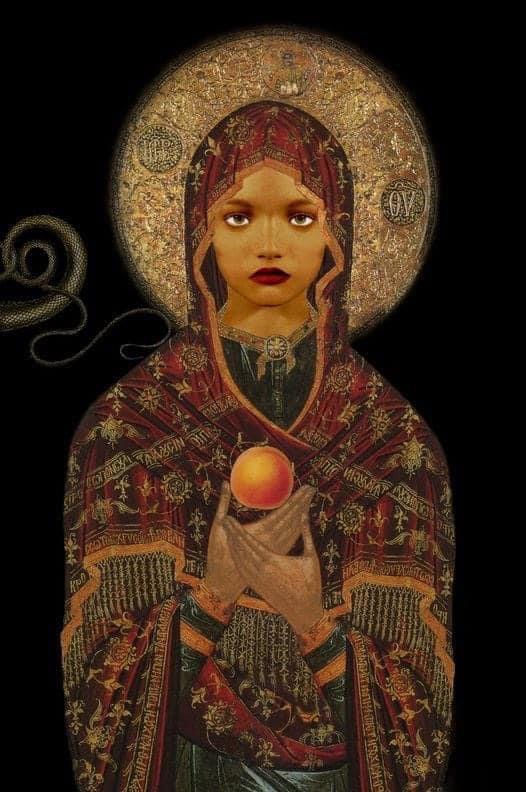
-icon written by Ulla Karttunen
Prophet of Prophets

Today the church remembers the Biblical prophet-in-exile: Saint Ezekiel, Critic, Visionary, and Giver of Questionable Advice.

Saint Ezekiel was (probably) born sometime in the early 600’s BCE while King Josiah was instituting the reforms that Judah had hoped would keep them in Divine favor and keep warring armies from continually conquering them.

Spoiler alert: the reforms didn’t work.

He was born into the priestly cast of Israel, and was supposedly a descendant of Joshua himself. Ezekiel, prophet and priest, was married and, because of his high standing in Jewish society, was exiled to Babylon when the Babylonians crushed Jerusalem. The Babylonians were no fools. To prevent an insurrection in their captured lands they would exile the best and the brightest (and those who held the most political sway) to work in Babylon for the king there, benefiting from their wisdom and preventing any influential characters from gathering power around themselves.

Ezekiel was married, and reportedly lived in Tel Abib on the banks of the Chebar river.

In the book of Ezekiel we get a glimpse into his prophecies and encounters with God. Ezekiel was a person who lived off of the visions he had of the Divine, much like Saint Julian of Norwich and Saint John of the Cross, and his mystical visions vacillated between beautiful and horrific. He warned of the coming destruction of the temple in Jerusalem and, for five years, acted out this destruction in a kind of pantomime for all to see.

Other notable illustrations in his visions were the graphic depictions of the angels surrounding the Divine throne (human face, ox, eagle, and lion), and the cryptic fiery “wheels in wheels” which always reminds me of the Johnny Cash song, “Ring of Fire.”

When the prophecy of the destruction of Jerusalem proved true, he became a would-be advisor for those also in exile in Babylon. Notably it was he who told Shadrach, Meshach, and Abednego to refuse to bow down to King Nebuchadnezzar’s golden idol, creating the fun Easter Vigil story popularly known as “Three Men in a Fiery Furnace” because when you don’t do what the King wants, you get thrown in the oven.

You know, that old chestnut…

Surely that was questionable advice, but everything turned out alright.

Ezekiel is held as a model of faith in all three of the Abrahamic traditions, the “People of the Book.” The Eastern Orthodox Church honors him on this day, as do many other communities (including Lutherans).

Ezekiel is a reminder for me, and should be for the whole church, that even when you find yourself as an exile from your home, stay true to your convictions and you’ll find your home is never far away.

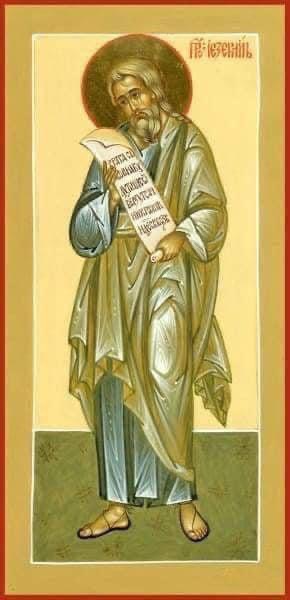
-first icon is a typical Russian writing of Ezekiel and can be purchased at orthodoxchristiansupply.com

-second icon is a writing of Ezekiel’s vision of “wheels within wheels” and, though I’ve tried hard for a while to find the writer of the icon, I’ve been unable to locate them. Note that I’m not the writer of either.

Firebrand

Today the church remembers a firebrand of a saint who threw off the shackles of patriarchy every chance she got: Saint Elizabeth Cady Stanton, Speaker, Feminist, and Woman’s Rights Advocate.

Saint Elizabeth was born in Johnstown, New York to strict Presbyterian parents in the first part of the 19th Century. Early into adulthood she married abolitionist Henry Brewster Stanton, and together they had seven children. She organized women across the country to fight for the right to vote, coming alongside other advocates like Sojourner Truth, Harriet Tubman, and Amelia Bloomer.

Together they organized the first Women’s Rights Convention in Seneca Falls, New York in 1848.

She was extremely witty, a brilliant scholar, and a staunch abolitionist. She created the “Declaration of Sentiments,” an expansion of the Declaration of Independence that inserted the word “woman” and “women” throughout the document. Along with advocating for woman’s suffrage and against slavery, she also moved the needle on the right for women to own property and divorce their husbands.

She was a regular church attender, but a sharp critic of Christianity (and religion in general) which makes me think we would probably have been friends.

She died in 1902, never witnessing the 19th Amendment or realizing the right to vote. Nevertheless, she paved the way for that legislation to happen.

Saint Stanton is a reminder for me, and should be for everyone, that sometimes we don’t see the results we labor for, but we must labor on.

-historical bits from Pfatteicher’s New Book of Festivals & Commemorations

-icon written by Fr. Robert Lentz and can be purchased at trinitystores.com

Multiplicity of Thought

Today the church remembers a 4th Century saint who was often overshadowed by her more famous brothers Greg and Bas (you know them Gregory of Nyssa and Basil the Great, two of the three “Cappadocian Fathers” of the faith): Saint Macrina the Younger, Scholar and Universalist.

Saint Macrina was born in a family already well-steeped in the early Christian movement. She was named after her grandmother, Macrina the Elder, and though her brothers would gain notoriety for their scholarly treatises, they themselves mentioned Macrina as a teacher of faith in their home.

Having been betrothed in an arranged marriage by her father, Macrina never tasted wedded life as her fiancé died before the wedding. She came to see her vows as belonging to Christ alone, and lived an aesthetic and austere life with her mother and a group of women who pledged themselves to communal living. In this community, everyone was equal, whether you were formally a servant or wealthy enough not to owe anyone anything.

It’s one of the early egalitarian communities of the faith, and St. Macrina grew in responsibility as the community grew, taking on what we would call an Abbess role in time.

St. Macrina was also the tutor of her younger brother, Peter of Sebaste who would become a Bishop in the early church. She taught him not only the great philosophical ideas of the time, but also about The Way which was spreading like wildfire in the West and the Near East. In this way, and because she had such a strong influence on Greg and Bas (as I call them), means she was a shaper of the early church, an unseen hand on the needle of the faith.

Known for being a deep thinker, St. Macrina was supposedly a Universalist, and is lifted up by the Universalist Unitarian Church as a great scholar. Her brother, Gregory of Nyssa, composed Dialogue on the Soul and Resurrection in which he records a conversation with Macrina on her death bed (actually, her aestheticism was so great she refused to die in a bed, and chose to die lying on the ground). In that conversation she notes her deep conviction that everyone would be reconciled to God in the end, faithful and pagan alike.

St. Macrina died on this day in 379 AD in Pontus, modern day Turkey.

Saint Macrina is a reminder for me, and should be for the whole church, that the early Christian movement comprised a multiplicity of thoughts and theologies…and still does, despite what the zealots in all corners might want you to think.

-historical bits from open source publications

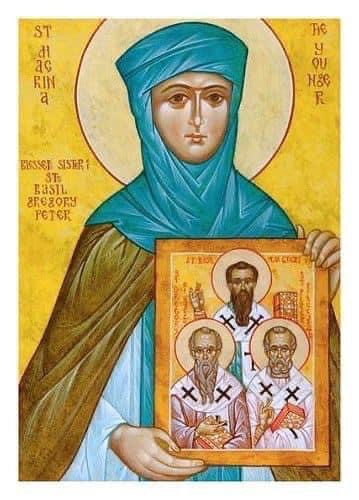
-icon a classic Byzantine style by unidentified writer where St. Macrina holds an icon of her brothers

Every New Moon

The ancient Celts had a strong inclination that the rhythms of nature were echoed in the rhythms of the human body. Winter was for silence and rest, Spring for energy and growth, Summer for blazing work and toil, and Autumn for winding down and letting go.

They understood that living in a way that was in alignment with these rhythms led to a balanced way of being in this world.

At every new moon they also saw that the cycle of life both as continued and began again at the same time, giving support for this idea that time is circular, not linear, and that every moment is both a continuation of a past step and the opportunity for newness.

Let those with ears to hear, hear.

Patriarchy is Hard to Eradicate

Today the church remembers one who is considered to be the first Christian ruler of Russia: Olga, Princess of Kiev, Confessor and Ruler.

Saint Olga is the grandmother of the first “official” ruler of Russia who confessed the faith. Her grandson Vladimir gets the “official” title because of patriarchy, but in actuality Olga was the first official Christian to rule the nation.

Born in the late 9th Century, Olga married Prince Igor and, after his death in the year 945 A.D., officially ruled in his stead until her son came of age.

She was known for being courageous, “sticking it to the man,” instituting reforms that her husband was unable to carry out regarding financial and administrative changes, and had been an early convert to the faith through the Scandinavian missionaries who traveled down the river system from the West.

In the year 957 A.D. Olga visited Constantinople and some say that is where she was officially baptized, though others claim that she had long been an adherent to the faith. Regardless, her personal faith did not indicate a change of heart for her country, and her son who came to rule after her was not a confessor.

Olga is remembered in Eastern Orthodoxy as the “Blessed Princess Olga,” and is honored in the Ukrainian and Russian branches of the church. She is remembered as being witty and brave. The story goes that when she went to be baptized in Constantinople, the Emperor saw her beauty and asked her to marry him. She replied, “First I must be baptized,” and then followed it up with, “and I need a Godfather. Will you be mine?”

The Emperor agreed and, following her baptism, returned to the invitation of marriage. The bright Princess replied, “We are now family through baptism, and never has a father married a daughter, even amongst the heathens!”

Knowing he had been outsmarted, he gave Olga his blessing to return to Russia with the faith.

She died in the year 969 of old age.

Saint Olga is a reminder for me, and should be for all the church, that too often the female saints amongst us don’t really get their due because, well, patriarchy is hard to eradicate and we must always keep in mind the author of histories and, well, read between the lines.

Let those with ears to hear, hear.

-historical notes gleaned from Pfatteicher’s New Book of Festivals & Commemorations

Glimmers of Hope

Today the church recognizes a peasant from Bavaria who would influence both an entire continent and an island nation, Johannes Flierl, Missionary to Australia and Papua New Guinea.

Born in humble beginnings in 1858, Flierl was ordained a pastor in Bavaria and started his mission work in the interior of Australia with the native aboriginal persons there. Roughly eight years later, he boarded a boat and hopped across the Torres Strait, landing in Finschafen, Papua New Guinea, the capital of the German colony of Kaiser-Wilhelmsland.

Flierl was the first Lutheran missionary on the island. He established a mission near Simbang, but didn’t baptize any locals until 14 years later.

Flierl is remembered not only for his mission work, but most importantly as a champion for the locals in their fight for rights against government oppression. A seminary in Finschafen was established in his name in 1957, ten years after his death.

Flierl’s mission would eventually become the Evangelical Lutheran Church of Papua New Guinea which, along with the Batak Church in Indonesia, is the largest of all Lutheran mission churches.

Flierl is notable for a few reasons, not the least of which is his innovative chin hair. It does my heart good to hear of a 19th Century missionary who was fighting for the rights of the people they were sent to walk with, not just trying to bludgeon them with a religion they didn’t ask to be exposed to.

The ELCA’s model for missions is one of accompaniment, and though it is unclear how closely Flierl’s work embodied that same spirit, I see glimmers of hope in his story that he may have practiced some of that mindset in his missions.

-historical notes gleaned from Pfatteicher’s “New Book of Festivals & Commemorations”

On Hussians

Today the church honors a proto-Reformer who, had the printing press been available during his life, may have caused all of us to be called “Hussians” rather than Lutherans: Jan Hus, Martyr, Gadfly of the Church, and prelude to Luther’s Reformation.

Jan Hus was born “Jan of Husinec” sometime around 1373 to peasant parents in Bohemia. He was fortunate to attend the newly established Charles University in Prague, where students shortened his name to “Jan Hus”…which was funny because “hus” literally means “goose.”

St. Jan, that wild goose, would go on to receive his Masters Degree and eventually teach Theology at Charles University while also being named the preacher of the Chapel of the Holy Innocents of Bethlehem. In that church he preached in Czech, a drastic departure from the Latin used in the rest of Christendom. But in these days the church was in conflict (three Popes claimed the Chair of St. Peter), and reformation was in the air!

St. Jan had been greatly influenced by that other rascal, John Wycliffe, who had truly formalized much of the radical thinking that Luther would glom onto in the Reformation. Though Jan and John differed in many areas, St. Jan began to be more Wycliffian in his preaching and writing, including condemnations of the abuses of the church (and her lazy priests) in his regular sermons.

This, as you can imagine, was a problem for the Archbishop.

St. Jan did crazy things like, oh, suggest that the bread AND the wine could be provided to the laity in the Mass. He openly questioned the historic episcopate, and started to advocate for only two sacraments (baptism and communion) to be officially recognized.

Sound familiar?

Pope Alexander V condemned Wycliffe’s writings in 1409 and, in short order, excommunicated St. Jan in 1412. Interestingly enough St. Jan was not excommunicated for his own writings, but rather because he refused to travel to Rome to give an account of them. Basically, he didn’t show up to court…

St. Jan Hus refused to be quiet, though, and even as a heretic of the church preached against the avarice the local priests showed. He was summoned to the Council of Constance in Switzerland in 1414 and, though he had been promised safe travel back to Bohemia after his trial, was immediately arrested, held in the dungeon there, brought up on false charges, and burned at the stake.

It is said that he was praying the Kyrie eleison as he died.

St. Jan Hus is a reminder for me, and should be for the whole church, that sometimes not saying something is not an option, even if it costs you your job, your status, and yes, your life.

-historical bits gleaned from Pfatteicher’s New Book of Festivals & Commemorations

Carpenter and Community Organizer

Today the church (should, in my opinion) remember one who has long been venerated as a contemporary folk saint, and is now remembered more broadly throughout communities both religious and secular: Saint Denmark Vesey, Carpenter, Community Organizer, and a Founder of Mother Emanuel Church.

Saint Denmark was born into slavery on the island of St. Thomas under Captain Joseph Vesey. Following Captain Vesey throughout the islands, Saint Denmark eventually landed in Charleston, SC and, having won a lottery option, was able to buy his freedom. Unfortunately he was unable to buy the freedom of his first wife, Beck, and their children out of slavery, despite being a very good businessman.

Saint Denmark made his living as a carpenter and was quite skilled. He also grew influential in the Black community both in Charleston and on the surrounding plantations. It should be remembered that by the early 1700’s the population of South Carolina was majority enslaved. Black power was kept in check by intimidation and violence.

Saint Denmark knew this. He saw this. He saw the potential for an uprising, and knew he couldn’t sit still and continue to let his enslaved siblings toil for riches they’ll never see and dignity they’d never be able to earn.

Saint Denmark became very involved in the Black Church in South Carolina, even founding a free African Methodist Episcopal church in the city now known colloquially as Mother Emanuel. Both within the church and through his business he gathered support for an uprising against the powerbrokers and plantation owners that was so massive both with influence and scope, it shook the status quo to its core.

In 1821 plans were made for a mass revolt. Using his skills as a lay preacher, Saint Denmark went over plans for the community action in the classrooms of churches throughout the city, primarily at Mother Emanuel and Second Presbyterian. In the churches the plans for freedom were made, Beloved. Saint Denmark invoked the story of the Exodus in his meetings, weaving the story of the enslaved person in Charleston with that of the enslaved person in Egypt.

Plans were put in motion and, being influenced by the French, Bastille Day (July 14, 1822) was chosen as the date. They would all converge on the Meeting Street Arsenal and, once they took control of the weaponry, would commandeer ships and set sail for Haiti freeing slaves along the way.

Because this planned revolt had gained so much support and attention, word slipped out regarding the details. Even after Saint Denmark moved up the date of the insurrection, the wheels of power were already getting set to crush the leaders, and crush them quickly.

Mayor James Hamilton of Charleston quickly formed a militia and rounded up the key conspirators. After his arrest and quick death sentence, Saint Denmark told his pastor, “I will die for a glorious cause.”

Saint Denmark Vesey died on this date, July 2nd, 1822, by hanging in Charleston, South Carolina.

In 1990 African-American residents of Charleston proposed erecting a monument to Saint Denmark, memorializing how he tried to overturn slavery in this city. Many white patrons balked at the idea, noting that they did not want to commemorate one who they considered “a terrorist.” I mean, let’s totally IGNORE the Confederate statues that dot the city landscape (confirmed terrorists), but, whatever.

Racism is alive and well, Beloved.

Saint Denmark Vesey is a reminder for me, and should be for the whole church, that liberation has always been talked about in the Sunday School rooms of our churches…

We just don’t like to talk about it and conveniently have amnesia when doing so makes us uncomfortable and we’re the ones who have to change in order for liberation to happen.

Let those with ears to hear, hear.

-historical bits gleaned from publicly accessible information and Illes’ work Daily Magic.

-statue of Vesey below was finally erected in 2014 in Hampton Park, Charleston, South Carolina. Ed Dwight was the American sculptor.

Gained in Translation

Today the church remembers a translator of hymns (and, particularly, one of my favorite hymns), Catherine Winkworth, 19th Century poet and hymn writer.

Born in London in the 1820’s, Catherine would grow up with a deep appreciation for music. Her first work would be published when she was in her 30’s, a translation edition of German hymns, Lyra Germanica. It was immensely popular, churning out five editions in just a few years. She was seen as someone with the rare ability to keep the spirit of the German lyrical genius even when translated into English.

Her skill in translating German into English while retaining the essence, not just the literal word of the text, would lead her to become one of the premier translators of her time.

She was also a staunch advocate for women’s rights in the 19th Century, eventually becoming the secretary of the Clifton Association for Higher Education in Clifton, England, and a member of Cheltenham Ladies’ College.

Catherine and her sister, Susanna, were delegates to the German Conference of Women’s Work, presided over by Princess Anne.

At the age of 51 Catherine died suddenly of heart disease on July 1st, and a monument to her was erected in Bristol Cathedral.

It’s interesting to note, especially for those of us from Reformation backgrounds, that while men are known to be the “great translators” of ancient Greek and Latin hymns, the authoritative translators of post-Reformation German hymns were almost all women, including Catherine Winkworth.

My favorite hymn of her translation, and one we sang often around Thanksgiving here in the States, is ELW 839, “Now Thank We All Our God.” The second verse reads:

“Oh, may this bounteous God
through all our life be near us,
with ever joyful hearts
and blessed peace to cheer us,
and keep us all in grace,
and guide us when perplexed
and free us from all harm
in this world and the next”

Winkworth is a reminder to me, and should be a reminder to the church, that when it comes to theology, to scripture, to “God-talk,” the literal will never do. We must capture the essence, lest we lose ourselves in the particulars. God is found between the words, between the notes, between the letters even…not in them.

-historical bits gleaned from Pfatteicher’s New Book of Festivals & Commemorations