
“Ash Kicking” or “Why I Don’t Think Ash Wednesday is a Good Day for Peddling Religious Goods”

I know this post might not be popular with many of my colleagues, but it is timely…so I’m going to put it out there.  ashes

I get why pastors and church people stand by the bus stop and the train stop and on busy thoroughfares for Ash Wednesday.  We “get out of the church and into the world” by doing this, right?  We “take the ministry to the streets.”

I get the rationale; I get it.  And I get that it probably can be pretty powerful for the ashers, and possibly the ashees, too.

But here’s my concern, specifically with Ash Wednesday: I fear it is cheap.

Yes, cheap.

Ash Wednesday is a day of solemnity when we hear the prophet Joel encourage people to “return to the Lord.”  The liturgy involves a movement from the Kryie (Lord, have mercy) to hearing Joel’s encouragement to Matthew’s prayerful penitent beat his chest, and then we take last year’s Hosanna’s, burn them as a sign that we’ve burned so much of our praise in pursuit of the dust of this world, and mark ourselves again as dust.

It is a movement of stark realism.  It is a movement, like a carefully put together album, that leads you from the realization of mortality to a hopeful life despite the fact that you are dust.

Beautiful stardust…but dust nonetheless.

But more than anything, it is a movement.  And it takes a bit of time.  Not much time, but some time.  Mortality does not sink in so quickly (without sudden tragedy, of course).  And we should allow the time.  Not much time, but time nonetheless.  As the beginning of Lent, a season of intentionality, it seems odd to me that we would start out with such slack intentionality…

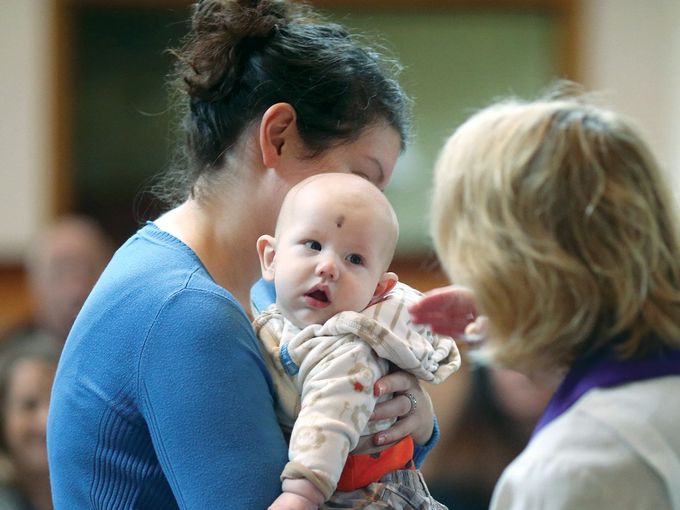
It is much more than a simple smudge at the bus stop.  Sure, there are many who will also offer prayer in that time.  Sure, there are many who will also offer information about how the individual seeking to be “ashed” (or get the “ash kicking” as I like to say) can hook up with a faith community.

I’m not saying you shouldn’t do it.

I’m just saying why I’m not going to…and I want to ask the question publicly.

Because despite the prayer and the information on faith communities, I don’t think Ash Wednesday is the day to do it.

We don’t see people out on Easter passing out lilies.  Actually, that makes a ton more sense to me…

I don’t want Ash Wednesday…I don’t want my mortality…to be a gimmick.  And I worry that the church can turn it into that.

And there’s something important about having Ash Wednesday with other people of faith, all together, in one place.  There’s something important about me, the individual hearing “Memento, homo, quod pulvis es, et in pulverem reverteris” but then also having all of us, communally, hear it.

It’s not just about me; it’s about us.  All of us.  We are all stardust…and our systems of power and “isms” and phobias have reinforced it.

And there is something powerful about having a train full of cross-smudged commuters.  I won’t deny that.  But what does it mean that they got it running for the 8:05am?

Have an early morning Ash Wednesday service.  Or a noon one, where people can do it at lunch hour.  Or, have a full one at the bus stop, 20 minutes long.  Or point people toward a service that happens right as work gets out downtown.  I think these are good options.  But not as they’re running by…

Because I want to know: what do we think we’re saying when we’re offering a reminder of mortality on the fly?

What We Lose When We Exorcise Mystery from Religion

So, this Sunday falls directly on Candlemas, and for dorks like me that’s a bit of a big deal.index

For those of you not in the “know,” Candlemas is that time in the church year (for some of us) where we haul out all the candles in the church (or at least a representative sampling) and bless them.  My colleague calls it a “hinge day,” marking the midpoint between the Winter’s Solstice and the Spring Equinox.

So we haul out the candles and we bless them to acknowledge the Christ as being the “light of the world.”  And I’ve never met anyone who didn’t sit in solemn silence in the presence of a candle illuminating a darkened room.  There’s something deeply True about doing that.

It’s kind of like how many of us will burn greens right after Christmas, pray late into the night on the Winter’s Solstice, and bless houses at Epiphany.

All of these rites, these rituals, help us to breathe deeply  with history, with the Earth’s movement, and with the mystery that connects us to one another and to the Divine.  It’s why I bow toward the cross as it comes into my midst: I want to honor in my body the mystery of salvation.

But a lot of places don’t do this.  Won’t do this.  Indeed, a lot of places think these acts are superfluous at best and superstitious at worst.

I don’t bless candles because I think they must be blessed.  I bless them because, in doing so, I acknowledge that light will overcome darkness. Always. And that deserves blessing.

I don’t pray late into the night on the Winter’s Solstice because I think that evil resides in the shadows and I must pray it away.  No. I know evil resides in the shadows.  Hence why we don’t tell our secrets…many times they’re too full of evil, guilt, or shame to expose to the light.  So I pray late into the night to acknowledge that, from that point on, it will get lighter and lighter each day as we lean toward Spring.

And then, perhaps, I can allow a little light to shine more and more on my secrets.

And all of these practices help to connect me with a mystery of life and salvation greater than myself.  It’s kind of like our big harvest festival, Thanksgiving.  Ever since our forbears figured out that a dead seed will spring from the Earth, a mix between careful tending and damn luck, they’ve acknowledged that to live, and to breathe, and to eat is a gift.

All of it, gift.

And part of living into that gift is acknowledging that there are moments in life that are just bigger than us…and that should be ritualized. Communally ritualized.

But so much of modern faith is all brain or all heart and no mystery (unless we’re expected to believe that Jonah mysteriously wasn’t dissolved by stomach acid).

We just feel it’s true.  We assent to mental tenets (or reject them).

And yet, deep love is neither mental nor emotional.  It doesn’t make sense to the brain, and is often too fleeting with the heart.

No. Deep love is a mix of the head and the heart and the guts and…and that’s where I find true faith to reside, too.

Timothy Keller and Christopher Hitchens attempt to rationalize everything (they are in good company).  They are the different sides of the same coin. Not everything has an answer.

Likewise, the absolute emotionalism of charismatic and ecstatic communities miss the mark, too, I think.  Things aren’t true because they move our emotions; emotions are fleeting.  “Mystery” doesn’t mean believing just anything.

No. Things are true because they connect us deeply in the past and far into the future.

Hence why myth is True in a deeper sense then pure history.  Hence why rituals are True in a sense deeper than mindless monotony.

A belief system (and, remember, even atheism is a belief system) that attempts to exorcise mystery by finding a formula for everything and explaining everything or, conversely, by necessitating a constant emotional response is a faith that has lost something.

I think it’s lost depth.  My atheism was shallow.  As was my previous faith.  And while I don’t claim that I’ve reached some sort of amazing depth in my faith life now, it’s certainly more connected then anything I’ve practiced before.

Rituals don’t “save” me.

No.

I don’t do them to earn anything.  Rather, they do exactly what “religion” claims to do: they reconnect me.  Re-ligio comes from the same root as “ligament.”  It  reconnects us.

Because we have a way of disconnecting from life.  But, too often, even religion fails to live up to it’s name these days.

So, this Sunday, haul out some candles.  Give thanks for the light.

“Power Sucks” or “Sing the Magnificat Carefully”

So, I’m going to try my best not to join the chorus Phenom-Power-631of people lamenting Joel Osteen and Joyce Meyers and Beth Moore and the like.  Well, at least not too much.

Needless to say I think they’re all full of it; I don’t think I need to point out to you why that is in any great detail.

But too many in the church are calling them “false prophets” and other such crazy names.  Frankly, I think that’s giving them too much credit.  We shouldn’t call them prophets at all because their message isn’t, in the least, prophetic.  They’re just people trying to make a buck, I think.

No really, I think that’s all they are.  They’re great showmen.  They’re good speakers (not great speakers, mind you).  And they’re good at organizing other people around them.  Natural leaders.

But they’re not prophets.

To be a prophet, to speak prophetically in the historical sense, was to speak truth with some boldness.  It was to speak in such a way that the very powers and systems of the world were shaken, afraid of your message.  This is why Paul speaks of teaching and preaching, “boldly.”  He does so in such a way that the very powers were afraid.

Hence why he ended up in jail so often.  Prophets usually ended up dead because of their message.

I’m pretty certain Olsteen, Meyers, Moore, Dollar, Jakes, and basically the personalities of channels 460-480 on my cable package will end up in jail.

For tax fraud.

Not for speaking too boldly against the powers of this world.

See, their message is one of power: God wants you to be powerful.

Powerful bank accounts.  Powerful influence.  Prestige.  Powerful enough to look at a house and “claim it” before you can afford it (aka “The Joel Osteen Story” coming to a Lifetime time-slot near you).

Powerful enough to actually believe that Living Proof Ministries would be an attractive name for a company that publishes “educational material” written by someone with no scholarly training in Biblical history or interpretation (that’s Beth Moore’s ministry outfit, in case you were wondering).

I need the living proof that she’s qualified to write material…

Here’s where the cognitive dissonance comes for this Christian: Jesus, in his life, in his birth, in his death, in his interactions, was not powerful by any worldly definition of power.

In fact, the song we’ll be singing in my faith community on Sunday, The Magnificat (Luke 1:46-56), talks about how God throws down the mighty from their thrones, fills up the hungry but sends the rich away empty, scatters the proud, and causes all sorts of ruckus for those who play by the power rules of the world.

Look, Jesus was a homeless man, born to an unwed mother.  He had no job, lived off of the kindness of others, and died when he was a young man in the most horrible way possible.

By all accounts, Jesus was a failure.

And apparently Meyers’ and Olsteen’s and Jakes’ message to Jesus would be, “God’s got a blessing just waiting for you!  Just wait and see!  God doesn’t put up with people who are down on themselves, who don’t think they can. You are powerful in God!”

To which Jesus replies, “My God, my God, why have you forsaken me?”

Power sucks.  It sucks the life out of us.  It sucks the message out of the church.  It just plain sucks.

Look, I’m not down on wealth or self-esteem.  God hasn’t made you to be a Debbie Downer (though God did make Rachel Dratch for that role).  Nor has God made you to be scraping by economically (though, I think there is such a thing as having too much).

I’m just down on wealth and self-esteem being pandered around as the central message of the church in this nation’s biggest churches.  And especially at this time of year, when laser-light Christmas pageants are being planned, and live camels are being rented, and all sorts of nonsense is costing people millions of dollars and hundreds of hours because they think God desires “bigger and better!”…

I have to imagine Jesus is in the back row, quietly lighting a candle, looking up at the stage and saying, “Father forgive them…for they know not what they do.”

Oh, and Father, forgive me, too.  This reluctant Christian is often just a little too proud in his thoughts.

So scatter my ego as well.

Then perhaps I, too, can sing The Magnificat with Mary this Advent.  Carefully.

Really Re-Claim Advent. We Need It.

I love Christmas.7772528906_b6961079fb_z

Secular Christmas, religious Christmas, Christmas movies, Christmas cookies, Christmas eggnog, Christmas candles, Christmas lights.

I am the quintessential consumer of Christmas crap that every marketer dreams of and every minimalist fears.

Because at Christmas it should be classy…but the definition of classy has permeable boundaries.

And I listen to Christmas music early in the season.  Mostly because I think it reminds me of Christmases when I was a kid, which were always full of magic and mystery and all sorts of greatness.

And perennial calls for stopping “wars on Christmas” or yelling for “no Christmas music until Advent is over” is all a bunch of nonsense from people who love to control things and who have an inordinate amount of time to obsess over nothingness.

But one thing is true: Christmas is for children.  And I’m not just talking about secular Christmas with the fat elf and the flying Rangifer tarandus.  

Religious Christmas is for children, too, in many ways.  You may not want to hear that, but it’s true. The myths that have grown themselves around the first two chapters of the Gospel of Luke (often conflated awkwardly with the first two chapters of the Gospel of Matthew) have created a narrative that theologically resonates, but realistically falls flat.

Angels, traveling Magi, virgin births…it’s all hard to swallow as reality, even for the faithful. It’s a story for children’s books.

And I’d advocate that you need not swallow it all to be Christian.  In fact, it sounds like so much myth mostly because it was written to evoke that kind of thought in the reader and that kind of hope in the reader’s heart.  You, too, are supposed to see that something unusual, epic, of mythical proportions is taking place in the person of Jesus.

Yes, you too.

But we’ve taken the mythical narrative and have tried to pass it off as history, and it all makes for people creating wars on Christmas (real and imaginary), and people rejecting theological truths because they don’t line-up with historical reality, and…

Well, here we are.

But see, this is the thing: the mythical nature of Christmastide is, and should be, balanced by the stark reality of Advent.

If only we could really re-claim Advent.

And I’m not talking about the Advent calendar with nice little doors that have chocolate inside until you get to Christmas eve.

That’s not real Advent.  That’s commercial Advent.

And I’m not talking about just banning Christmas hymns or music in deference to Advent music.  That’s like only focusing on one tire on a car, when the whole thing is broken.  It won’t do what you want it to.

No, we need to reclaim the totality of Advent because Advent is for adults.

Advent is for adults who wait for births, or for diagnoses, or for the death of a loved one, or for a new job, or for any job, or for that pink slip they know is coming, or for relief from pain, or for visitors to arrive and cheer up a lonely existence, or…

Or anything that we wait for that causes anxiety.

Because Advent is all about receiving the uncomfortable news that God is on the scene, is going to show up, is going to shake up your world in some way.  And that news when coupled with the “Fear not!” of the angel message is what balances out this season.

Your life is going to be shaken.  But fear not!

Jesus, we need to hear that again.  And I mean that phrase in every way it can be taken.

Because all the ridiculous anxiety around this time of year just points to the unrest that we have, the imbalance that we feel, when we focus so closely on one part of a larger issue.

The church needs to reclaim Advent because society, humanity, lives in Advent quite a bit of the time.  It’s one of the shortest seasons in the church year, but one of the longest seasons of our lives: the season of waiting.

And we need to practice waiting well.  Advent can do that, for the secular and the religious alike.

And I’m a reluctant Christian at times because most of the Christian world just skips right over it in deference to “defending Christmas” or focusing on music rather than meaning, or just abandoning it all together because, who cares?

Who cares?

That’s a question I’ve asked myself many times while waiting  as both ends of the wick burn, as patience runs thin, as the meagerness of my existence comes colliding with the immensity of the existing world and I feel like a measly piece of nothingness against it all.

And I don’t have time for nothingness.

Who cares?

Advent’s answer to that question is, “Wait for the Lord, whose day is near.  Wait for the Lord; be strong take heart.”

I don’t like answers.  I like questions.  But when all I have are questions, Advent’s response is balm for a weary soul.

“Obscenity” or “On Why I Discourage People from Writing Their Own Marriage Vows”

I do a lot of weddings. I have a young community that I serve; it comes with the territory.writing-wedding-vows

And marriage is certainly on the radar these days in the States as more and more parts of the Union have legalized the union of same-sex couples.

I support same-sex marriage.  I should just say that off the bat.  I support it because, despite what you might hear out there, the Bible doesn’t have a thing to say about marriage.  It has many things to say.  And many of those things run contrary to modern notions of marriage.

What I don’t support, though, is for couples to write their own vows.  Sometimes I allow it…with conditions.  But, by and large, I don’t support it.  I’ll just come out of the proverbial closet on this: I’m against crappy vows.

If you want me to use my special designation by the State to do marriages, I’m going to force you to do pre-marital counseling with me.  Each session focuses on a different aspect of life together (and life, in general): family, finances, friends, and intimacy.

(If you want to keep going with “f” words it become obscene).

Another “f” word, faith, is woven through all of those.  Faith as trust: trust in the Divine and one another.

The very first session, though, is where we plan out the ceremony itself.  We spend a little while talking about order and structure, and then we look at words.  I think words are important (as you may know from previous posts).

I think words are so important, in fact, that I don’t continue with my string of “f” words when describing the different pre-marital counseling sessions…even though it would fulfill my great delight in alliteration.  The “f” word we commonly associate with intimacy is anything but intimate.  And although it’s a curse word that spices up language (and I’ve been known to curse), let’s not kid ourselves: we don’t feel particularly intimate with the “f” word in a way that is lasting.

If we did, we wouldn’t use it so liberally.  It is an obscene word that we use to indicate that something is just that: obscene.

“Love” is by far a scarier word to say.   And intimacy is not obscene, it’s scary.

So, because words are important, I always take the couple through the various words that I can/will use in the service: the declaration of intention, the prayer of the day, the blessings.

And then we get to the vows. And at this point I usually say something like this, “Now, I’m going to give you some options for vows and I want us to talk about them.  I want you to use one of these options. If you want to write your own vows, that’s a possibility…but I need to see them before hand.  And we need to talk about them.”

In all honesty, most couples aren’t interested in writing their own vows.  They’d rather have someone write something for them on a day when they’re already more visible than they’d like to be.

But every so often a couple will want to write their own…and that’s when I do my damnedest to try to talk them out of it.

See, this is the thing: in marriage, you can’t just promise whatever you might want.  And because love is scary, we often don’t know exactly what we want…and so we just go with what we know.

And so much of what we know is just sentimental generalist crap.

A vow is something very specific.  I had one of my best couples consider writing their own vows because, as the future bride put it, they wanted to “publicly express their love for one another.”**   Of course they do.  But that’s what the marriage ceremony is in and of itself.

A vow is not an expression of love, and yet so many labor under the delusion that it is.

A vow is a sacred promise, a statement that you say in front of people who, if they are at their best, will hold you accountable to them.  A vow is you saying, “Hey everyone listen up! I’m going to pledge some very specific things to this person across from me, and I want you to hear them and hold me accountable to them.”

Expressions of love are not vows.  Expressions of love are emotionally based.  Vows are not emotionally based, no matter what popular culture tries to tell you.

Vows don’t come from your heart, nor do they come from your head.  Vows come from that place that exists somewhere between rationality and emotionality, because you keep them even when it doesn’t make sense, and even when you don’t feel like it.

So many couples want to write their vows in secret, apart from one another, and then surprise the other with them.  Such surprises are best left for other points in the service, or other times in the whole event of the marriage day.  If you write your vows in secret, how are you to ensure that you’re vowing the same things to one another?

One of you cannot vow to be with the other to the bitter end, while the other only mention staying together in sunny times.  That happens, you know.  I’ve heard self-stylized vows that had very little to say about “the worst that is to come.”

And that’s when the vow is so important!

In a day and age of choice, which is what we are in, I’m sorry…I’m not willing to provide you with this particular choice.  You cannot choose what you vow to one another in marriage; marriage cannot mean whatever you want it to mean.

And I know that may seem to trample on individuality, but I’m trying my hardest to impart one thing and one thing only on you two: this is important.  You will make of your journey together what you will, but I want to hear how you’re going to make the journey, and I’d prefer you use ancient words that people have leaned on throughout all of time.

Because for as much as this is about you and your love, it’s also about all of us who witness it.  Because you invited us to be there.  So I’m going to try to hold you accountable to these things to the best of my ability.

And I’m not one who believes a couple should “stay together at all costs.”  Sometimes an amicable divorce is healthier than an acrimonious marriage.  But, at the very least, can we not look at the vows you made and figure out where things went wrong?  Let’s not pretend that people divorce over irreconcilable differences.

We divorce because vows are difficult to keep and we have trouble living together in covenants.

And so, instead of vows, too often we just have statements of love and intention because other people are really really difficult to live with.

No one marries intending not to stay together; I know what you intend.  I want to know what you vow.  I want to know what you promise from that place between your head and heart, that place of deep yearning that leads people to come together in marriage in the first place.

I don’t think marriage is under threat because people of the same sex want to marry.  Any two people can make a vow; gender doesn’t have much to do with it.  Marriage is under threat because people, of any sex, want to marry on their own terms.

And so much of the church is missing the boat here, I think.  We shouldn’t stand against same sex marriage, we should stand against shoddy vows and a society unwilling to comment on them in a meaningful (read: not judgmental) way when they fall apart.

I think the Bible has many things to say about marriage, most of them absolutely foreign to our modern ears and notions about the institution.  The question for the church isn’t, “What does the Bible say about marriage?” It is rather, “What does our faith say about marriage?”

And our faith, the Christian faith, says vows and covenants are important.  This thread flows through both testaments.

I’m a reluctant Christian at times because, well, we’ve been silent on the vows…but have a heck of a lot to say about who should marry.

And to not see the difference?  That’s just obscene.

**The couple eventually decided to have some statements of love that they had written to one another read before the vows themselves.  This is a great option, I think.

The Pews Stink (and So Do the Chairs)

There is so much going on in faith communities.girl-church-pews_8615_990x742

…and so much NOT going on…

Arguments pop up all over the place in mainline protestant churches (mpc’s) over the stupidest things: where an American flag is placed, where a baptismal font is placed, whether guitars or organs are appropriate in services.

By and large I look at these things and think, “Holy crap, folks.  We have enough dysfunction in our families outside of the church doors, we don’t need more inside.”

No wonder the rumor is that mpc’s are dying if these are the things they’re arguing about (I say “rumors” because, well, every bush needs some pruning to grow so all the fervor over “dying” is just anxiety over “changing”).

But it is true: I’m not interested in inviting spiritual dysfunction in my life.  I think spirituality is about me and about others and about the Divine.  Too often churches focus on just one of the three (“God loves YOU…it’s all about YOU and YOU’RE decision to invite Jesus into your heart (the physics of which boggle the mind)” or “God loves your neighbor and you must, too!  Community is God and God is community!” or “You owe God a hell of a lot…don’t you feel bad about that?  Don’t you want to ask forgiveness and be shown mercy? God is angry…”)

I mean, there is a lot in all three of those statements, but by and large I find most churches choose one to focus on and ignore the others.  Like churches who only mention “God” or only mention “JEEEHESUS” or only mention “Slain by the Spirit!” and forget about the other two.

As if faith can be parsed so crassly and simply…

But there is one argument I’m wanting to have, but it’s difficult to have.  I want to have it for practical reasons and spiritual reasons.

In short: I hate pews.

They’re uncomfortable.  They’re difficult to navigate (bump your knee recently?). They force you to face only one way.  They’re immovable.

But…I also hate chairs.

They take a long time to set up.  They’re sloppy looking when set up.  Their style doesn’t lend itself to formal settings (no matter how you gussy up that seat cushion).

The church I serve is a cathedral-style church.  A bunch of chairs in there looks like a mistake.  The pews, though, are immovable and too close together and breaking.  But we can’t just do chairs because it wouldn’t work. One of my marginally-churched friends noted one day that they’d far prefer a pew to a chair if given the choice because your butt can take up the room it takes up instead of being confined to a chair seat.

Plus, I don’t want to do just chairs.  They stink just as much as pews.

I know it seems like so much dysfunction to chat about how you sit in a worship service, but I actually think how our bodies are will impact how our spirits and minds are.

Flexible seating disorients us enough that we subconsciously begin to realize that it’s not all about us, or all about our neighbor, or even all about God.  Different arrangements highlight different foci…and that’s an important thing to acknowledge about faith that the church usually refuses to acknowledge: at different points in life faith takes on different foci.

And then I came across St. Peter’s Lutheran in NYC.

St. Peter’s has short pews that can sit three to four butts…and are moveable.

You have to sit close, but you can change the seating.  You can’t think it’s all about you sitting so close (the benefit of a pew), and yet you can use them flexibly (the benefit of a chair).  You can turn them for intimacy at times that call for intimacy.  You can face them all in the same way for times that call for that, too (and, yes, sometimes that is called for, I think).

And for mpc’s that are “dying”, often times the struggle is how to build intimacy in a cavernous space.  When our second service at the church I serve was launched, this was one of the problems for my community.  We had about 30 folks in a space that seats 200.

What to do?

We took out some pews to make some gathering spaces.  And we gathered.  We gathered around the altar for communion.  We gathered in the aisle for prayer.  We gathered around the font for baptism.

We got our butts out of the seats and into flex space.

And, lo and behold, the intimacy created energy…and now we’re at the point where we can’t do that anymore because there are too many people.

…but I still want to.  How to do it now?  I think I have an idea…but it’ll be a hard sell.  Because we like things we can rely on.  We like things the same.

And if there’s one thing most people rely on, it’s that church is a place where they won’t be confronted with discomfort.  It’s all about them, after all.  Or all about community, so they don’t have to deal with their own crap.  Or all about God, and God loves them but is tired of their crap and the community’s crap.

It’s not about the uncomfortable tension that all three of those things combined causes, right?

Pews stink.  Chairs stink.  I want a hybrid.  I want flexibility.  I want to acknowledge that faith in post-modernity must be more flexible than most places want to acknowledge.  The conservative churches want you to think they’re linking you into unmoveable truth tenants, and yet most of them use chairs because they think they can anchor you theologically as long as you can move physically.

A nice bait and switch.

The so-called liberal churches suggest that nothing is fixed and all is fluid…and yet most use pews because you can change your religious views, but God forbid we change how we view the front of the sanctuary.

Mixed signals galore.

In truth, faith is a mixed bag of all that and a lot more…and how our bodies are can affect and reflect how our minds and spirits are (thanks yoga and t’ai chi for reminding the West of this).

So, how about we chop up our pews, un-anchor them from the floor, and start acknowledging something different in our lives? How about we ditch our silo-inducing chairs and start sitting closer so that our neighbor’s faith might affect ours? It might be uncomfortable.

But, hell, I’ve never been in the presence of God and felt comfortable…

On Death and Christmas Eve

In those days a decree went IMG_1595out from Emperor Augustus that all the world should be registered. 2This was the first registration and was taken while Quirinius was governor of Syria. 3All went to their own towns to be registered. 4Joseph also went from the town of Nazareth in Galilee to Judea, to the city of David called Bethlehem, because he was descended from the house and family of David. 5He went to be registered with Mary, to whom he was engaged and who was expecting a child. 6While they were there, the time came for her to deliver her child. 7And she gave birth to her firstborn son and wrapped him in bands of cloth, and laid him in a manger, because there was no place for them in the inn.

In “those days…”

Those days.

I wonder when “those days” are supposed to be.

I have “those days.”

Those days when everything seems to be amiss.

Those days when it appears that love has hitchhiked to the next county and isn’t coming back; when loneliness has set in to the point that darkness seems like it will never leave.

Those days when the world has turned all around to the point that up and down are no longer real directions because I don’t recognize where I am in life, let alone which way is positive and which way is negative, which way leads to life and which to death.

In “those days…”

In those days of Jesus’ birth there was peace.  Pax Romana, we call it, the “Roman Peace” brought on through imperial domination.

Rome won all the wars.  It forced people to be peaceful…according to the Roman definition of “peace” which sometimes involved people being hung from crosses or eaten by wild beasts for sport.   Not exactly a Christmasy sentiment…

In those days of Jesus’ birth counting people was the task at hand.  How many are here?  We have to have the numbers if we’re going to assess how much people are worth, after all.  Your taxes were directly dependent upon your citizenship and status.

In those days people’s worth and wealth were directly connected.

That, in many ways, doesn’t only sound like “those days”…it sounds a lot like “to-day.”

Luke’s beginning to this most memorable reading sets us squarely in place.  I imagine he’s expecting us to land in the first century when Quirinius is governor of Syria.

But it also sets us squarely in “those days.”  Those days when it seems like there’s nothing left to us and everything is going cold.  Where we try to force ourselves into a peaceful state, only to fall back into darkness.

Much like the cold of Christmas Eve night.  Much like the darkness of Christmas Eve night.

I’ve spoken about this before, but it’s worth repeating, Christmas Eve reminds me a lot of our other big late-into-the-evening-I’m-so-sleepy-why-am-I-here? service: The Easter Vigil.

Because this, too, is a vigil.

The Easter vigil is where we await the resurrection, where God brings life out of death.

But Christmas Eve is a different sort of vigil.

Instead of waiting for resurrection, on Christmas Eve night we await a death.

Now, I know that might be surprising to hear, especially because Christmas is all about babies being born and cookies frosted and ringing bells and warm feelings.

But, trust me: this waiting for a death is a good thing.

Christmas Eve we keep vigil, waiting for the Emmanuel, the God-with-us, once again, so that “those days” can die.

Those days when we feel unloving and unloveable.  Those days when we feel we aren’t worth it.  Those days when we fear that our lives are purposeless, that our existence is accident, that our only hope is in our hands or in our emptying bank accounts or in…nothing.

Those days when we try to force peace upon our lives but fail as we’re devoured by the beasts of greed, fear, anxiety and hung on the cross of our ego…

On Christmas Eve we light a candle, we celebrate the silence of the night as “those days” gives out one last gasping breath and we remember that those days are gone if the Nativity story is true.

Joy to the world.  Joy to you and me.  “Those days” are gone.

God rest ye merry gentlemen and gentlewoman, “those days” have only the power we allow them to have because their real power is gone.

We wish you a merry Christmas because “those days” are impotent.

So forget about whether or not the Nativity is factually real in all its glorious, romantic detail.  Theologically it is real in the most true sense of the word!

Because in “those days” God saw fit to show humanity, show us, that we have purpose enough for God to take on our form and show love.  That we are deliberately and wonderfully made in our existence.  That our hope is not in our hands or our emptying bank accounts, but in the hands of the small babe on that night when heaven was emptied so that the earth might know the fullness of God’s love.

Christmas Eve celebrates that those days are gone, and new day has begun.  A day full of God’s grace shown in the smallness of kicking legs and infant cries; a grace so vulnerable that even you and I can approach it with the assurance that it does not harm but only helps.

Such is God’s nature; such is God’s grace.

That night, light a candle to the death of those days.  And as we pass that flame from one candle to the next, we’ll create new light with all of our waxy ends, reminding us that the darkness of those days is dispelled on Christmas Eve night.

The night of the newborn baby.

The night of the new light.

The death of “those days.”

Merry Christmas.

Dem Bones…

On the eve of All Saints we do what we love to do: play dress-up.

And it is just play.  Theologies and theologians that glorify Halloween as “Satan’s Day” aren’t good students of history.

That being said, the gore that is often associated with this day doesn’t appeal to me.  I’m a fan of horror flicks; I love a good scare.  But I’ve seen enough real blood in hospital rooms, ER’s, and elsewhere to not need the fake stuff.

But Halloween and All Saints also conjure up in me thoughts about life, mortality, death.

I find myself singing the spiritual

“Dem bones, dem bones, dem, dry bones…”

I’ve written previously about the importance of having  funeral at the time of death.  I still feel that it’s supremely important to honor and celebrate life by acknowledging, grieving, and honoring death.

Yes.  Honoring death.

Not as something to revere or worship, but as something to peer into as mystery.

I live with a biologist.  Carbon returns to carbon; it’s nature’s way.  As I’ve said at every funeral liturgy I’ve ever presided at, “ashes to ashes, dust to dust.”  We certainly shouldn’t labor under the delusion that somehow death is unnatural or evil.  I can understand how some people may come to this conclusion reading certain parts of Genesis and Romans.  Yet there are other sections of scripture, the Lazarus story in John for instance, that give another glimpse at death.

In that story Jesus “tarries” a while…not preventing Lazarus’ death.  One wonders why he might want to.  But in raising Lazarus, what Jesus does is dispel the fear of death.

This idea, I think, is something that the religious individual can grasp tightly.  Death is not to be sought; surely we are not masochists (at least, not most of us).

But neither is death to be feared.

The fear of death is all around, though.  In skin-products that promise ageless beauty.  In caskets lined with gold…perhaps because, the thought is, we can take it with us.  In medical procedures that prolong breathing but cannot prolong life.

We fear death, and we have made a market on that fear in the buying and selling of death-killers.  Surely the market is the death of our modern souls.

Hear now from Rabbi Abraham Joshua Heschel about the wisdom we can mine from the mystery of death:

The greatest problem is not how to continue (living) but how to exalt our existence.  The cry for a life beyond the grave is presumptuous, if there is no cry for eternal life prior to our descending to the grave.  Eterenity is not perpetual future but perpetual presence.  God has planted in us the seed of eternal life.  The world to come is not only a hereafter but also a herenow.

Our greatest problem is not how to continue but how to return. “How can I repay unto the Lord all his bountiful dealings with me?” (Psalm 116:12)  When life is an answer, death is a home-coming. “Precious in the sight of the Lord is the death of the saints.” (Psalm 116:15)…This is the meaning of death: the ultimate self-dedication to the divine.  Death so understood will not be distorted by the craving for immortality, for this act of giving away is reciprocity on our part for God’s gift of life.  For the pious…it is a privilege to die.

My wife gave me a note that someone passed her on the street.  It’s in the shape of a “1 million” dollar bill, and it has written on it, “The million dollar question: Where will you be after you die?”

Such conversion tactics are wasteful in the “throw this away for me” sort of way.  Theologies that only point toward heaven are useless.  If the goal of this life is to get somewhere else, why bother?

My response to the giver of that note would be, “The million dollar question isn’t where will I be when I die, but how have I lived?”

And if I have a million dollars, or perhaps one dollar, that might make heaven a reality for someone here in this existence and I fail to do it, then I have been negligent in my life.

I do not fear death, nor do I seek it.  I trust in the promise of heaven, but my home is here.  And may I do my part to bring heaven to this reality, trusting that what awaits me after my last breath is God’s eternal presence…something I’ve never been separate from.

And at my last breath, I imagine I’ll pray the same prayer that I’ve prayed at every funeral I’ve presided at with all “dem bones” in my body,

May God support us all the day long till the shadows lengthen and the evening comes and the busy world is hushed and the fever of life is over and our work is done.  Then in mercy may God give us a safe lodging and a holy rest and peace at the last.

Amen.

“The Broken Record,” or “The Trouble with Church…”

“The trouble with church is…” or, “If only we would…”

I hear those phrases a lot when people start talking about church.

It’s like a broken record.  Everyone’s agenda is either blamed as the cause or heralded as the cure for whatever is wrong with “church.”

I’d like to hit the needle on that record player for a second.

It’s not that I think organized religion doesn’t have issues.

Man, does it have issues.

Huge issues.

And in many ways it needs to follow the path of Jesus and die a bit so something new can be raised up.

But I think that many times the reasons we give for churches and communities having “trouble” (however you define that word) are pretty lame.  I think we’re pretty good parents, but pretty lousy doctors, when it comes to church dysfunction: we know something is wrong but can’t diagnose it.

Myself included.

But I think I’ve identified some things that might be food for thought.  There are others, of course.  Other responses, other questions, other diagnoses.

The following are my top five; you probably have your own.  Feel free to share them.

So, here are 5 of my responses to 5 of the reasons I hear most often when it comes to “the trouble with church.”

# 5: “The trouble with church is that we don’t have a ‘contemporary’ service.”

Hey, have whatever style of church service you want.  We have a couple different worship styles where I serve.

But if I were to guess, I’d say that the trouble with your church is not that you don’t have a “contemporary service” (whatever that means).  The trouble is that people aren’t connecting with the service that you do have.

The relevance of religion can’t be assumed in this day and age.  I think the common person walking around today downloads apps on their phone for two main reasons.

1: they feel they need it.

2: they think it’s interesting.

That’s why I download the apps I do (and my wife hates the “flashlight” app…mostly because I use it to find the bed late at night if she’s gone to sleep before me).

So why do you do services at all?  Why do you need them?  Why are they interesting/insightful for you?

Do people even know why you’re doing what you’re doing?  Do they see the deep connections that are present?

Do you know?

People talk about “relevance” when it comes to church all the time, but I think they want to do it abstractly and with the wild assumption that everyone thinks “church” is necessary.

But in the concrete, what does it mean to sing communally?  What does it mean to read ancient texts together and hear someone reflect on them?  What does it mean to join your voices in prayer, refocusing yourself on the needs of the world and those who are ill?  What does it mean to eat a communal meal where everyone is invited forward and no one leaves without something?

Are you talking about these things?

I really don’t think that Christians today can fail to have the conversation on why the worshiping community is important, but so many churches aren’t having that conversation at all.

Not even amongst the people that do show up at church.

Change the style all you want.  Unless the deeper conversation is happening, I don’t think it’ll go anywhere.  And then you’ll just have someone come up to you and say, “You know what the trouble with this church is? We don’t have a “traditional” service…”

#4: “The trouble with this church is that we don’t have any young people.”

Yeah, this is a problem in some ways, just like a church with only young people is also a problem.

But energy isn’t generated by age; it’s generated by mission.

If your church doesn’t see a growing group of disciples, my guess is that the group that is there is unclear about what it’s doing there in the first place.  A church that understands itself (much like a person who understands themselves) works best because it knows where it is going.

Where is your church going?  Have you discussed it?

Many times I’ve heard people lament the absence of “young people,” and I think to myself, “So, you’ve already identified what you don’t have…but what do you have?  Where are you going?  Yes, you’ve talked about what you were, but who are you now?”

Know thyself and you will grow thyself.

Or, if not, if you come to understand yourself as a community best served in joining others in service through disbanding and moving your energies that way, then do so.  If people aren’t coming into your community, go out and join theirs!

#3: “The trouble with church is that this pastor doesn’t work enough.”

I know lazy pastors, just like I know lazy accountants, bankers, plumbers and politicians.

But I find that most pastors that are accused of being lazy are actually just burned out.

And they burn out because we’ve stopped hiring pastors to help us be church, and just expect them to do church for us.

Perhaps the trouble is that the pastor doesn’t feel supported.  I have colleagues who don’t even feel liked!  They are simply another reminder to the congregation that they are not who they once were in the roaring 50’s when the beloved pastor reigned over an era of pew-packing popularity, mostly due to the fact that American culture and the church had aligned themselves in an unholy union that we’ve only just recently been able to divorce ourselves from.

It’s unpopular to say out loud, but I feel much of the exodus of this generation from the pews of their parents can be traced back to those boom days when this hemisphere thought that Jesus was waving an American flag…

If you think your pastor is lazy, ask yourself if you’ve taken them out for coffee to chat about what’s going on in their life.  If you do, I’d bet that you’d find a calendar so packed that they’re demoralized before they rise out of bed in the morning because there is absolutely no way they can turn the ship around by themselves with so many issues to attend to…and that they’ve been trying to for far too long.

#2: “The trouble with church is that I could use my time better doing something different on a Sunday morning.”

I hear this one most often from people who aren’t in a faith community.  I can understand their point.

Sunday morning seems, by and large, to still be a time of relative inactivity in this hemisphere.

For right now.

Youth soccer and dance is starting to invade into the Sunday morning schedule, though…and they’re just the first in what, I imagine, will be non-stop programming.

I think this is a cultural problem, by and large, although there are some steps that churches can take to change this.

We, as a culture, or over scheduled.  And we’re teaching our children to be over scheduled, too.

In polling the people of my church community on why they attend, what feeds them, a large percentage mentioned the peace and quiet that Sunday morning hour offers them.

Which means that they’re sleeping through the sermon…

But, I find myself seeking the same thing: an escape from the over scheduled, hectic pace.

That, in and of itself, has a positive psychological impact.

As a person of faith, I happen to believe there are other positives too: a connection with the Divine, connection with intentional community, re-connection with a self that is lost within a sea of calendar appointments.

But if we find that Sunday morning is the only time that we have to ourselves, I don’t think church is the trouble.

To borrow an old cliche: are we living to work or working to live?  Are we taking time to examine our lives, or just gasping for breath between sprints?

I think there is a deep spiritual problem with a life that is so over-crowded that intentional community feels like another thing on the “to-do” list.

When done well, I think, intentional community gathered around the things of the Divine can be the generator that helps us tackle our to-do lists.

#1: “The trouble with church is that it just brainwashes you.  God isn’t real, anyway.”

Again, I usually hear this from people outside of a faith community.

Although, I do have to say that there are plenty of brainwashed people within the church who behave as if God isn’t real…

I think a typical reaction to a statement like this is one of defense.  I’ve heard many people, who truly care about another person who has this opinion, go into a litany of “proofs for God”, eventually collapsing in a fit of tears.

Because proofs for God are dead-ends, and nothing brings a person to tears with such intensity as the realization that your worldview isn’t shared by everyone…and that they may have some pretty good reasons for thinking the way they do, too.

Churches have a history of being, and many still are, places where brainwashing happens.  But so are movie theaters, concert arenas, political conventions, book clubs…the list is extensive.  Group think can happen anywhere if two or three are gathered, I guess.

Because of this, I think that this reason deserves some careful consideration by those Christians whose knee-jerk reaction would be to challenge it out of hand.

We don’t want to be places of brainwashing, do we?

Do we?

I hope and think the point of an intentionally community gathered around God would be to ask better questions: about life, existence, how scripture informs our days and weeks, about justice and the path of the Christ.

And I think that intentional communities like a church can be places that de-program cultural brainwashing when it challenges you not to live for greed, but to give of yourself for the life of others.  Or when it challenges a community to not seek glory, but rather stand with the oppressed.  I think our culture tries to brainwash us all the time with mixed signals that only confuse us: buy this, reject that; eat here, follow this diet plan; give money here, divest there.

In fact, I think that our culture tries to convince us that God is real, and that God is us.

But there is another way to live.  A way around shared experience, intentional Divine connection.  A way of song, prayer, meal.  A way where the reality of God isn’t always assumed, but arrived at through communal interaction where we find God most present.

After all, I can’t force somebody to see the reality of God anymore than I can force somebody to see that I love them.  It takes relationship to come to that realization…and relationships that are coerced, hampered by knee-jerk reactions or blind allegiance don’t often go very well.

The Church has a lot of trouble; that can’t be denied.  But I’m not sure it has to do with service style, age demographics, pastor efficiency, timing, or group think.

Those excuses play like a broken record.  I think that any church who listens to those excuses will never be able to move the needle and get on their way with mission.

I think most of the time the trouble with church starts with the individual who finds the problem.

Myself included.

And I know I need a community with an eye toward the sacred to help me dig that out.

“An Invitation to Trust” or “An Invitation Not to Believe”

The Script has a song, Breakeven, that starts out,

I’m still alive but I’m barely breathing
Just prayin’ to a God that I don’t believe in

When this song first came out, I had a friend call me up and ask if I’d heard it.  “You’ll like the first two lines,” he said.  I was in seminary at the time, and while this friend would be someone who would probably identify as skeptical, he would always come and hear me when I preached or taught.

He knew my theology, my style, my leanings.

He knew that I think that many people pray to a God that they don’t believe in.  Perhaps he is one of them.

Perhaps we all are at one time or another.

We must remember that the opposite of faith is not doubt.  The opposite of faith is certainty.  Somewhere down the line of history we’ve lost sight of this, to the detriment of those of us who identify as religious and spiritual.

I’m a big proponent of changing the word “believe” into “trust” when we’re reading the scriptures.  Our post-enlightenment habits have tended toward making everything that happens in this world begin in the brain.  We use the words “belief” and “believe” in all ways as if it can be equated to “mental assent.”

But in the ancient world, no such corollary existed.  Diana Butler Bass notes this in her most recent work Christianity After Religion.  She writes,

Although Western Christianity would eventually be defined as a belief system about God, throughout its first five centuries people understood it primarily as spiritual practices that offered a meaningful way of life in this world-not as a neat set of doctrines, an esoteric belief, or the promise of heaven.  By practicing Jesus’s teachings, followers of the way discovered that their lives were made better on a practical spiritual path…members of the community were not held accountable for their opinions about God or Jesus; rather, the community measured faithfulness by how well its members practiced loving God and neighbor. (p 149)

When I was going through my first wrestling period with faith, I felt terrible.  I felt as if I had been fed these lies that I was supposed to mentally assent to and that I was finally coming out of a deep hole…only to find the world around me disordered and frightening.  It felt as if I was breaking a relationship with someone.

It felt as if I couldn’t breathe.

But I still attended services.  I still attended church.  I still contributed in religious discussions.

I still prayed to a God that I didn’t believe in.

And those practices brought me back around to faith.  Those practices, and some meaningful discussions with people who took faith seriously enough to fight with it, brought me back around to a space in this world where I could once again interact with God.

But it wasn’t belief, per se.  It was much more powerful than belief.

It was trust.

This is why, when Rick Warren the pastor of the mega-church Saddleback Church and author of The Purpose Driven Life, writes in an article published early last year that “change always starts in the mind,” and “to help people change, we must change their beliefs,” I think he’s ridiculously lost in the post-enlightenment mindset that has led the church to this place where people are leaving in droves.

He goes on to write that, “trying to change behavior (without) changing belief is a waste of time.”  I couldn’t disagree more.  My story wouldn’t make sense if trying to change behavior without changing beliefs is a waste of time. Warren obviously doesn’t understand lex orandi, lex credendi…

Sometimes I think these pastors that go for the “belief then behavior” theory of Christianity are no more than self-help gurus that insert the word “God” where it’s convenient. “You can change your behavior.  You can do it.  God will help you, if only you believe…”

Take out the God wording in that sentence, and I think it exposes what they’re really saying.

I don’t want to invite people to believe in God.  I want to invite people to trust in God.

We can believe all sorts of things about God, about God’s nature, about God’s action in the world.  We can believe all sorts of things about God’s authority, about what God expects of us.

But if “belief” is equal to “mental assent,” then everything rests on whether or not I believe what you believe about God.

If not, we end up fighting or not talking.

But if we trust God, we can trust enough to ask questions about God, of God, of one another without being threatened.

And then trust enough to invite people into those questions as well.  And trust is, I think, indicated through activities and practices.

I think that as we head into this next phase as people of faith, practices…activities of trust…will become more and more important.

I’m not sure how to invite Jesus into my heart, or even what that phrase means.  But I strive to live as if God is already present inside of me. And you, too.  And in the stranger, regardless of what they believe.

And I find it important to gather with other people who trust in that way, too.  Or who want to trust.  Or who don’t trust but think it’d be interesting to see what it looks like.  We teach one another.

And as someone who has been there in the deep hole of not making sense of whats up or down because not everything that you’ve been taught to believe lines up with reality, it’s really important, when you find yourself barely breathing, to pray to God…even if you don’t believe.

Doing so you’re embodying something more powerful than belief.  You’re trusting.

And trusting can change things.