

The Nashville Statement and an Islamic Tale Walked into A Bar…

926be0ae335555eb4dfe0e3eb9f2c358--sufi-quotes-jalaluddin-rumiI once heard that tortured Irish metaphysicist Peter Rollins tell this little Islamic tale:

A dervish was sitting alone one day, and a stranger came up behind him and slapped the back of his head.

The dervish whirled around, ready to defend himself, and the stranger said, “You can hit me, but first ponder this question with me: did the *smack* that we both just heard come from my hand or the back of your head?

The dervish glared at him and said, “You have the luxury of asking that question, but I do not, because I’m the one sitting here dealing with it.”

So my question to my evangelical friends who crafted and support this so-called Nashville Statement: you have a theory, loosely based on small bits of a huge tome of scripture, and not based at all in historical-critical study, that has to do with people who didn’t have a seat at the discussion table.

You released this in the middle of a huge national disaster, a few weeks after a huge white supremacist march which prompted multiple resignations from an administration that refused to outright denounce it at the highest level (but surprisingly none of those resignations came from within your advisory ranks).  You basically just reissued the same statement you’ve been trumpeting for years, chasing youth into conversion camps and suicide attempts, imperiling marriages as gay people marry straight people because there is no other option for them, continuing to be the genesis of strife in many families as parents are forced to choose between their faith and their out children.

And I want to know: “How’s this going for you?”

Because your little theory that you affirmed in this statement doesn’t take into account the people actually sitting there, dealing with it.  And every theory has to, at some point, wrestle with that refining question, “And how’s living with this perspective going for me?”

Here’s an idea: why don’t you invite a person who identifies as LGBTQ to sit with you at a bar? You bring your Nashville Statement, and they’ll bring their life story, about the fear of coming out to their family, about the shame they had to endure after that first person found out and told everyone, about how they tried to love somebody that convention told them they should and just couldn’t, about the time they contemplated (and attempted?) suicide, about falling in love but not being able to hold hands in public, about wanting children but being told by so many people that kids need a “mom and a dad.”

And then, at the end of the hour, after a few drinks (of whatever you want, don’t worry, I won’t tell), ask yourself, “How’s this statement going for me?”

Because after that, guess what: some of their experience will then be yours, if you have any semblance of a heart.

Oh, and here’s a theory: I bet many evangelicals would absolutely be open to accepting their LGBTQ kids, parents, and friends.  In fact, in their heart of hearts, my theory is that they already do.

Poet Christian Wiman writes in his heart-wrenching memoir, My Bright Abyss, “How astonishing it is, the fierceness with which we cling to beliefs that have made us miserable, or beliefs that prove to be so obviously inadequate when extreme suffering–or great joy–comes.”

Lord, this is most certainly true.

You know what I think those people in my theory are worried about?  

What other parents, kids, and friends will say.  Will they say something like this Nashville Statement?

And to them…well, I want to just encourage them to come out of the closet.

“Churches Should Behave Like Start-Ups” or “Be the Yeast, Not the Loaf”

2721032_1408333739618_acee1eadStart-ups are motivated by possibility and imagination.  They’re not just reacting to what’s going on around them, they’re forming what’s going forward.
Start-ups are interested in perfecting one or two things that they’re doing, while dreaming of that one next thing.  They’re not trying to be everything to everyone, becoming bogged down in propping up the part of their enterprise that is flailing.

Churches should behave like start-ups.  All churches, not just new churches.

Now, I get it…you don’t like comparing a church to a business model.  I don’t like the comparison much, either.  But let’s not pretend that we don’t have something to learn here.  Churches *should* excel at implementing metaphor to everyday life (looking at you, parables), so let’s metaphorically explore this, OK?

Start-ups respond to imagination; establishment responds to fires.  If you don’t spend more time on what you can do than what you used to do, you’re not responding to imagination.  Big establishment brands have just that: a brand.  But they’re constantly having to try something new to keep the brand and keep the edge (think New Coke). They’re constantly putting out fires to maintain the status quo, instead of starting new fires of inspiration.

“Thing kingdom of God is like yeast,” Jesus said, “which leavens the whole loaf.”

The yeast starts a fire in the loaf, and try as it may, the loaf can’t help but react.

Be the yeast, young grasshopper…not the loaf.

Instead of trying to keep the brand, though, why not just make innovation and imagination part of the “brand?”  Google has successfully done this (so far), as has Apple. It is possible to change the narrative, but you have to respond to dreams rather than fear.  Which brings me to my next point…

Start-ups dream and have faith; establishments fear. Once you get power, you long to stay in power.  Once you become the biggest, your quest becomes about staying the biggest.  One of the terrible things about being a start-up is the uncertainty factor of the future.  But if a start-up moves into the establishment phase, they quickly learn that the uncertainty factor never fully leaves, it just changes into fear: fear that you’ll lose market share or newness or what have you.

And so the trick, then, is to ignore the uncertainty altogether and rely on innovation and potential as your main motivator.

This doesn’t mean you don’t heed advice or warning signs in a failing endeavor.  If anything, leaning on potential and dreams will hopefully spur you to do some due diligence and research before setting out on the next new adventure you undertake.  But when big establishment thinking entrenches a system, it becomes about big conservation strategies, big consolidation efforts, and big risk-aversion…which leads to big death.

Jesus said that we are to give of ourselves for others (Matt 16:24). Which might mean that the current decline of the church might just be a sign that we’re starting to understand what Jesus means.  I’m not saying that size is indicative of discipleship (though I’ve made a claim smelling like that before), but I am saying that if we’re failing to risk on reaching out because we’re afraid it will change things and change us (and our church culture/habits/etc.), then we’re probably adopting fear rather than faith as our motivating impulse.

Start-ups make history; establishment protects history. Well, sort of.

Look: the history of your church is important.  Your church has done a lot of good in the neighborhood.  It has changed peoples lives.  It has provided a spiritual home.  Perhaps it has been a change-agent in the footsteps of Jesus for your community.  None of that can or should be denied.

But if your church is going to continue to do good in the neighborhood, to change lives, to be a spiritual home, to be a change-agent, it can’t be trying to lift up its past as some sort of golden-age of life.  Every living thing has a life cycle.  But if you want to hasten a demise, start pining for the past.

Start-ups don’t have hang-ups about the past because they don’t have one to be hung up on.  No matter how long your church has been at the corner of First and Fairbanks, every day it has a ministry opportunity that was not present yesterday, and so while it has a past, it also has tons of potential futures.  That is what you focus on, by God.

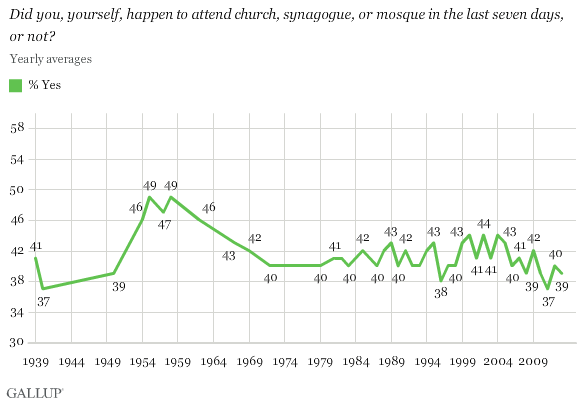
Look, I have the unfortunate lot in this work of being stuck in the post-boom years of churchgoing.  I call it unfortunate only because so many people lift up the 50’s as the standard of how churches should be and operate in America.  If you look at the 50’s, where civil religion and the church walked hand-in-hand post World War II, you’ll see an anomaly, not a norm, when it comes to church participation.

If you want a norm, check out church attendance from the 30’s.  There’ll you’ll see kind of a plumb-line.

ssmrnnozskgngstz2qohsq

And, can I be honest?  While church attendance in the 50’s and 60’s may have been high, poll folks around my age and ask them if they think the society they’ve inherited is utopian.  Turns out that church attendance may not directly correlate to societal health.

Churches of the mainline: hold on to your past loosely and embrace the dreams of the future.  Innovate. Explore. Jesus calls this out of you more than anything because it’s what we need now more than anything.

In other words: be the yeast, not the loaf.


A Letter to My Boys about Disappointment

letterHey guys,

I’m going to be a bit transparent and bear my soul for the (electronic) world, but mostly just for you for a minute (though you can’t read yet, but you will one day soon at the rate you guys are going!). I write as your dad. And I do so knowing that not everyone your dad knows will like this letter. But I’m banking on the fact that we can be honest with one another and still be together, right?  That’s what we say, right?

Look, I was disappointed in the election last night.  And not because a party won or lost, but because I really wasn’t sure what to do with the candidate that won.

And now, on the other side of Michigan’s electoral votes, I’m curious about the future, but I can afford to be.  Because our President-Elect (who I now pray for and who will be our President) said some things that really trouble me, though they weren’t to me. And I have to be honest about that with you.  That’s not to say none of the other candidates, including the primary rival, didn’t also say or do some things that made me cringe.  But he said things about vulnerable people. He said things about people with disabilities.  He said things about veterans, about our Muslim brothers and sisters, about our Mexican brothers and sisters, and about our Black brothers and sisters.  His VP pick has done things that hurt our LGBTQ brothers and sisters. 

He said things about women that I never want to hear out of your mouths.
Ever.

In fact, he said those things so loudly, that it was hard for me to hear the other things that he was saying, so I’m really confused today about what is next. Confused and curious.

But I know that others did hear him, and liked what they heard (what they liked and what they heard, I’m not sure, but it’s clear they did).  And they, too, are our brothers and sisters, many of them, I think, in vulnerable situations, too.  And I think that we share more common values than disagreements. I really do.

But you have to know something about yourselves, boys.

See, you’re middle class white kids in a country that’s still made for you. You don’t need to feel ashamed of that, by the way. But you need to be aware of it.  The current world is situated for you, and your responsibility is to start situating it for all, with all. The risk for you in the world is minimal, save for those risks we all have associated with living: cancer, natural disasters, deranged individuals, and the hazards of driving with your grandparents.

And so, what I want to say about disappointment is this: though I am disappointed (and disappointed that we do not, yet, have a female Chief Executive as an example for you, though your mom is pretty good at filling the role), disappointment is something you must get used to.  You don’t always get what you want, even when you feel you work really hard for something.

But I will be more disappointed if we somehow fail to help you understand two things:

  1. You live in community with other people, a community that is ever expanding, larger and larger. All of the following has to do with that, because no attempt at shrinking it will make it smaller. So you must get used to this. Know your words in this world have consequences. And your actions have consequences. So you must defend the weak and vulnerable. You must have courage to be who you are. You must look after your fellow brothers and sisters, especially those who are looked down upon or who are in vulnerable situations. That is your responsibility, no matter who is the Chief Executive of our country, because that’s what God and decency requires of us. And, if they’re worth their skin, they’ll look after you. That’s how good community works, and even if we’re not yet *good* at community, you can be good within community.
  2. Sometimes you’re going to be disappointed. And that doesn’t mean that you get angry (though anger is natural and OK in pieces) or get even (never OK). It means that you lean into your values of cooperation and love and respect and you do what you can, where you can.  And you don’t have to hate or hurt people who disagree with you. They are part of your global neighborhood, guys.

The world you’re growing up in is more divided than ever.  Some of that is because my generation and previous ones haven’t really learned how to disagree well with one another.  We’re struggling with an increasingly globalized world in a way that we aren’t really prepared (or mature enough?) for in most cases.  We’ve been fed that we must tolerate one another, when really what we should have been taught is how to love each other.  We’re not yet comfortable with that.

And no amount of platitudes will ease this discomfort.  What you must do is reach out to those different from you, however that difference is made evident, and be with them.  You don’t have to stand for intolerance, but I don’t want you to just tolerate anyone, either.

I want you to love people, as you’re best able. And loving people means you don’t make fun of them, you don’t assault them, and you don’t generalize them. It means you listen and have dinner with them, and you pick up the tab half the time.

And yes, you can be snarky, but try to avoid cynicism.  And yes, you can have strong opinions, but if your opinion becomes a personal attack, it fails to be an opinion and has devolved into a baser form of communication, which should be avoided at all costs because, well, you’re bright guys and are better than that.

We’re going to be disappointed sometimes, boys. But know yourself, and know who, when disappointment strikes, will feel the aftershock the most.  And that’s who you look out for. And not because you are some sort of savior or guardian, but just because that’s where you’re supposed to be, by God.

Got it?

Love you guys. Go Cubs!

Dad…

“You’re Not Promised Tomorrow” is a Lie

It seems like after every national tragedy–and let’s be honest, tragedy on any scale–people have this “ah-ha” realization about the fragility of life.

I think that’s a pretty natural reaction.  A wake-up of sorts.

And that “ah-ha,” that realization, often gets filtered into a phrase that comes out something like this: “we’re not promised tomorrow.”  It’s a carpe diem phrase of sorts. A call to mindfulness.  A call to smell the roses.  A call to, as Qoheleth and Dave Matthews chirp, “Eat, drink, and be merry” for tomorrow we die.

Or, at least, we might die.

On the one hand, I get that sentiment.  In a cosmic sense it is absolutely true, and shouldn’t be ignored.

But the tragedy in Orlando was not some cosmically caused killing.  A meteor didn’t fall from the sky and destroy Pulse. It wasn’t some freak shark attack.

If it had been a meteor or a freak accident, then I could get behind the phrase “we’re not promised tomorrow” as a response to this terrorist attack.

But this was a terrorist with a gun living under the laws and regulations of the United States of America.  We can’t just shrug our shoulders, hold our babies closer, and hope it doesn’t happen to us.  That’s ridiculous.  On some level, uttering that phrase in response to this particular act is just plain stupid sentimentalism; a vapid romanticism.

At its core, the laws and regulations that we live under are a social contract of sorts, a promise if you will, that your tomorrow cannot be purposefully infringed upon by my actions in a way that inhibits your “life, liberty, or the pursuit of happiness.”

I’m saying that those people at Pulse were promised a tomorrow.  At least in the sense that no one could infringe upon their tomorrow in a forceful way by law.  We had a social contract that someone decided to break, and here we are shrugging our shoulders and saying, “No guarantees.”  Sure…no guarantees.  But we do have promises which, while not guarantees, are the social contract version that is pretty darn close.

And when we say something like, “We’re not promised a tomorrow” as a response to a situation that is a breach of social contract we abstract the incident to arms length, when what we actually need to do is draw the incident as close as possible.

Because things at arms length…we have little control over that. It’s a psychological crutch. But this type of mass shooting is actually something that we, through our social contracts, can take action on.

When Moses went up to Sinai and descended with those two tablets (three, if you believe Mel Brooks’ account), it was to establish a social contract both between humanity and between Divinity and humanity.  It is basically a response to, “how shall we then live?”  And it was, in essence, a promise of tomorrow for those people.  This is how we order ourselves, by promising one another a tomorrow because God has intended tomorrows for humanity.

And for the Christian, the promise of tomorrow goes even past death.  So Christians must take quite seriously this part of our social contract.

And we cannot, of course, ever guarantee something like this shooting won’t happen.  Our laws are no preventative guarantee; they are a promissory note, though.  A promissory note that we all sign onto.

And, look, the promise was broken.  Let’s not pretend it was an act of God.  Let’s not pretend this was written in the stars or some similar platitude that will help us swallow this pill.

Do not swallow this tragedy.  Choke on it.  Choke on it and let action to save lives be our response.  If you throw it out at arms length we’ll just do this all again.

Let’s not pretend we have no way of figuring this out. We know how this happened; we know how it happens.

Let our “ah-ha” moment not be a realization about the fragility of life, but a renewed commitment to tomorrow and to keeping promises and to doing the things that help us all to keep our promises.

Because, actually, we are promised tomorrow.  Not guaranteed…but at least promised.

And if you say otherwise, you are delusional or lying or just unwilling to face the reality that we are not powerless here, we’re just choosing to be powerless here…

The Arrow and The Cross

version2-ryze-logo

Going up?

The votes are in.  It is clear that, in many and various ways, the church is slowly but surely abandoning the cross as its primary identity.

The new hotness? The arrow.

And if you doubt this is true, think of all the churches that have an arrow pointing upward, or “right and up” as the business world calls it, in their logos. As their logo. It’s the new “thing” and it speaks to optimism and the “you can do it” vibe that much of Christianity is giving off these days.

You don’t have to Google too much to find one.  You probably will see it on a bumper or as a window cling on your way home from work today.

And that’s not bad, necessarily.  But it certainly isn’t the cross.

Sermons are now “TED talks.”  They’re “how can I improve my life?” talks instead of “how does Jesus ask me to give up my life?” proclamations. (And I love me some TED talks)

And, look, I’m all for practical and relevant sermons.  I think I give them. And I’m all for trying to improve myself and others.  I hope I do that in some ways.

But I’m pretty sure Jesus didn’t die on the cross so that I can learn how to reach higher in life.  I’m pretty sure Jesus talked, lived, and died in such a way that makes me desire downward mobility rather than upward mobility.

The downward mobility of washing feet.  The downward mobility of kneeling with those in grief. The downward mobility of embracing a life that banks more on repentance and grace rather than “trying harder” or “getting it right.”

In my neck of the woods so many churches are embracing the arrow over the cross.  The arrow of “make your life better” instead of “God is embracing you where you are, and believe it or not, that is better than constantly trying to make your life better.”  And I get why it’s happening, at least in part.  Arrows can speak to transcendence, a desire that humanity has been wrestling with since we first started to think bigger than our stomachs.  But the problem is that arrows promise a false transcendence; a transcendence that requires you to “keep climbing” instead of giving up.

But the cross speaks of giving up.  Specifically giving up your life for the sake of others.  And only then realizing that your life is given back to you in a new way.The cross speaks to the truth of human fragility, human vulnerability, human suffering and, subversively, Divine hope.  The arrow speaks to the lies of stair-stepping our way to salvation and human moral progress in such a way the sacrifice is less about “what I give up” and more about “I’m going to work harder.”

A difficult truth to swallow for some may be this understanding, which I’ve come to see as true: sometimes I find people following other faith paths (and sometimes even no faith path) living a more cruciform life than those with Jesus fish on the back of their cars.

And it’s not about wealth or church attendance or even belief statements, necessarily.  It’s about, as Jesus says, “Losing your life to gain it.”  It’s about starving the all-consuming ego monster in deference for the Other in front of you.  It’s about God resurrecting you more than you trying over and over again to resuscitate your happiness, self-worth, career, what have you.

This is something that 12 step programs understand so well, and something that we’re missing in the pews (or auditorium chairs, if that’s your thing).

Now, before you write that response below, I have to clarify something: I’m not for living or wallowing in total depravity.  I’m not for shunning the gym or canceling your therapist.  I am all for self-betterment in the non-annoying, non-cloying, non-consumerist ways it can happen (spoiler alert: that audio book will not “take away your Mondays”…but you knew that before you bought it and you bought it anyway because you’re willing to try anything to get rid of that feeling, right?).  This is not just a “grumpy church person” rant.

I think these things form and shape us.  And I think arrows are bad news when it comes to spiritual life.  They look like good news, but as a Lutheran I must “call a thing what it is.”  And it is bad news.

Because we don’t climb our way out of life.  This life is not about the climb.  We can’t climb out of that life, no matter how high you go, but we can live in such a way that we give up that life in exchange for a different one not so intent on moving up, but more intent on having the Spirit move within.

But the Spirit does all sorts of thing that will make you unhappy.  Things like:

Ask you to give up your life for the sake of others.

Ask you to put down the self-help book, to help the other selves around you.

Ask you to speak out against injustice  and own your role in the system (a system that promises you ascension at the expense of others).

Things like convince you that God is less interested in how much money you make, and more interested in how much money you decide to keep.

And, ironically, that’s exactly what we need.

A Midrash: Jesus and the Little Brown Boy who Makes Clocks from Mark 9

3087694160_65e7783731_oMark’s 9th chapter, a small but hearty portion of which is the Gospel lesson for this Sunday, speaks directly to fear.  Here’s how it goes.

Jesus and his close friends were walking to school one day. You could tell by the way they walked that Jesus was the leader of this would-be gang.  Thomas hung behind a bit, not sure if he should join.  Judas snuggled in close to Jesus’ shoulder, feasting on every word (and every envious glance from others) that this new-found friend provided. James and John walked a little ahead tripping each other at the feet.  Peter and Andrew both fiddled with a pocket knives and some shaveable wood…they were always doing something.  Doers, those two. And the rest? Well, not much else of note for the rest of them.

And as they were walking, he kept on telling his friends about how anyone who wants to save this failure of a school system needs to break away from the need to be popular, take a risk to propose some new, innovative, even scandalous ways of doing things.  And though it would get negative attention and probably even get them expelled, the new life that would follow would be worth it.

Honestly, his friends were only half-listening.  They’d been hearing this all year from Jesus and they still couldn’t make heads or tails of what he meant, though his presence certainly made life more exciting at school.  But if you could look into the recesses of their hearts, some of them actually did start to understand what he was saying…they were just afraid of what it would mean for them and chose a convenient ignorance on the whole matter.

Besides, soon they’d rule the school the way things were going.  And even teachers and administrators listened to the most popular students.  In fact, as they rounded the block past Peter’s old house they started having hushed conversations about which one of them would be “the enforcer,” Jesus’ right-hand guy.  And also who would be the “gate-keeper,” you know, the one everyone had to get through to get to Jesus.

This was important stuff!

First period began.  Half of the friends headed toward Algebra II where they would ponder invisible integers in an attempt to come up with real-world answers (for some of them this would be their life’s work).  A few others skipped class to smoke in the bathroom, warming themselves with nicotine before heading into the classroom.  And a few other stuck by Jesus in the opening class of the day.

As the shop teacher unrolled a scroll of blue-print paper for the day’s project, Jesus turned to John and asked what they’d been talking about.

The shop teacher began passing out smaller copies of the blue-print, interrupting John’s halting explanation of their hushed conversation over greatness.  As the paper landed on the desk Jesus spied it: two beams of wood joined at the center with long spikes.  It was to be an example of an impressively massive marking post to let everyone know that “something important happened here.”

They’d each be constructing their own.

At the back of the class was a little boy.  Smart.  He was known by Jesus, but John and Peter and the rest didn’t pay a lot of attention to him.  He was different than they were in many ways.  But he was smart, and that day he’d just happened to throw together an imaginative example of a clock built from ordinary parts.  No sun dial, this.  It had a motherboard, wires, and a digital display with a tiger print face.

He was proud of it.

As the class period was drawing to a close, barely anyone had finished their assignment.  Some had abandoned the project altogether; others just figured it was too hard to start and didn’t.

The little boy himself had been working on a different project, though similar in scope.  It was strange to some people, but that was nothing new for the boy.

As the bell rang everyone got up to leave.  The young brown boy with the clock in his bag who had been working on a different project walked up to the teacher, proudly displaying his gadget.

The teacher looked at the boy, and the clock, and just wasn’t sure what to make of it.  Was it dangerous?  Was this boy dangerous?  He did, after all, work on a different project than most everyone else…

The boy was escorted to a different room where the chief principal and the secretarial scribes interrogated him with the school truancy officer.  It became clear that a different official outside of the school would have to be summoned, and in walked the Stateys.

It was deemed that the boy would be too dangerous for the good of the people, and he was cuffed and showed the door, leaving his clock behind.

Meanwhile, Jesus and his friends were standing by their locker, having seen what was going on.  As the boy passed by, Jesus turned to his friends and, in a bold move, pulled the young boy into the middle of them.

“If you want to be the greatest,” he said, “you must be willing to stand with, no…more than that…become this one that the world writes off.”

As he was saying this a Statey pushed Jesus out of the way, causing him to tumble backwards, the contents of his backpack spilling out.  Amidst the pencils, pens, and planner that came tumbling out was that blue print of two crossbeams gathered at the center.  It landed square on the floor as if to mark that something important was about to happen.

And Jesus fell straight back onto it, hands splayed out.

And then the friends got it…though the rest were confused about what they were seeing.

Let all who have ears to hear, hear.

Oh, the Subtle Ways We’re Racist…

Upon the chair the child sits. Upon their head our judgment sits.

Upon the chair the child sits. Upon their head our judgment sits.

It is absolutely a sign of my privilege that I forget that racism is alive.

I get “down time” from the uncomfortable, awkward, demeaning, and violent ways that racism infects conversation and interaction.  I don’t mean it’s not there.  I mean that I get a rest from realizing it.

Which is no rest at all.

At our local church assembly yesterday I came out of a workshop session and was talking with a colleague.  A member of local congregation that he knew came up and started chatting as well.  And then it got weird typical:

Colleague: “How did you like the morning workshop you attended?”

Congregant: “Wasn’t helpful.”

Me: “Yeah, I think we were at the same one.  It wasn’t helpful for me, either.”

Congregant: “Yeah. All I want to know is what you do when your Confirmation students look like this.”

And as he said the words “like this” he pointed to a chair sitting nearby.

A black chair.

Colleague: <red face>

Me: “I don’t get your question.”

Congregant: “You know, like this.”

Me: “What are you saying?”

Because if you’re going to say it, say it.

Congregant: “When they’re black.”

Me and Colleague: “…you teach them.”

And I turned back to my colleague and resumed our conversation…and the man left to go somewhere.  And I knew I was giving him the cold shoulder.  And I knew I was angry.  And I knew I didn’t know what to say.  And I knew I felt bad about not knowing what to say.

And then later on we would go to vote on anti-racism legislation for our church and vow to be against racism in all it’s forms…a sea of blue cards would fly up, easily passing it…

Send the medicine, Lord. We’ve got the sickness already.

And here’s the thing: I don’t think he knew his words were hurtful.  That’s not me making an excuse for him; there’s no excuse.  Equating anyone to the color of an inanimate object is really inexcusable and tacky and all sorts of sad.

But it was another knock on my heart at how deep the system is.  Because I imagine that this man probably thinks he’s open and welcoming to everyone.  I imagine he thinks that he’s an ally.

And I imagine that in some ways he is.  But in subtle ways, he’s not.

Louis CK had a stand-up bit on the season finale of SNL a few weeks back.  It was really awkward, as most of his bits are. But this particular act was really in poor taste, I thought.  Nothing is funny about child molestation.  Social commentary is one thing. He went too far.

And it’s too bad that the parts about child molestation overshadowed the whole routine, because I actually think he hit on a nugget of reality in the monologue that is good to ruminate on, even if uncomfortable.

He talked about how he’s not racist, and how when a black man in a hoodie walks into a convenience store late at night while he’s shopping the aisles, he has to continue to repeat to himself, “I am not racist. I am not racist. I am not racist.”

And that, there, is what I’m talking about.  Because for as much as he’s “not racist,” the subtle triggers that have been given to him by the media, by privilege, and by his own uncomfortability in being absolutely present in situations that test the tribal mentality of his cultural upbringing still persist.

Because Louis CK is racist. And an ally. He’s both.  And pretending he’s not won’t do any good.  And he knows that. Because the minute we forget that the system is alive is the minute it steals from you, like it stole from me in the exchange with the man yesterday.

Because if I had been present in the moment, I would have been more forceful in telling him, point blank, how uncomfortable his words made me feel.  How when he pointed to that chair, all I could see is my own Confirmation students sitting there.  And how their heritage is so important to them. And how I could see them looking down as this man pointed at them as if they are an issue that he had to figure out.

If the man is having trouble teaching students of any race, then the man is the issue, not the student.

I speak out about the overtly racist system all the time.  I forget about the subtle racist systems…and it always steals my voice. Because it exists in me, too. And it is pernicious.  And it operates under the radar for most of us (and in most of us) who consider ourselves allies.

Oh the subtle ways we’re racist…even in the church…maybe especially in the church…

What Christians in Indiana Should Do in Response to the “Religious Freedom Restoration Act”

You’ve all heard the hubbabaloo by now going on in Indiana where Governor Mike Pence signed-in private I might add-the9740026677_b5c818f328_o Religious Freedom Restoration Act which effectively allows businesses and vendors to not serve people if it violates their…<cough>…religious convictions.

Great.  Because we have so many examples in the Scriptures of Jesus not serving people because of their sexual orientation, occupation, reputation, and (insert favorite reason to dislike people here).

So many examples.

So many, that I’m not sure how to choose from the examples.

Like that woman at the well who had so many husb…oh wait, scratch that.

Like that woman about to get stoned because she was adulter…oh wait, not that one.

Like that man, the short tax collector who was cheating people, his name started with a Z…oh wait, nope.

Well, at least there is that traitor Judas, right?  At least Jesus puts him in his place, right?

Except that right before Judas betrays Jesus, Jesus kneels before him and washes his feet.  Right before he sells Jesus for profit, Jesus lovingly takes his heel, douses him with water, and scrubs the dirt right off his sole.

…see what I did there?

Lexicon it.  Jesus doesn’t refuse service.  Even the Gentile woman in Mark’s gospel gets a piece of Jesus’ love, despite Jesus’ initial protests.

So tell me, Indiana legislators, lobbyists, and general public who might support such drivel, where you get the idea that this somehow restores religious freedom.  Because I don’t think you’ve read your Bibles.

I really don’t.

Because if you read your Bibles, if you read the story of Jesus instead of the soundbites of crazy, profit-hungry, TV preachers, and bigoted, rapture-awaiting, crazy folks who pretend to be pastors/messiahs/prophets, but are nothing more than charlatans or hustlers, you might realize that to Jesus religious freedom actually means that you are not free to do whatever you want.

My patron saint (no, not Jimmy Buffett…he’s my muse), the Blessed Martin Luther says it this way, “A Christian is absolutely free; subject to no one.  A Christian is absolutely bound, servant of all.”

Another way to think about that is to recall Jesus’ call for us to be yoked to God.  That yoke is “light.”  When we bind ourselves to God, our yoked-ness is light.

How?

Because being yoked to God actually takes away your choice.

This was something that Christopher Hitchens actually got right in his books.  He took umbrage with the idea that we must, as Christ followers (and Torah followers), love our enemies.  It was the height of forced-abuse, he thought (for more on this read his God is Not Great).

So I call on all Christians in Indiana to actually do what this bill, in title at least, claims to do: restore your religious freedom.  Restore the yoke of God to yourself, because if you refuse service to someone for any reason that may be part of an “ism,” you’ve sloughed off the yoke.

But woe to you liberals, too (no one gets out of this one unmarked).

I hear your calls to boycott legislators from your businesses.  I hear your cries of anger, and your threats to not serve supporters of this act in your establishments.

To you, again, I encourage a close reading of Scripture.  Because Jesus actually has said something about this.  In Matthew 18 Jesus instructs Christians on how to deal with those who sin.

And I gotta tell you, I think this law is an example of sin in this world.

What do you do?  You talk to them.  I know many have done that already.

And if they don’t listen, you take another with you so there is a witness.

I think we’ve all witnessed this step…

And if they still don’t listen, you bring in the church leaders.  And for us in the ELCA, this has already happened, too.

And if they still won’t listen, you “treat them as you would a Gentile or a tax collector.”

And this is the moment when you think you’re given permission to stick it to The Man.

Except, when you look at how Jesus treated Gentiles and tax collectors (see references above), you realize that, unfortunately for our egos and sense of justice, we are servant here, too.  We do not boycott them from our eateries and services.  We do not block them off from our handshakes and welcome.  We may not re-elect some of the legislators, but we in no way get to marginalize them.

See, this following Jesus thing is pretty tough.  This yoke is light in that it takes away my choice.  But it is pretty heavy on my ego and my own sense of retaliation…

Ugh.  This mess in Indiana makes me a reluctant Christian.  And then Jesus’ own advice on what I’m supposed to do makes me reluctant, too, because it’s not what I want to do.

So, what should Christians in Indiana do in response to the Religious Freedom Restoration Act?  Speak out; yes.  Be active; sure.

But also eat with those who you consider your enemies.  Bless those who persecute, because in doing so you show them a love that they are unwilling to give and to receive.

Your anger is justified.  But your discrimination is not.  None is.

Public Service Announcement: Poverty Isn’t Seasonal

2 (7)‘Tis the season to carry spare change, right?

At my faith community we raised over $2000 this week for the hunger advocacy center we helped to start a few years ago.  We made over 200 meals for gay/bi/trans/queer teens and served them in Boystown on Thursday.  And we packed up over 40 complete Thanksgiving meals for the food insecure in our neighborhood.

Oh, and we fed ourselves that night, too.  Five turkeys, every side-dish you might imagine, wine, cider, and a partridge in a pear tree (extra delicious).

It was awesome.

But the sad thing is that with exception for the 200 meals (we do that monthly), we only do this once a year.

I mean, we do other things in other seasons, but we only do this particular type of feasting once a year.

And, despite what we might want to think, poverty isn’t seasonal.

Do we donate at this time of year so that people can have a “nice Christmas”?  What about making sure that people have a nice life?

Seriously.

Thank God we can reach into our pockets once a year to donate a little more…how generous of the haves…

(and I’m a have)

Dave Ramsey had this terrible list out about a year ago, and it caused a little stink.  In it he lists the 20 habits of the rich (that, the not-so-subtle inference is, keeps them rich) and pits them against what he calls “the poor.”

It’s at this moment that I encourage you to look up Luke 6:20.  Go ahead, I’ll wait.  You know that word “poor” the Gospel writer uses there?  It’s an economic term, not a spiritual term (though Matthew makes it a spiritual term, perhaps to soften the blow).

And how nice of Ramsey to pit the rich against the poor.  No need to draw such lines, Ramsey. Life does it well enough without your help, but thanks for contributing.

It caused such a stink, though, that Ramsey followed it up with an explanation (keep scrolling in the article to see what I’m talking about).  He defends himself by saying that what he posted “is a simple list outlining the habits of the poor versus the habits of the rich.”

The problem is that the list isn’t simple at all (and that there are serious philosophical problems with the whole thing).

It’s not simple because Ramsey imagines that the discussion is just about behavior.  But poverty is not simply about behavior.  I know out of work men and women who work harder than those of us with jobs, and for much less reward.

It’s not about behavior; it’s about systems.

And if there’s one big mistake that I think Ramsey makes it’s that he mistakes privilege for what he presents as “common sense.”

How lovely that you are wealthy enough to eat fresh fruits and vegetables.  How nice that you have the ability to focus on “one goal” in your day.  It probably means that you have access to a supermarket and only one job.

And you read for pleasure?! Bully!

I’m relatively wealthy; no denying that.  I have a bank account, savings, and we have a college plan set up for our children.  I have investments and disposable income.  We have a car, and when it needs fixing we can usually fix it right away. I never wonder how I’m going to eat, and I am (for the most part) not worried about how I’m going to keep the roof over our heads. Our son goes to daycare twice a week, and we fully pay for it. I read for pleasure and for work and spend more a week on coffee than any reasonable human being should (I’m working on it…).

I say all of the above not to make anyone feel bad, but to give myself…and you, reader…a gently disturbing thought: one of the fears that I have is that our participation in the systems of poverty is given a nice little exclamation point by our sense of generosity at “this time of year.”

I’m looking forward to giving a little more this Christmas.  More to my neighbor and more to God.

And then I’m hopeful that in doing so I might one day learn to give more on December 26th, too.  And May 9th.  And July 12th.  And…

Because poverty isn’t seasonal, and I want to remember that a Merry Christmas isn’t the same as a merry life.

How To Observe Armistice Day

Jesus wept-John 11:35

For such a short verse, John 11:35 gets a lot of airtime.  And rightly so.ww12

I guess we all need permission to cry.  And if we can get that permission from God, a God who cries with us, then all the better, right?

I’m not sure why we need permission to cry, though.  I think it might have to do with the fact that most of us generally don’t like that emotion, that feeling, that uncontrollable sobbing that happens when we cry.

For me it’s kind of like throwing up.  I hate throwing up because I hate not being in control of my body.

When we cry we lose control.  And, as Kristin Wiig’s character in Bridesmaids noted, some of us are ugly criers.  So there’s that…

On Armistice Day, Veterans Day, my thoughts turn to my grandfathers Red and Sodie.

My Grandpa Red, with his Cardinal red hair, never cried.  At least I never saw it…though I don’t suppose I would have.

He served in World War II, the second time we had cut the world in two, invaded little islands to set up bases displacing people who had nothing to do with our own little fights.  And then we sent babies off to fight in suits and ties.

Today I see more military pictures of women and men in fatigues, but the pictures from my grandfather’s era usually had them in dress uniform.  Suits and ties fighting for the men in big offices with suits and ties who had caused the problems in the first place.

No wonder my generation is experiencing a delayed adolescence.  Nothing makes you grow up at the young age of 18 like being told that today could be the “the day.”  The day it all ends.  The day you end it for someone else.  The day you’re drafted.  The day…

It reminds me of the beginning of the Gospel of Luke where the writer says, “In those days there came a decree from Caesar Augustus that the whole world should be taxed…”

Those days.  That day.  Perhaps that’s what Jesus came for.

The only time my grandfather mentioned the great war was when he wanted to tell me vividly that war is hell.  He talked about coming home from battle finally after being a gunner on B-25’s over occupied China (and being shot down), going to the house of his best friend in the war who had died in action, and being rejected by his friend’s mother as she opened the door.

No, not rejected, slapped in the face.  “It should have been you,” she said.

My childhood fascination with the war faded there.  The military channel, fighter planes, hero stories…they all paled in comparison to this story, a story about a grief obscured.

My other grandfather, Sodie, fought in the European theater.  He was shot in the stomach.  He received the purple heart.

He died when I was three, before I knew him.

One day when I was 13 I was nosing around some boxes in the basement, and I found a cassette tape.  I popped it in and found a recording of him, my grandfather, on his death bed saying goodbye.  I don’t know that I’ve told anyone this before…

He was saying goodbye and talked about some regrets.  Regrets of failed relationships and things he had wished had gone better.

And there was a little line in there about the war, about fighting.  And not regretting being in the war or going to war for his country, but something about regretting that we fight at all like that.

The sound was garbled…another grief obscured.

Growing up we used to sing Onward Christian Soldiers as a hymn.  We were “going off to war with the cross of Jesus going on before.”

The irony there, of course, is that the cross was meant to end all war, all record keeping in that way.  It was meant to be the end of such violence and hatred and fear.  It was to show that killing can’t stop God, can’t stop life, so why bother?

But now the cross is a grief obscured.

Obscured by our desires for control and domination.  Obscured by our wanting to seem powerful in a world where we feel quite powerless.

I can’t sing that hymn anymore, though it’s nostalgic for me in some ways.  I think nostalgia can sometimes obscure our grief, too.  The church seems to be particularly good at doing this: obscuring the grief of the world through glossing over hard realities.  “Good Friday” can’t be too sad or else people won’t come to services.  Ash Wednesday can be done on the fly, at the bus stop or corner, because people are too busy to observe their mortality for any length of time other than a quick swipe.  Funerals can’t be too mournful because the person is in heaven now and we should be happy they’re in a better place…

Let’s pretend Jesus is a captain and we are Jesus’ soldiers and we’re fighting the world…when the real story, the actual story, is that Jesus was a servant who died for a world all too in love with violence and fighting.

I won’t observe Armistice Day by singing a hymn about might.  I don’t want to obscure the grief anymore than it already is.

I won’t observe Armistice Day by pretending that I think war is ok.  I don’t.  I just don’t.  I respect our soldiers, I pray for them, but I weep that those making the decisions to go to war are not those signing on the dotted line to fight them.

Integrity seems a bit lost there.

As a Christian, I observe Armistice Day by giving thanks for those who have given their life so that I can write like this.  I give thanks for my grandfathers who, though their grief was obscured, lived full lives after the hells of war.

Today I observe Armistice Day by praying that we’ll learn war no more.  Today I observe Armistice Day praying that we’ll have no more grief obscured, that we’ll take care of those scarred by war and help them sort out their grief.

I don’t begrudge people for waving a flag or putting one out.  I understand sacred symbols; I see why they do that. There is a part of me that loves Americana.  But I don’t do that on Armistice Day.

Today I give up a little control as a Christian.  Perhaps I even weep a bit like Jesus.  Weep with my grandfathers who couldn’t, or didn’t, or didn’t feel like they could, for whatever reason.  Today I let myself observe my grief over the whole idea of war; I don’t obscure it.

In doing so, I hope that I not only honor our veterans, but stand with them a bit.