“O Lord, refresh our sensibilities. Give us this day our daily taste. Restore to us soups that spoons will not sink in, and sauces which are never the same twice.
Raise up among us stews with more gravy than we have bread to blot it with, and casseroles that put starch and substance in our limp modernity. Take away our fear of fat, and make us glad of the oil which ran upon Aaron’s beard.
Give us pasta with a hundred fillings, and rice in a thousand variations.
Above all, give us grace to live as true folk–to fast till we come to a refreshed sense of what we have and then to dine gratefully on all that comes to hand.
Drive far from us, O Most Bountiful, all creatures of air and shadows; cast out demons the demons that possess us; deliver us from the fear of calories and the bondage of nutrition; and set us free once more in our own land, where we shall serve thee as thou has blessed us–with the dew of heaven, the fatness of earth, and plenty of corn and wine.
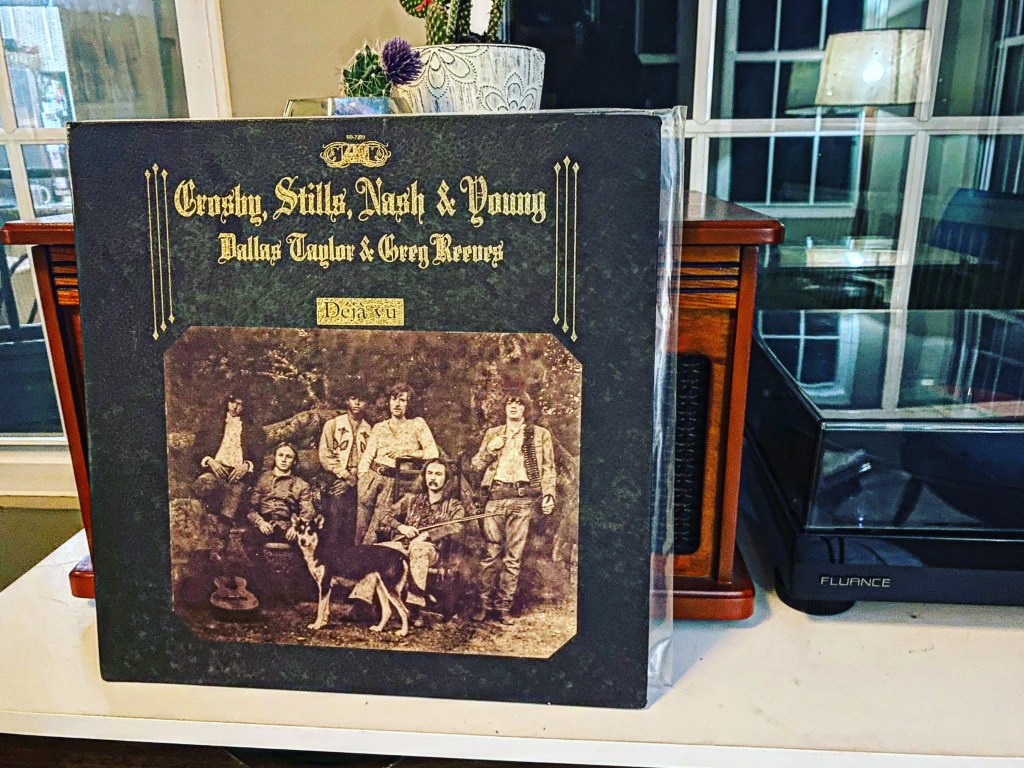
Crosby, Stills, Nash, and Young was one of the first bands I ever fell in love with.
I blame my Pops. And I thank him for it.
David Crosby was not a perfect human. He had issues, and his history with the band bore them out.
But I hope none of us are remembered for the worst things we’ve done.
He was a musical genius in so many ways. And he made me look to the stars, to see the Southern Cross. And he made me Teach My Children Well (I think). And he made me look at Our House.
On the 12th Day of Christmas I will now list for you the 12 most horrible, and obscure, Christmas songs…that I still love to listen to:
-“Our Love is Like a Holiday,” by Michael Bolton.
Terrible chorus: “I’ve been to Paris, London, L.A. I feel the tropical sun in my face This Christmas we don’t need to get away Cause our love is like a holiday”
-“Christmas Through Your Eyes,” by Gloria Estefan.
Notable lyrics: “I see the rain, you see the rainbow Hiding in the clouds Never afraid to let your love show Won’t you show me how Wanna learn how to believe again”
-“Jingle Bell Rock,” by Hall and Oats.
Please note: theirs is the worst version of this song…and the video is, literally, the worst. I’m obsessed.
-“8 Days of Christmas,” by Destiny’s Child.
This modern take on the 12 Days not only gets the number of days wrong, but also includes this gem: “On the eighth day of Christmas my baby gave to me/A pair of Chloe shades and a diamond belly ring”
-“Hard Candy Christmas,” by Dolly Parton.
This is my favorite on this list. Killer verse? “Hey, maybe I’ll learn to sew Maybe I’ll just lie low Maybe I’ll hit the bars Maybe I’ll count the stars until dawn Me, I will go on”
-“Go Power at Christmas Time,” by James Brown.
If you ever needed proof he was often high, look no further…
-“This Christmas (Could Be the One),” by Ledisi
Never heard of this one? Consider yourself amongst the lucky…
-“Christmas Wrapping,” by The Waitresses.
This mono-tone little ditty exemplifies all the reasons why you’ve never heard of this group.
-“Go Tell it on the Mountain,” by Andy Griffith.
This is normally a great song. You didn’t know Andy Griffith sings, you say? He doesn’t.
-“Christmases When You Were Mine,” by Taylor Swift.
Tay Tay, what are you doing?!
-“Christmas for You and Me,” by Brian McKnight and Vince Gill.
Looking for that special song that mentions cheese this Christmas? Here you go! “It’s 11 o’clock and I’m almost home I’m just calling to let you know Leave on the light for me Soon we’ll make us some brie”
-“Candy Cane Christmas,” by Darius Rucker.
Vomit along to these lyrics: “Angels sittin’ high upon a tree Watchin’ over presents patiently Milk and cookies on a plate Santa Clause is on his way The kids should be fast asleep”
“I once heard you should never vote for a politician who tells you how to pray, and you should never listen to a pastor who tells you how to vote,” their parting email said.
The family would be leaving the church because I was “too liberal,” even though I had never told anyone how to vote, from the pulpit or otherwise. I mentioned this fact, by the way, and he said, “Yes, but we can tell what you think about it and how you’d wish we would vote…”
That’s a big assumption.
No goodbye in the office. No farewell. Just an email with no subject line.
It hurts when people leave your church over politics. It still stings me, even now, to think on that family and a number of others.
It feels like a failure of some sort, like you couldn’t keep people together.
By the way, the translation of the above phrase actually should be, “you couldn’t keep people happy,” which is absolutely true. A pastor’s call is not to keep people happy, anyway, despite what the people will tell you…
It hurts when people leave because they see you have a bumper sticker for a different candidate than they prefer (this actually happened, btw).
It hurts when people leave because you were just trying to keep them safe with masks and social distancing and they wanted to “trust Jesus” rather than “trust the science,” pitting Jesus against science in a way that I think would make Jesus himself scratch his ancient head.
It hurts when people leave because you talk about tending the poor and needy and they hear “socialist!” instead of hearing Isaiah, Amos, Micah, Jesus, and Paul.
It hurts when people leave because you say “Black Lives Matter,” because it’s just true and Jesus was a person of color and all they hear is the filtered funnel of the media.
It hurts when people leave because you mentioned the existential threat of gun violence in that one sermon because, honestly, it is an existential threat that is killing our babies (and if mental health is such an issue…which is certainly is…suicide alone is enough reason not to keep a gun in the house!), and all they heard was that you think all guns are terrible.
The honest truth is that it hurts like hell. Even if you know that they won’t be upset all the time anymore, and even if you know that this kind of a break is coming, and even if you know that you won’t have to sweat when opening your email inbox on Monday because they’re perturbed by something they heard or thought they heard or pretended to hear on Sunday, it hurts.
Even when you see it coming from a mile away, it hurts.
No two-ways about it.
And you know what? It hurts even more when you see them at the grocery store around town, or see their social media posts about how happy they are at their new church where the pastor “never talks about politics” (translation: doesn’t talk about political things I disagree with). It hurts even more when they still hang out with the people who stayed and you see them at parties, but you don’t talk to them, or feel like you can, because no matter what the truth about their leaving is, it feels like it’s because of you.
You.
And it is at this point where you might expect I’d say something like, “They’re better off,” or “You don’t need them,” or “Shake the dust from your feet and move on,” or “But look at all the new people joining!” or “It’s not you, it’s them.”
But I’m not going to, because I can’t.
While all of those platitudes might be true, none of it heals the other deep truth that it. just. hurts.
In this Advent season I clutch perpetual hope tightly, hanging on as if my life depends on it (which it probably does). But I do wonder if pastoring in these hyper-partisan times is perhaps the hardest in recent history, and I’m not sure where hope plays into that in the immediate moment.
Even so, pastor, I hope the pain recedes in time.
And I hope those people, even in my life, are happy how they find themselves.
And I hope that one day political partisanship won’t split the pews and the pulpits.
We are captive to systems. Systems prevent us from critiquing consumerism or looking at our own prejudices with any sort of honesty.
Those angered over Thanksgiving, Black Friday, and Cyber Monday shopping seem elitist and judgmental. It must be nice to sit back and have the pleasure of a day off to tell others they aren’t spending it correctly.
Likewise, those excited by the chase of a good deal reinforce an economic system that acknowledges, through “deals,” underhanded pricing and an addiction to excess. It must be nice to narrow our scope so much to ignore the real impact of our dollars.
So we cannot critique without seeming elitist (and being elitist), and we cannot enjoy the marketplace because it woos us into needing more at the expense of others.
We cannot talk about it well because the system has confused our language to the point that all we hear are attacks.
Seems like a nice alternative is to just point out that fact, pray for our addictions to elitism and consumerism, and have some coffee where I’ll both consume and critique…and stand where we all do: stuck in the system.
“I think this is part of how God shows us to be grateful, you know? For what we have. For our health. To teach us.”
This was the response that someone gave me after I was lamenting about the unfairness of disease and catastrophe.
The idea that people are sick in order to be object lessons for people who are not is one of the many problems that we have with narcissistic religion and a form of Christianity that is totally devoid of deep spirituality.
It becomes cruel.
People are not sick in order to teach you a lesson.
Today the church remembers and mourns Executive Order 9066.
By executive order of President Roosevelt, Japanese Americans, two-thirds of whom were United States Citizens, were forced into internment camps on this day, February 19th, in 1942.
It is estimated that, at the time of the attack on Pearl Harbor, 112,000 of the 127,000 Japanese Americans lived on the West Coast. Of those American residents, around 80,000 of them were second and third generation, never having spent any time in Japan.
Forced from their homes, schools, and places of business, anyone with Japanese heritage (in California they exacted it to 1/16th of Japanese lineage) were placed in regional concentration camps. What was trumpeted as a “security measure” in case any of them were sympathetic to Japan, was actually legalized racism. Such measures were not taken for German or Italian residents in the United States, many more of whom were not legalized citizens (though a small number of people of German and Italian heritage were also forced into these camps on the West Coast).
By this order all people of Japanese heritage were forced to leave Alaska, as well as many areas of California, Oregon, Arizona, and Washington State.
In 1944 a legal challenge to 9066 came to a close, and though it’s constitutionality was upheld on technicalities (another instance where the small print delayed justice, and it didn’t even opine on the concentration camps themselves), it was affirmed by the court that “loyal citizens cannot be detained.”
The day before the results of this legal ruling would be made public, 9066 was rescinded, an implicit admission of purposeful wrongdoing in my book.
In 1980 Japanese Americans lobbied forcefully to have Executive Order 9066 investigated. President Carter initiated the investigation and in 1983 the commission reported that little evidence of disloyalty was found in the Japanese-American community of the day, and that the internment process was blatant racism. In 1988 President Reagan signed the Civil Liberties Act of 1988 and officially apologized on behalf of the United States government, authorizing monetary settlements for everyone still alive who had been held in a camp.
In other words: the US government gave reparations. It’s not unprecedented…
The larger question for me, though, is: where was the church?
Why wasn’t the church lobbying hard to have these fellow sisters and brothers released?
Additional studies have shown that religious prejudice also played a part in the justification for these internment camps. In a largely “Christian America,” these often Buddhist, Taoist, and Shinto practicing Japanese residents were seen with much more suspicion (which is probably why the German and Italian residents, also largely thought to be “Christian,” were not rounded up).
The church failed to protect a vulnerable population. The church held hands with the politics of the day in ignoring at best, and aiding at worst, the abuse of other humans.
Today we remember, mourn, and are honest about this failure.
This commemoration is a reminder for me, and should be for the whole church, that when religion holds hands with politics we end up on the wrong side of history.
-historical bits gleaned from Clairborne and Wilson-Hartgrove’s Common Prayer: A Liturgy for Ordinary Radicals as well as common source news
-art by Norman Takeuchi with his piece, “Interior Revisited,” stated that “Interior and ‘internment’ are synonymous for many of Japanese-American lineage,” because they moved people from the coast to “the interior” of the United States for these camps.