5 Phrases I Think Christians Should Say More Often

My most recent blog post made some waves, and I certainly didn’t expect it.  When I wrote down “5 Phrases I Think Christians Shouldn’t Say,” I never imagined that it would be sent far and wide for consideration and comment.

I’ll no doubt offer some more thoughts on those phrases.  As with all public statements, there are other thoughts to give and more clarification needed.

I’ll also probably add to that list, too.  Christians say a lot of unhelpful things in the attempt to explain everything in the world.  I find that fact interesting, actually.  In my ordination I was entrusted to be a “steward of the mysteries” for the community…and yet so much of the community of faith just seems to want to explain away mysteries with vacuous, pat answers that end up being about as useful as a boat in the desert.

But, I’ve been pondering my previous list, and I’d like to offer up some phrases that I think should be said as well.  So, here are 5 phrases that I think Christians should say more often.  And, of course, there are undoubtedly more…

5) “Let’s read a book together; your choice.”

This might seem like a dumb request, or some awkward way to try to curry favor with someone, but I’m absolutely serious.  So many times I find people of faith utterly petrified by engaging in serious conversation over a text that might challenge their faith because they feel they might not have “the right answer.”

And the problem there, of course, is that someone along the line explained faith to them as some sort of equation, a specific formula where certain values must be plugged in for the desired outcome.  In short: we’ve made faith into a system instead of a conversation.

So, here’s an experiment: go to a person of a different faith: Buddhist, Sikh, Atheist, etc.  Or maybe they’re a different denomination of your own faith…whatever.  Engage with someone different than you and invite them to read a book with you, but let them choose.

And go with whatever they choose.

So, let’s say they pick Christopher Hitchens and “god Is Not Great” is what they’re asking to read. Read it.  Let it come into conversation with your faith. And then talk about it.

Or, let’s say they pick a translation of the Qur’an (or if you can read Arabic, read the actual Qur’an).

Read it. It’s not a sin.

Read it and let it come into conversation with your faith.  We need to be a society where people are reading together.  Right now I’m reading The Kingdom of God is Within You  by Tolstoy with a congregation member who identifies as “questioning.”  His idea; his invitation.  Tolstoy is fascinating.  And not only are we having a great discussion about faith and values, we’re getting to know why we think the way we do while also learning more about how the other person thinks.

But for this to work, you have to let them choose the text.  So often people of faith think they only have something to impart on people with other worldviews and nothing to learn.  God save us from such blind certainty.

4) “That’s interesting!  Tell me more…”

Too often people of faith only utter this phrase if they’re talking about gossip.  That’s a topic for a different post, I think…

But what if we said the above phrase when people came to us with a different perspective on God, being, the meaning of life, or the authority of scripture?  What if our first reaction to hearing something that may not line up with what we’ve been taught/have come to believe isn’t a rebuttal or an argument, but an invitation to hear more?

And what if you seriously meant it?

So many times people have said, “that’s a slippery slope…” when it comes to questioning tenets of faith and critically listening to other perspectives.  But just as often I’ve met people who have said, “(that particular tenet of faith) didn’t prove true…so I abandoned faith altogether.”  To both statements I just have to sigh.

When we have been taught that questioning is bad or that all statements rest on one singular foundation, we invite unthinking automatons whose sole purpose in life is to defend their own thoughts, or people primed for disbelief because some premises (like the inerrancy of scripture, for example) just can’t stand up to experience.

Instead, we should invite people to tell us more about their thoughts and beliefs.  And, yes, share our own.  But too often we’re all to eager to do the latter and not interested in the former because…gasp…we might actually be changed in the process.

3) “I can’t buy that…it doesn’t square with my faith…”

This one might rattle some nerves.  Hear me out.

It’s amazing to me that people of faith can shun pornography but buy 7000 square foot homes for a family of four.  It’s amazing to me that people of faith can censor Showtime on their cable TV’s so that their kids won’t see a sex scene, but they’ll spend thousands of dollars on a birthday party for a two year old.

It’s amazing to me that people of faith can see money as “theirs” because they earned it, but can look at another person’s sexual orientation and see it as a “choice.”

Now, I’m not saying that you can’t have a 7000 square foot home.  I just want you to think and ask if your faith has anything to say about it.  And if so, what?  I’m not saying there’s a right or wrong answer here; I just want to see that conversation happen!

And the point of me bringing this up isn’t to cause someone to feel guilty, it’s actually to ask the question: Does your faith have anything to say about what/how you consume?

And if so, does your checkbook reflect it?  Money is just as powerful as sex, and yet somehow it seems that Christians only want to talk about sex and not about money (probably, in my view, to distract from their use of money…but that’s also a different post).

2) “You’re right, I struggle with what is written in the Bible there, too…”

I’m a pastor who wrestles with the Bible.  I think every person of faith (and arguably, everyone) should wrestle with the Bible..and any text.  Converse with it. Engage it.

Don’t look at scripture like an encyclopedia that just gives “answers;” view it as a conversation partner!  Professor David Lose at Luther Seminary in Minnesota writes eloquently on this in his book Making Sense of Scripture. (The title is misleading in that he doesn’t actually offer a way to “make sense” of scripture, but a way to view scripture)

His point, though, is that when we look at the Bible as simply a reference book, we don’t engage it.

But if we engage it, then when someone with a different worldview brings up the fact that it’s hard to accept that God really sent “she-bears” to devour children who were mocking Elisha’s bald head (2 Kings 2:23-24), we can admit it!  It’s ludicrous to believe that that actually happened. Plus, I’m balding, and I sometimes get mocked.  Please, Lord, send the she-bears!

And it doesn’t hurt my faith, or my witness, to say that it doesn’t make sense because I don’t believe that the authority of the Bible is dependent upon the absolute inerrency of every little verse.

One of refrains that I heard over and over again from atheist/agnostic readers of the previous blog post was that it was refreshing to see/hear a person of faith who actually thought.  That fact made me sad because it means, by and large, that unthinking morons are the poster-children for faith in the eyes of many skeptics.

And, yes, I know that is not a charitable description…but I’m not sure how to soften that phrase and still make the despair it causes me hit home.  And part of that perception problem, I think, comes from the fact that people of faith refuse to admit that some of the Bible is weird and doesn’t seem to square with experience.

And my mention of 2 Kings, by the way, doesn’t mean that I write off the book or even that I want to exclude from the canon.  It’s there; it’s not my place to exclude it.  But I converse with it.  I make a distinction between story and history.  I make a distinction between fable, myth, and fact.  And I admit that scripture can hold all three…and that that doesn’t have to impede it’s ability to have Truth.

1) “That’s not OK…”

As evidenced by some of the responses I received over the weekend, some Christians are all too ready to say that it is not OK for me to suggest that we dump “Love the sinner; hate the sin” as a phrase.

I’ll just repeat my belief that this phrase, no matter how you want to defend it, is disingenuous.  I’ve filed it under “complete nonsense” in my file cabinet.

But we need to speak out when people who represent the faith say things that are outrageous and downright dangerous.  I know, that’s a statement that involves a lot of subjectivity.

An example?  Where is the public outcry from people of faith against the pastor in Maiden, North Carolina who preached that homosexuals should be corralled and given just enough food to survive in an effort to let them die out?

If you’re wondering what I’m referring to, you can find the video here.

It is graphic.  And despicable.  And disgusting.  And I cannot see how it squares with my faith.  And I will tell anyone and everyone so. (By the way, the American Psychiatric Association removed homosexuality from their list of mental disorders in 1973, no matter what the Focus on the Family might want to tell you.  And I think it is high time that the church remove it from the list of spiritual disorders, too.)

Now, it’s true that this pastor is small-time.  The community he serves is small, and his influence is small (although I see his video is now on CNN).  But if we hear this extremely vehement nonsense and keep quiet, can we be surprised that people think this is what all people of faith believe?

We need to decry Robertson and Graham publicly when they make ridiculous comments.  We need to call Olsteen into question when he says that God wants you to be rich. We need people of faith to say that Mark Driscoll doesn’t speak for me or my faith when he starts spouting off about masculinity or marriage in ways that are derogatory to both men and women.

And we need to do the same with some others in the faith, too. Luther, Wesley, Calvin…not to mention modern day heads of the church, are not infallible.  Some of their writings deserve some denouncing.

And until people are willing to call such things ridiculous loudly, publicly, and without exception, we can’t be surprised if people dismiss Christians as unthinking and hateful.  And we can’t be surprised, either, when people defect from faith in an attempt to distance themselves from this sort of thing.

I’m a reluctant Christian at times because I think that we, too often, only engage the world and those around us with a defensive stance as if we have something to prove.  Engage life in a meaningful way, in a way that calls faith into practice; in a way that invites questions and not just recitation.  Engage this world in a challenging way.

Oh, and while you might have expected the #1 phrase that I wish Christians would say more often to be a cuss or a curse, I just figured that would go without saying…


5 Phrases I Think Christians Shouldn’t Say

Sometimes I curse.  I don’t pepper my language liberally with curse words like people might pepper a house salad, but sometimes I curse.

It surprises people to hear that pastors sometimes curse.  But really, that’s all I can do sometimes.  When you see terrible tragedy where you have absolutely no response other than sadness and despair, cursing happens…because you can do nothing else.

Likewise, sometimes when I see utter beauty a word will slip through my lips, brought from the very depths of my emotional being where words live only to be used in situations where no word seems appropriate.  Usually that’s a curse, too.

Pastors sometimes curse.  Christians sometimes curse.

And, really, I hear things slip from Christian mouths with reckless abandon that I believe are far worse than curse words.  Here are just 5 (there are undoubtedly more):

5) “That’s not Christian…”

I’ve heard this a lot.  I once told a person that I meditated.  They responded, “Well, that’s not Christian you know…”

Sigh.

See, the problem with that line of thinking is that it narrows what can be identified with living a life in Christ.  Rob Bell does a great job in his book Velvet Elvis on dissecting the danger in turning the word “Christian” from a noun (as it’s used in the Bible) into an adjective. In the noun form, a Christian is a follower of Christ.  In the adjective form, it describes an action…presumably an action that a follower of Christ should/shouldn’t do, and therefore sets up categories that have definite barriers. And in doing so, it implies some judgment that is unwarranted at best and untrue at worst.  Consider these phrases that I’ve actually heard:

“It’s not Christian to fire that person.” (Implication: A Christian can’t do some things because they’re seen as “mean”)

“It’s not Christian to think those sexual thoughts.” (Implication: A Christian isn’t sexual, or if they are, they don’t think about it because God hates sex and real Christians can control such things)

“You can’t do yoga!  It’s not a Christian practice…” (Implication: A Christian can’t borrow from other faith traditions…or, apparently, stretch with intentional breathing on rubber mats)

“You can’t get a tattoo; it’s unchristian to defile the temple of God.” (Implication: God has an opinion about the tribal band around your ankle)

People say it all the time, and while a generous interpretation of their words might be to assume they are calling a specific action/thought into question, the reality is that they just end up calling the person doing that thought/action “unchristian”…to hurtful consequences.  For those questioning or skeptical of faith, it erects another barrier, and further narrowly defines who is in or out of a relationship with God.

What if someone were to say, “It’s unchristian to make that amount of money”? Or, “It’s unchristian to have a house that large because you really don’t need that much space”?

We should ban “Christian” in the adjective form.  We can’t use it with any consistency.

4) “I love the sinner but I hate the sin..”

Great.

See, the problem that I have with this phrase is that it assumes that “sin” is a specific action that is done/can be undone.  If that’s the case, name the specific action that you hate.

“I love you, Tommy, but I don’t like it when you break my glasses.”  “I love you, Sarah, but I don’t like it when you kick my shins.”

But really, I haven’t heard this phrase used in those ways.  I’ve only heard it used when people are talking about identity.

“I love gay people, I just hate that they act on their homosexual orientation…”

There we go.  There’s an honest statement.

And an unhelpful one.

It’s unhelpful because, you can’t love me apart from my sexuality.  I really don’t think you can.  It’s part of what makes me who I am, even if it’s not the whole of my definition.  So, if you were to say to me, “I love you, but I hate that you’re heterosexual…” I would probably stop listening right then and there because, well, I wouldn’t believe you.

You can’t love me and yet hate an essential part of me.  This phrase is disingenuous.

3) “You need to surround yourself with some good Christian people…

I once had a well-meaning friend tell me this when I was trying to sort out a problem.  I think they were suggesting that I seek faith-based advice.  I understand that sentiment.

But one of the problems with this sort of thinking is that, well, when you live in a bubble all you breathe is soapy air, and you may begin to think that is all there is.

As a pastor, people want me to have office hours at church.  But in all seriousness, I can’t all the time.  If I don’t go to the coffee house a couple times a week, I suffocate in my bubble.  I need diversity because it is only in diversity where my thoughts, beliefs,  and ideas are challenged.

And really, if I only see Christians all the time, I’m a pretty crappy pastor.

It is narrow to believe that somehow surrounding yourself with only one worldview will help you see the world better.

And besides, sometimes Christians surrounded people and then burned them on stakes…

2) “You just have to do God’s will…”

I am utterly suspicious of people who claim to know the specific will of God.

I’m even more suspicious of people who claim that God’s greatest wish is to have us be in a relationship with God.  I think this is where much “praise and worship” music get it’s singular focus.

In the abstract, I get what they’re saying.  I think God does desire for humanity to live in shalom with it’s creator.  But to claim that this will takes precedence over God’s desire to have humanity live in shalom with one another, and with the environment, and with other creation is, I think, short-sighted.  Theology runs into a similar problem when it focuses so much on “Jesus, Jesus, Jesus” and fails to mention the other persons of the Trinity.

We run into real problems when we begin to think that with regard to specific situations (like, say, my future husband/wife) that God has one will.

I cannot see how that can be true.  I love my wife.  But do I think she’s the only person in the world I could have married?  Do I think that I’m the only person in the world she could have married?  No.  I don’t.  She’s bright, beautiful, and funny.  There are lots of people who would have asked her to marry them (and still might…she’ll just have to say “no”).  Likewise I’m beautiful and funny (jury is out on the “bright”), and could have found another partner.

I just found her and we decided to do this. (It was actually much more complicated than that…and a bit more romantic…)

I hope this gives some freedom to those in the world who believe that there is only one right job, one right spouse, one right school, one right anything that they must find or else they’re missing out on God’s will for their life.

And this leads me to the number one…

1) “It’s all in God’s plan…”

That you lost your baby.  That your sister was murdered.  That you got cancer.  That your life is in shambles.

I really can’t think of a worse thing to say to someone, especially when they’re in pain.

We cannot use God to fill in the gaps between events and the people they effect.  We want to give solace, to promise that there is a purpose behind madness, but if there is one thing that the cross shows us definitively, it’s that God takes the pain in the world and makes resurrection.

But we should not think that this means that God makes the world’s pain, or the specific pain in a person’s life.  It’s an important distinction.

One of the reasons I left faith for a while was because I had heard too many times that God was flipping switches on people: causing children to die, cancer to spread, poverty to happen, etc.

Not only do I think that saying this to someone is adding hurt to hurt, I think it breaks the second commandment.  When we say such things, we use God’s name in vain; we use it “uselessly” as the word is better translated.

So when you’re confronted with the news of your friend’s tragedy or a relative’s pain, stand in solidarity with them and scream, “Dammit!” I’m a reluctant Christian at times because I think that those who call themselves Christian don’t think enough about their words.

Frankly, I wish they’d just curse more.

“Faith and Sex” or “Save Me From Your Concern…”

“Will you please talk to him?  I’m worried about his salvation…”

I hear that a lot.  I hear it from spouses of people who identify as skeptical/unsure/agnostic/atheist.   I hear it from people who have friends who believe or think differently from them.  I hear it from people who are worried about their gay/transgendered/pierced/tattooed/(insert other conventional taboo here) relative.

I hear it a lot.

And, I don’t question their sincerity.  The church has trained people to be concerned about this.  I just want to question that training…and that concern.

We’ve been conditioned to speak about salvation as a product.  It’s gotten, acquired, assured…what have you.

The problem that I have with this line of thinking, indeed with this concern, is that it implies that somehow we have a say in the matter.  And I realize that there are, indeed, some Christian circles that do believe that humanity has a say in the matter of salvation.  I heard a whole sermon by a prominent pastor at a huge church who assured the gathered congregation that they had to say “yes” to the Christ knocking at the door or else their salvation was in jeopardy.

In fact, I’ve heard scores of such sermons.  And, perhaps at one time, shared their thinking and nodded in agreement.

And believing that we must respond to the gracious invitation of God to reap salvation benefits is a stance that can be intellectually defended. It’s transaction based.  We love transaction based models: they’re concrete, every party gets to do something, everyone gets to act.

But I don’t see how you can hold a transaction model stance and then, in the same breath, utter that salvation “can’t be earned.”  Every time I hear someone say that salvation can’t be earned but then say, “and yet you must accept Jesus in your (pick your location: heart, life, worldview, marriage)” my brain starts going crazy.

Cognitive dissonance.

We run into a problem when we try to parse the word “earned,” but in the business of transaction, “earning” something is providing payment or appropriate satiation. I think a person who believes that you can’t earn salvation and yet must say “yes” to have salvation is not being intellectually honest.

Is not even a “yes” payment, in this instance?

Some might affirm that idea; some might reject it.  Frankly, I don’t see how it can not be an instance of payment.  We’re not talking about passivity here; we’re talking about action, the act of saying “yes,” the act of assenting.

Smacks of earning.  I think it is.

And this is where people start to get nervous.  They start saying, “Well, salvation is a free gift from God, but you can choose to accept it or not.”  And, in some ways, that makes sense, right?  If my local coffee store offers free coffee, I can choose to take a coffee or not.  In fact, proponents of the “free but accept” concept love to use examples just like that.

And that works if we’re just talking about coffee, cars, or other goods and commodities.

But are we?  Do we really want to lump salvation into the category of cars and candy bars?  Because, whether or not we want to, I think that we have.  There are many books that point out this fact, Rob Bell’s Love Wins is but the most recent. I think he does a decent job of exposing how we’ve cheapened salvation by using this transaction model, and in the process have actually ended up limiting God’s grace instead of, as the usual argument goes, limiting free will.

Theology nerds out there will want to blame Anselm at this juncture; I would encourage you not to do so.

It’s not Anselm we need to blame.  His atonement theory has not held sway over the Christian story just by luck or chance: it’s the theory that provides Christians with the most control over the field of life.  We should blame ourselves for reducing salvation to the same kind of transaction as buying a dishwasher.

Now, at this point Christians start to wring their hands and say things like, “Wait…then everyone has salvation?  I don’t need to worry about my atheist/agnostic/questioning/tattooed/Mormon/Muslim neighbor?”

I want to point out here in no uncertain terms that I’m not claiming everyone has salvation.  Any sort of claim I might make on the subject wouldn’t use that phrasing, as I don’t think it’s helpful.

But, in response to the question, I’d ask them to define “worry.”  Do I think you need to care for them?  Yes.  Do I think you need to be salt and light for them and for this world?  Yes. Do I think that their lives will/would benefit from being in a relationship with God and others who are asking important questions about life, meaning, love, and purpose through the lens of Jesus?

Yes.  Unequivocally, yes.

Do I think you need to wonder in the late-night-sweating-anxious-pondering way about what will happen to them after they die?

No.  I can’t say that I do.  Because I don’t think there’s anything that you can do about it.

Truly, I don’t think you can.

I think it’s dishonest to worry about people because you want them to adopt your worldview.  I think it’s dishonest to worry about people because you’re unsure of whether they’ll go to heaven, hell, Pluto, or Middle Earth after their last breath.  We should worry about people for the sake of their life now, not after death.  Millions of Christians go without feeding the Christian poor because, well, we care more about their salvation than we do their stomachs.  Likewise, millions are spent on Christian missions where bellies aren’t attended but “souls” are.

Pass out bread and keep the Bible.  Or, better yet, live the scriptures and pass out bread.

So, finally, what do I think about salvation and having/not having it?  I go back to an ancient model, a model of promise.  Christians cling to an eternity spent with God based on a promise.

Nothing more, nothing less.

The Christian doctrine(s) of salvation, heaven, and hell that have cropped up over the last 2000 years have been largely a disservice to the message of Jesus.  People set their eyes on post-life and begin to ignore this life, or people begin to think they have salvation in the bag and then stop engaging or critically thinking.  Or…well, I’ve mentioned some of the other “or’s.”

It’s a travesty.

Part of the benefit of living on a promise is that you take it for granted.  The promise, that is, not the relationship.

I think we need to continually foster a relationship with God, and that we need to foster a relationship with others that asks questions about God, life, and salvation.  And I do so not because I hope to get something, but because I think it is good.

But the promise of salvation?  I leave that up to God.

And with God, nothing more than a promise is needed, actually.  It’s in human transactions where we feel the need to deal with payment and satiation; guarantees and insurance are for human transactions.  God has always operated on promise and covenant.

“But what about them?  What about those that don’t believe or say “yes” to God’s invitation?”

Yes, what about “them?”

Whenever I do pre-marital counseling, I always do the “faith” discussion with the “sex” discussion.  I feel like the attitudes of both our sexuality and our spirituality need to be similar: we invite; we don’t coerce.

We can’t coerce someone into having sex with us.  That is a terrible use of power, and makes the choice ultimately not their own.  “You’ll do it if you love me,” is neither a real invitation nor attractive.  “Believe in Jesus or your salvation is in jeopardy,” doesn’t seem all that different.  It’s not honest or attractive.

And truthfully, when someone says to me, “Please talk to them; I’m worried about their salvation,” I have to wonder what they think I’ll be able to do.

I can only do what they can do: invite.

You can’t argue your way to faith (or out of faith, actually, despite many of the New Atheist writings of today).  It has always happened by invitation, promise, covenant. And to dangle the idea of salvation as a reality or non-reality based off of belief/response seems pretty coercive to me (not to mention intellectually dishonest).

I believe that a life lived in relationship to God is life-giving.  It’s salvatory here and now, in this life.  I believe that salvation after death is real and a mystery; as mysterious as the paradoxical cross I stare at every Sunday that testifies both to humanity’s hate and how God turns humanity’s hate into an act of love.

And, like all mysteries, it’s not to be gained or attained, mastered or bought.  It’s to be held, contemplated, treasured…and in doing so, lives are changed.

I’m a reluctant Christian at times because we’ve turned salvation into a business transaction, and one that’s focused on death rather than life.  It breeds panic, unhealthy evangelistic practices, and pietistic but baseless concern.

So, before we begin to be concerned over someone’s salvation, perhaps we should take a step back and think of our own.  Did our saying “yes” to Christ save us?  If so, then aren’t we what got us our salvation?  Wasn’t it our yes?

And if the thought of that makes your stomach turn, as it does mine, then perhaps we need to lift our salvation up to God and say what I think is the most intellectually honest statement about this subject, “You take care of it.”

And then go back and begin inviting people into a relationship with God that has more to do with the here and now.

“Doing Church Differently” or “Spare Me the Hip…”

Spare me the hip.

You do not do church “differently” just because you meet in someone’s home.  Or because you meet at a time other than Sunday morning.  Or because you sing songs that aren’t considered hymns.

You do not do church differently because you wear hipster glasses, or you wear a t-shirt and jeans.

In fact, you do church just as church has always been done.  Churches have always met in people’s homes…and that eventually grew into meeting in cathedrals and large buildings because, well, your living room isn’t super comfortable with more than 9 in it, let alone 25.

Churches have always worshiped on different days: sometimes Saturday evenings, sometimes Wednesday evenings, sometimes three times a day, sometimes nine times a day!  It’s not new; its ancient.

Churches have always sung a variety of songs, some contextual and some more reflective of their ancestors.  Ancient Christians sang new songs, ancient Jewish songs, and then some new Christian songs to ancient Jewish music.  You could say the same of any church you go in today.  Amazing Grace done on electric guitar comes to mind.

I would argue, however, that this trend of church songs having only one theme (some variation of “Jesus loves me personally” or “God is awesome”) is fairly recent (within the last 70 years).  That newness, though, doesn’t make it different…I think it should invite us to evaluative questions like, “Is this really the best we can do in expressing our thoughts about God in song” or “Is God other than awesome?  Is Jesus more than just for me?”.

It’s clear those questions aren’t being asked in many circles.  Please, someone, ask those questions.  Mumford and Sons is writing songs with more theological depth than most anyone in the world of CCM.*

And churches have always sought people “where they are.”  And I’ll admit I’m guilty of using that line, mostly because I think it’s true.

I don’t think it’s different, though.  And it certainly isn’t hip.

It’s just that, well, can you actually be anywhere where you aren’t?  Do you really know of a church that thinks you have to change to walk in the door?  If you do, I wouldn’t argue that they’re doing church “the same old way.”  If you have to change to walk in the door, they’re just doing church badly.

And if you think that just because you don’t wear robes you’re “doing church differently,” I’d ask you to read a Christian liturgy book.  Robes, the clothes of a servant, were meant to give a “replaceable” quality to the leader of worship…much, I think, like the t-shirt and jeans of many of today’s preachers who think they’re doing something different.  The “See, I’m no different than you” of the t-shirt and jeans is not a far cry from the, “See, you too can do this. I’m totally replaceable” of the robe.

Along those same lines, the mass-media approach of projectors, screens, TV’s, and made-for-worship movies are no different than candles and incense.  Engaged senses?  Yes.  Ordinary objects?  I bet you’d find candles in the ancient home just as often as you’d find a TV/computer in the homes of today.

The rock-arena stage setting of many “doing church differently” churches reflects a contemporary concert experience.  Bach composed music that reflected his contemporary concert experience.  JSB and BNL are not so far apart.

So, my question is this: why do you feel the need to say that you “do church differently?”

Spare me the hip.

Do you try to connect people to God?  Do you try to tell the story of a world in desperate need of Divine intervention in the person of Jesus?  Do you try to help people see how God is active in the world?

If you do, then you don’t do church differently; you do it in the way it has always been done.  And there’s nothing wrong with that.  I’m a reluctant Christian at times because, well, church branding has become a business taking its cues from contemporary advertising.  In the need to feel relevant, so many places just end up fading into the same melange of commercials bombarding people daily.

What I think Christians and churches should be asking themselves is: are the symbols and mediums we use deep in meaning?  Do they reflect a fullness that exemplifies the fullness of God?

How about we spend our time on that rather than spend time trying to convince people that we “do church differently.”

Don’t do church differently.  Tell the story.  Invite people into a relationship with the God shown through the Christ.

And turn off the advertising machine.  It’s not different.  And although it tries to be hip, it is not.

*Gungor is creating some good stuff, but they often rely quite heavily on male stereotypes in their depiction of God.

“Trayvon Martin and Liturgy” or “We Have Tools To Counteract This…”

I live in Chicago, not Sanford.

And yet, I find myself in Sanford a lot lately.  Not physically, of course.  Just mentally.

I find myself there because, well, the streets of Chicago can be scary, too.  There are times when I’m walking around my neighborhood and I’m looking for the suspicious character…and find myself being the suspicious character in some neighborhoods.

But luckily, I have a tool that counteracts the fear of suspicious characters.  I’m not talking about a gun, a baton, a taser, or some other self-defense tool or technique.

I don’t have those.

I have “The Peace.”

“The Peace” is what I share every Sunday morning at my church, where I go around to shake the hands of people I know, and people I don’t know.  And as I do it, I say, “The peace of God be with you!”  It’s a peace that I extend with my hand.  It’s a peace that I, sometimes, extend with a kiss.

It’s a peace that I extend to everyone.  Everyone there.

And I do it, week after week, first and foremost, to teach myself.  To teach myself how to be the peace, to live in the peace of God, that peace that I’m extending.

Secondarily, I do it to receive the peace of the other person.  To allow myself to be vulnerable to them, to receive their blessing, that we hold to be the tangible blessing of God.

My hope is that in living in this rhythm of intentionally greeting people I don’t know on a weekly basis, I might be shaped and formed into a person who doesn’t fear the stranger, the “other” in front of me.

Some weeks I feel it “takes” better than others.  But I go back, week after week, believing that the process is teaching me a spiritual muscle memory that will pay off.

And why?

Because otherwise we end up worshiping idols.  Like the idol of security.  Security that comes with packing a firearm with you.  And as a good friend said recently, “The idol of false security always demands blood.”

And that’s what we saw in Sanford: the idol of false security taking its blood payment.

But for those of us who profess to be Christian, we have a different model, a different norm that we practice week after week in the liturgy.  The Peace can teach us, if we pay attention, that vulnerability leads to relationship, that openness leads to community.

The Peace can teach us how to act with courage, and not to seek out false security.  Courage, as I see it, is holding the appropriate amount of fear, but stepping forward nonetheless.

If Christians profess the faith of a Christ who is calling the universe toward unity (read Ephesians 1 if you’re wondering what that mystery might look like), then why are we so silent on this issue?  Why are we not lifting up the tools that we have, that we use, that we practice to counteract this issue?!

I think we are inactive, and largely silent, because we fail to take The Peace seriously.  We don’t reflect on the liturgy anymore; it’s simply the bridge between the sermon and communion.

That, or worse, it’s a time to greet our friends. Exclusively.

But what if that time, in every community, could be a time when we actively counteract the violence around us?  Where we reach out to the other not with a sword (or gun), but with an open hand?

Of course it appears as if other things muddy these particular waters.  Racial tensions are very present (and very real).  Policies and laws that glorify the individual rather than the community provide for troubling legal escapes.  But the fact remains that the church has a wealth of knowledge in the communal practice of our liturgical gathering to speak about this issue, and even those that muddy the waters!

Where is that voice?

This is one of the reasons that I’m a reluctant Christian.  We’ve become so numb to our own worship practices that we can’t see them as tools for daily living.  We might as well get in line at at our local chain coffee shop, put in our ipods (and, isn’t it funny that all of those products begin with “i”…we’ve stripped the community out of everything), and never greet those around us.

What does it mean to participate in a meal where all are invited forward and none leave without something?  What does it mean to bathe a person in the waters of grace and tell them, definitively, that we affirm their existence as a child of God?  What does it mean to weekly greet people we do not know, to welcome them into our personal space without asking them for something?  What does it mean to sing corporately songs of longing, songs of peace, songs of lament, shunning our ipods, iphones, i-gadgets for just a while?

You’d think such practices, if internalized, could be life changing.

Or, in this case, life-saving.

We have tools for this.  We’ve just forgotten how to use them.

“If it’s wrong, I don’t want to be right” or “I don’t want to be right, even if that’s wrong.”

In the July 8th issue of The Guardian, David Hare has an interesting interview with the Archbishop of Canterbury, Rowan Williams.

Yes, get your “Mr. Bean” jokes out now.

Williams has been an outspoken critic of the New Atheist movement happening in his backyard, but his critiques have been mostly what I would call a “failure to engage.”  But as I read more and more about Williams, his theology, and his argumentative style, I would classify his critiques less as a failure to engage and more as a choice not to talk over.

That is, after all, what most of these shouting matches between atheists and theists have been: talking over one another.

So when one can boil the Archbishop’s responses down to the simple, awfully British, phrase, “Oh, please…” I now understand better why.  Williams finds the whole process of argumentation to be an exercise in futility.  And one, I might add, that leads to more bitterness and entrenchment than anything else in my experience.

I, too, came to this realization about a year ago.  In my search to mine the depths of my own skepticism, I finally came to much the same conclusion that Williams appears to have known for some time (if only those with ears would hear): argumentation in this arena is a futile attempt at making oneself believe by mind what is only known by heart.  Or, as St. Ambrose reminds us, “It does not suit God to save (God’s) people by arguments.”  Williams apparently often recites this.

This realization is not an escape, mind you.  That’s ultimate Truth.  And if you think you know it, I would question if you do.

Willaims explains this idea much more satisfactorily in the interview:

“Oh, look, argument has the role of damage limitation. The number of people who acquire faith by argument is actually rather small. But if people are saying stupid things about the Christian faith, then it helps just to say, ‘Come on, that won’t work.’ There is a miasma of assumptions: first, that you can’t have a scientific worldview and a religious faith; second, that there is an insoluble problem about God and suffering in the world; and third, that all Christians are neurotic about sex. But the arguments have been recycled and refought more times than we’ve had hot dinners, and I do groan in spirit when I pick up another book about why you shouldn’t believe in God. Oh dear! Bertrand Russell in 1923! And while I think it’s necessary to go on rather wearily putting down markers saying, ‘No, that’s not what Christian theology says’ and, ‘No, that argument doesn’t make sense’, that’s the background noise. What changes people is the extraordinary sense that things come together.

In reading Harris and Hitchens, in reading Craig and McGrath, I’ve come to this conclusion: I enjoy the reading.  On both sides.  I find myself nodding to Hitchens about just as much as I find myself nodding to McGrath.  And I find myself shaking my head in the same places, too: where the argumentation devolves into silly straw-people stereotypes and supercilious name calling.

(Harris and Craig, actually, I find pretty tedious because their anger is not mixed with enough sarcasm.  I prefer my agitants to be laced with humor.  It helps the hate go down better.)

But all in all this interview with the fine Archbishop has helped me to hone in, once again, on what it is that I am giving up in this life constantly, and that is the need to be “right.”  He notes:

Put it this way, if I’m not absolutely paralysed by the question, ‘Am I right? Am I safe?’ then there are more things I can ask of myself. I can afford to be wrong.

My dance with religion has led me to find that I’m not dancing to learn the steps, I’m dancing to dance.  And perfection is not the goal of this endeavor; dancing is.  I’ve given up my need to have the right steps.

But if that’s the case, why are so many Christians concerned with orthodoxy?  In my own church, my own denomination, we’re continuing to struggle with issues over orthodoxy, and yet, if we’ve given up the need to be right as the Christ has freed us to, it appears we haven’t given up the need to fight about it.

It is at this point that many will say, “Sure, but your point certainly doesn’t mean that anything is permissible!”

Quite correct (I’ll refrain from using the word “right”).

But must we argue and divide and split on account of it?  Williams’ own tenure as Archbishop has shown that diverse opinions can be pillars that hold up the same house.  And whether it’s because his eyebrows are too threatening to tussle with, or because he’s actually on to something here, he truly believes in the church in a way that makes me not want to fight him on it.

But I’ll allow his belief to be my own for the present time.  For while I want to believe in the church, the church often makes me a reluctant Christian.  Christians make me a reluctant Christian. While I find myself free from the need to be right, it appears my sisters and brothers throughout the church do not.

Sigh.

And sure, the one last argument the dissenting reader will throw out is true, “But don’t you think you’re “right” in believing its correct to give up being right?!”

Fine.  Incurvatus in se.  I won’t argue with you on that…because arguing will get us no where.  But I don’t believe in the rightness of my belief.  I don’t believe in the rightness of religion; no way.

Instead, I’ll just say that it’s my lens. I lean on it.  I look through it. Or to put it another way, I’ll quote someone else much smarter than me:

“Religion is not primarily a something to be believed…Religion is first and foremost a way of seeing.” (Kushner, Who Needs God)

So, I guess I don’t want to be right, even if that’s wrong.  Because in my reading and my experience, being right or needing to be so, well, it just leads to blindness.

“Utopian Smoke” or “Bono was Right: I Still Haven’t Found What I’m Looking For”

It’s been a while since I’ve posted.

The absence has not been due to disinterest; quite the contrary.  The absence has been due to an overabundance of interest!

Reading, writing, reflecting…hospital visits, counseling…

But here and now, it’s time to post again.  And the topic at hand is a fun one, I think.

Utopia.

Or more precisely, the promise of utopias.  I love utopian promises almost as much as I love tacks in my socks and splinters in my finger nails.

And this is a promise that I hear from both theists and atheists alike.

An acquaintance of mine once said, “I feel sorry for those who haven’t accepted Christ in their life.  The world would be a better place for it.”  And, while I don’t necessarily disagree with the words she put forth, I think we’d disagree over the intention.

I have no illusions over the corrupted and corruptible nature of humanity.  It does not fill me with despair, mind you.  It just is.  So, would the world be “better”?  Depends what you mean by better.  I think the Middle Ages tried pretty hard to have the “known world” (leaving out entire continents, of course) under a banner that displayed a cross…erroneously…and that didn’t seem to go so well.

In even more stringent circles you have Darby-ists trying to create perfect heifers and advocating for all people of Jewish heritage to make it back to the “promised land” (a land that had been subsequently promised to the Palestinians, but then un-promised later on) in the hopes that somehow this will start some kind of cosmic clock to kick off a bloody Armageddon.

Sigh.

On the atheist side I find much the same argument.  The trick one must do is insert the word “science” or “reason” where the fanatical theist might insert the word “God” or “faith”.

In Sam Harris’s new book The Moral Landscape he actually begins to chomp at the utopian dream, believing that “science” and “reason” (always by his own definitions) will lead us to begin to make moral decisions.  Because, afterall, everything has to do with the chemical make-up of the brain.  Once that is mastered, once controlling and identifying those aspects are mastered, we’ll actually begin to discern what is moral and immoral not using ethical systems, but using science and brain chemistry as the plumb-line.

It sounds nice.

The problem is, we’ve tried it…with disastrous consequences.  Eugenics promised something akin to what Harris describes; how he misses the similarities is beyond me.  It ended with shame we still haven’t apologized for and atrocious smoke stacks full of humus, not to mention Pol Pot and other genocidal experiments.

One of my favorite sections of Harris’s frustrating book is his commentary on “Psychopathy” where he advocates for identifying the brain development of children early in order to identify them at the outset.  He writes:

“Unlike others who suffer from mental illness or mood disorders, psychopaths generally do not feel that anything is wrong with them.  They also meet the legal definition of sanity, in that they possess an intellectual understanding of the difference between right and wrong…for the purposes of this discussion…it seems sufficient to point out that we are beginning to understand the kinds of brain pathologies that lead to the most extreme forms of human evil. And just as some people have obvious moral deficits, others must possess moral talent, moral expertise, and even moral genius. As with any human ability, these gradations must be expressed at the level of the brain.” (The Moral Landscape, 98-99)

What’s so scary about that?  Take it one step further.  Do we allow those with “moral deficits” (by Harris’s definition) to exist alongside us “moral geniuses” (and I do suspect that that wording is correct…how many of you will place yourself under the “moral deficit” banner)?

Harris is not unusual in this line of thinking.  I’ve read a similar line in almost all of the New Atheist writings I’ve read.  And if you wonder if Harris is actually suggesting that we weed out “morally deficient” individuals, simply look at his writings on Islam and the solution to Islamic terrorism (hint: it includes the phrase “preemptive strike” and has lots of explosions).

But are these two positions really any different?  The fanatical theist wants to usher in the end of all things to expose the stupidity of those who don’t believe; the fanatical atheist wants to usher in the supremacy of science on the belief that it will expose the morally deficient and reform humanity.

Sigh.

The problem with both of these convictions is the absence of “competing truths.”

Can science usher in peace?  No.  Last time we tried that as a society we created a bomb that would destroy everything.

Can religion usher in peace? No.  Not as long as we refuse to accept that when we say the phrase “I believe…” we also, simultaneously are saying, “but I could be wrong…”

Utopias aren’t possible; humans haven’t the ability.  Heaven requires Divine intervention…something one side is trying to force while the other side is trying to prove is impossible, while claiming itself as divine.

And I’m a reluctant Christian because too often evangelism has turned into this sort of practice: ushering in utopia.  Instead its just made suburbs pop up around big-box churches.

Sigh.

Perhaps Einstein was right when he said, “I know not what weapons World War III will be fought with, but World War IV will be fought with sticks and stones.”

We have a dystopia.  It’s cause is Sin.  Are we capable of better?  Somewhat.  Are we willing?  No…

It seems we still haven’t found what we’re looking for…but we’ll probably kill ourselves, one another,  and the Earth, trying to prove we have.

“Divorce” or “Why the Governor of Alabama Reminds Me I’m a Reluctant Xtian…”

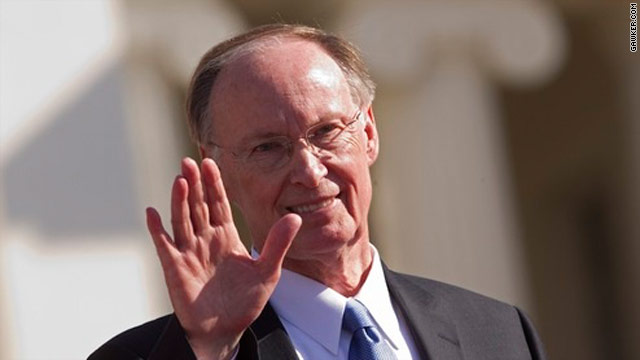
Governor Bentley waving to people who may or may not be "brothers and sisters."

Sometimes rolling your eyes just isn’t enough; sometimes you have to slam down the paper.

That fact alone makes me wish the news cycle of Alabama Governor Robert Bentley‘s inane comments on what constitutes “brothers and sisters” in a Christian context wasn’t on CNN.com.  For one, I can’t slam my computer on the desktop.  It harms my computer.  Secondly, I fear more people read CNN.com than traditional papers nowadays.  Which means there is one more example from the clowncar of the public Christian tumbling out.

But the fact that Governor Bentley doesn’t consider those who haven’t “accepted Jesus Christ as their savior” as a sibling doesn’t irk me half as much as the underlying theological claim.  Namely, that somehow accepting (defined loosely) Jesus Christ (again, loosely defined) as a savior (again…well, you get the picture) has some sort of theological bearing.

Before you stone me, have a seat to analyze that statement.

First, what does it mean to accept something?  Do you assent to it’s veracity?  Is it a mental construction, much like I accept that the number 2 is Real, and yet can’t produce the number 2 purely?

Or is something only accepted when actions flow from its internalization,  much like I accept that the fact that I have a goddaughter requires a response on my part to her faith life?

And if I accept a concept, how can I really tell if I have truly accepted it?  That question alone leads me to my next point: which Jesus Christ?

Is it the “historical Jesus,” the 160lb Jewish guy who walked out of Galilee?  Or is it the “Christ,” the a-sexual salvific presence that God has called us into communion with?  Or is it, perhaps, the Jesus as purported to in various Scriptures who occasionally knows who he is, but more often does not?  Is it the crazy Rabbi of John or the prophecy fulfiller of Matthew?  Which Jesus?

And if we do arrive at which Jesus to accept, we must then contend with how this Jesus is a “savior” and from what this Jesus “saves.”

Sin might be an answer.  But are we talking about the beautiful definition of Sin provided by Luther, this lovely navel-gazing, or are we talking about the sins of John Edwards (the theologian, not the politician…although perhaps the Edwards of the 18th Century might have a thing to say about the contemporary Edwards as well)?  Or are we perhaps talking about communal sin?

And if so, are we discussing Substitutionary Atonement (which, by the way, is a theory to which Christopher Hitchens seems to think all Christians subscribe…yet another error in his “rational process”), or are we talking about a moral example, or…

You see, the point is, I don’t think Governor Bentley would consider us siblings.  Because even if I were to say that I have “accepted Jesus Christ as my savior,” we would probably squabble over what it means to accept something, bicker over who this Jesus guy is (let alone how Jesus is the Christ), and blatantly disagree about what it means to be “saved”…half of my work has been saving people from being “saved.”

I say this not to provide a loophole for relativity, but rather to allow for complexity.

Governor Bentley talks of unification, he longs to have “brothers and sisters,” but only if they conform.  He talks of unification, but paints a picture of divorce.  Those who do not think as he thinks are cut off from him in a very real way.  Where is the sibling nature of a shared humanity?  Where is the sibling nature of a shared state of being?!

Gone.

And divorce of this sort is dangerous.  It’s fundamentalism.

It doesn’t take a radical jump from this type of thinking to a more extreme one.  Bentley’s is one version from the theistic side, so let us look at an atheistic model.  Consider this quote:

“I think the enemies of civilization should be beaten and killed and defeated, and I don’t make any apology for it.  And I think it’s sickly and stupid and suicidal to say that we should love those who hate us and try to kill us and our children and burn our libraries and destroy our society.  I have no patience with this nonsense.”

That is Christopher Hitchens from God is Not Great.  It probably goes without saying that he considers a good bit of the population to be divorced from himself as well, not brothers or sisters, because they assent to something other than his definition of reason or science (both of which are narrowly defined).

Two sides of the same coin.  Both turn my stomach.

Chris Hedges, in his work When Atheism Becomes a Religion, makes a great point concerning this coin.  He writes,

“The blustering televangelists and the atheists who rant about the evils of religion are little more than carnival barkers.  They are in show business, and those in show business know complexity does not sell.  They trade cliches and insults like cartoon characters.  They don masks.  One wears the mask of religion, the other wears the mask of science. They banter back and forth in predictable sound bites.  They promise, like all advertisers, simple and seductive dreams. This debate engages two bizarre subsets who are well suited to the television culture because of the crudeness of their arguments.”

Crudeness indeed. “Accept Jesus Christ as your Savior.”  “Accept Science and Reason as the answer to all of life’s mysteries.”

Both are as simple as can be…and both smack of divorce.

I’ve seen it in my own church as local congregations have splintered off into estrangement over sexual identity discussions.  Obviously “accepting Jesus Christ as your Savior” isn’t quite enough…you must accept the Jesus that dislikes gays.

Sigh.

Brother Bentley, sit down.

Brother Hitchens, sit down.

As Martin Luther so wisely said, “We all have gods, it just depends on which ones.”

And with that, I’ll sit down as well.