
“In the ‘pro-life’ and allegedly ‘family-friendly’ American Bible belt, conservative political leaders slash programs designed to help women and children while creating a justifying mythology about handouts versus empowerment.
In God-fearing America the poor are now the ‘takers,’ no longer the ‘least of these,’ and many conservative evangelicals side with today’s Pharisees, attacking the poor in Jesus’ name.”
-Frank Schaeffer, Why I’m an Atheist Who Believes in God
All (the church in Jerusalem) asked is that we (missionaries to the Gentiles) should continue to remember the poor, the very thing that I was eager to do. -Galatians 2:10
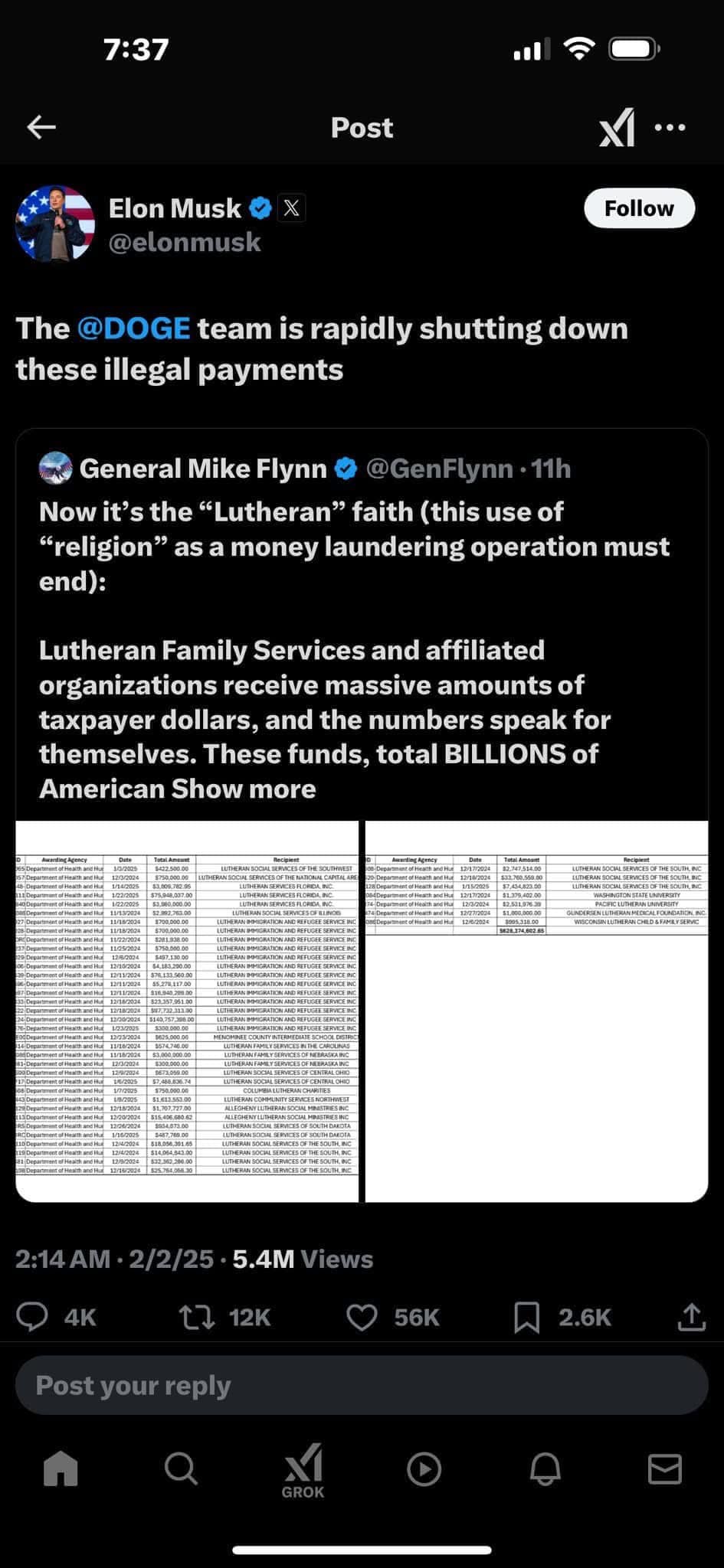
“Any word from the LC-MS (Lutheran Church-Missori Synod)?” a colleague asked me in the hours following Michael Flynn’s disparaging and libelous posting about Lutheran Social Services, Global Refuge and Lutheran Family Services.
A post then affirmed and doubled-down on by the supreme ruler of Department of Government Efficiency (a government “department” in the same way that a “closet” is a “room”…in other words, not really the same thing) Elon Musk.
The post called Lutheran Social Services, Global Refuge, and Lutheran Family Services money laundering organizations.
Which, is not only lauaghably false, but dangerously libel. Especially because on the other end of those services are families in need, children in need, babies, Beloved.
Babies.
And the reason that LSS and LFS have some government contracts (some, mind you), is because they have boots on the ground in localities that need the services and <gasp> do them better than a large beauracratic engine like a government agency could.
I mean, I guess I would put it this way: why use a fire hose to provide a drink when a thousand cups of water will do it better and toward better ends?
That’s what we’re talking about here, Beloved. We’re talking about efficiency and actual impact in actual lives.
But instead of noting that reality, these sledgehammering billionairs and synchophantic parasites decide to prey on misinformation and slander to disparage organizations actually doing the good work necessary for human thriving in the world.
But even though Lutheran Social Services and Lutheran Family Services are pan-Lutheran, and even though Global Refuge has (at least historically) worked across Lutheran denominations, there wasn’t a peep from the Lutheran Church-Missouri Synod.
Until there was. Almost a week later.
And it’s no wonder it took a week because what came from the President of the Missouri Synod was, well, weak.
And confusing.
And insulting.
And astonishingly vaccuous.
I won’t bother to read to you the tome (Harrison is in need of an editor), nor will I pick out any of the parts that were particularly troubling (pay attention to his personal opinion on Musk <spoiler alert: praise>). Honestly, slogging through non-speak and word soup once is enough for any ocular exercise…no need to do it twice. No souls will be saved from purgation by going through that torture again.
But I do want to say, quite plainly, why his letter is so disappointing.
I went to Valparaiso University in Valparaiso, Indiana. Valparaiso is a pan-Lutheran university. Quite proudly (or, at least it used to be a point of pride). In our theology department there we had students from both the ELCA and LC-MS learning together.
Debating together. Usually quite collegially.
Communing together (gasp).
Serving together.
Being in honest dialogue together.
And in that ecosystem we embodied the very first church, despite our theological differences.
Because when Saint Peter and Saint Paul disagreed on how to handle ministry to the Gentiles (Paul was for it, Peter was not so sure), they said that, even though they disagreed on a lot of theology, the one thing they could agree on is ministering to the poor (see Galatians 2:10 above).
And I guess that’s why President Harrison’s letter stunk so much.
Stung so much.
Instead of seeing an opportunity to lift up the good work that these organizations do for the poor, the marginalized, and the oppressed, he decided to talk about the benefit the church has had in immigrating white folks…but those days are now gone and so, while he empathizes with immigrants, the LC-MS isn’t a part of the work of these organizations.
Because, you know, they help lots of marginalized people. Like gay ones. And “illegal” ones. And they can’t be a part of that even though <checks scriptural notes> Jesus didn’t put any qualifiers on helping the poor and marginalized.
Oh, and he went to the trouble to even note how Flynn probably “meant well” by his “muckraking” which, last I checked, NEVER MEANS WELL.
It’s a kowtow to the powers, instead of speaking truth to them.
It’s the bullied cozying up to the bully so they don’t get picked on.
And it’s sad.
And for those of us who saw how Lutherans could work across ideological differences and even love each other, well…it makes me sad we thought it could be different.
Because the church used to agree on at least one thing: helping the poor.
That was the least it could do for the least of these.
It’s fascinating how some white parents will complain that some books that tell the truth about racism will “make their kids feel bad,” which is a reason to ban them.
But they’ll readily drag their kids to a church on Sunday where they hear from the pulpit that their sin and their child’s sin “made God crucify his only begotten son” and not blink an eye.
In honor of the good Bishop’s prophetic plea at the National Cathedral, boldly embracing the call, the freedom, to speaking truth to power:
Miriam on the Shores “All the women went out after her with tambourines and dancing.” –Exodus 15:20
Her skirt hangs heavy with seawater, staccato breath after running from death. She can still feel soldiers reaching out to seize her blouse before the waves caved in.
Collapsing on dry earth for a moment, the impulse to dance begins in her feet, spreads slowly upwards like a flock of starlings rising toward a dawn-lit sky.
So many dances in secret before, night-stolen movements after exhausting days heaving stones and harvest. She finds herself now upright, weeping.
To stand here, face to the sun, feeling an irrepressible desire to spin tumble sashay turn shake twirl
Savoring freedom with her limbs as if it were a physical presence like a fierce wind or the breath of labor, shackles slipping off slowly.
She couldn’t help but dance. The story says she picked up her tambourine, which means she had packed it among the essentials. In fleeing for her life, she knew this would be necessary.
How many of us still live enslaved in Egypt, beholden and weary? Do you have the courage to run across the sea parted just now for you? Will you carry your musical instrument and dance right there on the shores?
On this night last year I had just learned that the Minstrel of the Dawn, Gordon Lightfoot, had moved down that Carefree Highway.
To say he was a musical influence on me is to say far too little. From Cotton Jenny to Rainy Day People, his music was the first I learned to play and mimic on the guitar, and I spun his tunes religiously throughout college as if he, Jim Croce, and Kenny Loggins were the only artists I knew.
I am the proud owner of almost every one of his albums, most on vinyl, and can sing most by heart front to back, anticipating the next song.
His voice was backwater silk. His lyrics were the best kind: complete stories in each song.
But what I was most impressed with was his humanity. He was not a perfect person. Who is? But even some of his songs, like Sundown and That’s What You Get for Lovin’ Me, he didn’t like to sing anymore in these last years because they brought up shameful memories for him. Even though they made him millions and were covered by everyone and their mother, for him they were past markers of mistakes, and he didn’t want to live there forever.
Who would?
I loved that about him.
Like that old ship he iconically sang into our memories when he gave homage to the Edmund Fitzgerald, teaching so many of us about a maritime sailing disaster that would have been lost to history books without him, his music and soul sings on as the vinyls keep spinning his masterful melodies.
We’ll continue to sound Old Dan’s Records.
Or as we call them, Gordo’s Gold.
I guess I’ll end by singing along with what I imagined him saying in those last breaths,
“From my head down to my shoes, carefree highway, let me slip away…slip away on you.”
Though not an official saint day, I would lobby hard for it to become one.
Today the church (should) honor the 49 pulses stopped too soon in the Pulse Nightclub shooting, an act that was both domestic terrorism and hate crime wrapped into one bloody night.
In the days following I remember giving blood, and upon entering the waiting room, finding a number of young adults in tears, waiting. A young woman walked up to the attendant, asking, “How old do you have to be to give? If I bring my mom in, can she sign for me? She’ll give too.”
So much blood. On the dance floor. On the hands of a country that refuses to adequately deal with the scourge of gun violence. In vials filled to help the 53 victims wounded in the act.
And especially now when it seems to be increasingly dangerous for LGBTQIA+ folks due to hateful legislation being passed around the country targeting their representation, their stories, their families, and their dignity, we need to hear the call of the Saints of Pulse and act. We must not remain silent.
Pride month is a month of celebration; yes. But even more so it is a protest against the powers and principalities that seek to harm the splendid diversity of humanity through intimidation, violence, and laws that target rather than protect.
The Saints of Pulse remind the church, and all of us, that until we tackle both the hate of the heart and the lack of regulations that allow people to wantonly act on that rage in mass murder, we’re not done.
“You thumbed grit into my furrowed brow, marking me with the sign of mortality, the dust of last year’s palms. The cross you traced seared, smudged skin, and I recalled other ashes etched into my heart by those who loved too little or not at all.” -Elizabeth-Anne Vanek
Today the church holds a somber fast traditionally known as Ash Wednesday which dates back to the 11th Century.
In a number of places in the Hebrew scriptures ashes were associated with penance and remorse. The books of Jonah, Amos, and Daniel all note the practice of heaping ashes upon your head as a outward display of how guilt and penitence feel inside.
As the church year begins to ponder the death of the Christ in anticipation for resurrection, a more introspective, prayerful, and yes, honest tone is kept. Ash Wednesday is the start of that long road to Calvary.
While some might consider the practice to be sad or even scary (after all, who likes considering their mortality?!), the wise mystics of all faiths remind us that we must ever keep death before our eyes if we are to truly live.
You cannot outrun mortality, Beloved.
You cannot out-diet, out-exercise, out-supplement, out-buy, or out-smart the quiet, pervasive truth that all creation is indeed, dust at our core (beautiful stardust, to be exact), and we will all one day return to that dust.
There is no out.
And yet, as is true with all paradox, there is a certain amount of freedom that comes with embracing this hard truth. Being Wonder Woman and Superman for too long weighs on us all, and we’re really not meant to fly anyway.
We’re meant to walk, which means we stumble like all walking beings do from time to time. The reality of our imperfection is, too, a gift of grace.
After the church and the empire had joined hands, the rhythm of the church year was overlaid on the rhythm of the ancient celebrations of humans.
Ash Wednesday, the day of penitence, became a massive event; a “full Nineveh moment” in the face of the “holy” church’s Jonah proclamation: “Repent, lest ye be damned!”
Sackcloth. Ashes. Solemnity. That was the prescription. Interestingly enough, the diagnosis was proclaimed by the entity who also claimed to have the cure. Religion tends to do that…
But the people, used to more festive holidays, demanded some revelry before the fast. Intrinsic in our human bones, divorced of any religious pietistic profundity, we all know that a fast is seen best through the lens of a feast, and vice versa. A little bit of denial needs a little bit of indulgence to truly know what you’re missing, right?
And so Carnival was declared, a time to fatten our stomachs, our spirits, and our souls before the sobriety of Lent.
Masks were handed out so that, if you were in hiding for a crime, you could come out of your shelter and join in the fun. A hall pass of sorts. Acts of extreme gluttony are best done anonymously, right? On Carnival, everyone is criminal in some way, everyone is queen and king of their universe for just a bit.
The time for bending a knee will come; for sure. One day all masks fall.
But today is a day for reclining, gesticulation, and for pretending we don’t fear fat and sumptuousness, if only for a bit!
“O Lord, refresh our sensibilities. Give us this day our daily taste. Restore to us soups that spoons will not sink in, and sauces which are never the same twice.
Raise up among us stews with more gravy than we have bread to blot it with, and casseroles that put starch and substance in our limp modernity. Take away our fear of fat, and make us glad of the oil which ran upon Aaron’s beard.
Give us pasta with a hundred fillings, and rice in a thousand variations.
Above all, give us grace to live as true folk–to fast till we come to a refreshed sense of what we have and then to dine gratefully on all that comes to hand.
Drive far from us, O Most Bountiful, all creatures of air and shadows; cast out demons the demons that possess us; deliver us from the fear of calories and the bondage of nutrition; and set us free once more in our own land, where we shall serve thee as thou has blessed us–with the dew of heaven, the fatness of earth, and plenty of corn and wine.