O hushed October morning mild, Thy leaves have ripened to the fall; Tomorrow’s wind, if it be wild, Should waste them all. The crows above the forest call; Tomorrow they may form and go. O hushed October morning mild, Begin the hours of this day slow. Make the day seem to us less brief. Hearts not averse to being beguiled, Beguile us in the way you know. Release one leaf at break of day; At noon release another leaf; One from our trees, one far away. Retard the sun with gentle mist; Enchant the land with amethyst. Slow, slow! For the grapes’ sake, if they were all, Whose leaves already are burnt with frost, Whose clustered fruit must else be lost— For the grapes’ sake along the wall.
For the ancient Celts, October was a special month. All hinge points in the wheel of the year were seen as an opening into the next phrase.
January is Winter’s portal into Spring. April is Spring’s portal into Summer. July is Summer’s portal into Autumn, and October is the Autumn portal into Winter.
But within those four portals there was seen to be two great portals: the invitation into the light, and the invitation into the shadows.
April, with it’s growing light as our star decided to hang around longer and longer each day, was an invitation into the light half of the year.
October, with it’s lingering moon, was an invitation into the shadow half of the year, and was known as the “season of frost and firelight.” Indeed: we’ve lit a fire the past few mornings in our own house.
The Celts called the festival at the end of October “Samhain” (pronounced “sow-wen” in Gaelic). It literally means “summer’s end.” This festival was Christianized around the 7th Century as Hallowmas (or All Hallow’s Eve) and, on November 1st, All Hallow’s Day (All Saints’ Day).
That phrase continued to evolve and is now colloquially Halloween.
Rather than some sort of time to celebrate evil or goblins or whatnot, Samhain was actually a time where the Celts explored and ushered in the gifts and mysteries of the shadow-half of the year.
Why do things seem to “go bump” in the night?
Why do we take fire for granted until we can’t see anything anymore?
What does it mean to take seriously the idea that rest and fallowness are necessary for life?
How does family time change when we’re all stuck inside, and what does that mean for us? Could it be possible that, in these intense family times, dead family members join us around the fire (as specters or ghosts)?
Why, in the shadows, are we more fearful and tempted? How do we ward off such tempters? (One solution was the Jack-o-lantern)
The shadow-side of the year, like our own shadow-sides, is not to be feared but, as the Celts did, explored and held and learned from.
The ancient Celts found October to rest under the Ivy Moon. Now half past the month, the harvest is pretty much done and everything is starting to wear its nakedness.
But they called this Autumn moon Ivy Moon because ivy has a difficult time dying, and can live on even after the host plant has died. Ivy, for them, was a reminder that everything goes on in some form or fashion: life, death, rebirth.
It’s the way of things.
Ivy is strong, evergreen, resilient. Though the Earth is wearing their nakedness in these days, Ivy reminds us that the wheel is turning, not dying. It is spinning, not stopping.
For the ancient Celts, October signaled the end of their Autumn and opened the door for the shadowed half of the Celtic year.
Samhain (which literally means “summer has ended”) marks the final feast day of the season, and the convergence of the shadows and the weather inclined the Celts to believe that spirits were able to walk among the living causing mischief, curses, and sometimes blessings.
Practically it meant bringing in the cattle and the sheep down from the summer hillside and into the byre and the stable, now full of the harvested hay brought in throughout August and September.
It was also the time to slaughter the animals and prep them to last as far through winter as possible with salts, cold storage, cottaging, and drying.
The very last bits of barley, wheat, turnips, and apples were picked from the now naked fields, because come November the faeries would start breathing on all the fruit, frosting them and making them inedible.
While the sun still glowed it was also time to get the wood and peat stacked and ready for use. No one wanted to chop and gather in the frigid days coming.
This was a joyous month for the Celts, as the whole family was regularly gathered in the house and the barn: baking, salting, prepping, and preserving, envisioning the coming winter feasts and the cozy days ahead.
The summer sun now became the warm, dim room, and the noisy insects would be replaced with long talks and stories from family and visiting friends.
As our days grow darker and colder, I’m drawn again to my Celtic past and the rituals of these days.
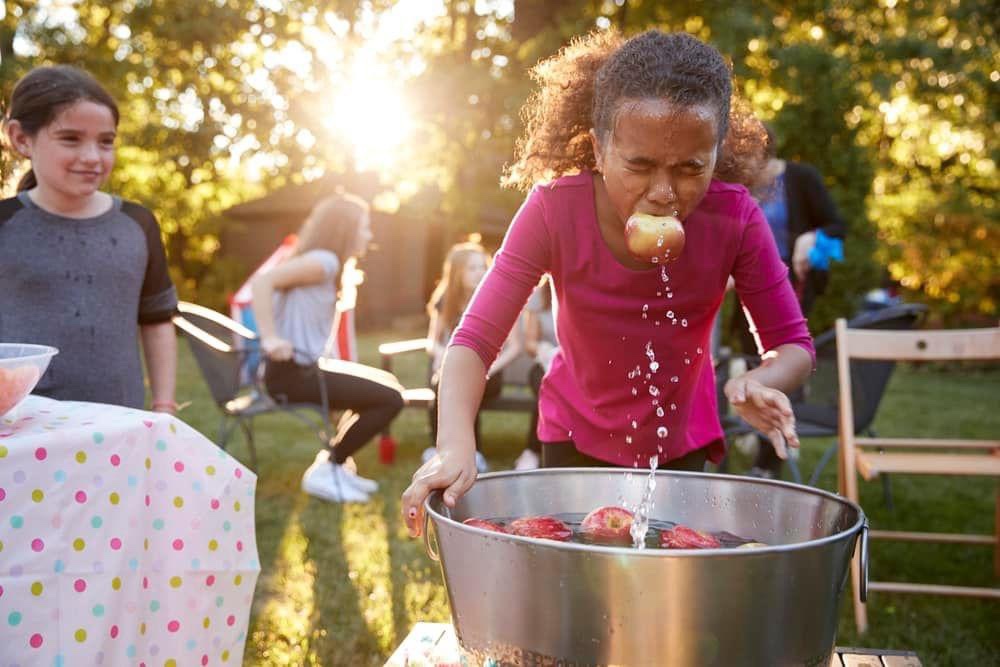
Have you ever bobbed for apples at a Halloween party?
This game is actually ancient, and hails from the Celtic Christians who married the practices of the past with the realities of the present.
The apple was known as the fruit of temptation in Christian circles, but was also a harvest fruit. In the ancient Celtic world, you’d bob for apples to determine who would be married next. The person with the fruit would be visited in their dreams by their true love.
When Christianity came to the Celts, the game took on a more festive Biblical character, as it was associated with the idea of temptation in the days of shadows. Lust, after all, was bad…right?
As the weather began to cool, the Celts spent more and more time in doors telling stories and singing songs. As we approach the equinox, my morning thoughts landed here briefly today.
Songs, and instruments, were (and are!) very important to Irish and Scottish families. Many families employed a harpist full-time to be available for parties, dinners, and to compose and perform at weddings and funerals. As Gaelic culture waned, these professional harpers weren’t able to be privately employed any longer, and became wandering bards exchanging songs and stories for meals and a bed for the night.
It is said that Irish appreciate three skills in particular: the ability to compose a clever verse, music on the harp, and the art of shaving a face.
For the ancient Celts, September marked the mid-point of their Autumn life. In these blazing days that might sound strange to our ears (it hardly feels like Autumn to most of us), but on the wheel of the year this quarter is earmarked for “harvest.” Their wheel, their internal rhythm even (and ours!) has the mid-month of every season as the transitional one:
That middle month is the one of transitions with the equinox or the solstice of the season lying in its belly.
September is a season of invention and harvest. The crops are pulled in fully in this month. The fireplace starts to roar at night not only around dinner time, but longer into the evening as cool air sweeps through the house and the canning and drying and preserving that needs to happen for the coming Winter gets underway.
The fire in the hearth is mirrored by the fire starting to show up in the leaves now gloried on their way to death, and the drying fields calming themselves, preparing for new birth next year.
Toward the end of this month, to honor the final bit of the harvest, dried pieces of wheat and barley would be woven into a crown and hung on doors and windows, or worn on the heads of children.
The whole town would come together as the last sheaf was brought in and they’d have a large feast where the last sheaf of the field was woven and decorated. They’d toast the sheaf, saying “Here’s to the one that helped us with the harvest!” Then they’d take the decorated sheaf and hang it in a place of prominence.
This is where we get our modern day “autumn wreaths” that adorn our own doors and fill up your local Michael’s or Kohl’s in the “home decor” section. Today we see these as pretty and festive. For the ancient Celts they were a sign of thanksgiving and triumph, as the harvest gods had once again provided.
Welcome, September, the month of transitions. We thank you once again for the harvest.
On one of these early August days, I’m reminded that now is the midpoint for the “Summer half of the year” for the ancient Celts, that time between May and November in their (and our) calendar wheel.
For the Winter midpoint of the year the Celts have the festival of Imbolc, or what we in the States call “Groundhogs Day.” It’s a feminine festival, with Imbolc meaning “still in the womb” (and, coincidentally they looked to burrowed animals in those ancient Celtic religions as nature’s alarm clock to wake from winter). For the summer, and specifically August 1st and the days just after, the Celts had “Lughnasadh (loo-nuh-suh)” in honor of Lugh, an ancient deity akin to Rome’s Mercury. I’m not sure their’s a modern American equivalent, except for maybe our flexible notion of “summer vacation.” The idea is similar.
Lugh, the ancient deity, was known as a “jack of all trades, master of none,” and the time is seen as more of a masculine festival in Celtic tradition. He was called a physician, a mystic, a smith, a trickster, and a bard. He did a bit of everything, and so the festival gives a bit of a nod to everything. Just as Imbolc marked the time when the world was emerging from the womb and celebrated was around the hearth, Lugh is an outdoor celebration that marks the days of “last hurrah” and a descent into the harvest, the colder times, the “beginning of the end” as we might say.
To honor the festival they’d reap the first ears of wheat, oats, and barley, and dig the first potatoes. They’d wean the young lambs so that the mothers would mate in order to continue the cycle in the expectant spring. First plump fruits would be picked from the gardens, and it was understood in all of this that the Earth was keeping its harvest promise.
They’d settle bets and business deals, race horses, and everyone would compete in team games for the “glory of today,” because the hard harvest work was about to begin in haste and the night was slowly taking over the sun’s brilliance.
This rhythm and pull between the womb of creation and the “last hurrah” before an ending is still our rhythm, both as humans in society, and as embodied beings.
In early August my ancient Celtic ancestors would celebrate the third great festival of the year, Lughnasadh, or “the assembly of Lugh,” the Celtic sun god.
August 1st marks the beginning of Autumn for the Celts, and so this was essentially a festival to give thanks for the harvest that will be collected over the coming months.
Yes, it was giving thanks for something that hadn’t happened yet…sometimes you have to bank on hope, right?
This festival became Christianized in the Middle Ages, commonly called “Feast of First Fruits.”
In these days the ancient Celts would ween the new lambs so that the parents would mate again, giving more lambs in the Spring. They’d begin harvesting, especially the now ripe gooseberries and billberries.
They’d also make something called a Lammas Loaf (a derivation off of the festival name), a loaf of bread baked and shared off of the first wheat harvested from the fields. They’d often make the bread into different shapes, like wheat stalks, owls, or “John Barleycorn” shapes (sometimes known as The Wicker Man), a legendary figure that often stands for the harvest god/sun god.
Since Lughnasadh falls directly opposite of Imbolc on the Celtic wheel, and Imbolc (“in the womb”) was seen as primarily feminine, Lughnasadh was seen as a very masculine festival, with games and outdoor competitions, kind of like a precursor to our State Fairs here in the United States, with rides and feats of strength.
At its heart, Lughnasadh is a reminder that everything dies and is reborn. “Unless a grain of wheat dies,” the Christ says, “it remains a single grain…”
So we give thanks in the right season, banking on hope.
In the heat of waning July days, the ancient Celts would ready themselves for the August festivals and the beginning of the harvest.
They would take these final days to spend intentional time resonating with the world around them, relaxing in the earth and seeking out sacred spots to bless and in which to be blessed.
You might say this ancient practice is a precursor to our ideas of “vacation” these days. Summer rest is not something we invented, Beloved, but inherited through the long echoes of phenomenological rhythms that pulse throughout the looping threads of time.
Celtic author Mara Freeman notes three ways to honor the earth in these last July days that fall on the cusp of transition.
First, you can give thanks. Find a quiet spot in nature, breath deeply, listen carefully, and be grateful for what is around you. She notes that “a sacred site does not have to be famous or located in a distant country. It can also be a quiet, secret place you have found in the woods or, if you live in the city, a favorite old tree in a local park.” (from Kindling the Celtic Spirit)
Secondly, do some clean up. Whether it is in your backyard, along a well-hiked stream, your local park, or even just bush pruning around the house, caring for nature is an act of sacrifice to the very Earth who will, in the coming months, sacrifice fruit for us. Pruning, by the way, is necessary for many plants, and should be done with the plant in mind, and should not primarily be about how your yard looks from the street.
Finally, take a pilgrimage. Journey to a place where the Earth has been damaged or is in danger of being defiled, calling attention to it. Whether it is the pipeline in the Dakotas, over-fishing off the coasts, or even unwelcome infringement on a natural prairie in your little pocket of creation, walking there, seeing what is happening with your own eyes, and calling attention to it is an act of power and grace. Or, as one theologian puts it, “an actively mobilized process of bearing witness to woundedness and to the mysterious possibilities of the sacred.”
In these acts, the whole Earth becomes an altar upon which our attention, our love, and our gratitude is sacrificed. These acts have rippled throughout the cosmos from our ancient parents until today.





 Reluctant Xtian