
Unknown's avatar

About Timothy Brown

A pastor. A writer. A dreamer. Occasionally a beer brewer.

A Flawed Gift

Today is the feast day of a giant of theology and philosophy, Saint Augustine, Teacher.

Fun Fact: Augustine was voted by his classmates, “Most Likely Non-Disciple to Get Lutheran Churches Named After Him.”

Augustine was born in Algeria in 354 to a Christian mother (Monica) and a pagan father. He was a good student, and in his early years practiced Manichaeism, a dualistic religion of Persian origin that was very “in the now” of his day.

He fathered a child early on in his life, and he named him Adeodatus which means “Gift of God.” History is quiet on the kind of father he was, but it’s important to note that this happened because all of this early material would lay the basis for his most famous work, Confessions.

Eventually Augustine ended up in Rome where he taught rhetoric and was wooed into the Catholic faith. There he was catechized under St. Ambrose and was baptized at the Great Vigil of Easter in 387.

Shortly thereafter Augustine returned to North Africa and lived a monastic life with friends. In 391 while visiting Hippo, he was chosen by the small church there to be their pastor.

All indicators point to his reluctance to take up the role, but eventually he was ordained into the priesthood and consecrated Bishop of Hippo, a role he kept for 35 years. He traveled extensively in the ancient world, and wrote volumes while he did so.

His book The City of God contains his reflections on society and the body politic in the aftermath of Rome’s collapse. In it he also defends Christianity and sets forth a vision of an ideal Christian society.

Spoiler alert: it looks nothing like America.

He established a Rule of Life and an order, Augustinian, was begun in his name. Martin Luther would adopt this Rule and this order.

Augustine died after he came down with an intense fever in the year 430. His remains, well, remain in the Church of San Pietro in Pavia, Italy.

Augustine is the model of the “second chance” life. And, quite honestly if you read Confessions, a third and fourth chance, too.

He is one of the most human of the saints because his foibles and misadventures are documented for all to see. He remains a gift to the church, even with all his flaws, and is a constant reminder that contrition and confession enable us to be born again.

And again.

And again.

-historical tidbits from Pfatteicher’s New Book of Festivals & Commemorations
Unseen Hand

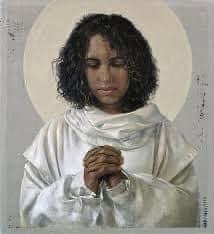
Today the church honors a 4th Century saint who is, perhaps, a hidden hand in Christianity, pushing theology and philosophy forward in remarkable but overshadowed ways, St. Monica, the Mother of St. Augustine.

St. Monica was born around 322 in North Africa to Christian parents, and was in an interfaith marriage to Patricius, an ill-tempered government official who, in his old age, softened and is even purported to convert.

A caring mother, Monica bore three children, but her first born is the one history remembers. She raised him in the faith, prepared him for baptism, and though Augustine had a well-documented wild-streak, continually kept him in prayer.

In 383 Monica moved with Augustine to Rome as he came under the instruction of Bishop Ambrose. Like many parents, she tried to “hook him up with someone nice,” but Augustine wasn’t interested in marriage. Eventually he decided to be baptized and accept the Holy Orders and a vow of celibacy.

Monica rejoiced.

Shortly after her son’s baptism Monica fell sick, and on her deathbed she had beautifully mystic visions which she shared with Augustine. She died in 387.

With Augustine’s rise, Monica’s legend continued to grow, and she retains a devoted following as an example of persistent parenthood and prayer. She is often called the “Patron Saint of Mothers,” and some Christians annually recognize her on Mother’s Day.

I chaff a little that she is always connected to her son in religious memory, though as a parent myself, I hope my best contributions to the world sleep in the room just adjacent to mine. Augustine is such a big personality in the annals of faith; anyone connected to him is both elevated by his coat tails and simultaneously overshadowed, even the one who bore and raised him.

Still, Monica was more than “Augustine’s mother.” As her deathbed experience notes, she was a mystic in her own right, and is an example for how interfaith marriages can be a blessing to the world.

In these tumultuous days I was moved again by Monica’s story, especially as I remember hearing in the audio shared in the George Floyd case on how he called out to his mother. Mothers, and fathers too, so often feel helpless as their children fly off into the world, battered by forces that can both lift and destroy.

A part of me wants to say that Monica, along with all mothers, heard that cry and moved cosmically through the mothering voices calling for change as we were all baptized in the tears shed.

Another part of me prays for mystics to rise up again and change hearts, as it feels like we all are on a kind of deathbed in these days. Either a deathbed, or a birthing cot. Maybe both.

Finally, I guess, St. Monica reminds me that sometimes, as a parent, we don’t see our work bear fruit until the very end, and therefore live and love in perpetual hope.

-historical pieces noted from Pfatteicher’s New Book of Festivals & Commemorations
The Young King

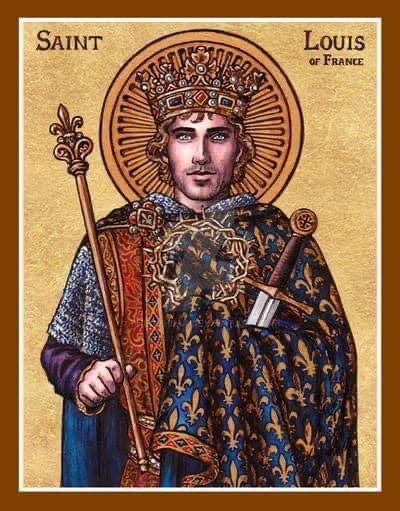
Today the church honors Saint Louis, the 13th Century King of France (not “The Gateway to the West”).

Now, before you ask, this is Louis the IX, not that other famous Louis of ill-repute.

In fact, Louis the IX was of quite upstanding repute, despite his involvement in the Crusades. Crowned at the age of 12, this young king expressed that he’d rather have joined a cloister than been royalty. He was loveable, a kind husband, and a doting father.

He also had a heightened sense of piety, often wearing shoes without soles as a sort of perpetual penance.

Oh, and he also would not allow cursing in his presence, which automatically makes me admire him and also makes me quite sure we would have never been friends.

St. Louis attended worship religiously (get it?), and was quite generous with his money, both publicly and privately.

In leading one of the Crusades in 1250 he was taken prisoner, and returned to France six years later. After mobilizing another army, he sailed again for North Africa in 1270 and, after much difficulty, died of dysentery in Tunis with a very “Oregon Trail” sort of ending. He’s buried in the basilica of St. Denis near Paris.

In iconography he’s often depicted with a crown of thorns, both because it was one of the relics he worked hard in his life to recover, and also as an homage to the humble way in which he conducted himself.

St. Louis is a reminder to me, and to the church, that power does not always corrupt and crush the human soul. Indeed, if we all are remembered as “loveable, kind, and doting,” well, we’ve done alright, right?

-historical bits from Pfatteicher’s _New Book of Festivals & Commemorations, and the icon is by “Theophilia” of deviantart.com

What’s in a Name?

Today the church honors a saint wrapped in mystery: St. Bartholomew, Apostle, perpetual Somebody/Anybody.

Bartholomew makes an appearance as one of Jesus’ 12 disciples in Matthew, Mark, and Luke, and reprises the role in the book of Acts.
His name is not even really a name as much as a description: he is the “son of Ptolemy” (except in Matthew where he’s called Simon Bar-jonah).

Bartholomew may, therefore, have another personal, intimate name that we have no knowledge of. In Matthew, Mark, and Luke he is associated with the disciple Philip, but in the Gospel of John the disciple Philip is yoked with a disciple named Nathanael. Could Bart actually be named Nate?

Maybe.

There are several traditions that map the two names together, and separately, though as early as the 9th Century the two names were often considered one and the same.

Lore has it that Bartholomew wrote a Gospel account, which is now lost to history. Some reports have him preaching in Asia Minor, Persia, and India, where he supposedly left a copy of the Gospel of Matthew written in Hebrew for the people to have and keep, a copy which was reportedly found at the end of the 2nd Century by a wandering missionary.

Most accounts have him ending his ministry (or, rather, having it ended for him) off the Caspian coast where he was grotesquely martyred (“flayed” according to the stories, which is why he’s often depicted with a knife, or even holding his own skin). He secured his place in the pantheon of saints by being included in the Sistine Chapel mural near Christ at the last judgment.

The Coptic church has a different tradition about this saint, though, one that has him preaching in Upper Egypt and North Africa, where he met his martyrdom by being cast into the sea.

Something I’ve come to love about this mysterious and secretive saint is the fact that they are relatable to many in our world who labor under an identity that they don’t quite jive with.

I’m thinking of the trans and non-binary youth I’ve walked with who struggle with what to call themselves. Often flayed in public opinion because they can’t quite put words around their own being, they struggle to find voice in a world of assumed norms.

I’m thinking of the people who are known less for who they are as people, and more for who they are in relation to other, more popular people. The eclipsed sibling. The child who never quite lives up to their parent. The quiet spouse. The one who was in a position directly before or after the beloved person who held that same position in a church, a public office, or even a family.

History is confused about this saint, and never really waited around for clarity.

Bartholomew/Nathanael is seen but not known. They are acknowledged but not really understood. They are talked about, but the details are confused and fuzzy because no one took the time to explore them, and they were never really given the chance to explain.

In this way Saint Bartholomew, this Saint Nobody/Somebody, is the patron saint of so, so many in this world…

-historical bits sifted from Pfatteicher’s New Book of Festivals & Commemorations

-icon written by Vranos Nik and can be purchased at oramaworld.com.

On How We Don’t Have to Put Up With Bad Behavior

She came every month with a copy of the mailed newsletter in her hand, marked up with red ink. The office admin answered the door graciously every month, as she had been doing since before I arrived. She took the bloodied copy, said thank you, and put it on her desk, slumping down in her chair.

“Who was that?” I asked. I’d caught a glimpse of the woman out the window, and had never seen them before.

“Oh,” the admin said, “she comes every month to show me all the mistakes in the newsletter. She doesn’t go here anymore, but she used to I guess. She stopped coming because she said it’s too hard for her to get here…”

“But she can get here to critique the newsletter monthly? That makes no sense,” I said, shaking my head.

I looked at the copy. The editorial corrections she was suggesting (demanding?) were from an outdated form of writing, anyway. Her edits weren’t actual edits, just grammatical preferences.

“Why do we allow this?” I asked, honestly. “This is just bad behavior.”

A month went by, and one day I saw the car drive up. The woman stepped out, ink dripped copy in her hand. The admin sighed and got ready to head down to answer the door. “Let’s go together,” I said.

I opened the door before she rang, and she looked at me, surprised. “You must be the new guy,” she said, smirking at me.

“I don’t believe we’ve met,” I said extending my hand. “No, you won’t see me on Sundays. But I know the newsletter has a lot of issues and people care about that sort of thing, so I still edit it for you so, you know, you can see your mistakes.”

She held out the document.

“No thank you,” I said. “We don’t need you to edit it anymore.”

“You know,” she went on, “I used to be an editor for this church’s newsletter…”

“When was that?” I asked.

“I left in 1982,” she said.

“That’s a while ago. Why did you stop?” I asked, genuinely interested.

“I got mad,” she said with a smile, “you know how these things go…”

“I do,” I said, “which is why I’m not interested in letting it go on. You’re welcome here any time. But we won’t be accepting any more of your newsletter edits. Please do not show up here with this kind of thing ever again.”

Her eyes narrowed.

“I bet you have a family, don’t you?” she said with a smirk. “When you go home tonight, you tell your wife that today you met a WOW.”

“A WOW?” I repeated.

“Yes. A Wicked Old Woman,” she said, turning and walking back to her idling sedan.

She drove off. We never saw her again.

And we were better for it.

Popular Recluse

Today the church remembers the first official canonized saint of the Americas: Saint Rosa of Lima, Eccentric, Vegetarian, and Caretaker of the Sick.

Born Isabel Flores de Olivia, Saint Rosa’s name came from one of her nannies who claimed to have had a vision where Isabel’s little face bloomed into a rose. They started calling her Rosie and, well, as many childhood nicknames do, it stuck. Her family was wealthy for one born in the late 16th Century in a far flung colony, and she had many siblings. When she was Confirmed in 1597 she officially took the name Rosa as her new name, and then her real work began.

Rosa was strong-willed. It seemed whatever someone else wanted her to do, she did the opposite. Suitors started to admire her beauty, so she cut her hair and rubbed spices on her face to make it break out. She started to fast three times a week, despite her wealthy family wanting her to have a full figure. She took a vow of virginity, despite her parents wanting her to marry.

She was her own woman, and knew what she wanted out of life: to give herself away.

In the quiet hours of the night she would go and find sick people on the streets, bringing them back to her room to care for them. She refused to eat meat noting that it caused harm, and instead had a crown of silver created with spikes on the inside for her to wear, mirroring the crown of thorns. She took the sacrament daily, and only slept two hours a night, devoting the rest of her time to prayer and service. She sold flowers and embroidered pieces of art (she is also the Patron Saint of Embroidery!) to help her family survive, but gave most of the monies away to the poor.

Eventually her behavior caused her to shy away from the larger world, and she functionally became a recluse.

Despite her eccentricities, her parents never allowed her to join a religious order, though she desperately wanted this for her life. Instead she took what is known as “tertiary vows,” living the life of a monastic without the formal orders, following the way of Saint Dominic in seclusion.

She was known to have visions and dream dreams, and in fits and spurts would relate these to the church.

Saint Rosa of Lima died at the age of 31 on this day in 1617. She is the Patron Saint of Lima, and her likeness can still be found on their currency. Despite her reclusiveness, she was well known, respected, and loved, especially because she was known for giving of herself and her wealth for those who had nothing. At her funeral everyone, and I mean everyone who was anyone, attended to give homage to her self-giving love.

Saint Rosa is a reminder for me, and should be for the whole church, that sometimes people know what they want out of this life from an early age and, despite the stereotypes, young people want to give of themselves for others.

And we can let that happen, by God.

-historical bits from public sources

-icon written by Theophilia

A Very Good Boy

Today is a strange day in the feasting life of the church because in some pockets of the community, specifically Celtic and French pockets, a saint is not honored, but rather an animal considered saintly: Guinefort the Hound, Protector of Children and Martyr.

The story of Guinefort is one that can be found in many different cultures. In Celtic lore his name is Gelert. In east India he’s not a dog at all, but rather a mongoose (a modern adaptation is the much beloved children’s cartoon, “Riki, Tiki, Tavi”). But though the names, and sometimes animal species, changes in across cultures, the story is largely the same: a faithful pet saves the family newborn from a deadly viper.

The testimony surrounding Guinefort the Greyhound comes from a Dominican monk, Stephen of Bourbon, from the 13th Century. In his relating a hunter left his French cottage to bring back breakfast, and upon returning finds the nursery room a complete wreck, and his faithful hound meeting him with a bloody snout. Assuming the worst, the hunter dispatches of the dog, only to find the young child unharmed under an overturned bassinette, with a dead viper nearby.

The faithful Guinefort had not destroyed the child, but had destroyed the viper.

In their elation over their child and guilt over the mistaken identity, they buried the hound and made an altar of rocks there to always remember him.

In France the altar became a pilgrimage site of sorts for the townspeople, and Guinefort became a revered “saint” in their eyes, with them calling upon him to protect their children in their work and play.

This veneration of a dog obviously rubbed the church the wrong way, and many attempts have been made in the centuries since to tamp down this sort of animal reverence (the Celts had been doing it forever, though, and some habits die hard!). Try as they may, Guinfort’s memory, story, and yes, saintliness remains to this day in many pockets of the world. The tale is a reminder for us not to be too hasty with our assumptions and to give those we know and love the benefit of the doubt.

It’s also interesting to see how the fear of snakes has a through-line throughout human history. Truly our evolutionary-driven fear of what is sneaky, silently, and venomous is common across cultures. Instead of making us more interested in learning the differences between different kinds of snakes, though, this has usually just encouraged us to kill all snakes regardless of their bite.

Which is too bad.

Regardless, it is clear that Guinefort is a very good boy.

Guinefort is a reminder to me, and should be for the whole church, that no matter what you want the people to believe or do, or whatever you want them to stop believing and refrain from doing, people will do what they do because sometimes tradition is stronger than belief for humans.

It just is.

-historical bits from common sources

Seeker of Relics

Today the church remembers a saint who went on a search for lore and said she found what she was looking for: Saint Helena, Mother of Emperor Constantine and Seeker of Relics.

Saint Helena’s childhood is a bit of a mystery. She was probably born in the Roman empire to a poorer family, though this is unconfirmed. She somehow found herself wedded to power, however, in the form of Constantius Chlorus who would become co-regent of the Western portion of the Roman empire. They had a son in the late part of the 3rd Century and named him Constantine.

Not one to pass up a political power play, Constantius divorced Helena and married Theodora, the step-daughter of the then Emperor (Maximinianus Herculius), making him next in line.

Constantius died in 308, and Constantine took the throne. As he ascended those steps, he brought his dear mother along with him, making her one of the “in crowd” again. Constantine ordered the empire to revere his mother as much, if not more, than he himself did, and under his influence Helena slowly converted to Christianity.

Now that she was the Empress of the land once again (Augusta Imperatrix was her official title), a newly revitalized Saint Helena undertook Indiana Jones-like quests to explore the life of Jesus on foot. Constantine charged her with finding any relics that she can relating back to the life of Jesus.

In her search for relics, Saint Helena built churches on the “sites” where she believed Jesus did important things like, oh, get birthed and ascend into heaven. These churches are still there in Jerusalem, including the one on Golgotha. Emperor Hadrian had built a temple to Venus on the site, and Saint Helena ordered it to be demolished. Lore has it that in the excavation they found three crosses, the middle being the cross of Christ.

Saint Helena supposedly recovered the nails used in the crucifixion, parts of the rope that bound Jesus, parts of his tunic, and parts of what is called “the true cross.” She took these back to Rome with her, and you can see all of these supposed relics still, the pieces of the cross being held at the Basilica of the Holy Cross in Jerusalem.

Now, of course, this is all very fantastical, right? Truly is unbelievable…and yet some do.

One of the issues, of course, is that the search for the historical Jesus will always come up lacking. No amount of splinters or threads of yarn can patch together what is actually being sought in that journey: verification.

Faith can’t be verified.

One of the gifts that Saint Helena did do was provide the world with beautiful things. The churches she started at these “holy sites” are truly remarkable, even if they may built on wishes and hopes.

Sometimes that’s all we have.

Saint Helena is a reminder for me, and should be for the whole church, that even though we seek out verification regarding the matters of the faith, we won’t find them. But, seek we still do, and as we do it I hope we make some beautiful things along the way…

-historical bits from public sources

-icon is traditional Russian style

Not All Pastors Serve Churches

Today I would lobby hard that the church remember a contemporary saint who just recently was welcomed into eternity: Frederick Buechner, Pastor, Author and Imagination Specialist.

I should begin by noting that Buechner did not die on this date, and usually saints are remembered on their holy exits. But because he died on the Feast of Saint Mary (August 15th), it is sometimes customary to transfer a feast when it falls on a previous one, especially one of great importance. Because we honor Mary on the 15th and Saint Stephen of Hungary on the 16th, and the 17th really doesn’t have a special saint (in my opinion), Saint Frederick Buechner makes so much sense.

Frederick was actually born Carl Frederick in 1926 in New York City. His father was often searching for work, and so Frederick (as he preferred to be called) didn’t have a very stable home life, constantly on the move. This instability intensified when his father died by suicide in 1936 when Frederick was only 10 years old. His family immediately moved to Bermuda, where things were relatively stable for a few years until they had to evacuate at the outset of World War II. Regardless, Bermuda felt like home for this young one.

Returning to the mainland, Buechner enrolled in school with an interest in writing, going on to Princeton (which was briefly interrupted by service in the Army), and graduated with a B.A. in English. In his senior year he won an award for poetry and began work on his first novel, A Long Day’s Dying. Published in 1950 it was a critical success. Shortly thereafter he left teaching, moved to New York City, and resolved himself to being a writer full time.

In New York City he continued to have success and reaped awards, but his interests expanded from just writing to now including religion in the mix. Having gotten involved in his local Presbyterian parish, he heard one Sunday from Pastor Buttrick a sermon and call that would compel him to enter seminary.

Note to pastors: sometimes this happens…words matter.

He entered Union Seminary in New York and became a pastor without a parish, having been invited to start a religion department at Phillips Exeter Academy.

Saint Buechner would serve Exeter for nine years, honing his preaching and continuing his prolific writing. He moved to Vermont in 1967 and once again dedicated his life and time to writing.

Buechner had the amazing ability to create characters that were imbued with honesty, spirit, and a good dash of humor, never making the religious symbolism or subtext (found in a lot of his work) a stumbling block to just a plain, good story. I’m not in love with all of his work, but how could you be?! He wrote so much. And not just novels, but plays, poetry, essays…the man was a writing machine, and the world is better for it.

Sometimes it’s just nice to have a novel that is not “religious” and yet it is, you know? It plumbs those depths in interesting and inviting ways. Only a few writers can do this well, in my opinion, Buechner chief amongst them. He was never dogmatic, but always inviting you deeper and deeper into the existential-yet-hopeful shrug of what it means to be alive with other humans.

Saint Frederick died on August 15th, 2022 at the age of 96. Though he never served a parish, I have to think those of us who read his novels, spiritual writings, and poetry were his pew-sitters, marveling at the wonder of the characters and thoughts he brought into being.

Saint Frederick Buechner is a reminder for me, and should be for the whole church, that sometimes serving a parish isn’t the end-all and be-all of pastoral work. In fact, his own Pastor Buttrick once quipped, at the thought of Buechner serving a parish, “It would be a shame to lose a great novelist in exchange for a mediocre preacher.”

In other words: not all pastors serve parishes. And that’s ok. This is most certainly true.

-historical bits taken from public access sources