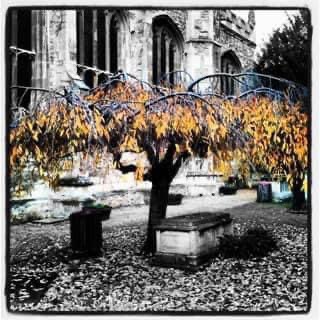
Today the church uses its parched tongue to cry out, “O Radix Jesse!” or “O Root of Jesse!”
The ask here is that the dead stump of a family line, scourged and ravaged by one conquering after another, eating away at the Family Tree, somehow live again.
This dead-end of a year may feel very stump-ish to you.
It’s also just true that while we may have eaten from the Tree of the Knowledge of Good and Evil, we have not learned its wisdom. That ancient tree is dead in our hands as we call what is evil, good, and what is good, evil.
On December 18th in Advent the church raises its voice to cry out, “O Adonai!” or “O Lord!”
This is, perhaps, the most honest prayer there is, Beloved. In times of trial and joy, “Oh God” or “My Lord” slips from our lips.
In the ancient context of Advent, this cry is both an invocation and a statement of political priorities. The Empire of old (and now?) would have you believe that power is Lord, that grievance is Lord, that Caesar is Lord.
In fact, all the ancient steles and decrees said just that: Caesar is Lord.
But the church, at its best, says that the Divine is Lord.
It’s a political statement. We’ve forgotten that…but we can remember. There is time.
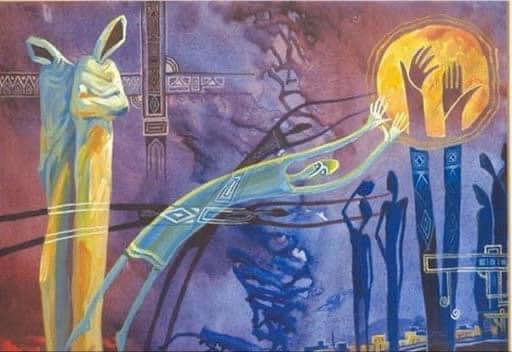
-art is by Michael Adonai, an Eritrean painter, entitled “Back to Homeland.” You can imagine crying out “O Lord” when longing to return to your mother…
The poet Nayyirah Waheed has broken me many times. Her work has, over the course of a few years, served as a meditation many mornings.
Like, this one:
stay soft. it looks beautiful on you. (from her book, Salt.)
One of the things I love about the rhythm of the church year is that it keeps me soft. Nimble. Pliable.
When we get too stuck in our ways, too embedded in our walled-off routines, we become rigid. So much of religion has become rigid in the hands of hard people who have obeyed dogmas not like one takes opportunities, but like one might follow a written recipe that is so complex no chef has mastered it.
Rigidity is brittle. A rigid faith breaks in time.
Advent is, like I say above, an opportunity to practice plasticity in the faith. With so much mystery sewn into the fabric of these short-sunned days, we are encouraged to dream a bit, to wonder and let our hearts wander (perhaps that’s where the old carol got its title?) and become soft again.
To melt, if you will, like you do when you pick up a newborn.
I remember one time taking my newborn son to visit our oldest parishioner. My son, only a few months old, was strapped to my chest in our carrier. The old woman, in her 90’s, asked if she could touch him. I bent myself over as she reached out her hand, and I guided her fingers to his little head (as her eyesight was failing).
I marveled at how both the oldest person I knew, and the youngest, felt the same in my hands: tender skin, soft skin, pliable skin.
It was a moment; eternity reaching out to touch at both ends.
She died not long after that visit…
That encounter made my heart pliable. Soft. It was beautiful.
Like the aged Elizabeth holding her son, perhaps, a story told in these middle days.
What is keeping you soft in these middle days, Beloved?
In learning about my Celtic heritage, I stumbled upon a fun tradition of something called “The Yule Lads,” 13 trolls that come from December 12-24 to play pranks. Especially popular in Icelandic lore, these trolls are fun tricksters who, when little children leave their shoes on the window sill, leave candies for good children and rotten potatoes for naughty kids.
December 12th: Sheep Cote Clod visits to harass sheep (but his peg leg prevents him from catching many, and he mostly makes noise).
December 13th: Gully Gawk comes from the mountains to hide in gullies, sneaking into barns to steal milk.
December 14th: Stubby comes to scrape out all the food left in your pans.
December 15th: Spoon Licker licks your spoons.
December 16th: Pot-Scraper scrapes out your pots.
December 17th: Bowl-Licker licks out your dirty bowls.
December 18th: Door Slammer comes late at night to slam your doors while you’re sleeping.
December 19th: Skyr Gobbler arrives. Skyr is a special kind of Icelandic yogurt, but he’ll eat any yogurt…he’s not picky.
December 20th: Sausage Snatcher comes to, well, self-explanatory.
December 21st: Window Peeper comes. A terrible name, this is the kindest of the trolls who is just looking for little snacks to steal by peering through your windows.
December 22nd: Doorway Sniffer comes. He has a strange name, but he’s just sniffing out your cakes and muffins to eat with his strong nose.
December 23rd: Meat Hook comes to eat the Christmas roasts you’re prepping for your holiday feast!
December 24th: Candle Stealer. This harkens back to a day when candles were made from fat and were edible. He waits to take children’s candles to eat!
Today the church celebrates one of the great mystics of history, St. Juan de Yepes y Alvarez, but you know him better as St. John of the Cross, Renewer of the Church and Visionary.
St. Juan was born in Fontiveros Spain, the third son of a Jewish silk merchant. His father died shortly after he was born, and his family placed little Juan in an institution for the poor.
St. Juan was extremely short of stature, even for his day, but showed great skill in craftsmanship from early on, and apprenticed at many places. He enrolled in college and worked his way through school striving to become an exemplary monk.
He was entranced in the Order of the Blessed Virgin (Carmelites), and was ordained. Soon after met St. Teresa of Avila, his spiritual cousin. She had begun to implement her reforms of the Carmelite order, and St. John promised himself to these reforms, adopting the name St. John of the Cross to embody his minimalist and mystic piety.
St. Teresa eventually helped get St. John appointed as Confessor to the Convent of the Incarnation, where she was a sister.
St. Teresa’s reforms were causing division within the Carmelite Order, and some monastics came and seized St. John, imprisoned him in a six foot by ten foot cell, beat him, and attempted to force him to renounce the austere reforms.
St. John refused and after nine months was able to escape, fleeing to a safe monastery in southern Spain.
This is where he began writing down his mystical visions and dreams, having had them in the confinement of his prison cell. His deeply spiritual writings often took the form of poetry. Most notable are The Ascent of Mt. Carmel-the Dark Night, and Living Flame of Love (which is more song than pure poetry).
In 1591 the controversy over the austere reforms rose again, and St. John was banished further south in Spain. It was there that he caught a fever and, though he sought medical care, was poorly treated because the prior of the monastery didn’t want the burden of another monk.
He died uttering the Psalms, saying, “Into your hands, O Lord, I commend my Spirit.” He was deeply beloved by the people, though he was rejected by much of the Church at the time, and was immediately heralded as a Saint.
You may not be too familiar with St. John of the Cross, but you’re certainly familiar with art that is based off of his mystical visions. Salvador Dali’s unique painting of the crucifixion was based on one of St. John’s poems.
St. John of the Cross is a reminder to me, and should be for the whole church, that sometimes the most despised in our midst are the wisest.
Let those with ears to hear, hear.
-historical notes from Pfatteicher’s New Book of Festivals & Commemorations
Today the church, especially those of Scandinavian heritage, remembers a young saint and martyr who, in memory, has a taste for sweet rolls and coffee: Saint Lucy, The Light Bearer.
Having lived sometime at the end of the third century in Sicily, Saint Lucy was a victim of the Diocletian Persecution, a purging of Christians in Roman territories. She was said to have lived a good life who had a heart for the poor. Legend goes that her mother fell gravely ill when Lucy was a young maiden, and when she recovered St. Lucy gave all of her bridal dowry to the poor in thanksgiving to God. Her would-be suitor did not like this at all, and turned Lucy in to the authorities for being a secret Christian.
As punishment Lucy was forced to work in a brothel…though she refused to work at all, which frustrated her oppressors. They took her out to the village square and built a fire around her in order to scare her into submission, but she remained unafraid. She eventually died due to these intimidation tactics, and her legend grew in the Christian communities as a brave young woman who had no fear in the face of danger.
Saint Lucy is remembered as the patron saint of the working poor. Her name literally means “light,” which makes the intimidation tactics of her oppressors ironic.
In modern practice Saint Lucy’s memory made its way far north to Scandinavia where she is highly regarded, especially as her feast day is quite near the Solstice.
Saint Lucy, or as she is known in the North, “Sankta Lucia,” is remembered by the procession of a young girl in the house wearing white with a red sash (the sign of a martyr), her head adorned with a crown of candles, bringing breakfast and a blessing to each room. These candles stand for two important symbols in Saint Lucy’s story: both the light that was used to intimidate her, and they also symbolize her eyes (the candle of the body), which prayers to Saint Lucy are reported to protect. A traditional breakfast on this day are Lussekatter, or “cat’s eye rolls” made of saffron and currants.
Oh, and if your home doesn’t have a young girl to process, have no fear. Young boys often dress in red as St. Lucy’s attendants by the name of “Star Boys.” They, too, carry on the tradition with star wands, blessing each room.
It makes sense that in the Scandinavian North around the shortest days of the year the people would seek out signs that the light would never be extinguished. Saint Lucy is one of those ancient signs; an ancient memory that humans have long utilized to remind themselves that though shadows lengthen, the light never dies.
Though the Saint Lucy practices are fun and highly tied to heritage, it is too bad that she is not remembered better as the fierce young woman of lore.
Saint Lucy is a reminder for me, and should be for the whole church, that reminders of hope are necessary for humanity, and stories often provide those reminders.
The story of Lucy the Light Bearer, the fierce and unafraid young woman, is worth remembering.
On this day I often recite a poem by Edna St. Vincent Millay, especially as daylight is at a premium and we’re all overworking:
“My candle burns at both ends it will not last the night. But ah, my foes, and oh, my friends, it gives a lovely light.”
-historical pieces from Pfatteicher’s New Book of Festivals & Commemorations
In the 8th Century it came to pass that the traditional twelve day festivals of the Celts was declared a sacred season by the Church. Emphasis was placed on December 25, January 1, and January 6. December 25 was called “Nollag Mor” by the Celts, “Big Christmas.” January 6 was known as “Nollag Beag,” or “Little Christmas.”
Public work and public business was suspended unless you were a butcher, baker, or someone whose livelihood added to the festivities. Our idea of “Christmas break” stems from this ancient pause in public life.
In these days you’d ponder love, both human and Divine, and would openly practice extravagant acts of charity: gifts to workers who you employed, loved ones near and far, and extra meat and bread to those who struggled throughout the year. In this way you emulated both the Sun who gives without asking, and, as religion gained influence, the Son who was said to do the same.
Because there was no work, people had time to dance and sing. So little caroling bands popped up around town dressed in fun costumes, spreading frivolity and sometimes asking for food or trinkets. We continue this tradition in Christmas caroling.
Everything has an origin, a reason, in this season.
On December 12th many Christians honor Our Lady Guadalupe.
I am not Roman Catholic, nor Latinx, but I do not and cannot underestimate the powerful connection to the Divine that Our Lady of Guadalupe provides for Christians who check both of those boxes. Arturo Perez says it best:
“Guadalupe’s significance is both word and symbol. She provides the answers to the prayers of the faithful people: ‘God is with you!’ Her very appearance, as one of the poor, aligns her with them. Guadalupe’s proclamation can be seen as God’s option for the poor.”
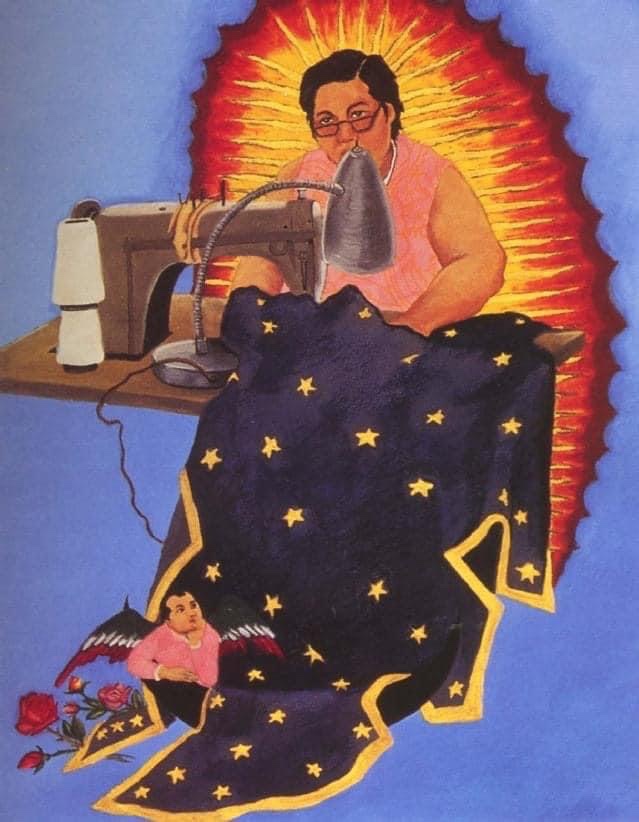
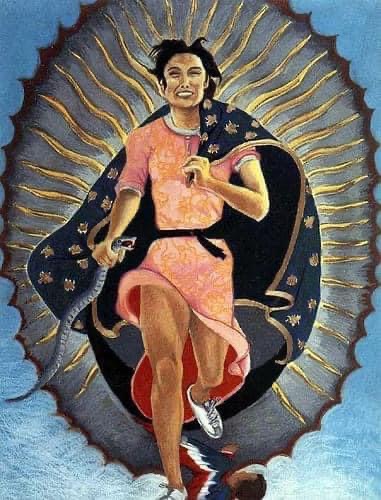
These two depictions, by artist Yolanda Lopez, flow not only from her heritage, but also from her work as a Mujerista Theologian. I find them both engaging and inspiring and, though they’re not traditional icons for this important Feast Day, they moved me.






 Reluctant Xtian