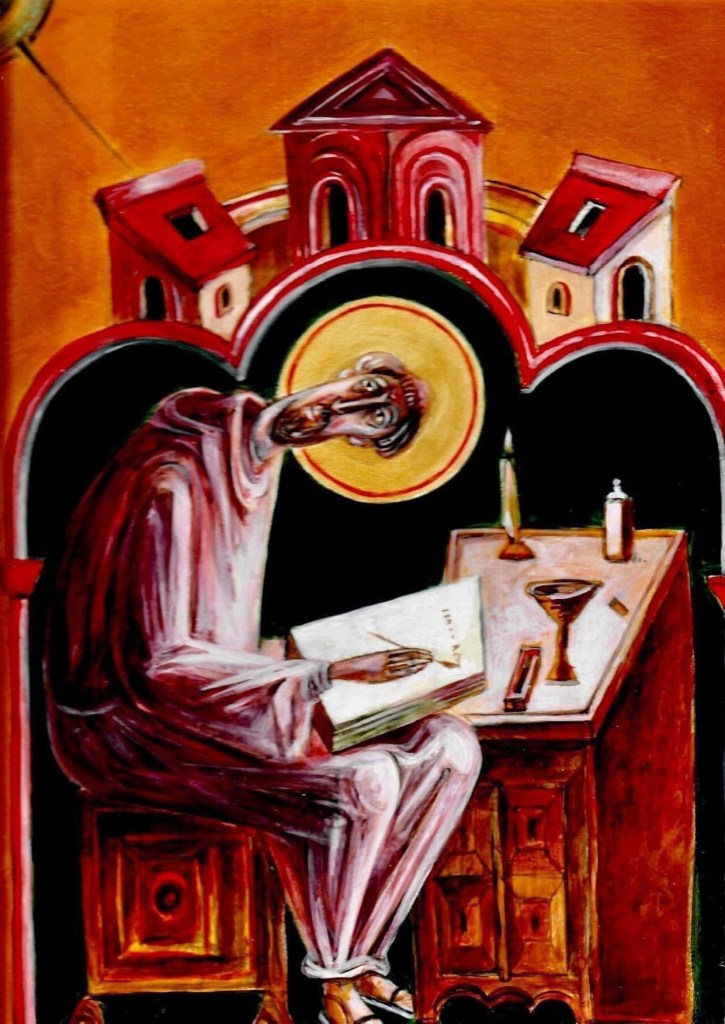
Today the Church remembers an 8th Century Saint who lived an uneventful life (which is what makes him interesting): St. Bede the Venerable, Monk, Priest, and Scholar.
St. Bede, known as “the father of English history,” was born in the late 7th Century near Durham, England. At the age of seven his parents dropped him off at the new monastery in Wearmouth to be educated, and he quickly grew in both learning and stature as being intellectual and wise (a combo that don’t always run in tandem).
He was ordained a Deacon at the age of nineteen, and became a priest at the age of thirty.
St. Bede devoted his life to scholarly pursuits, and could often be found in the monastic library. It is thought that he was the most learned person in Western Europe, and dabbled in history, grammar, metrics, understanding time (still an abstract topic!), and, predictably, the Scriptures.
He wrote An Ecclesiastical History of the English People (in Latin) which remains a primary text for understanding the 6th, 7th, and 8th Centuries of Anglo-Saxon culture and the ascendency of Christianity on the island.
St. Bede received the title of “Venerable” in accordance with the practice of the time as awarding that title to anyone who proved themselves as knowledgeable and holy. For him the title seemed to stick more than others in history.
St. Bede the Venerable died on Ascension Day in the year 735 A.D. while he was in the middle of dictating an English translation of John’s Gospel.
St. Bede is a reminder for me, and should be for everyone, that your life doesn’t need to be remarkable to be remembered.
-historical bits from Pfatteicher’s New Book of Festivals & Commemorations
-icon written by Mull Monastery Icons (in it you can see St. Bede leaning close to the scriptures to listen for God’s voice)
It was just two years ago when we stopped for a moment to reflect on the reality that Saint Tina of the Turners, who taught us to dance, had made her final move.
She taught us that you can attempt self-harm and survive and change other people’s lives because healed people can heal people.
She taught us that you can fight back when abused. You don’t have to stay in abuse.
She taught us what forgiveness looks like when she said she’d forgiven Ike, but also reminded us what self-love looks like when she said she’d never work with him again.
She taught us how to sing from our guts and how you can be the CEO of your own story even as others try to take it from you.
She was a true triple threat: singing, dancing, and acting.
Today the church remembers a star-gazer and mathematician whose mother called him Mikolaj Kopernik, but who you know as: Saint Copernicus, Revolutionary Thinker and Mapper of Worlds.
Born at the tail-end of the 15th Century in Poland, Saint Copernicus was privileged to have a successful copper merchant as a father. Yet he would taste bitterness before he hit his teens, as his parents died when he was still young and he was sent to live with his minister uncle.
In 1491 he entered the University of Krakow and developed a keen interest in astronomy. He would go on to study at the University of Bologna and spend hours reading and discussing Plato while he waited for familial strings to orchestrate an appointment as a canon of Frauenburg Cathedral (where he could live with some financial security).
This eventually happened, but Saint Copernicus had become an addict of education and refused to stay there.
Feeling like he didn’t yet know enough to be enough, he went on to study law and medicine at the University of Padua and in 1503 graduated with a degree of Doctor of Canon Law at the University of Ferrara. He settled back into Frauenburg and began to serve the poor and his medical knowledge.
All the while Saint Copernicus continued to look at the stars with fascination and profundity. He had given up on the reigning Ptolemaic geocentric model of the universe and thought there was something better to describe what was going on in the vast, crowded emptiness that was colloquially known as “space.” The geocentric model of the universe was increasingly unintelligible, even as theologians and scientists tried to defend it, and this moved Saint Copernicus to ponder an ancient idea that was much simpler and explained things a bit clearer: heliocentricity.
He started to run his own experiments with his crude instruments and though he became convinced of his own idea, convincing others would be dangerous and difficult.
In 1530 he published a private document, shared mostly amongst friends, that sufficiently argued his theory. His friends, being good friends, told him that he should publish it immediately. Copernicus, though, was hesitant. Heresies were not exactly embraced by the church nor society. Look what happened to Luther!
After years and years of hemming and hawing, Copernicus eventually sent one of his pupils, a Georg Joachim Rhaticus, to head to Nuremberg to get heliocentricity in mass publication. His thoughts were published with an unauthorized preface by Lutheran pastor Andreas Osiander where Osiander tries to soften the theological and scientific blow of the work by qualifying it, saying that a stationary sun “is only a convenient and simple way to describe the universe.”
As Copernicus lay on his death bed with only a few hours of breath left in his body he was brought his published work, The Revolution of the Heavenly Bodies, and he died without knowing the universe-shattering implications his models would have on the world.
His book was quickly banned, despite its truth (looking at you Florida and Tennessee) until 1758, and is now considered the prevailing model for understanding the movements of the observable heavenly bodies.
Saint Copernicus was not an especially devout Christian. In fact, it’s pretty clear he thought his ideas put him outside most church circles. Yet his ideas would eventually force the church to become more humble in the face of science, a lesson the church continues to need to learn. If God has given humanity brains to delve into the mysteries of the universe, our reluctance to do so just because we might have to reorient our thoughts is unfaithful to a creator who would give us such capabilities.
Saint Copernicus is a reminder for me, and should be for the whole church, that when presented with better evidence and better understanding, turning a blind eye to new knowledge is not only chosen ignorance, it’s unfaithful, by God.
-historical bits from Pfatteicher’s New Book of Festivals and Commemorations
-icon written by the fine artists at San Miguel Icons (sanmiguelicons.com)
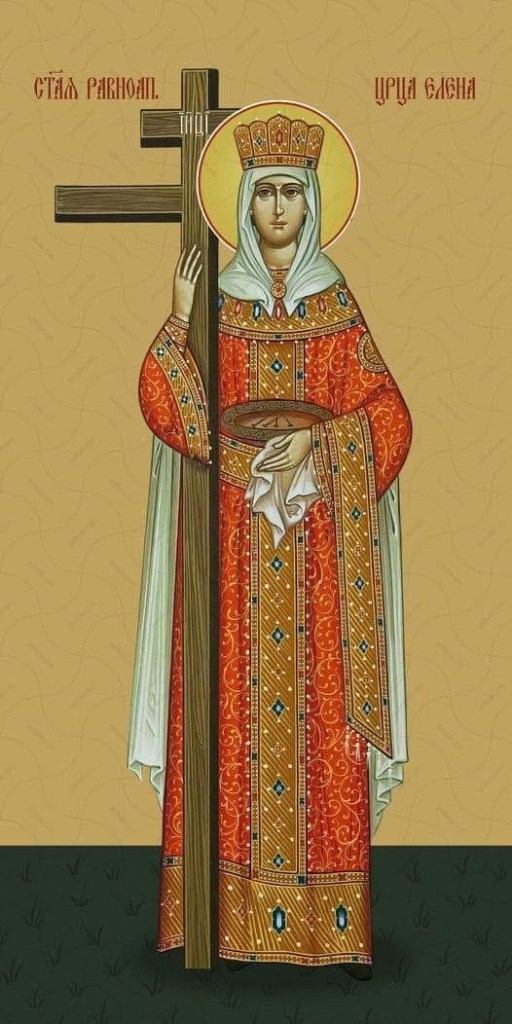
Today the church remembers a saint who went on a search for lore and said she found what she was looking for: Saint Helena, Mother of Emperor Constantine and Seeker of Relics.
Saint Helena’s childhood is a bit of a mystery. She was probably born in the Roman empire to a poorer family, though this is unconfirmed. She somehow found herself wedded to power, however, in the form of Constantius Chlorus who would become co-regent of the Western portion of the Roman empire. They had a son in the late part of the 3rd Century and named him Constantine.
Not one to pass up a political power play, Constantius divorced Helena and married Theodora, the step-daughter of the then Emperor (Maximinianus Herculius), making him next in line.
Constantius died in 308, and Constantine took the throne. As he ascended those steps, he brought his dear mother along with him, making her one of the “in crowd” again. Constantine ordered the empire to revere his mother as much, if not more, than he himself did, and under his influence Helena slowly converted to Christianity.
Now that she was the Empress of the land once again (Augusta Imperatrix was her official title), a newly revitalized Saint Helena undertook Indiana Jones-like quests to explore the life of Jesus on foot. Constantine charged her with finding any relics that she could relating back to the life of Jesus.
In her search for relics, Saint Helena built churches on the “sites” where she believed Jesus did important things like, oh, get birthed and ascend into heaven. These churches are still there in Jerusalem, including the one on Golgotha. Emperor Hadrian had built a temple to Venus on the site, and Saint Helena ordered it to be demolished. Lore has it that in the excavation they found three crosses, the middle being the cross of Christ.
Saint Helena supposedly recovered the nails used in the crucifixion, parts of the rope that bound Jesus, parts of his tunic, and parts of what is called “the true cross.” She took these back to Rome with her, and you can see all of these supposed relics still, the pieces of the cross being held at the Basilica of the Holy Cross in Jerusalem.
Now, of course, this is all very fantastical, right? Truly is unbelievable…and yet some do.
One of the issues is that the search for the historical Jesus will always come up lacking. No amount of splinters or threads of yarn can patch together what is actually being sought in that journey: verification.
Faith can’t be verified.
One of the gifts that Saint Helena did do was provide the world with beautiful things. The churches she started at these “holy sites” are truly remarkable, even if they may built on wishes and hopes. Sometimes that’s all we have.
Saint Helena is a reminder for me, and should be for the whole church, that even though we seek out verification regarding the matters of the faith, we won’t find them. But, seek we still do, and as we do it I hope we make some beautiful things along the way…
In May the Celts would turn their sights toward the land and the seeds to be buried in hope and prayer.
They’d pull out their ploughs and pray these instruments be sturdy to do the good work ahead of them, keeping their promise to help produce life-giving food for the land.
Here’s a modern Blessing of the Plough adapted from an ancient blessing (and also happens to be a nice one for those prepping for Holy Trinity Sunday):
Blessed be, God of all creation. Give softness to the land. Give us skill to work the land. This plough is sign to us of Your blessing. Give us softness of heart. Give us skill to serve You. Blessed be God–Creator, Christ, and Spirit, Three of Glory, Three of Light, Three of Life. Blessed be the Bright Three forever. God speed the plough. God speed the plough.
-prayer from Llewellyn’s The Celtic Wheel of the Year
Today the church remembers a Deacon of the faithful, Alcuin, Abbot of Tours.
Alcuin was a companion of Charlemagne, and founded organized learning in France. He was known as a monk, teacher, author, but primarily as one who practiced Word and Service in the world.
After being called as a deacon he became the head of the York school. In that service, he visited Rome and the Frankish court, and was convinced by Charlemagne to stay in the court and help to revive education in the Frankish territories.
He eventually left the court and became the Abbot of St. Martin’s at Tours, and is buried there still today.
In a day where the church was expanding, he was instrumental in incorporating Gelasian and Roman sacramentary practices together, allowing the church budding in Gaul to see parts of themselves in the practices of the church.
The Alcuin Club, a group dedicated to the study of Christian liturgy, continues his work.
He is a reminder that education has always been a focus of the faith, and that anti-intellectualism is incompatible with those who seek after the Truth that we claim God is.
Honoring, training, and listening to teachers is a part of our call, especially in times of crisis.
He is also a reminder for the faithful that some are called to practice the faith in ways other than just sacramental ministry. Although Alcuin never consecrated an element, he certainly influenced sacramental practice and the liturgy. The voices of pastors and priests are not the only voices to be heard.
Today the church honors an oft-forgotten saint, but one with a funny story: 10th Century Saint Dunstan, Archbishop of Canterbury.
Saint Dunstan is largely regarded as the person behind introducing the Benedictine Rule to Britain. After the Viking raids had largely decimated the churches and demoralized the clergy to the point of disrepair, he brought back the Rule of St. Benedict to the Island (as he had previously been exiled to Belgium for criticizing King Edward’s conduct) at the invitation of King Edgar in 957, and slowly but surely began the rebuilding process.
He retrained the clergy, re-established the liturgy, and with the protection of King Edgar, began movements among the people to free them from indentured servitude, the landlord system of organization, and provide for better education for lay people and clergy alike.
But that’s not the funny story.
Dunstan was said to have been a keen metal worker, and was rumored to have cast bells and built organs in his time as a priest. One day while working in his foundry, the devil apparently showed up in the form of a townsperson. Dunstan saw through the ruse, though, and as he was attending to his work, he turned around, clasped the nose of the devil with the metal tongs he was working with, and tweaked it until the demon ran off.
This is why, in iconography, Dunstan is often depicted holding tongs.
He is a welcome reminder for the church, and all of us, that initial defeats will not, in the end, define our lives. After all, how many people have been fired from their job, forced out of work, been the victim of office politics, or spoken up and paid the consequences for right action, and yet remain resiliant and continue to make a difference? Dunstan’s exile to Belgium was political, but he stuck to his convictions, his Rule of St. Benedict, and eventually returned to change the lives, hearts, and situation of many.
He is also a reminder that, if you get the chance to tweak evil’s nose, don’t hesitate.
Today the church remembers the 12th Century Saint: Erik IX Jedvardsson, King and Martyr.
St. Erik (you may call him King) ruled over a great bit of what is now Sweden, and is remembered as an advocate for the faith throughout Scandinavia. He became the subject of quite a bit of legend and lore, outgrowing his brief moment in history to live on in perpetuity.
St. Erik had, in his royal and religious zeal, the idea that the Finns needed both a ruler and a new way of being in the world. He and St. Henry (Jan 19th) set out to do so, with St. Henry becoming the de facto founder of the Finnish church through that quest of 1155.
Though St. Erik was obviously ambitious, he was known more-so for being just and kind, especially to those who called him king. He instituted salutary laws and, in response to his faith, ordinances that meant to help the poor, the sick, and the infirm, creating an ancient version of the “social safety-net,” almost unheard of for the day.
The lore around St. Erik’s martyrdom is legion, most of them having him fall at the hands of a pagan Danish prince. A prominent story goes that, as St. Erik was celebrating the Feast of the Ascension, he got word that a Danish army was nearby intending to kill him. Not wanting to abandon the service mid-Mass, he is noted as saying, “We’ll finish the Eucharist and then keep the feast elsewhere.” The Danish army was not on the same timetable and, before Mass was over, rushed the church and beheaded the goodly king.
Or, so the story goes.
Though many saints compete for the hearts of the Swedes, St. Erik came to be chief amongst them. Along with St. Henry of Finland and St. Olaf of Norway, he stands as one of the iconic symbols of not just the faith of the land, but the people there.
St. Erik is a reminder for me, and should be for the whole church, that ambition does not always mean abuse of power. He was ambitious, yes, but he used his power to watch over the last and the least.
Let those with ears to hear, hear.
-historical bits from Pfatteicher’s New Book of Festivals & Commemorations
The Celts would, in mid-May, honor the warrior queen Maeve of Connacht. She was often depicted dressed in red with a pet bird perched on one shoulder, and a pet squirrel on the other.
She was known for having three criteria in the men she would consider for marriage: they couldn’t be stingy, they couldn’t be jealous, and they couldn’t have any fear.
She was half lore and half reality, like all interesting people, and her name came from the pre-Christian Celtic goddess, Sovereignty, who was said to be the one who would approve a royal’s right to rule. Should a royal be overthrown, it was because Sovereignty had deemed them unworthy (stingy, jealous, or afraid).
Today I would lobby hard that the larger church adopt a calendar option that our Episcopal siblings have done, and honor on this day Justice Thurgood Marshall, Warrior for Equality and Trailblazer.
Born in 1908 to former slaves, this Baltimore son was raised hearing court cases as a form of informal education. He attended Frederick Douglass High School, graduated a year early, and entered Lincoln University, an HBCU, where he sat in classes with Langston Hughes and excelled on the debate team.
After graduating and marrying, he went on to Howard University to study law. In his law practice he partnered with the NAACP and became chief council for the organization, arguing a number of historic cases in the pursuit of civil rights, most notably arguing before the Supreme Court in Brown v. Board of Education.
JFK appointed Brother Marshall to the Second Circuit Court of Appeals, but he was prevented from officially taking the chair by a group of Senators (led by Mississippi Democrat James Eastman) who didn’t love the idea of a Black man serving that high in system. Marshall took the seat by recess appointment and, when offered the chance, LBJ elevated him to U.S. Solicitor General, making him the highest-ranking Black government official of his day.
When Justice Tomas Clark left the court, LBJ put Thurgood Marshall’s name forth as the justice to replace him. He was confirmed by the Senate, and described his political philosophy as, “You do what you think is right and you let the law catch up.”
Marshall served on the court for 24 years as the first Black Associate Justice.
In 1991 he retired from the court, citing failing health, and in 1993 he died of heart failure. He is buried at Arlington National Cemetery. It is his personal Bible that Vice President Kamala Harris used in her swearing-in ceremony.
Brother Marshall was not perfect, and nor would he claim to be. But he was fair and sought to champion the rights of those who had few champions with political power at the time. He is a reminder for me, and should be for everyone, that sometimes, well:
“You have to do what’s right and let the law catch up.”
-historical bits from public source materials -icon written by Christopher Davis