Unknown's avatar

About Timothy Brown

A pastor. A writer. A dreamer. Occasionally a beer brewer.

“Ash Kicking” or “Why I Don’t Think Ash Wednesday is a Good Day for Peddling Religious Goods”

I know this post might not be popular with many of my colleagues, but it is timely…so I’m going to put it out there.  ashes

I get why pastors and church people stand by the bus stop and the train stop and on busy thoroughfares for Ash Wednesday.  We “get out of the church and into the world” by doing this, right?  We “take the ministry to the streets.”

I get the rationale; I get it.  And I get that it probably can be pretty powerful for the ashers, and possibly the ashees, too.

But here’s my concern, specifically with Ash Wednesday: I fear it is cheap.

Yes, cheap.

Ash Wednesday is a day of solemnity when we hear the prophet Joel encourage people to “return to the Lord.”  The liturgy involves a movement from the Kryie (Lord, have mercy) to hearing Joel’s encouragement to Matthew’s prayerful penitent beat his chest, and then we take last year’s Hosanna’s, burn them as a sign that we’ve burned so much of our praise in pursuit of the dust of this world, and mark ourselves again as dust.

It is a movement of stark realism.  It is a movement, like a carefully put together album, that leads you from the realization of mortality to a hopeful life despite the fact that you are dust.

Beautiful stardust…but dust nonetheless.

But more than anything, it is a movement.  And it takes a bit of time.  Not much time, but some time.  Mortality does not sink in so quickly (without sudden tragedy, of course).  And we should allow the time.  Not much time, but time nonetheless.  As the beginning of Lent, a season of intentionality, it seems odd to me that we would start out with such slack intentionality…

It is much more than a simple smudge at the bus stop.  Sure, there are many who will also offer prayer in that time.  Sure, there are many who will also offer information about how the individual seeking to be “ashed” (or get the “ash kicking” as I like to say) can hook up with a faith community.

I’m not saying you shouldn’t do it.

I’m just saying why I’m not going to…and I want to ask the question publicly.

Because despite the prayer and the information on faith communities, I don’t think Ash Wednesday is the day to do it.

We don’t see people out on Easter passing out lilies.  Actually, that makes a ton more sense to me…

I don’t want Ash Wednesday…I don’t want my mortality…to be a gimmick.  And I worry that the church can turn it into that.

And there’s something important about having Ash Wednesday with other people of faith, all together, in one place.  There’s something important about me, the individual hearing “Memento, homo, quod pulvis es, et in pulverem reverteris” but then also having all of us, communally, hear it.

It’s not just about me; it’s about us.  All of us.  We are all stardust…and our systems of power and “isms” and phobias have reinforced it.

And there is something powerful about having a train full of cross-smudged commuters.  I won’t deny that.  But what does it mean that they got it running for the 8:05am?

Have an early morning Ash Wednesday service.  Or a noon one, where people can do it at lunch hour.  Or, have a full one at the bus stop, 20 minutes long.  Or point people toward a service that happens right as work gets out downtown.  I think these are good options.  But not as they’re running by…

Because I want to know: what do we think we’re saying when we’re offering a reminder of mortality on the fly?

You’re Married, Not Besties

So, I hear “I’m marrying my best friend”…and I cringe just a bit.

It’s said honestly, and I don’t mean to belittle the sentiment at all.  But, just in time for V-day, perhaps knowing that you don’t have to share your bed with your best friend will provide some comfort to someone.

My best friend and I would never write in the sand.  Probably.

My best friend and I would never write in the sand. Probably.little bit.

And I’m not against you and your partner being, in some ways, friends.  Or even “best __________” in many ways.

But I do not think that you must (or maybe even should) be “best friends” with the person you marry.

You need to be great partners.  You need to be great lovers.  You need to be great confidants and plan out a common trajectory.

But you need a different best friend.

See, many marriages fall into the trap of “all-needs-met.”

“All-needs-met” is the syndrome where one, or both persons, in a relationship feel that all their needs will be met by this one person, in this one relationship.

And it’s just not going to happen.

Especially needs that fall within the realm of “social needs.”

Sexual needs, deep emotional needs, partnership needs…these can be met within the marriage unit.

But many friendship needs can’t, and probably shouldn’t, be met there.

Why?

Because you need to dance well together.

There was an interesting interview last night during the Olympics where a reporter was grilling a couple competing in ice dancing.  She said, “We know you spend so much time together, and that you’re best friends…”

And the couple gave such a look to the woman and to one another, you’d have thought that lobsters were crawling out of the interviewer’s ears.

They weren’t best friends.

They had a deep bond, an emotional bond, and they spent a lot of time together working hard at their craft, laughing, joking, crying, helping one another up, and making beautiful movements gliding through this world.

But they weren’t best friends because they needed to dance together, and to do that well, they couldn’t be best friends.

The term “best friends” probably has a different meaning to most everyone, I think.  So perhaps the confusion is on my end.  I may not need to cringe when I hear it.

But, then again, perhaps it’s just a truth that needs to be named: you don’t need to be best friends to be married.  In fact, maybe you shouldn’t be.

The marriage covenant is deeper than friendship.  And your marriage cannot meet all your social needs.

It shouldn’t meet all your social needs.

Because you need to dance with intimacy and having/being a family and setting a common life trajectory and, well, a complex support system needs to surround you because those things are hard enough without trying to throw “being besties” in there.

And I think this confusion lies especially within the church who often sets marriage up as the container that holds all relational meaning.  The church has set marriage up on this pedestal, has made it the culmination of everything and all things, and doesn’t mention enough that marriage is a call that not everyone feels, and that marriage will not satisfy every human longing within the heart.

We all need friends, I would say “best friends,” outside of marriage.  And we all need to know that that is OK.  It does not make your marriage anything less to say that your spouse is not your best friend.

They are more important than that.  They are your partner.  They are your lover. They are your family.

They don’t have to be your bff even if you have covenanted to be together forever.

Because you have to dance together, and even in dancing you need a certain amount of distance between the people to do it well.

Otherwise you’re just tripping over one another…

My Obligatory Post about the “Evolution vs. Creatonism” Debate

…I didn’t watch it live.earth-space

We watched Dallas Buyers Club instead, starring a gaunt Matthew McConaughey and even more gaunt Jared Leto.  And ate pork tacos that I made myself from ingredients I cobbled together from the store.

It was a great movie, based on a true story.  And I make great tacos.

And, dare I say, the movie and the tacos had more to do with reality than the so-called debate.

I’m an evolutionist when it comes to how things have ended up the way they have; no mistake about that.  It’s the theory I think best explains the questions it sets out to explain (at least, so far). But to think that these two people were actually debating the same topic is naive (I watched the debate online this morning).

They weren’t debating the same topic.  It might have appeared like they were, but they weren’t.

It appeared like they were debating how the world came to be and why there is “something” rather than “nothing.”

But really, Ham was talking about a worldview, and Nye was talking about science as a way of discovering truth.

Those are not the same thing.

Science is a method of discovery.  A worldview is composed of convictions on what the person feels has already been discovered.

So it’s no wonder why, when asked what would change each of their minds on the supposed topic, Ham said “Nothing” and Nye said “Evidence.”

Science is a method of discovery based off of evidence. It changes because more, different, or better evidence is found (or previous evidence appears unfounded). We could say that the sum total of Nye’s thoughts, some of which are informed by science, comprise his worldview (so far).  Nye’s worldview includes science, but I wouldn’t say that science is his worldview.  Science probably answers the “how” questions for Nye, like it does for most of us, but it doesn’t answer every question.

A worldview, however, is the total sum of all conceptions in one place.  Ham was debating his worldview.

Changing a worldview doesn’t take evidence. It takes a life-changing encounter…or a series of life-changing encounters. And Ham was describing his worldview where everything (dare I even say even relationships and love?) are contained within what he considers to be Scripture.  Especially questions like “how.”  His worldview says that “how” questions are found in Scripture. He’d have to encounter something that would dramatically shift him out of that way of thinking for his worldview to change.

An encounter is not a discovery; it is the absolute disruption of a worldview regardless of the method of discovery used.

Suffice to say, anyone who makes a “Creationism Museum” (and I use”museum” here in the sense that “things are on display”…like a thimble museum…it is not, in my opinion, a museum in the same way as The Field Museum here in Chicago) is not open to many life-changing encounters, I would think.

That’s just my assumption, but I think there is evidence to support it.

I would venture to guess that Ham feels like he’s already had his life-changing encounter…and doesn’t need any other ones.

And that, by and large, is my biggest beef with that mindset.  It’s the idea that things are “settled.”  So Nye could have shown him anything, said anything, and Ham still wouldn’t budge.  Because his worldview doesn’t allow for that…doesn’t allow for more, better, or different evidence.  It’s not based on evidence.  It’s based on being, and remaining, settled.

And a worldview that is settled is static, not dynamic.

And I think that we, the church, should encourage dynamic worldviews. And we need to be encouraging dynamic faith, too.

Evolution is mysterious.  It’s amazing.  In fact, Nye used “mysterious” multiple times when speaking! It’s how a simple thing becomes complex in structure and, yet, retains some simplicity even amidst it all.  It’s so interesting!

Creationism is static.  “Boom,” it is said, “a fully developed tree with rings and everything.”

It’s…uninteresting to say the least.

One of the common critiques about accepting evolution as an answer to” how things are as they are” is that it erodes “God’s glory” (although I’m unclear of what the critics mean by that phrase).

God’s glory isn’t diminished because God might use a mechanism like evolution to create.  In fact, I think that enhances God’s glory (and by “glory” here I mean God’s “awe-inspiring traits”).

God’s glory is diminished, I think, when we assume God would take the road that we would take…the road of least resistance.

Because, let’s be honest, I often just want things to *poof* be as I’d want.  Creationism is what I would do.  Hopefully God is more inventive than me…more awe-inspiring than me.

This reluctant Christian hopes people don’t think last night was a real debate.  Real debates need to be on the same topic intending to influence people. I would be astounded to hear that anyone changed their mind about creationism or science by hearing it.

You want to know what I think would be a good debate?  The debate between static faith and dynamic worldviews; between static and dynamic faith.  What are the pros and cons between thinking you have it all figured out and continually searching?

Tag, NPR, you’re it.

On Naming the Dead and why I’ll say Philip Seymour Hoffman’s Name Next Sunday in Church

There are only two community worship experiences that we do where we name a list of all of the recently departed in a row: All Philip-Seymour-Hoffman-Saints (in November) and the Easter Vigil (the night before Easter).

And slowly and surely I’ve started to include not just the saints of the church who have passed on in recent years, but also celebrities, activists, politicians, and local heroes.

And I’ve started naming them on Sundays, too, when we give thanks for the saints who have gone before us. Like today I read out Pete Seeger’s name as a faithful witness in this world to the life of God shown in the Christ.

Was Seeger a Christian?  I don’t know.  I know he had a godchild.  I heard an interview with her on NPR. But there are plenty of people who have godchildren and don’t identify as “Christian.” I don’t think it matters in this case.  If there’s anyone who lived into the Beatitudes as a peacemaker, I feel Seeger is it.

We named him.  And we’ll name Philip Seymour Hoffman next week, too. Because it is less about how they identified themselves, and more about how God has identified them: child of God.

And, to be honest, Philip Seymour Hoffman touched me, and so many people, in his work that I think we’d do collective harm in not publicly grieving for him in some way; in some faithful way.  And I’m a firm believer that one of the ways that the Holy Spirit works in this world is through the arts, and I believe that God moved through him and his gifts.

Lord, he had gifts…

We name the saints not because of what they did  in life (though that is certainly part of it), but more because of who God claims them to be.

And there were demons there, now come to light, which we all have.  And if people knew the full truth of any of us, I think they’d balk at having our names read in any list of so-called “saints.”

And yet, my name is there.  And so is yours.  And so is any of ours.

So, if you worship in a community and there is a time to call out the dead, name him.  Do it.  Or when the Vigil comes around to your community and your pastor knocks on the parish door to invite the dead to worship in the resurrection, make sure his name is there along with Pete’s (we don’t ever do last names, so technically I’ll just say “Philip Seymour”).

Or if you’re making a list for All Saints, include him there.

Him, along with everyone else you know personally who has died this year.  Him, along with every other faceless, nameless person suffering from addiction who will die this week that we won’t ever hear about.

Because, and here’s the main point, in naming Phillip Seymour, I hope and pray I’m also naming about 100 other people who will die this week in Chicago of an OD that we’ll never hear about, and no one will care about.

And if we can’t care, in some small way, who will?  If we can’t point to this and all other deaths, especially tragedies, and say, unequivocally, “there lies a child of God, loved and redeemed even now,” of what use is the church in truth-telling?

May light perpetual shine upon Pete and Philip and all the other nameless ones we’ve lost this week. Amen.

What We Lose When We Exorcise Mystery from Religion

So, this Sunday falls directly on Candlemas, and for dorks like me that’s a bit of a big deal.index

For those of you not in the “know,” Candlemas is that time in the church year (for some of us) where we haul out all the candles in the church (or at least a representative sampling) and bless them.  My colleague calls it a “hinge day,” marking the midpoint between the Winter’s Solstice and the Spring Equinox.

So we haul out the candles and we bless them to acknowledge the Christ as being the “light of the world.”  And I’ve never met anyone who didn’t sit in solemn silence in the presence of a candle illuminating a darkened room.  There’s something deeply True about doing that.

It’s kind of like how many of us will burn greens right after Christmas, pray late into the night on the Winter’s Solstice, and bless houses at Epiphany.

All of these rites, these rituals, help us to breathe deeply  with history, with the Earth’s movement, and with the mystery that connects us to one another and to the Divine.  It’s why I bow toward the cross as it comes into my midst: I want to honor in my body the mystery of salvation.

But a lot of places don’t do this.  Won’t do this.  Indeed, a lot of places think these acts are superfluous at best and superstitious at worst.

I don’t bless candles because I think they must be blessed.  I bless them because, in doing so, I acknowledge that light will overcome darkness. Always. And that deserves blessing.

I don’t pray late into the night on the Winter’s Solstice because I think that evil resides in the shadows and I must pray it away.  No. I know evil resides in the shadows.  Hence why we don’t tell our secrets…many times they’re too full of evil, guilt, or shame to expose to the light.  So I pray late into the night to acknowledge that, from that point on, it will get lighter and lighter each day as we lean toward Spring.

And then, perhaps, I can allow a little light to shine more and more on my secrets.

And all of these practices help to connect me with a mystery of life and salvation greater than myself.  It’s kind of like our big harvest festival, Thanksgiving.  Ever since our forbears figured out that a dead seed will spring from the Earth, a mix between careful tending and damn luck, they’ve acknowledged that to live, and to breathe, and to eat is a gift.

All of it, gift.

And part of living into that gift is acknowledging that there are moments in life that are just bigger than us…and that should be ritualized. Communally ritualized.

But so much of modern faith is all brain or all heart and no mystery (unless we’re expected to believe that Jonah mysteriously wasn’t dissolved by stomach acid).

We just feel it’s true.  We assent to mental tenets (or reject them).

And yet, deep love is neither mental nor emotional.  It doesn’t make sense to the brain, and is often too fleeting with the heart.

No. Deep love is a mix of the head and the heart and the guts and…and that’s where I find true faith to reside, too.

Timothy Keller and Christopher Hitchens attempt to rationalize everything (they are in good company).  They are the different sides of the same coin. Not everything has an answer.

Likewise, the absolute emotionalism of charismatic and ecstatic communities miss the mark, too, I think.  Things aren’t true because they move our emotions; emotions are fleeting.  “Mystery” doesn’t mean believing just anything.

No. Things are true because they connect us deeply in the past and far into the future.

Hence why myth is True in a deeper sense then pure history.  Hence why rituals are True in a sense deeper than mindless monotony.

A belief system (and, remember, even atheism is a belief system) that attempts to exorcise mystery by finding a formula for everything and explaining everything or, conversely, by necessitating a constant emotional response is a faith that has lost something.

I think it’s lost depth.  My atheism was shallow.  As was my previous faith.  And while I don’t claim that I’ve reached some sort of amazing depth in my faith life now, it’s certainly more connected then anything I’ve practiced before.

Rituals don’t “save” me.

No.

I don’t do them to earn anything.  Rather, they do exactly what “religion” claims to do: they reconnect me.  Re-ligio comes from the same root as “ligament.”  It  reconnects us.

Because we have a way of disconnecting from life.  But, too often, even religion fails to live up to it’s name these days.

So, this Sunday, haul out some candles.  Give thanks for the light.

I Want My Children to Know This About Faith

Having a kid changes your perspective.  I used to roll my eyes when I heard parents say that, but it’s true.Father-Son-Shadow

Like, for instance, how I’m much more willing than I used to be to just drop those last papers and emails and meeting notes to get home before bedtime.  I still work late…but I’m much more willing to let it all go to snuggle a snotty face, read Jimmy Buffett’s “Jolly Mon” storybook, and change a diaper before the little guy goes to sleep.

And as we’re raising this little guy, and as a pastor, there are a few things I want this little guy to know about faith.

First, faith and religion won’t give you self-esteem.  It’s not meant to.  It’s not meant to make you feel good.  It’s purpose is not to get you to love yourself.  Don’t stick with the faith because it makes you feel good.  If you’re doing it to feel good, you’re an addict, not faithful.  Get more vitamin K.

But…

But sometimes the faith can love you when you can’t love yourself.  Sometimes hearing that God chooses you can replace those moments in your life when you feel like you can’t choose yourself, don’t love yourself, can’t believe in yourself.  There have been times in my life where I’ve let the faith believe things about me that I couldn’t muster myself to believe…and it made all the difference in taking the next step the next day.

Secondly, faith isn’t about getting answers.  Faith isn’t about knowing certainty, “figuring it all out,” or attaining a perfect worldview that will put all the pieces together.  If you’re looking for your faith to do that you will be disappointed.

But…

But faith is intended to help you ask better questions about your life.  It is intended to provoke your thoughts about yourself, about purpose, about others around you in such a way that you see the world differently than the world tries to get you to see it.  It is provided to help you celebrate the life of the mind rather than the pursuits of greed, fame, and fortune.  It is the antithesis to a world that says “Success is the mark of a life well lived.”  No. “Pursuit of a purpose bigger than yourself, specifically the purpose shown in the life of the Christ in sacrificial love…that is the mark of a life well lived.”

While we’re on the subject of answers, the Scriptures are not meant to explain everything in this world.  They are not meant to explain how the world came to be, or how sexual orientation should be understood, or how psychology is understood.  No.  Faith is the quest for “why” not “how.” The Scriptures are inspired words by inspired people about the history of the quest for “why.”  Why is there something rather than nothing?  Why am I to love even if I don’t feel like I want to?  Why is humanity connected in such a way that makes me feel responsibility toward someone else?

Faith is meant to help you embrace mystery, hold tension, and walk well in a world that wants to polarize you into this answer vs. that answer.  Your dad is a reluctant Christian because this has been largely lost.  I want you to be a Christian, too (even if you’re reluctant like your old dad…)

Thirdly, faith isn’t supposed to make you feel superior.  There are no “poor souls…”  You are as poor as any soul out there.  And if your job in the world is to “save” someone, you better be a lifeguard.  Only the Divine can save.  All you can do is be Christ’s hands and feet.

But…

Faith is something that I think you should share.  Not in the “I think this and you should, too…” sort of way.  But rather, in the “Here’s something I find really true…” sort of way.  In the “Here is my hope…” sort of way.  In the “Here’s what moves me…” sort of way.  And never be afraid to ask someone else what moves them, either.  Their beliefs do not threaten yours.  There is much to learn from one another.  I want you to have friends who believe and think different things than you do, and I want you to talk to them about it.  Often.

Finally, I want you in a faith community.  Why?  Because I don’t know how else to help make sure that God doesn’t end up looking like you.  And I want you in a multi-generational faith community where you have to interact with lovely old ladies and hold little babies. Hopefully it can be racially and ethnically diverse, too.  I don’t care if it’s big or small, I just want it to be diverse.  I want you to be in a faith community where questions are encouraged, where mystery (specifically in the sacraments) are lifted high (because then maybe you’ll see how the Thanksgiving table in November is like the thanksgiving table on Sunday mornings, and live in response to that bounty).  I want you to remember that you are loved and redeemed and meant to be a light in this world that too often is full of shadows, and the only way I can think that you’ll be reminded of that often enough is when you gather with other people to read and hear ancient words, to shake hands, to eat and wash together, and to drink strong coffee (optional).

There’s more to say this morning to you, buddy, but the freezing temps outside have closed your daycare, which means I’m in charge of lunch.  But this is a good start…

“Relationship Issues” or “Jesus Doesn’t Want to be My Boyfriend.”

I know…the title.  images

I actually wanted to title this “Jesus Isn’t That Into You” as a play off of the movie…but that would have really brought the hate mail.

So let me start with a disclaimer.

Let me say, unequivocally, that I think Jesus is “into you” (although I think that sounds weird).

But maybe…maybe Jesus isn’t that into you.  Or, at least, not as solely about you as we’ve made it out to be.  Jesus doesn’t want to be my boyfriend.

Let me explain for a second.

In my blog on 5 Phrases I Think Christians Shouldn’t Say, I got a lot of push back for #2 on my list, “You just have to do God’s will…”  Specifically for my statement in the subsequent lines where I posit that I’m not convinced that God’s greatest wish is for us to be in relationship with God.

I should have put an asterisk next to that statement because, here’s what I really mean by that: I think that Christianity has adopted a “win souls for Jesus,” “you must invite Jesus into your heart,” “you need to have a personal relationship with Jesus” mentality at the sacrifice of every other type of relationship that God might desire for humanity.

We’ve given up our relationship as stewards of the Earth so that we can build monstrous mega-church compounds on open land to focus on the “Jesus-and-Me” relationship, adopting crazy ideas that perhaps global warming is fake and is God’s plan for the world.

We’ve given up our authentic relationships with others who, perhaps, don’t think the same things we do, because our singular focus is now to try and convert and “win souls for Christ.”

American evangelical Christianity has focused so much on fostering personal relationships with Jesus Christ, most other relationships are left in the dust…

Plus, speaking from a place of honesty, much of the agnostic/marginally Christian world (and a good number of us convicted Christians) finds the super-close-Jesus-is-my-boyfriend talk creepy.

I think we all want to be known; really known.  And I think God knows us; truly knows us.

But when we start talking about Jesus like he’s our lover in the modern sense we really are talking in ways that put people off.

Don’t think we do that?  Consider the song “In the Secret.”  Here are the lyrics:

In the secret, in the quiet place

in the stillness you are there.

In the secret, in the quiet hour I wait

only for you (this part is usually whispered)

Because I want to know you more.

I want to know you,

I want to hear your voice

I want to know you more.

I want to touch you

I want to see your face

I want to know you more.

Creepy, right?

Or what about Hillsong’s “I Surrender” where you sing “have your way in me, Lord”?  I’ve banned that song from my church because I can’t hear that without imagining how someone who has been sexually abused hears it…

I mean, c’mon folks, maybe Jesus isn’t that into us.

I’m all for the talk of having the “heart strangely warmed,” to use a Wesley phrase (and he was reading my boy, Luther, btw).  I’m all for the stirring of the spirit, for soul-stirring that you can’t explain.  I’m Lutheran, a spiritual descendant of the one who kept repeating over and over again, pro me, when it came to Jesus’ promises in Scripture.

“For me.”

It’s personal.  And the opposite can be true.  A lot of places talk so much about God in the abstract, that any sort of relational talk is totally absent.

But I hear less of the latter and more of the former.  It’s good to talk about a personal relationship with Jesus Christ, but we’ve taken that and run right into the crazy bin.

If that’s all we focus on, the personal…and that’s a lot of what I hear…then, well, I think the boat has been missed, by and large.

When Jesus said “Love the Lord your God and your neighbor as yourself,” I don’t think he imagined we’d stop on the first part as much we have.  Remember, that second part is “like the first.”

I’m all for a relationship with God; the mystic in me can’t do without it. St. Julian spoke of her relationship with Jesus in the most intimate way possible (totally scandalous…everyone should read some St. Julian).  But even from Julian you get the sense that she’s speaking from a “remain in me” kind of way, echoing Jesus from the Gospel of John.

But if it stops there…

No, really…I think a lot of places talk as if it goes on from there, about helping the neighbor, loving people for who they are and where they are in life, but it’s really just about you and Jesus and what you gain from that.

If that’s the case, well, then I’d say you have relationship issues. Maybe it’s good to consider that Jesus might not be that into you…not your boyfriend.

And that singular focus that I hear so much really often makes me a reluctant Christian.

“Love is Heavy, but Hate is a Burden” or “The Old Switch-a-Roo”

“I have decided to stick with love. Hate is too great a burden to bear.”-Martin Luther King, Jr.index

Love is heavy.

It brings with it many frustrations and tears.

I walk with people caring for aging parents and see this to the fullest.  They are tired, weary, worn.  They love their parents…but it is a heavy burden.

I walk with new parents and see the same thing, after a while.  They are tired, weary, worn.  They love their children…but they’re a burden.

Or parents of children with special needs.  Or adults who work primarily in the service industry.  Or adults who work in social services, or nurses, or educators, or hospice workers.

Or people who do justice work.

Because, and this is a truth about humanity that I think is under-appreciated by those who don’t work daily, one-on-one, with a wide swath of humanity: people suck.

They do; no two ways about it.

But sometimes the general nature of people can get the best of us.  Especially those of us who fancy ourselves as doing justice work.

How easily justice work can turn into hatred.  I’ve seen that too many times.  Justice work becomes full of “us and them” dichotomies when the heart is left unattended.  The unattended heart easily turns to hate over time.  Calcification is the natural state of everything that is left alone.

The heart is no exception.

We like to think that love and hate are opposites.  No; they are cousins.  Love and apathy are opposites.  Hate and apathy are opposites.  Love and hate are cousins who quickly dress alike in their zeal and passion when left unattended.

Love and hate are like those twins you dated in high school.  You’re always wondering if they’ve pulled the old “switch-a-roo” on you.

It does no good to hate the oppressor…MLK knew this in a powerful way that is instructive for us all.

Working against an oppressor must be a labor of love, not a labor of hate.  If it’s not, then pain is just transmitted instead of transformed.

This, of course, is easy for me to say as a white, able-bodied, heterosexual, male.

But even there, too, I must be careful.  In my zeal for justice work I can get sucked into reactionary hate against my status and privilege.

I must learn to give up my privilege as best I can.  Hating it does very little to change things.  Only in giving things up can we change them.

Jesus understood this.  “Father, forgive them, they don’t know what they’re doing.”

As I said, MLK knew this.  He gave up his justifiable hatred for a humanity that moved…moves…too slowly toward justice and peace.

But that’s indicative of a heart attended to.  Attending to the heart is heavy work.

But letting the heart calcify…that’s the work of the dying and dead.

I think the task of justice work these days is to work against systems of oppression while also attending to the heart.

Unfortunately I don’t see it very often.  Too much “us and them” talk coming from liberal circles.  Too much silence from conservative circles.

The radical circles are the ones speaking against justice while attending to the heart.  MLK was a radical, not letting the heart calcify to the point of hate.  I think he knew that, to do otherwise would be to replace one burden for another.

And Lord knows we have too many burdens to add anymore to this world.

I Found Jesus…He Was Behind the Couch

My wife and I have a magnet on our fridge that says, “I found Jesus…he was behind the couch the whole time!”7786.jpg_3

My nephews love it.  I love it.

I think my nephews are even likely to tell their pastor that.  I encourage them to.  I told them it’d always be the “right” answer in Sunday School…because, you know, faith is all about having the “right answer”.

I think it’s funny.

I think it’s funny because, well, that whole theme of “lost and found” in the Bible is turned around by this whole notion of “finding Jesus.”

In all of those “lost and found” verses in the Bible, it’s not Jesus who is lost, but the other person.

Even in that “seek and you shall find” passage, there’s no indication that it’s “seeking” Jesus.

Seeking knowledge.  Seeking enlightenment.  Seeking salvation, liberation, wholeness…sure.

But not Jesus.

So this idea that we can “find Jesus”…well, you might as well look behind the couch because I think you’re just as likely to find Jesus crouching there as you are to find him in the “seeker’s service” at your local big-box worship center.

I’m not trying to come down harshly on “seeker services”; I think faith communities need accessible points of entry.

But if we think we’re giving them Jesus, as if Jesus can be commodified…well, we should stop fooling ourselves.

The search for Jesus is the search for the white stag…it’s pointless.

Yeah, pointless.  Because I think all you’ll end up finding is a mirror image of yourself that you pass off as Jesus.

Instead the faith teaches that Jesus is/was/will be right where you are, and has been all along.

Martin Luther has this totally unhelpful/helpful phrase about looking for Jesus.  When explaining how God is present in the Eucharist, Luther said that Jesus is “in, with, and under the elements.”

This is absolutely unhelpful to the rational mind.  The literalist, the legalist, the fundamentalist, they won’t accept that answer.

There must always be a system, a way of finding, a problem/solution answer.

But what if there isn’t?  What if, instead, we leave those things behind and just agree to encounter the mystery of a present God, seen in the Christ, who subverts every single system and search, and who just surprises us as being on the scene?  What if we just walk with mindfulness?

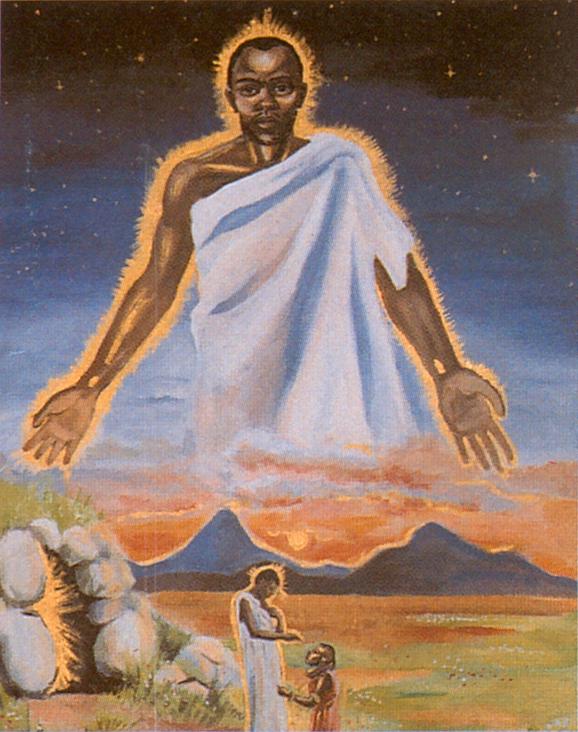
It’d be a Biblical way of operating, that’s for sure.  Jesus surprises everyone at the tomb, the house of Mr. and Mrs. Clopas, the upper room, Paul’s lonely road to nowhereville.

Jesus surprises everyone in little Bethlehem (remember the Magi go six miles off course to Jerusalem to find him?).

Hell, maybe Jesus is behind the couch.  It’d surprise the socks off of me.

But if you looked, you won’t find him there.  Instead, it seems, Jesus finds us on the roads of confusion, in the upper rooms of fear, at the tomb of despair, in the little town of doubt.

That seems to be Jesus’ way.  This is why I don’t shy away from confusion, doubt, and despair.  I don’t have to have it all worked out.

Because that’s not the point.

I have a little mantra I repeat a lot to myself: “Jesus walked into a bar and no one noticed.”

Yeah…that sounds about right.

On How I Can Trust that Jonah is a Story but That the Resurrection Was/Is Real

I trust that the Jonah story is myth and not a real event.  I trust that the resurrection of Jesus was/is not myth, but a real event.

I trust that they are both true.

This is a difficult concept to grasp, I think, especially if you come out of a tradition where the Bible is taken very literally.

JonahBear with me a bit on this, though, because the binary thinking of “true/untrue” or “fact/fiction” is not as clear cut as we like to make it out to be.

If we take the Bible absolutely, unequivocally literally, we do it, it’s teachings, and ourselves a disservice.

Primarily we do a disservice because we know that the Bible was not meant to be taken literally in it’s origins.  How do we know this?  Because it contains different types of writings: histories, prose, poetry, legend, and yes, myth.

And Jonah is a myth.  An instructive myth, a myth worth being in the Bible, but a myth.  It’s form is mythic.  It’s pattern is mythic.  It’s characters, narration, plot, all of it is mythic.  It’s not meant to be taken literally.  It’s to be read and learned from and pondered over and thought over…but not in the way you’d ponder over a math problem.  Not in the way you’d ponder over how someone could be stuck in a whale for days and not eaten by stomach acid.

So, we do Scripture a disservice when we hold all of it’s parts (written over hundreds of years) as all the same type of writing.

Secondly, we do it’s teachings a disservice by holding the whole Bible as being all the same type of writing to be held at the same status.  Why?  Well, if I can’t bend my mind around how Jonah can sit in a whale and not be eaten by stomach acid, and that story is just as real as a Jesus story, then I have to throw the whole thing out.

This line of thinking is a byproduct (an unfortunate one) of the Enlightenment.

Finally, we do ourselves a disservice by thinking that it all is the same because we either force our brain to believe something that we know isn’t…and isn’t supposed to be…true, or we keep ourselves from deep riches found in Scripture because, if we can’t buy all of it the same, we’ll buy none of it the same.  In this case we don’t allow ourselves the great love of God shown in the Scriptures, and a relationship with God informed by these ancient writings, specifically around the message of the Christ.

So, how then are we to take the resurrection?  Here’s how this pastor sees it.

For the Christian, something should be honored at the outset: the resurrection is central to the faith whereas the story of Jonah is not.

I think that’s just true.

Were Jonah missing from Scripture, the Christian faith would largely go on with all systems normal (for better or for worse).

I feel that, without the resurrection, the central tenet that God’s work moves into a future where nothing is lost, specifically the very people God has come to hold in love through eternity, would be missing.  In short: the bookend of the salvation story would be lost, leaving everything before it in a heap on the theological floor without any sense, order, or telos.

And thus we end up with Saturday morning Christians: the Christ is crucified, time to hideout in an upper room because there’s nothing left.

It’s also worth noting that, for Jewish-Christians to propose that someone singularly rose from the dead is not only unthinkable, 15-the-resurrection-of-jesusbut would most likely initiate charges of blasphemy and result in death or expulsion from the Jewish community of faith.  If they were willing to risk talking in this way, that’s telling.  The masterful theologian N. T. Wright goes to great lengths on this in his book Surprised by Hope, which I found myself agreeing with.

This all being said, do I think that you have to believe in the bodily resurrection to be a Christian?  No.  The calls from Tony Jones and other theologians (even in my tradition) for those who may not subscribe to a bodily resurrection to “re-think” and recant on their take of a metaphorical/mystical or otherwise-known interpretation are wrongheaded.

As if the Christian faith was ever meant to be one with a list of beliefs that one had to check-off to be considered a Christ follower.  If that is the case, the most literal Christ-followers in Scripture, both the Magi in Matthew and the disciples pre-Easter in all of the Gospels, fail the test.  The Magi were pagan and the disciples were clueless.

Any attempt to coerce another person into trusting the veracity of a certain story, historical, mythical, or otherwise, is not creating trust and faith, it is trying to force fact.

A story can be true without being fact.  I’m reluctant Christian because much of the church has forgotten this.

For this Christian I think it is intellectually honest to acknowledge that not all of scripture is meant to be read the same way. We do all sorts of disservices when we do.

But, for this Christian, a healthy dose of mystery surrounding the central stories is also important, especially those written so as to be a history of the salvation story.  After all, the resurrection is not a “problem” to be solved.  It is a mystery to be pondered over, embraced, and loved.

Jonah is a great fire-side tale that tells many truths and should be embraced and loved and pondered over (and should be acted out by persons to get the whole picture).  But it wasn’t written to be history, and we shouldn’t have to take it as history to be faithful.