
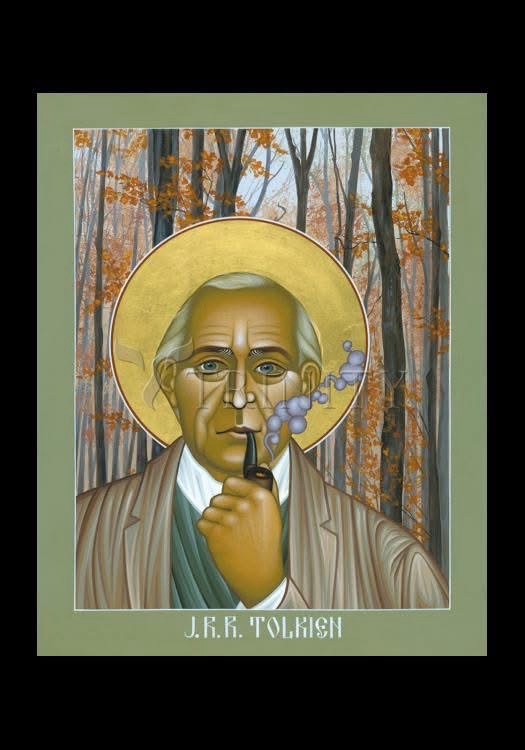
The Storyteller

Today I would lobby hard that the church recognize a 20th Century storyteller who found a way into our imaginations through small characters with big hearts: Saint John Ronald Rueul (but you can call him J.R.R.) Tolkien, Weaver of Tales and Patron Saint of Adventurers.

Saint J.R.R. was born at the tail-end of the 19th Century to British parents in the Orange Free State in the Republic of South Africa. When he was just three years old he, his brother, and his mother journied back to Britain, with his father intending to join later…but his father fell ill with fever and died in South Africa.

Having no income, the family bounced around Britain, often staying with family. He was taught in the home with his brother, and he was especially fond of learning about botany and languages. He knew Latin before many of his contemporaries knew English.

Saint Tolkien could read by the age of four, and loved fantasy books. His until-then Protestant mother decided to join the Roman Catholic church, despite objections from her extended family, and though it cost them their financial support (J.R.R.’s relatives refused to support a Catholic) Tolkien was raised in the stories of the Roman Catholic faith. In fact, when his mother died of diabetes at the young age of 34, she had left her sons in the care of Father Xavier Morgan, a local parish priest.

As an early teen Saint Tolkien started experimenting with language. He and his cousins would invent nonsense languages that, while fictional, followed rules and orders just like any other language (except, of course, English…because English has few rules and just a whiff of order). This play with languages would eventually serve him well as he constructed Elvish, Entish, and a variety of other fantastical languages from fanciful friends (and foes).

In these teen years he would have many adventures, hiking through mountains and taking long tangential trails, traversing hither and yon. Another way to say it: he practiced his Hobbitus long before Hobbits existed.

It was also in these teen years where he fell in love with a young Protestant, Edith Mary Bratt. Fr. Morgan forbid St. Tolkien from fraternizing with this non-Catholic (he was very disappointed) until he was 21. This probably ensured that Saint J.R.R. finished college because young Edith had a way of making him forget about his studies…

When he turned 21 Saint J.R.R. wrote to Edith, and soon after they were engaged and she agreed to convert to Catholicism (infuriating her family). Shortly after Saint Tolkien followed his countrymen to war, fighting on the front lines and surviving the first German gas attacks ever recorded. In the trenches, on the front lines, his unit in particular was plagued by disease, danger, and hardship. Tolkien developed a fever from the rampant lice infestations of the time, and was taken back to Britain, small and frail.

Many of his friends were killed in the war. It is no mistake that the great battles Tolkien would think up reflected so many real battles…Tolkien lived Middle Earth’s wars.

After the war Saint J.R.R. went to work for The Oxford Dictionary, and began tutoring students at nearby universities. This led to him joining the facult of Leeds where he continued to write, and eventually scored a fellowship at Pembroke College where he wrote The Hobbit and the first two books of The Lord of the Rings.

After penning a translation of Beowulf, Saint Tolkien had solidified his place as a master with story and languages. In fact, when the second World War broke out (because we just can’t learn our lesson, can we?) they courted Saint J.R.R. as a codebreaker, though he never was used in that capacity.

In 1945 he took a professorship at Merton College, Oxford, where he completed his trilogy and stayed until his retirement in 1958.

It’s well known that Saint Tolkien and Saint Lewis shared a pint or two weekly, both discussing their works of fiction. It is often noted that Tolkien’s faith was part of the influence that drew Saint Lewis from staunch athiesm back into the believing fold.

Honestly, I wish Saint J.R.R. had adopted some of Saint Lewis’s brevity, and Saint Lewis some of Tolkien’s character development. Lewis was always too “on the nose” with his Christological stereotypes for my taste…

Saint J.R.R. becamse quite famous and, though he didn’t like fame, he also didn’t shy away from the influence in the world it gave him. He recieved numerous honors late in life, and was even nominated for the Nobel by his pint companion, Lewis, in 1961.

Edith and J.R.R. had four children, and Saint Tolkien was a devoted father, often sending elaborate notes and drawings to his children, especially at Christmastide. Edith died in 1971 at the age of 82. Upon her death J.R.R. returned to Oxford to live out his days. He would die 21 months later on September 2nd, 1973.

Because the church doesn’t have a notable saint on this day, and already has September 2 taken, I would lobby to transpose his commemoration to this day.

Before his death he had “Luthien” engraved on Edith’s tombstone, a nod to the daughter of the elf-king. He was buried in the same grave, and instructed that “Beren” be added to his name…the name of the mortal lover of Luthien in his great trilogy.

His stories live on not just in popular media, but more importantly in the real lives of those who the world sees as small in stature (literally or otherwise), but with outsized souls who strive mightily to do what is right in a world that conspires against justice in deference for power and destructive practices of the power-hungry.

In a world of Mordors, create the Shire.

Or, better yet, be a Samwise. Samwise is the true hero of the triology.

Saint J.R.R. is a reminder for me, and should be for the whole church (everyone?) that a good fiction says more truth than a boring reality. We can transcend all of this mess in the world right now and eek out a hero’s tale in the end, Beloved.

It’s been done before.

-historical bits from public resources

-icon written by Br. Robert Lentz, and can be purchased at Trinitystores.com
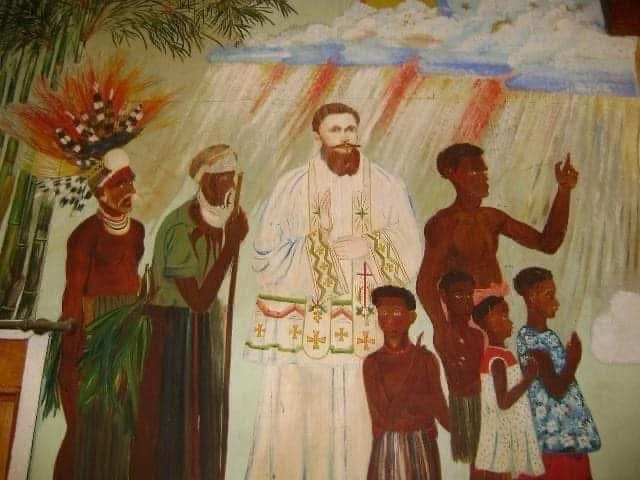
The Martyrs of Papua New Guinea

Today the church honors often overlooked saints, but ones close to my heart, The Martyrs of Papua New Guinea.

I know…you’ve never heard of them, which is too bad.

They’re relatively recent additions to the calendar of commemorations, added in the late 70’s.

When the Axis Powers invaded New Guinea in 1942, a number of the European missionaries on the island nation had already been called back to their countries of origin.

The Anglican Bishop of New Guinea, Philip Strong, challenged his clergy to remain with the people. Eight missionaries and two Papuan laymen were betrayed to the Axis Powers and martyred in August of 1942 for their defiance and insubordination.

In 1948 the Martyrs Memorial School was opened in Sangara as a living memorial to these brave souls. The school continues today and can be found in Agenahambo.

Often included in this memorial day are the 15 Lutheran, 24 Methodist, and 168 Roman Catholic Missionaries in Papua New Guinea, New Britain, and the Solomon Islands who died during the WW II.

-historical pieces gleaned from Pfatteicher’s New Book of Festivals & Commemorations

On Meteorological Autumn

For the ancient Celts, September marked the mid-point of their Autumn life. In these blazing days that might sound strange to our ears (it hardly feels like Autumn to most of us), but on the wheel of the year this quarter is earmarked for “harvest.” Their wheel, their internal rhythm even (and ours!) has the mid-month of every season as the transitional one:

February-Mar-April-Spring
May-June-July-Summer
August-Sep-Oct-Autumn
Nov-Dec-Jan-Winter

That middle month is the one of transitions with the equinox or the solstice of the season lying in its belly.

September is a season of invention and harvest. The crops are pulled in fully in this month. The fireplace starts to roar at night not only around dinner time, but longer into the evening as cool air sweeps through the house and the canning and drying and preserving that needs to happen for the coming Winter gets underway.

The fire in the hearth is mirrored by the fire starting to show up in the leaves now gloried on their way to death, and the drying fields calming themselves, preparing for new birth next year.

Toward the end of this month, to honor the final bit of the harvest, dried pieces of wheat and barley would be woven into a crown and hung on doors and windows, or worn on the heads of children.

The whole town would come together as the last sheaf was brought in and they’d have a large feast where the last sheaf of the field was woven and decorated. They’d toast the sheaf, saying “Here’s to the one that helped us with the harvest!” Then they’d take the decorated sheaf and hang it in a place of prominence.

This is where we get our modern day “autumn wreaths” that adorn our own doors and fill up your local Michael’s or Kohls in the “home decor” section. Today we see these as pretty and festive. For the ancient Celts they were a sign of thanksgiving and triumph, as the harvest gods had once again provided.

Welcome, September, the month of transitions. We thank you once again for the harvest.

On Chill

Three yeara ago today we lost Saint Jimmy of the Buffett’s, a tropical bard who embodied chill for a world needing instructions on how to do it, all the while using his business savvy and heart to create a legacy of ongoing chill that will outlive him.

I was introduced to Saint Jimmy early in my life. Some called him a novelty, some a joke, but to me he presented the quintessential ideal of someone enjoying their life’s calling to the fullest. I immediately found a kindred soul: he loved to make people happy and sought out different ways to do it through all the senses.

His love for bar food and boat drinks led to an empire of eateries.

His love for people of all ages led to retirement communities that encourage chill in the third act of life.

His love for human connection was found in a touring schedule that would make artists half his age fatigued in half the time, drawing thousands and thousands of Parrot Heads who saw following him on tour as an honor that bonded vagabonds and misfits and CEOs and school teachers together, all needing a break for a few hours, everyone letting their hair down (even if you didn’t have any).

His love for the written word led to books upon books to be published, both for adults and children, all highlighting the sand and the surf and the hoisted sail.

And his love for music? Well, Saint Jimmy was not an amazing composer, but he was a prolific one. And he knew something that so few people do: how to tell a good, complete story in song.

In “The Captain and the Kid” we learned about his grandfather’s struggle to retire from sea life. In “Son of A Son of A Sailor” we learned about his life’s ambition to be on the waves forever like his grandfather, and in “A Pirate Looks at 40” we heard him struggle with the fact that he’ll never live that kind of life because, by chance, he was born “200 years too late…an over 40 victim of fate.” Even in his little-known tune “Mailbox Money” we got a glimpse of his life, hearing how his residuals just appeared in his mailbox in the morning and even how, when in his island life the postal service was spotty, he’d take up the helm delivering the mail by boat to his neighbors.

Though I find toe-tapping fun in his hits “Fins” and “Cheeseburger in Paradise,” I’ve always been drawn to his sentimental tune offerings like “Barefoot Children in the Rain,” and “Take Another Road.”

After Hurricane Katrina wiped out large swaths of New Orleans and lower Mississippi, he wrote a song to ease their hearts, donating the proceeds of the album to their recovery. In the song he sang,

“I bought a cheap watch from a crazy man,
Floating down Canal.
It doesn’t use numbers or moving hands,
It always just says ‘now.’
Now you may be thinking that I was had,
But this watch is never wrong.
And if I have trouble the warranty says,
‘Breathe in, breathe out, move on.’”

I cannot tell you, Beloved, how many times those lyrics have saved my life.

Saint Jimmy sought the good life and accidentally stumbled upon a meaningful one. Saint Jimmy sought the ocean, but instead brought happiness to oceans of humanity through community-building tunes.

Saint Jimmy found his way into the ears and hearts of so many who just needed a license to chill, and he wrote the order for them to do so without hesitation. I had the joy of hearing him for the first time just a few years ago, even as I own just about every one of his albums on vinyl.

He was a serious businessman who peddled in amusement as his currency, and we were grateful to join in that commercial exchange, finding privilege on both sides of that transaction.

It is fitting that he died on the cusp of Autumn, having led a Summer existence.

And, at least for me, I find it fitting that I remember of his death this morning looking at the waves of the Atlantic, his home he introduced me to and invited me to see as my own.

Sail on, Jimmy.

Here’s the view from my beach, and I have to imagine that this morning, well, yours is the same one