
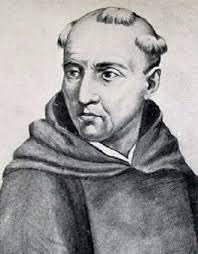
Today the church remembers a 16th Century pioneer in educating the hearing impaired in a day and time when many suspected, as Aristotle claimed, that the hearing impaired could not be taught: Saint Pedro Ponce de Leon, monk and educator.
We don’t know much about Br. Pedro’s early life, though his name betrays the fact that he was of noble lineage. We do know he took his vows in 1526, and lived and worked as a monk in the San Salvador de Ona Monastery near Burgos, Spain.
Though he apparently could hear perfectly well, he stumbled into educating the deaf through a chance encounter with two aristocratic brothers who were unable to hear. In working with the brothers he devised his own sign-language using common hand gestures used by monks who had taken a vow of silence for individual letters. Though this sign-language was nothing like modern versions of the language, it provided an onramp for those hard of hearing to interact in a new way with those who could hear, and enabled them to learn with conventional education models.
He also took it upon himself to encourage the spontaneous vocalizations of his pupils, shaping their lips and sounds into intelligable language, a huge gamechanger!
Br. Pedro eventually took a number of pupils, of varying ages, and taught them using this homegrown method. He was even able to help a young man who wanted to take holy vows complete the journey, teaching him through this method so that he could eventually sign and even say his confession, a necessary step in holy orders process.
I want to take a moment to point out how revolutionary this all is, by the way. We sometimes can take for granted present realities because we’ve forgotten history. Developmental impairments, like hearing loss, deafness, or muteness, would often relegate those who had the impairment to the sidelines of society. They wouldn’t be educated, because no one wanted to take the time to do so, and were often assumed to be of low intelligence (which is definitely not true) just because the so-called “intelligent ones” without the impairment couldn’t figure out how to make it work.
And here’s the real kicker: Saint Pedro wasn’t a genius or anything. He didn’t have a degree in education.
You know what he was?
He was kind.
And interested in helping folks.
And he had an interest in gardening, not education, but because of his kindness to those others shunned, he found himself in the company of hearing impaired youth and decided to do something about it, by God.
Saint Pedro made it work, ya’ll.
He is largely considered to be the first teacher for the deaf.
Literally, a miracle worker because he did what others assumed could not be done.
I wonder what barriers in society we have now that we assume can’t be overcome…
He died on this day in 1584.
Saint Pedro Ponce de Leon is a reminder for me, and should be for everyone, that when it comes to dignity and inclusion, we’re called to work until we make it work.
-history gleaned from open source resources
-commentary mine

