Not Known for Brevity

Today the church remembers 4th Century Bishop St. Athanasius, who presided in Alexandria and was not known for brevity.

Athanasius is known as “the father of Orthodoxy,” arguing vehemently with the Arians who denied the full divinity of Jesus. Because of him the phrase “of one Being with the Father” became central to the Nicene Creed at the Council of Nicaea in 325.

He assumed the Bishopric as the successor of Bishop Alexander, but many opposed his selection and, like he with Arius, brought him up on heresy charges. He appealed to Constantine himself, and was mercifully exiled to northern Gaul.

After Constantine’s death he was allowed to return to Alexandria and resume his duties. Yet, it wasn’t before long that he was charged again by those who disliked him. Pope Julius I convened a council in the late 330’s and declared Athanasius innocent.

He would be brought up on heresy charges again, of course, and by his death he would see exile from the church five times.

The Athanasian Creed, named after Athanasius (though not written by him) is still sometimes recited on Holy Trinity Sunday in some parishes. It is yet a further “circling of the wagons” of the creeds of the ancient church, leaving less room for interpreting God’s work in the world.

Athanasius is seen as a great “doctor of the church,” but he should also be seen as a case study for what happens when our search for what is “correct” overwhelms the church. The one who cried heresy against others was quickly charged of heresy himself…and it would mark his whole life.

The schisms in our own Lutheran legacy are a testament to this deep and unfortunate truth.

If the faith is contingent solely on right and inerrant interpretation, you eventually end up with a church of one: yourself.

-historical bits from Pfatteicher’s New Book of Festivals & Commemorations

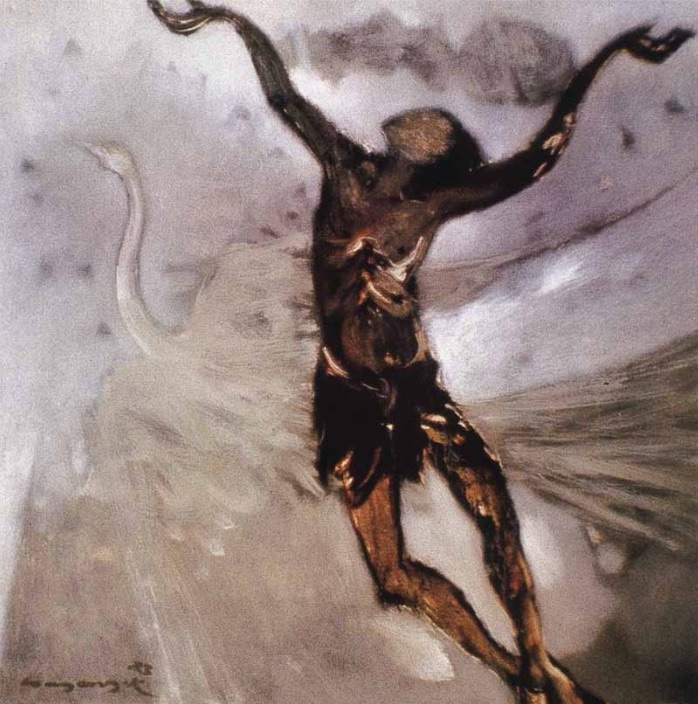
-icon can be purchased at monasteryicons.com

Beltaine

Today the ancient Celts would celebrate the festival of Beltaine, welcoming May as a month where the increasingly hot sun (the “tene” part of the word above) would warm the greenery enough to produce harvest. The “bel” portion of the word is a mystery, as it could stand for an ancient Celtic sun-god, Belanos, or could just be a form of the ancient word for “brilliant”

At dusk, having let their own hearth fires die out (which they only let happen once a year), the whole clan would ascend a nearby hill to get as close to the setting sun as possible. They’d set up huge poles and dance around them with flowers in their hair. They’d drink, and feast, and sing. They’d create flower garlands to adorn their doors or trees near their houses.

They’d create huge fires which they believed would help warm the sun, and they’d jump over the fires as a way of emboldening themselves for summer work, and if you were planning to be married soon, you’d do it three times for good measure. The elderly would circle the flames reciting prayers, and mothers would carry newly born infants near the coals as a way to ensure they’d be protected in childhood.

Fire, for them, purified the air of disease, and they believed that a bit of the hair from the same dog could be the cure, as they hoped setting these fires now would protect the unborn harvest from lightening strikes or other natural fires in the hot days.

As the fires smoldered each family would take a coal home to start their new hearth fire, and the rest was scattered throughout the crops for good luck.

If you stayed up all night on May-day, those who observed the sun rise would swear it danced for joy three times upon the horizon before jumping up in summer glory.