

The Yule Lads!

In learning about my Celtic heritage, I stumbled upon a fun tradition of something called “The Yule Lads,” 13 trolls that come from December 12-24 to play pranks. Especially popular in Icelandic lore, these trolls are fun tricksters who, when little children leave their shoes on the window sill, leave candies for good children and rotten potatoes for naughty kids.

December 12th: Sheep Cote Clod visits to harass sheep (but his peg leg prevents him from catching many, and he mostly makes noise).

December 13th: Gully Gawk comes from the mountains to hide in gullies, sneaking into barns to steal milk.

December 14th: Stubby comes to scrape out all the food left in your pans.

December 15th: Spoon Licker licks your spoons.

December 16th: Pot-Scraper scrapes out your pots.

December 17th: Bowl-Licker licks out your dirty bowls.

December 18th: Door Slammer comes late at night to slam your doors while you’re sleeping.

December 19th: Skyr Gobbler arrives. Skyr is a special kind of Icelandic yogurt, but he’ll eat any yogurt…he’s not picky.

December 20th: Sausage Snatcher comes to, well, self-explanatory.

December 21st: Window Peeper comes. A terrible name, this is the kindest of the trolls who is just looking for little snacks to steal by peering through your windows.

December 22nd: Doorway Sniffer comes. He has a strange name, but he’s just sniffing out your cakes and muffins to eat with his strong nose.

December 23rd: Meat Hook comes to eat the Christmas roasts you’re prepping for your holiday feast!

December 24th: Candle Stealer. This harkens back to a day when candles were made from fat and were edible. He waits to take children’s candles to eat!

Fun stuff.

Rotten potatoes for all!
On The Most Despised

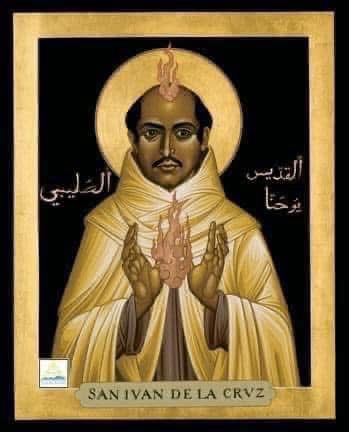
Today the church celebrates one of the great mystics of history, St. Juan de Yepes y Alvarez, but you know him better as St. John of the Cross, Renewer of the Church and Visionary.

St. Juan was born in Fontiveros Spain, the third son of a Jewish silk merchant. His father died shortly after he was born, and his family placed little Juan in an institution for the poor.

St. Juan was extremely short of stature, even for his day, but showed great skill in craftsmanship from early on, and apprenticed at many places. He enrolled in college and worked his way through school striving to become an exemplary monk.

He was entranced in the Order of the Blessed Virgin (Carmelites), and was ordained. Soon after met St. Teresa of Avila, his spiritual cousin. She had begun to implement her reforms of the Carmelite order, and St. John promised himself to these reforms, adopting the name St. John of the Cross to embody his minimalist and mystic piety.

St. Teresa eventually helped get St. John appointed as Confessor to the Convent of the Incarnation, where she was a sister.

St. Teresa’s reforms were causing division within the Carmelite Order, and some monastics came and seized St. John, imprisoned him in a six foot by ten foot cell, beat him, and attempted to force him to renounce the austere reforms.

St. John refused and after nine months was able to escape, fleeing to a safe monastery in southern Spain.

This is where he began writing down his mystical visions and dreams, having had them in the confinement of his prison cell. His deeply spiritual writings often took the form of poetry. Most notable are The Ascent of Mt. Carmel-the Dark Night, and Living Flame of Love (which is more song than pure poetry).

In 1591 the controversy over the austere reforms rose again, and St. John was banished further south in Spain. It was there that he caught a fever and, though he sought medical care, was poorly treated because the prior of the monastery didn’t want the burden of another monk.

He died uttering the Psalms, saying, “Into your hands, O Lord, I commend my Spirit.” He was deeply beloved by the people, though he was rejected by much of the Church at the time, and was immediately heralded as a Saint.

You may not be too familiar with St. John of the Cross, but you’re certainly familiar with art that is based off of his mystical visions. Salvador Dali’s unique painting of the crucifixion was based on one of St. John’s poems.

St. John of the Cross is a reminder to me, and should be for the whole church, that sometimes the most despised in our midst are the wisest.

Let those with ears to hear, hear.

-historical notes from Pfatteicher’s New Book of Festivals & Commemorations

-icon written by Br. Robert Lentz