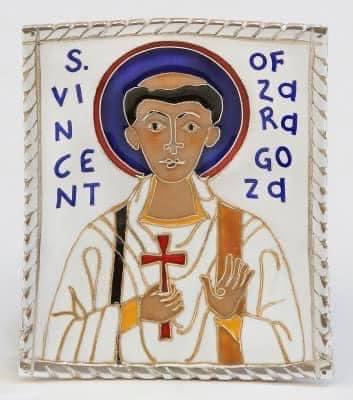
Another 4th Century Saint marks our days on the 22nd of January, and this one is especially dear to those with Spanish heritage: Saint Vincent of Saragossa, Deacon, Martyr, and Voice of the Divine.
St. Vincent is the most celebrated of Spanish martyrs, and he, like St. Agnes of yesterday’s note, died in the Diocletian persecution in 304 A.D.
St. Vincent, though not the Bishop of Saragossa, did the work of a good Deacon in regularly preaching for Bishop Valerius, who suffered from a speech-debilitating stammer. Both Vincent and Valerius were imprisoned for their faith, and while Valerius received the sentence of exile, Vincent received the sentence of torture and death.
Starvation, held in stocks, and tortured by fire, St. Vincent who so regularly preached on behalf of the Divine offered his final sermon to the world with his body, and the world listened. In the Middle Ages, a number of churches throughout England were built in his honor and named for him.
St. Vincent is a reminder for me, and can be for the whole church, that community is a team effort that will threaten powerful people who would rather dominate alone.
-historical helps by Pfatteicher’s New Book of Festivals & Commemorations
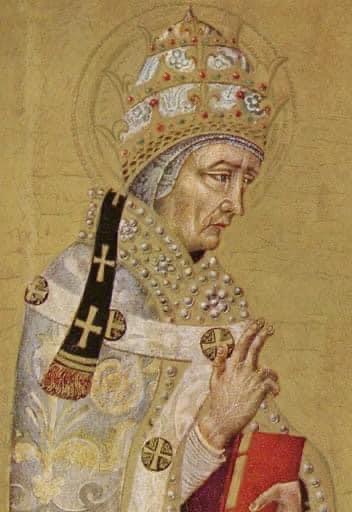
Today the church honors an unlikely Bishop, perhaps only second in unlikeliness to St. Peter himself: Saint Fabian, Bishop of Rome, Martyr, and Snow White Prodigy.
St. Fabian was not clergy. He didn’t even live in Rome, proper. But one day, early in the third Century, he wandered from his farm into the city just as the gathering clergy were meeting to elect a new bishop for the young, fledgling church.
Several names were being tossed about, mostly powerful people within the Christian movement who had gained popularity and notoriety. No consensus could be found, though, until the gathering was interrupted by a descending avian.
A dove flew into the crowd and, like a scene out of Snow White and the Seven Dwarfs, alighted upon the head of Fabian.
The gathered clergy saw this as a sign, and they immediately ordained him and elevated him to the role of Bishop by unanimous acclamation.
Fabian set about doing the work of Bishop from a farmer’s mindset. He divided the city into seven plots, or districts, and set deacons in charge of each area so they could respond to practical and charitable needs as they arose. He took to remembering the ancestors of the faith, the martyrs, venerating them in their catacombs. All of these practices would shape the church forever, even unto today.
For fourteen years Fabian led the church in Rome, eventually dying at the hands of Emperor Decius in the year 250 AD. In his death he was remembered by fellow Bishops as being “incomparable,” and on his grave to the day you can see inscribed in the Catacombs of St. Callixtus, “Fabian, Bishop, Martyr.”
St. Fabian is a reminder for me, and should be for the whole church, that sometimes the most qualified persons aren’t the richest, the most powerful, from the best schools, or who are the most well known.
Sometimes the most qualified persons are those who just appear, almost out of nowhere…kind of like, you know, Jesus. And Fabian.
-historical bits gleaned from Pfatteicher’s New Book of Festivals & Commemorations
Today the church remembers an obscure 11th Century Bishop of the Anglo-Saxon Church who rocked a cool name: Saint Wulfstan, Bishop of Worcester and Abolitionist.
Bishop Wulfstan was a Benedictine monk who lived his whole live in Worcester, never venturing further than the last doorpost of the parish he served. He did this because, well, he was so busy. He is the first known Bishop to make it a point to visit all of the parishes in his area systematically and regularly. His goal was to instill a sense of friendship and learning amongst the churches and the people of the area, and he sought to make Worcester a place of learning for the north.
He also fought hard to stop the practice of selling the English as slaves in Ireland, believing that no person could own any other person legitimately.
His fame grew, though he never traveled outside of his little area.
As he traveled from parish to parish, he is said to have recited the Psalter from beginning to end, and if you rode with him he would make you sing the alternating verse. On these trips he also carried a large satchel full of coins which he readily gave out to anyone who asked of it.
He is remembered as a good and kindly Bishop, perhaps the best of his time.
St. Wulfstan is a reminder for me, and should be for the whole church, that you don’t need to be exceedingly well-traveled to be known and make a difference in your own back yard.
-historical bits from Pfatteicher’s New Book of Festivals & Commemorations
Today the church notes an important feast day that’s not focused on a person, but on a person’s words: The Confession of Saint Peter.
So, this strange feast is the only feast dedicated to words, which feels very appropriate in these days where we’re all seeing, a little too close to home, the power of words.
Words can move us, for good or for ill.
Words can shape worlds, and tear them down.
Today the church remembers Peter’s famous confession, “You are the Christ.” This confession comes near the Week of Christian Unity for the church, but I have to be very honest with you when I say that the church feels more fractured today than it has in many decades.
Seeing Christian flags used to storm the capitol building three years ago was too much for me.
I’m pondering, on this feast day, what words I follow in the world. What words shape me? What words do I use to shape?
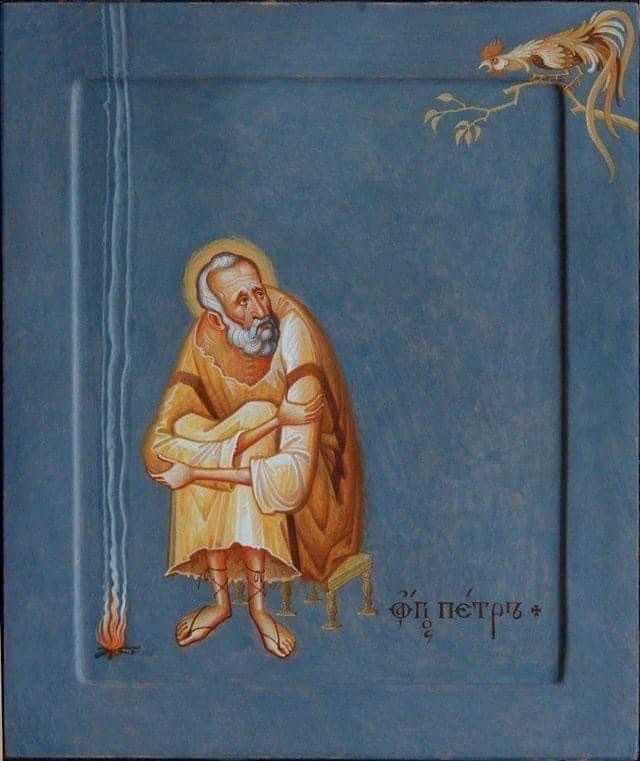
I chose this icon by Russian icon writer Oleg Shurkus for the day because I feel it’s most appropriate for where we are. This is obviously not of St. Peter’s confession, but in the aftermath of his denial and betrayal.
We don’t always live up to our ideals. We sometimes betray our own words. This feels like where we’re at.
Still, there is always a possibility for resurrection, right?
Perhaps on this day when the feasts of the church comes on the heels of our civic MLK feast, these words will suffice for the day:
“The time is always right to do what is right.” -Martin Luther King, Jr.
Today the church remembers a saint pivotal to the Christian movement who doesn’t get a lot of press, but continues to get a lot of emulation: Saint Antony, Abbot in Egypt, Earnest Seeker and Embracer of Extremes.
We should cut to the chase: Saint Antony of Egypt is the founder of Christian monasticism.
Born in Egypt in 251 A.D. at the outset of this new way of living in the world, Antony heard the Gospel edict, “Go and sell all you have and give it to the poor” (Matt. 19:21) when he was just a young man and, for better or worse, took it very seriously.
He sold everything…and he had a lot. His family was extremely wealthy, and he inherited quite the ancient fortune.
Nevertheless, Saint Antony didn’t see much wiggle room in the Gospel call, and so he sold it all and went to live the solitary life in Upper Egypt as an anchorite, ascetic, and prayerful penitent, dedicating his life to following the Divine.
To put bread on his table he wove baskets and sold them at the local market, and he lived in total solitude for twenty years.
The thing is: he saw how living alone could be dangerous for some. It only took him twenty years to figure it out, but in this spiritual experiment he found that loneliness was a sordid companion and had dangers of its own. To combat that the dangers of solitude, Saint Antony gathered the other lonely anchorites and ascetics who were emulating his lonely life and knit them together into a community that could hold one another accountable while also providing some friendship. He drew up some organized rules for their life together, and created a pattern of life that included work, prayer, and worship. In this community fraternal love and a reasonable sense of order created the scaffolding not only for helping those seeking to dedicated their life to following the Divine more sustainable, but inadvertently created a model of being that has grown into a network of souls dedicated to living a life of devotion lasting thousands of years.
For Saint Antony, though, solitude was not so bad. After organizing this initial monastic order, he once again retreated into the womb of his own being, spending the remainder of his life alone in a cave on Mount Kolzim in the Eastern Desert near the Red Sea. People would seek out his lonely cave, asking advice and desiring to glean the pearls of wisdom that fell from his spiritually well-seasoned tongue. He occasionally would also venture out to visit his followers in their little pockets of apocalyptic people and hermitages. He even made the trek to Alexandria in his old age to argue against the heresy of Arianism, though he was more measured in his words than many of his contemporaries.
Funny thing about Saint Antony: he was never ordained and never took any holy orders. He was a lay person his whole life, and had lived over a century when he took his last breath. The Monastery of St. Antony still exists today and remains a pilgrim point for many in the monastic world, and he is commonly now known as Saint Antony the Great.
Saint Antony of Egypt is a reminder for me, and should be for the whole church, that sometimes loneliness for clergy can be a killer, and we need to have some formal structures in place to combat this. I’ve seen this in my own life…and continue to see it all around me.
Let those with ears to hear, hear.
-historical bits gleaned from Pfatteicher’s New Book of Festivals & Commemorations
-icon written by Fr. Theodore Koufos over at Legacy Icons
Today an obscure saint is remembered by the Church, one of the founders of the Religious Society of Friends: George Fox.
Fox, born in England, left his home at eighteen to follow a religious quest, and reportedly had many visions and spiritual awakenings along the way.
He arrived, in time, to the idea that God speaks to the inner-soul, not through the forms and norms of the established church, which put him at odds with his Puritan surroundings. This inward insight became the plumb-line for guidance and faith, above clergy, doctrine, and even scripture itself.
Because of these stated beliefs, as well as his peculiar habits (he wore leather suits and never took his hat off), he was beaten, stoned, and jailed numerous times. Nonetheless, followers continued to flock to his message, including William Penn and Robert Barclay.
His followers became known as “Quakers,” an unpleasant term used to describe these people who refused to make pledges, pay tithes, or make oaths to authority.
Because of Fox and his message, the state passed the Toleration Act of 1689 which formally outlawed religious discrimination (though it continued informally), and left an impression on courts forcing them to struggle with what it means to be “equal before the law.”
-Summary from Pfatteicher’s “New Book of Festivals & Commemorations”-
Though today is Martin Luther King, Jr’s birthday, the church reserves his commemoration for April 4th, conforming with the practice they do with all martyrs by remembering him on the day of his death.
Nevertheless, it is certainly appropriate to honor him today (as well as on the civic holiday next Monday).
To do that, I’ll share my favorite quote from King, one that doesn’t get a lot of circulation, though you may have heard it before. It’s from “The Drum Major’s Instinct.”
“If you want to be important–wonderful. If you want to be recognized–wonderful. If you want to be great–wonderful. But recognize that he who is greatest among you shall be your servant. That’s your new definition of greatness. And this morning, the thing that I like about it…by giving that definition of greatness, it means that everybody can be great.
Because everybody can serve.
You don’t have to have a college degree to serve. You don’t have to make your subject and your verb agree to serve. You don’t have to know about Plato and Aristotle to serve. You don’t have to know Einstein’s theory of relativity to serve, you don’t have to know the second theory of thermodynamics in physics to serve.
Today the church remembers a contemporary Norwegian saint who deserves to be remembered more than he is: St. Eivind Josef Berggrav, Bishop of Oslo and Gadfly of the Nazis.
St. Berggrav was born at the end of the 19th Century, the son of the Bishop of Hamar. He planned to be an engineer, but fell in love with Theology and decided that would be his life’s pursuit.
He didn’t enter the ministry immediately upon graduation, spending some time studying the psychology of religion as the editor of a prominent publication dedicated to the topic. It was clear he was wrestling with his own vocation. At the same time, he took up teaching.
Finally in 1919, he was ordained by the Church of Norway and appointed to the rural parish of Hurdal. In 1925 his ministry took a jaunt directly northward, as he was elected the Bishop of Tromso on the arctic plains of Norway, close to the land of the Lapps. These fur trappers, fishermen, and sea people taught him how to be a Bishop of the church
In 1937 he was appointed Bishop of Oslo, and soon after the President of the World Alliance for Promoting International Friendship through the churches. The world was on the brink of war at the time.
In 1940, after the Nazi invasion of Norway, St. Berggrav was named one of the negotiators assigned to assess the intentions of the Nazi occupation.
He lasted two days in the post before resigning in protest, saying that he would never compromise with them. From this stance, he led a formal opposition to Nazi interference, focusing on the independence of the clergy and the sacred rights of the Jewish people.
This, obviously, upset the powers that be. They stripped him of his bishopric and his clerical credentials, and they put him on house arrest. In protest, 797 of the 861 priests of the Church of Norway resigned on Easter Sunday, showing what resurrection-in-action truly looks like.
Feeling Berggrav was the primary instigator of this rebellion, he was imprisoned in a solitary log cabin on the outskirts of Oslo under the edict of Hitler himself.
An underground church quickly formed in Norway, continuing the life of the faithful in exile. In something out of a spy novel, Berggrav donned a disguise and escaped from his log cabin, hiding out in Oslo until the liberation of Norway in 1945.
After the war, Berggrav lobbied for greater participation by the laity of the church in ecclesial affairs. He became a leader in the World Council of Churches and the Lutheran World Federation, and served until he fell ill in 1950. He died on this day in 1959.
A prolific writer, Berggrav published half a dozen books in his distinguished career, the last entitled When the Fight Came about his disobedience to the Nazi regime.
St. Berggrav is a reminder for me, and should be for the whole church, that there are some things you can’t compromise on.
-historical pieces inspired by Pfatteicher’s New Book of Festivals & Commemorations
A 4th Century Saint is honored by the church on January 13th: St. Hilary, Bishop of Poitiers and Hymnwriter.
Hilary (think “happy” or “hilarious,” because his name is derived from the Latin for fun/cheerful) was born in Gaul to powerful pagan parents. He was not baptized until relatively later in life, at age 30, and in the year 350 he was made bishop of Poitiers by popular demand, though he was already married and had never been ordained!
Throughout history, good order has often been circumvented by the desires of the masses, for good and for ill.
St. Hilary bucked Emperor Constantinus in not going along with the Emperor’s demand that Western Bishops adhere to a compromised Nicene faith, and for this he was banished to Phrygia in Asia Minor.
There he continued his work as a theologian, writing On the Trinity while in exile, a foundational document for the early church.
In 360 he was allowed to return to his post at Poitiers to great acclaim, and he became the most respected Latin theologian of the time, and is lauded as one who brought Eastern wisdom into the Western church largely due to his time in exile and learning from those in Asia Minor.
He is also remembered as having written the first Latin hymns. Having been influenced by Greek hymns during his exile, he brought many back and created Latin versions of them while also writing new hymns altogether for the Western church. He was disappointed with the ability of the people in Gaul to carry a tune, however, and complained that they were “unteachable in sacred song.” I guess you can’t always have a win.
Hilary is remembered as being one intensely focused on Orthodoxy, but also as one who, due to his life experience, broadened and expanded the practices of the church.
Oh, and fun fact: I passed by the parish of St. Hilary weekly when I lived on the north side of Chicago.
St. Hilary is a reminder for me, and should be for the whole church, that sometimes spending some time in exile, on the outs, at the margins, can be a blessed time of learning where the gems of the wilderness can be mined and brought back into the center of life.
-historical pieces gleaned from Pfatteicher’s New Book of Festivals & Commemorations
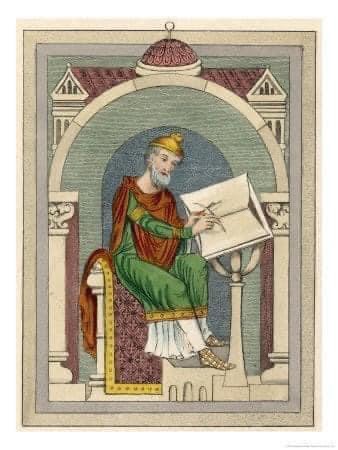
Today the church observes Aelred, Abbot of Rievaulx and Good Friend.
Born in the 12th Century, Aelred was the son and grandson of Saxon priests. He was sent to work in the home of King David of Scotland at a young age, and when he entered adulthood experienced some deep inner struggle of an unknown nature.
All we know is that he was conflicted.
To help discern his angst, he entered a Cistercian Order at Rievaulx and soon gained a reputation as kind, wise, and a good friend to all.
His greatest mark left on the world was his capacity for profound sympathy, and he went on to write Spiritual Friendship, a reflection on the goodness of having and being a true friend in life.
The good Abbot was known to create deep, meaningful friendships, and hold these up as the pinnacle of godly relationship.
“A friend praying to Christ on behalf of his friend, and for his friend’s sake desiring to be heard by Christ, directs his attention with love and longing to Christ; then it sometimes happens that quickly and imperceptibly, the one love passes over into the other, and coming as it were, into close contact with the sweetness of Christ himself, the friend begins to taste his sweetness and to experience his charm.”-Spiritual Friendship
St. Aelred is a reminder to me, and should be for everyone, that sometimes the best thing you can be in this world is a good friend.
After all, if the only thing anyone remembered us for is our deep capacity for sympathy and friendship, it wouldn’t be the worst thing in the world…



 Reluctant Xtian