On Meaning

“What’s going to happen?” she wondered. “There has to be a bigger purpose…”

“Why?” he asked honesty.

“Because I need it all to mean something,” she replied, tears welling up in her eyes.

“We all want things to mean something in some bigger plan,” he said, “but what if they don’t? What if the map is being drawn one second at a time? Does that mean it’s all…well..meaningless?” he countered.

“Well, no…” she said. “I would just like some assurances.”

“I’m not sure life gives you those,” he said. “What if the larger point is for us to embrace that things have meaning not because there’s some ‘larger plan,’ but because our small, little plans are beautiful enough? And the mistakes? They don’t need to fit in some larger scheme to be redeemed. They’re redeemed because we learn from them, heal them as best we can, and move forward just a little bit on this ever-evolving, ever-scrolling map we make.”

“Significance,” he went on, “is not assigned from above. It’s assigned from within. Things mean something because they’re important to us, to you, to him. Or her. It’s subjective, by God. And that’s OK. It doesn’t make it less. It probably makes it more.”

“More?” She closed her eyes trying to wrap her head around it all.

“So, my quest for certainty is a fool’s errand?” she wondered.

“No,” he said, “because you’re not a fool. It’s the most human thing in the world, I think. But what if we just got used to embracing the idea that there is no certainty?”

“It might be freeing…” she said, honestly.

“It just might be.”
The Flower

Today the church begins to set its collective eyes toward Candlemas (February 2nd), which comes on the heels of St. Brigid’s Day (February 1st).

On the wheel of the Celtic year, spring begins in February. They call it “Imbolc” which means “in the belly,” a sign that we’re in the belly of the cold time and emerging into warmer climes. It’s not over, but it’s beginning to change.

To mark this change they looked toward nature and the animals, seeing if they’d emerge from their dens or remain dormant. In America we call this “Groundhog’s Day,” but it all began with the Celts.

It was also the season where they’d haul out their new candles, as the old ones were spent, and would bless them for new service. These new candles would last longer, possibly the rest of the year. The church coopted this practice and Christianized it into Candlemas.

But we’re not there yet.

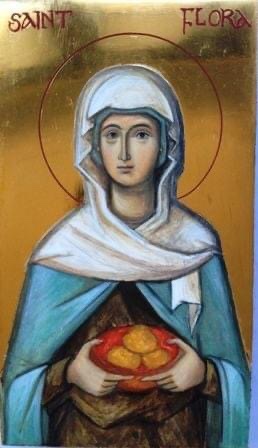
So, to prepare for St. Brigid’s Day/Candlemas, the ancient church honored St. Brigid’s cook at Kildare: St. Blath, Patron Saint of Cooks, Cafeteria Workers, and Volunteer Food Servers.

St. Blath, also known as St. Flora (because “Blath” in Gaelic means “Flower”) was St. Brigid’s convent cook. While we don’t know much about her, she was rumored to be a tireless worker, faithful in good times and in bad times, knowing that full bellies helped bolster spirits.

Which, I think we can agree, is a universal truth with all animals, especially humans.

St. Blath’s work takes on new and urgent meaning when we imagine that those early 6th Century sisters at Kildare, having taken a vow of poverty, would regularly give away their food to the poor. St. Blath was constantly prepping and serving, then, not only the sisters, but also those to whom they offered their meals.

It was said of St. Blath that her bread and bacon were the best in the land, a high honor if you know anything about Celtic culture.

Saint Blath died in the year 523AD, but her legacy of service lives on.

St. Blath is a reminder to me, and should be for the whole church, that it does no good to have faithful people if their other needs, especially their stomachs, aren’t attended.

Let those with ears to hear, hear.

-historical bits from Illes Daily Magic.

-icon written by Katherine Sanders