The Saint of Existentialism

In these November days, an “in-between-time” of the year wrestling with whether it is “fall” or “winter”, we honor perhaps my most favorite theologian and saint who embodied wrestling in his questioning of the struggles of human existence, St. Soren Kierkegaard, Writer, Theologian, and the Father of Existentialism..

Soren was born in Copenhagen in the early 19th Century, the seventh child of aged parents. His father, Michael, was a farm laborer who was born in abject poverty but, through toil and a good bit of luck, succeeded at business and became quite wealthy. There is a story that Michael, deeply unhappy with his life, stood on a hill and cursed God one day…which changed his business fortunes but, in his estimation, also gave him terrible heartache. He believed that God blessed him in business but cursed him in life. His wife and five of his seven children died quite early, and Soren only knew his father as a grieved and sad person.

Soren studied theology and quickly got the sense that God, in retribution for his father’s curse, had summarily cursed the whole family. He tried to cut ties with his father, and lived a quite wild life for a bit, but eventually had a religious conversion that sent him back to make amends. His father died in 1838 and left Soren a considerable fortune.

Kierkegaard eventually finished his theological degree (he was a brilliant student), but never sought ordination because, despite all his study, he could never fully make “the leap of faith,” a phrase he would come to coin and use throughout his work.

In 1849 Soren became engaged to the young love of his life, Regine, but following in the footsteps of his ever-grieved father, was troubled and broke off the engagement when he struggled making sense of inviting someone to share his unhappy existence, this “curse” he felt was still very present.

Breaking off his engagement sent Soren further into a deep and shadowed depression where he publicly (in writing) wrestled with how we know anything at all with certainty.

He began publishing thoughtful works in earnest, using a nom de plume: Either-Or, Fear and Trembling, The Concept of Dread, and many others. The public assumed these were works of fanciful, thoughtful, fiction, but in fact they were Kierkegaard wrestling with life.

As a writer, Kierkegaard became open to public scrutiny, and was engaged in more than a few public feuds with other publications who viewed his work as ridiculous or the mad thoughts of a rich kid who had too much time on his hands. Soren did not take to being mocked, and argued bitterly against his detractors…and all this sent him further into a pit of despair.

His final issue, though, came when Kierkegaard heard officials from the Danish church spout what he identified as sterile theology. Never being able to quite embrace an orthodox faith, Kierkegaard still knew a theology of smoke and mirrors when he saw one, and became quite critical of a church that he felt didn’t take anything seriously and looked to keep people quiet and tamed more than encourage them to adopt deep, thoughtful wrestling.

Soren, in his despair and distress, one day collapsed in the streets of Copenhagen at the age of 42. Doctors diagnosed him with some sort of bone disease, and a month after his collapse he died in November of 1855.

St. Kierkegaard’s big hang-up with the church, and with life, is the notion of how one could talk with such plain certainty about things that are so unexplainable. The inability or unwillingness of the church to faithfully wrestle with itself and its teachings, even core teachings of Divine existence and what constitutes morality in a world that seemed destined for rule by the privileged, troubled him. How does will, risk, and choice play into our life-trajectory? How can a theology that smacked of status quo even begin to mirror the sacrificial life of the Christ?

Kierkegaard always tried to point the church back to this “troubled truth”: you can’t be certain, so stop pretending you can be.

For Kierkegaard truth was experienced more than taught by scholars in a classroom, and in this way he embodied a very “ground-up” theological stance which, for obvious reasons, chaffed against the hierarchy of the Church.

I deeply resonate with St. Soren’s wrestling with faith and truth, and to say that his works Stages on Life’s Way and Fear and Trembling had an effect on me is to say too little. I continue to consider myself a follower of his particular vein of theological inquiry: questioning, uncertain, and yet always striving.

I also think he is an outstanding writer and that you should read him for that, if for nothing else.

St. Soren is a reminder for me, and should be for the whole church, that the people in our pews can be trusted with a bit of ambiguity, can be invited to a deep (and necessary!) wrestling with the faith, and should not be served the vapid theology and trite moralisms and “pie in the sky” escapism.

Wrestle, by God. It’s uncomfortable, it can even be painful, but it is worth the effort to live an examined life.

-the life of Kierkegaard cobbled together from my own work and Pfatteicher’s New Book of Festivals & Commemorations.

-opinions my own

-do yourself a favor and read Fear and Trembling

-painting by Fabrizio Cassetta

Martinmas

Today the church honors the start of an ancient feast, Martinmas, named in honor of St. Martin of Tours, Bishop, Conscientious Objector, and Gentle Bishop.

St. Martin was born in the early 4th Century in modern day Hungary. His family was not Christian, and his father was a distinguished Roman legionnaire.

In his childhood he came under Christian influence, and at the age of ten he took it upon himself to sign up for Catechism classes (imagine that happening today!).

As a young teen, though, his catechumenal exploration was put on pause as he was drafted into the Roman army, a common practice for children of Roman soldiers. He was a good soldier. Very good, in fact, and well-liked by his comrades.

This is a nice tie-in to Veterans Day, no?

But, as the legend goes, one winter night he was stationed in Amiens, and on night watch he saw a poor old beggar at the city gates shivering in the cold. St. Martin had nothing to give him, so he cut his cavalryman’s cloak, and gave the old man half to wrap himself in. That night St. Martin dreamt that he saw Christ wrapped in his cloak, saying, “Martin, still a catechumen, has covered me with his cloak.”

Well, this sent St. Martin into an existential crisis. Over a period of time he became convinced he could no longer be a soldier because he could no longer justify killing.

He decided to be baptized and asked to leave the army. He was twenty years old.

St. Martin went off to seek Bishop Hilary of Poitiers (see Jan 13th for his feast day) to learn from him. He met with him and decided he wanted to join him in his work in Poitiers, but first wanted to say goodbye (and convert) his family back in Hungary. While St. Martin was journeying back to Hilary after hanging with his family, he learned that Bishop Hilary had been exiled. St. Martin decided then that he, too, would seek a solitary life for a while, and lived a hermits life in a hut outside Poitiers.

The thing is, St. Martin was becoming famous for not wanting to be famous. And so his little hut grew into two, three, thirty…a thriving humble monastery had formed that was providing charitable work all over the French countryside. In 371 the Bishopric of Tours became vacant. St. Martin’s followers tricked him into entering the city, and then would not let him leave until he agreed to be their Bishop.

“Fine,” he said. “But I’m going to do it my way…” (cue Frank Sinatra).

St. Martin, now Bishop, set up his home in a cave on the cliffs of Marmoutier, two miles from Tours. The office for his Bishopric was a hut just outside the cave. And though he had an unusual lifestyle, and an unusual approach, he was unusually effective in reaching the poor countryside people of France with charitable love, good works, and the Gospel message.

He fought for the rights of peasants in front of Emperors, not afraid to advocate on behalf of the poor. He established centers of charity and teaching in places no one else cared about. And when the Church first used capital punishment as the sentence of heresy, as they did in 386, St. Martin strongly opposed the sentence and began to ask tough questions about mixing the church and state.

He thought government and the church should not hold hands too tightly.

St. Martin died in 397. Interestingly enough, his work set much of the foundational work for the Celtic Christian Church, as missionaries trained in his little outposts traveled to the British Isles.

Martinmas, much like Michaelmas, became a festival time in much of Christendom, perhaps even spanning ten days originally. After the Reformation, many Lutherans continued to celebrate Martinmas, but did so to honor both St. Martin of Tours and Blessed Martin Luther (whose birthday is November 10th).

St. Martin’s motto, “Non recus laborem” or “I do not turn back from work” has been the motto of many of the faithful throughout the centuries.

St. Martin is a reminder for me, and should be for the whole church, that catechetical study has been known to significantly alter how people live and work. It has been formative…and could still be.

-historical bits from Pfatteicher’s New Book of Festivals & Commemorations

-icon written by Aiden Hart depicting St. Martin’s formative experience

How Jesus Was

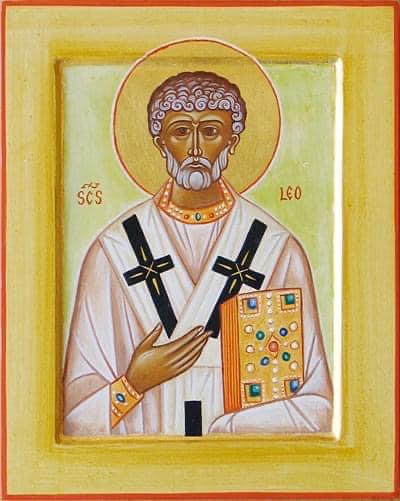
Today the church honors an important leader in the church that most church-goers have never even heard of, St. Leo the Great, Bishop of Rome and Mediator of the Church.

Long before the church was arguing about the nature of humans and their race and sexuality, the church set about arguing about the nature of Jesus. In the 5th Century, when Pope Leo was consecrated as the Bishop of Rome, the Catholic faith was being torn asunder by schisms over who Jesus was and how Jesus was.

Yes, you read that correctly: how Jesus was.

How was Jesus both Divine and human?

Pope Leo refocused the question on faith rather than nitty-gritty explanation. He affirmed the idea that Christ had two natures and, as he was enlarging the influence of the Papacy around the known world, issued his famous (at least to churchy-people) Tome to Flavian, the Patriarch of Constantinople that had the clearest articulation of Christ as human and yet Divine.

You still talk about this idea, by the way, every time you say the Nicene Creed.

At the time all sorts of schisms were going on inside the church, there were tons of wars being fought in real-time, too. St. Leo kept Rome safe from Attila the Hun in 452, and a legion of Vandals, whom he persuaded not to destroy Rome, in 455. He put restrictions on who (under what training) could enter the priesthood, and affirmed the goodness of “all matter,” rejecting the idea that the created world is evil and we need only wait for some heaven, lightyears away.

He was a devoted liturgist, and further developed the words of the Mass, shaping the words we say yet today.

St. Leo was wise, if not particularly brilliant. He understood how to use power effectively and for twenty-two years led with theological ability and personal resolve.

St. Leo is a reminder for me that wisdom and brilliance don’t always hold hands, and you can certainly be one without the other.

But of all the things that Pope Leo the Great is remembered for, the thing that struck me is how he looked at creation and without hesitation affirmed what Genesis had already said: “this is good.”

Why does it matter?

Because, Beloved, it articulates clearly that everything that is created, matters, and therefore we can’t just do what we want with it…

-historical bits from Pfatteicher’s New Book of Festivals & Commemorations

-editorials by me

If Public Singing is Lost…

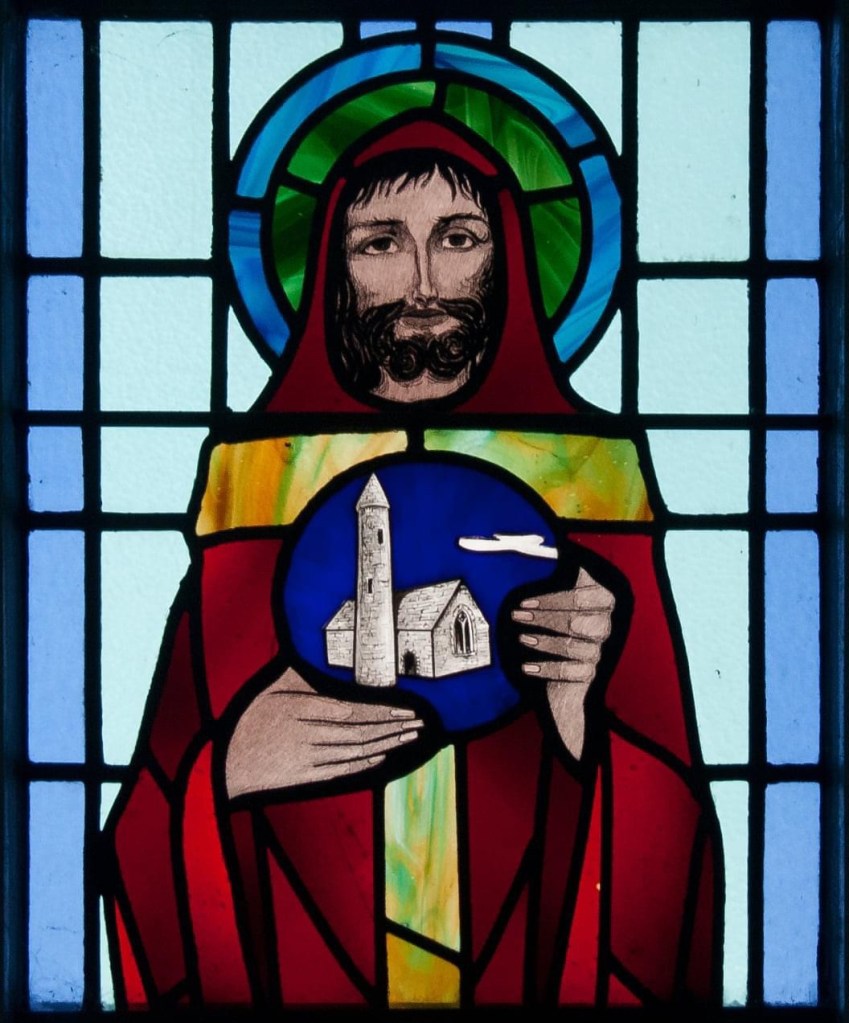
Today the church remembers an Irish saint said to have been baptized by Saint Patrick himself: Saint Benen the Gentle, Psalm-Singer and Friend of the Emerald Isle.

St. Benen was the son of clan chief, born in the early 5th Century. When Saint Patrick visited his clan with Celtic Christian teachings, young Benen was baptized and tutored by Patrick in language and theology.

As St. Benen grew he went on trips with Patrick and, while on the road with him, became known for his musical acumen and compositions, making him part of the Irish bardic tradition with Celtic-Christian flavor.

In adulthood St. Benen took a leadership position within the growing Celtic-Christian church, becoming the first rector at the Cathedral School of Armagh.

As it is with all Irish saints, St. Benen has some fun tales surrounding his life. One such tale was that, when tested by a clan chief arguing over religion, St. Benen was put in a flaming house and, like something out of the Hebrew scriptures, was able to sit in that “blazing furnace” with no problem (and he was probably singing).

He died in the year 467, having resigned his rectorship so that a younger generation could take the mantle.

St. Benen is a reminder to me, especially in these lingering pandemic days, of how central song, music, and the arts are to human spirituality. The church is one of the local conservatories of these things. The only place you sing in public is the church and the local bar (unless you’re in a choir).

If public singing is lost, we will be less whole.

-stained glass icon written for Kilbennan St. Benin’s Church Window

Stories Around the Hearth

For the ancient Celts, November was a time of storytelling.

With All Saints and All Souls Day celebrations, with more time inside as the thermometer dropped and the sun became shy, they’d sit around “the lamp of memory” and tell the stories of the family, of the land, of their people, late into the night.

Sometimes you’d hear a knock at your door in the evening around suppertime, and a Shanachie would arrive and barter a story for dinner. These Schanachie (which literally means “old-ones”) where the keepers of the clan stories, and though they weren’t always old, they were in this ancient tradition and held on to the “old lore.”

You still find these people, by the way, not only in Ireland and Scotland, but also in the places around the world where the Celts have roots. Here in the mountains of North Carolina it’s not strange to go into a country store and find someone there willing to tell a tale to a bent ear.

The fact that November is a time of stories in Celtic tradition and a time of Thanksgiving in our American tradition pairs nicely with one another.

Perhaps this Thanksgiving more stories will be heard: stories of the family, of past holidays, of past holy days.

Ordinary Saints and Re-Forming Truths

(This is a sermon I gave at Lutheran Church of the Redeemer in Atlanta, Georgia on Reformation Sunday, 2022)

John 8:31-36

31Jesus said to the Jews who had believed in him, “If you continue in my word, you are truly my disciples; 32and you will know the truth, and the truth will make you free.” 33They answered him, “We are descendants of Abraham and have never been slaves to anyone. What do you mean by saying, ‘You will be made free’?”
34Jesus answered them, “Very truly, I tell you, everyone who commits sin is a slave to sin. 35The slave does not have a permanent place in the household; the son has a place there forever. 36So if the Son makes you free, you will be free indeed.”

Ordinary Saints and Re-Forming Truths

Greetings, Beloved!

My name is Pastor Tim Brown, and I serve the ELCA as the Director of Congregational Stewardship, though I live just up the road from you all in Raleigh, North Carolina with my wife and two crazy boys.  It’s my honor to bring you blessings and greetings from Presiding Bishop Elizabeth Eaton, and all the churchwide staff.  In my work in congregations, Lutheran Disaster Relief, Lutheran World Hunger, and the many missions that you all support here with your good work I have seen lives changed.

You’d helped make that happen. You make that happen. Thank you.

Before I was the Director of Congregational Stewardship, though, I was a parish pastor both in Raleigh and before that in Chicago, where I had a couple opportunities to meet your Mark, back when we were young and full of dreams.  And Pr. Jenny and I served together for a while on the ELCA coaching board.

That’s all to say, though it’s my first time in worship here at Redeemer, I know parts of you.

And I wonder if some of you might know a bit about me, not through my work at churchwide, but rather through some of my writing.  In the past few years, I’ve come upon this habit of researching and writing a bit about the saints of the church, both formal and informal, and have put my findings in a few places on the interwebs, and I know Mark sometimes shares those posts on the Book of Face, which is always kind of fun for a writer.

And I love that I’m here both on Reformation Sunday and on your Consecration Sunday because it kind of brings two of my passions together, that of stewardship and the saints, because Reformation is nothing if not a moment in time when some rag tag saints of the church tried to steward their life and words and treasures and gifts a bit differently in response to the Gospel of Jesus Christ.

Afterall, what is saint other than someone who tried to steward their life in a memorable way?

You know, every year on Reformation Sunday we get this text from Saint John, the most spiritual of the Gospel writers which is why when he is depicted, he’s often shown as having an eagle hovering over him, indicating “high spiritual flight.” His Jesus is philosophical, cerebral, and so it’s no wonder that Jesus offers this thought-provoking little tidbit for our Reformation Sunday talking about the Christ making us free.

What does it mean to be free in Christ?  What kind of knowledge can make you free, what kind of truth can make you free?

Saint Janis of the Joplins reminds us that, “Freedom’s just another word for, nothing left to lose…”

She might be right about that, Beloved.

But what’s the truth behind that freedom?

Our own Blessed Martin Luther might suggest that freedom comes from trusting in the word alone, by grace alone, through faith alone. His Reformation movement was founded upon this idea. But what word, what faith?  And grace? 

Beloved, let me tell you a deep truth I’ve learned from my life: the only way I understand grace is by having experienced it, otherwise it just confuses me to have such overwhelming love envelope all my blessings and my faults…

And here’s the thing, something that we often forget: things after the Reformation were not suddenly better and peaceful.  The Peasant’s Revolt, the Thirty Years War, the Reformers themselves fought amongst each other and argued and bickered…they may have been free from Papal authority, but they certainly didn’t always behave in a way that embodied the grace to which they clung.

You know, that’s one of the things I like the most about studying the saints and their beautiful attempts to steward their lives: the deeper you dive the more you find out that they are nowhere near perfect.

Saint Francis of Assisi actually tried to have himself martyred in the Crusades, having a bit of a death wish because he thought it would bring him glory.

Saint Mother Teresa had faith-crippling doubt where she wondered if God was real at all even as she served God in the poorest of the poor places.

And our own Blessed Martin Luther got so crabby and crotchety in his old age that he turned to prejudice rather than performative grace in some of his writings, writings that the Lutheran Church has disavowed forcefully.

Saints are not perfect. They live their faith in their best moments, and when they fail, they rely on the same grace everyone does…this is no more evident in Blessed Luther’s dying words where he uttered, “We are beggars; this is true.”

May none of us be remembered for our worst deeds, Beloved…

But back to that original question I posed, that one at the very beginning where I wondered where these saints gained the gumption to live into the freedom of Christ; what is this great truth they leaned upon? A truth worthy of lifting up on a Reformation Sunday?

In thinking about this I want to mention another saint, a lesser-known saint, but one I know deeply and dearly, Saint Ladye of the Brown’s, or as I called her, “Grandma.”

My grandmother, whose actual name was Ladye…a strong southern name, having been born and raised in Florida, was the first person who truly taught me stewardship.

By the way, a bit about this saint, and lest you think I have some rosy view of her: she was not perfect.  She was delightful and fun at parties and she shortened her life in many deliciously ill-advised ways, having a love for Manhattans and a 2-pack a day habit since she was 16 that she never abandoned until a year before her death when she cut it back to 1 pack a day as a kind of experiment in longevity.

She lived to 83, and relished her moments, especially serving as the church secretary where she never met a bit of gossip she didn’t relish.

She was not perfect…

When I came home from college with a tattoo I said, “Grandma, you want to see my tattoo?!” and with a cigarette in one hand and a Manhattan in the other she took a drag and said, “I don’t know why anyone would do that to their body…”

But when she died.

When she died and we were cleaning out the house that she and my grandfather had bought in 1948 for $10,000 in Miami Springs, Florida with the help of a GI Loan, I found her writing desk in her room, a desk that now sits in my parent’s spare bedroom.

And on that desk, I found her checkbook, and thumbing through those pages I found that she had pre-written, for months, checks to the many people and charities that she loved dearly: her church, Lutheran World Hunger, Smile Train, and yes, her children and grandchildren…just a little to us.

But she had pre-written these things because, Beloved, where her treasure was…well, it was also where her heart was.

And I remember a truth about her, something she told me and my brothers every time she saw us: “I love you for who you are.”  And she said this to me without fail, even in those times when I didn’t really love myself, those times in middle school where I would find pictures of myself and literally burn them in the bathroom because I didn’t like what I looked like, and I was sure I liked who I was.

And she said the same to my brothers, and most everyone she met and knew.  She was not perfect, but she knew that she was perfectly loved, and loved others with that perfection. That gave her the gumption to be free, to live freely in that love and grace.

And that’s no small thing, Beloved.  How many of us walk around with guarded hearts? Guarded heads? Guarded feelings? Guarded gifts?

The Gospel of the God known in Jesus Christ makes us free, friends. And not free because of military might, and not free because of supreme power, but free because, well, as the now sainted bald and beautiful…and there is no other way than bald and beautiful…the Reverend William Sloane Coffin, pastor of Riverside Church in New York City said, free because in Christ we live in the shadow of “powerless love rather than loveless power.”

And at the heart of it, that is what I think I take most when thinking about the Reformation, a movement which continues today as Blessed Martin Luther found a perfect love in the scriptures that took his breath away to the extent that he thought there was nothing else more wonderful in the world.

And it is this truth, Beloved, this truth that I think makes us free.  As one of my Theology professors at Valparaiso University put it, and this is I think the freeing truth:

“God loves you, for Christ’s sake, and will not let you go.”

In fact, I think God would rather die, very literally as we see in Jesus, than have you believe otherwise.

Which is why we sing, “I love to tell the story of unseen things above, of Jesus and his glory, of Jesus and his love, I love to tell the story because I know it’s true, it satisfies my longing as nothing else will do…

And it is that love, that grace that can only be known by being felt, Beloved, that freeing truth that keeps forming me, and re-forming me, and re-forming me.

That is a word.  That is a grace. That is a re-forming faith worth clinging to, by God, on the Reformation and every single reforming day afterward.

Amen.

The Hinge of November

November is a “hinge time” in the life of the world.

The Celts knew this. As the bonfires they used to celebrate All Hallow’s Eve smoldered, they prepared themselves for the encroaching shadows as the sun turned in early.

They hung their herbs in the house to scent the place and prepare for winter meals, and began to bolt their windows against the wind. They’d unpack the candles they had made from the fat of the Fall slaughter, and would begin to do the hard work of nesting in.

They knew that November marked the hinge between Fall and Winter, between light and shadows, between dying and sleep, and they embraced it the way that you embrace that necessary fallow time we all encounter in our lives.

It’s good to realize that some times in our lives will just be fallow. Embrace the rest. Use the reserves. And remember that this time has a beginning and an ending, like all things in life, with rebirth on the far side.

And it feels like a very large hinge time in these days.

Stories Inspire

Today the church remembers an obscure saint, St. Willibrord of Utrecht, Missionary to Frisia.

Willibrord (b. 658) was raised in Ireland where he was ordained a priest in 688.

He was heavily influenced by the Northumbrian monk, Egbert, who told fantastical stories of his travels and work. Willibrord was enamored with these tales, and wanted in on the action. At Egbert’s invitation, Willibrord dedicated himself to exploration and missionary work.

He sailed to Utrecht in Frisia (the Netherlands) where he set up the first official see of the Roman Catholic church in that land (well, the Pope founded it, but gave Willibrord permission to do what he was doing: running it). Willibrord set to work founding schools, parishes, and monasteries. He was consecrated as Bishop by Pope Sergius I in 695, and did much to plant the church in the Netherlands.

In his old age he retired to a monastery he founded in what is now Luxembourg, and died there on this day in 739.

St. Willibrord is a reminder for me, and should be for the whole church, that stories inspire. Hearing Egbert’s tales enticed him to explore the world! The faith is full of inspiring stories, and telling them in such a way that they’re heard as the wonderful tales and testimonies they are should inspire exploration, not entrench people in trite moralisms, stilted orthodoxy, or make the faithful fearful of what’s on the other side of any fence.

A lovely historical development: as one so inspired by stories, he now has so many stories about him shared throughout the Netherlands. These tales of his accomplishments are richly embellished and fantastical, ensuring that this one so moved by stories is the subject of many moving stories himself.

-historical pieces from Pfatteicher’s New Book of Festivals & Commemorations

-also, it should be noted that I will probably look like this old Irish saint when I become an old Irish saint…

We Have To Talk About It

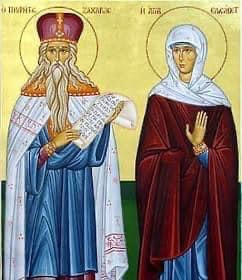
Today the church honors two ancient saints of the faith, perhaps the “Patron Saints of Waiting,” St. Elizabeth and Zechariah, the Parents of St. John the Baptizer.

This feast is honored in Palestine on this date, and honoring them begins to turn our collective faces toward the season of Advent, the season of hope and patience.

Zechariah is the pious priest in the line of Abijah, noted by St. Luke in his first chapter. Elizabeth, whose namesake is the wife of Aaron (the brother of Moses), was also of priestly lineage. This makes it, at least in the ancient world, an ideal marriage: pure and priestly.

By the time of Jesus, there were so many of priestly lineage alive that the duties of the temple were afforded by lot, as not all could participate. One day this privilege fell to Zechariah, as the story goes, and he was ordered to light incense in the Temple. As he was performing his priestly duty, an angel appeared to him and announced that he and Elizabeth would, in their old age, have a child.

By the way, if your Biblical mind isn’t brought back to the aged Abram and Sarai and their son Isaac at the mention of this story, you’re not paying attention…these stories are meant to invoke one another, Beloved.

If your Biblical mind isn’t brought back to Hannah and her son Samuel in the telling of this story, you’re not paying attention, Beloved.

Luke, in writing his Gospel, knew what he was doing with these lovely saints…

Elizabeth, that dear saint, did not, for whatever reason, have any children in her young age. In this way, she followed in the footsteps of Sarah and Hannah before her.

By the way, I note “for whatever reason,” because contrary to popular belief at that time (and even today), we have no biological indicators that note that anything was amiss with Elizabeth’s ability to conceive. Indeed, Zechariah could have had an ailment that prevented him from parenting. But, as with all history written by men, for some reason the fault falls on Elizabeth.

I love Saint Elizabeth, and St. Zechariah, too, because their struggle is so relatable to so many today.

Zechariah had a hard time believing that they could have a child, and for this reason he became both deaf and mute for a time being. This is a strange biological development…much like having a child in your old age would be…but the theological development is pretty clear: some things that the Divine makes possible are hard to talk about and hard to listen to.

Zechariah and Elizabeth named their dear child John, defying tradition. At the naming of their child (Zechariah wrote it down for those present), his voice was restored, and immediately he was blessed with a song that we still sing in the church today during the season of Advent, the Benedictus Dominus Deus. It is a song about promise fulfillment and echoes the Magnificat of Mary and the Hebrew Scripture song of Hannah in 1 Samuel.

St. Elizabeth and St. Zechariah are a reminder for me, and should be for the whole church, that sometimes Diving things take a little while to happen, and that patience and hope must continually hold hands in this life.

They are also a reminder for me that the church needs to openly and honestly talk about the difficulty of conception, a topic so few want to discuss because of its delicate nature. But, Beloved, this is such an important and wide-spread issue, the church must talk about infertility with honesty, and forget with the nonsense of “in God’s time” or any such mess that can be hurtful for those who want to be parents but have difficulty for whatever reason.

Let those with ears to hear, hear.

Don’t Check Your Brain at the Door

Today the church remembers an Anglican priest and eloquent writer who argued for a middle way between Roman Catholicism and the rising pietistic tide in the 16th Century: Fr. Richard Hooker, Apologist for the Middle Way.

Saint Richard was born in 1554 near Exeter in Britain in a time when the nation, and the church, was mightily confused. Though the Anglican church had embraced the Reformation, it was struggling with just how it fit into the sweeping changes rolling through religion and politics.

Roman Catholicism, on the one hand, saw the Anglican Church as having abandoned the one true faith. Puritans, on the other, thought the Anglican church had abandoned the Bible (which the pietistic movement saw as the only text with any authority at all).

Into this melee Saint Hooker was born, educated at Corpus Christi College in Oxford, and ordained. He served several country parishes early on in his priesthood, attending the needs of country people. Using his experience in the parish, in 1593 the good Father penned a seminal work, Laws of Ecclesiastical Polity, a roadmap for the Anglican approach to the faith.

In stark contrast to Martin Luther, Saint Hooker’s work was charitable and eloquent, meticulously laying out how Scripture, tradition, and reason (yes: reason) could provide a way for the faithful to organize themselves. The Puritans chaffed at the idea, thinking only the Bible provided any answers to any questions. Roman Catholicism could accept this trifecta in part, but thought that tradition trumped the other two, especially when it came to the Papacy.

Nevertheless, Saint Hooker plodded on, believing that the law of nature (reason) could help people organize themselves within a religious construct. His scaffolding became an overarching philosophical defense of Anglican practices where reason, scripture, and tradition all had a pillar in presenting a platform for encountering the Divine and interacting with one another.

Saint Hooker died in the year 1600, but his legacy lives on. He is a reminder for me, and should be for the whole church, that checking your brain at the church door and deferring reason to tradition or even to scripture is too high of a price for admission.

-historical bits from Pfatteicher’s _New Book of Festivals & Commemorations)