
For the Rest of Us

Today the church commemorates All Soul’s Day, or “The Day of the Faithfully Departed.”

This festival day is a product of the evolution of the church and its understanding of the departed and how they play into the eschatological and cosmological understanding of all things.

If saints were those who led extraordinary lives, what about the rest of us?

All Souls Day is an answer to that question. Indeed, many people who aren’t technically “saints” in the narrow definition of the term have led wonderfully beautiful and impactful lives. All Souls attempts to honor that fact. It became common practice, for instance, to lift up particular benefactors of parishes on this day, giving a nod to those who made the physical (and spiritual) structures of the faith possible.

In a more pedestrian sense, All Souls Day is, at least for me, a day where we can all embrace the reality that, saint or not, people deserve to be remembered.

In my first parish we had these magnificent stained glass windows put in decades earlier. In them you could see glimpses of not only the artistry of the day, but you could also feel a sort of timelessness that was pervasive, connecting those who had first stared into and through those windows with me and my own children who looked at them now.

Good art does that: it creates connective tissue between the past and the ever-expanding future.

But All Souls Day is a reminder that good theology does that, too. We stand upon the beliefs of the past, hauling some of them with us, and leaving some on the path behind us as signs and markers of thoughts discarded and avenues that were dead-ends.

All Souls Day lifts up the very practical, very pious, and very pedestrian people on whose shoulders we stand. In this way it is even more meaningful than the pomp and circumstance of All Saints Day.

If All Saints Day is the fine-dining establishment in your city, All Souls Day is the little cafe you frequent where you know the owner, have a favorite booth, and don’t need to glance at the menu because you know it by heart.

In other words, All Souls Day is really where most of us will find ourselves: in the ordinary annals of a life that tried its best, did some great things, fell short quite a bit, but is remembered by a small, but faithful, group of loved ones who know our names.
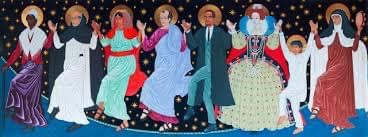
See That Host All Dressed in White

Today the church celebrates All Saints Day, the day in which the formal saints of the church (those canonized) are recognized and remembered as examples of the faith.

This celebration is very old, perhaps dating back to the 4th Century, though it is clear that earlier commemorations of this feast day were held in the spring, sometime between Easter and Pentecost. It was originally intended to celebrate not just any saints, but the martyrs of the faith.

The focus and the date of the day shifted sometime just before or in the early 7th Century. In the British aisles it had already been honored on November 1st, probably in response to the pagan autumn festivals that culminated at the end of October (which many of you participated in last night with ghosts and goblins socially-distancing at your door!). The date stuck for the whole church within the century, and came to have a deeper connection not only with the seasonal cycle on display in the northern hemisphere, but also with pre-Christian sensibilities. One example is this Celtic idea that the arrival of mists and frosts around this time were examples of ghostly/faery visitors, so it made sense to have a day remembering them when they started to make their presence known again.

In the 7th Century the date came to commemorate non-martyrs as well, probably in response to the fact that Christianity became dominant and was less-oppressed…resulting in fewer martyrs of the faith. The faithful who died both naturally and by martyrdom were recognized on this date every year, especially if they had died in that calendar year.

Today Orthodox, Roman Catholic, and Anglican branches of liturgical Christianity still keep this day to honor those canonized saints of the church, reserving the non-canonized dead to be remembered tomorrow on All Souls Day (more on that tomorrow). Lutherans, with our penchant for comingling the idea of “sinner and saint,” usually don’t make such a distinction, and just honor all those who have died in the faith, regardless of status, on this day.

Whatever your proclivity, today is a powerful day when honored with intention, even for those of you who don’t find yourself in any faith tradition. Honoring our ancestors, learning from their stories, embracing their goodness and foibles, is an important part of the human experience in my estimation. We all are, after all, an unwilling product of those who came before us, but we continually have a choice in deciding what we’re going to carry with us from those past ancestors, and what we’re not going to let continue into the next generation.

All Saints Day is a reminder for me, and should be for the whole church, that those who came before still speak into our present, and that the Divine who seems in love with continual creation also seems in love with some measure of continual, constant, though hidden and obscure (like through a mirror darkly?) preservation.

-historical bits from Pfatteicher’s New Book of Festivals & Commemorations

-icon from St. Gregory of Nyssa in San Francisco

-opinions and Celtic reflections mine