
Public Service Announcement: Poverty Isn’t Seasonal

2 (7)‘Tis the season to carry spare change, right?

At my faith community we raised over $2000 this week for the hunger advocacy center we helped to start a few years ago.  We made over 200 meals for gay/bi/trans/queer teens and served them in Boystown on Thursday.  And we packed up over 40 complete Thanksgiving meals for the food insecure in our neighborhood.

Oh, and we fed ourselves that night, too.  Five turkeys, every side-dish you might imagine, wine, cider, and a partridge in a pear tree (extra delicious).

It was awesome.

But the sad thing is that with exception for the 200 meals (we do that monthly), we only do this once a year.

I mean, we do other things in other seasons, but we only do this particular type of feasting once a year.

And, despite what we might want to think, poverty isn’t seasonal.

Do we donate at this time of year so that people can have a “nice Christmas”?  What about making sure that people have a nice life?

Seriously.

Thank God we can reach into our pockets once a year to donate a little more…how generous of the haves…

(and I’m a have)

Dave Ramsey had this terrible list out about a year ago, and it caused a little stink.  In it he lists the 20 habits of the rich (that, the not-so-subtle inference is, keeps them rich) and pits them against what he calls “the poor.”

It’s at this moment that I encourage you to look up Luke 6:20.  Go ahead, I’ll wait.  You know that word “poor” the Gospel writer uses there?  It’s an economic term, not a spiritual term (though Matthew makes it a spiritual term, perhaps to soften the blow).

And how nice of Ramsey to pit the rich against the poor.  No need to draw such lines, Ramsey. Life does it well enough without your help, but thanks for contributing.

It caused such a stink, though, that Ramsey followed it up with an explanation (keep scrolling in the article to see what I’m talking about).  He defends himself by saying that what he posted “is a simple list outlining the habits of the poor versus the habits of the rich.”

The problem is that the list isn’t simple at all (and that there are serious philosophical problems with the whole thing).

It’s not simple because Ramsey imagines that the discussion is just about behavior.  But poverty is not simply about behavior.  I know out of work men and women who work harder than those of us with jobs, and for much less reward.

It’s not about behavior; it’s about systems.

And if there’s one big mistake that I think Ramsey makes it’s that he mistakes privilege for what he presents as “common sense.”

How lovely that you are wealthy enough to eat fresh fruits and vegetables.  How nice that you have the ability to focus on “one goal” in your day.  It probably means that you have access to a supermarket and only one job.

And you read for pleasure?! Bully!

I’m relatively wealthy; no denying that.  I have a bank account, savings, and we have a college plan set up for our children.  I have investments and disposable income.  We have a car, and when it needs fixing we can usually fix it right away. I never wonder how I’m going to eat, and I am (for the most part) not worried about how I’m going to keep the roof over our heads. Our son goes to daycare twice a week, and we fully pay for it. I read for pleasure and for work and spend more a week on coffee than any reasonable human being should (I’m working on it…).

I say all of the above not to make anyone feel bad, but to give myself…and you, reader…a gently disturbing thought: one of the fears that I have is that our participation in the systems of poverty is given a nice little exclamation point by our sense of generosity at “this time of year.”

I’m looking forward to giving a little more this Christmas.  More to my neighbor and more to God.

And then I’m hopeful that in doing so I might one day learn to give more on December 26th, too.  And May 9th.  And July 12th.  And…

Because poverty isn’t seasonal, and I want to remember that a Merry Christmas isn’t the same as a merry life.
How To Observe Armistice Day

Jesus wept-John 11:35

For such a short verse, John 11:35 gets a lot of airtime.  And rightly so.ww12

I guess we all need permission to cry.  And if we can get that permission from God, a God who cries with us, then all the better, right?

I’m not sure why we need permission to cry, though.  I think it might have to do with the fact that most of us generally don’t like that emotion, that feeling, that uncontrollable sobbing that happens when we cry.

For me it’s kind of like throwing up.  I hate throwing up because I hate not being in control of my body.

When we cry we lose control.  And, as Kristin Wiig’s character in Bridesmaids noted, some of us are ugly criers.  So there’s that…

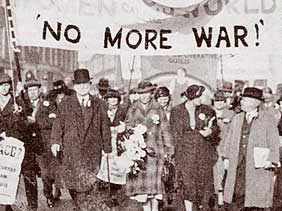
On Armistice Day, Veterans Day, my thoughts turn to my grandfathers Red and Sodie.

My Grandpa Red, with his Cardinal red hair, never cried.  At least I never saw it…though I don’t suppose I would have.

He served in World War II, the second time we had cut the world in two, invaded little islands to set up bases displacing people who had nothing to do with our own little fights.  And then we sent babies off to fight in suits and ties.

Today I see more military pictures of women and men in fatigues, but the pictures from my grandfather’s era usually had them in dress uniform.  Suits and ties fighting for the men in big offices with suits and ties who had caused the problems in the first place.

No wonder my generation is experiencing a delayed adolescence.  Nothing makes you grow up at the young age of 18 like being told that today could be the “the day.”  The day it all ends.  The day you end it for someone else.  The day you’re drafted.  The day…

It reminds me of the beginning of the Gospel of Luke where the writer says, “In those days there came a decree from Caesar Augustus that the whole world should be taxed…”

Those days.  That day.  Perhaps that’s what Jesus came for.

The only time my grandfather mentioned the great war was when he wanted to tell me vividly that war is hell.  He talked about coming home from battle finally after being a gunner on B-25’s over occupied China (and being shot down), going to the house of his best friend in the war who had died in action, and being rejected by his friend’s mother as she opened the door.

No, not rejected, slapped in the face.  “It should have been you,” she said.

My childhood fascination with the war faded there.  The military channel, fighter planes, hero stories…they all paled in comparison to this story, a story about a grief obscured.

My other grandfather, Sodie, fought in the European theater.  He was shot in the stomach.  He received the purple heart.

He died when I was three, before I knew him.

One day when I was 13 I was nosing around some boxes in the basement, and I found a cassette tape.  I popped it in and found a recording of him, my grandfather, on his death bed saying goodbye.  I don’t know that I’ve told anyone this before…

He was saying goodbye and talked about some regrets.  Regrets of failed relationships and things he had wished had gone better.

And there was a little line in there about the war, about fighting.  And not regretting being in the war or going to war for his country, but something about regretting that we fight at all like that.

The sound was garbled…another grief obscured.

Growing up we used to sing Onward Christian Soldiers as a hymn.  We were “going off to war with the cross of Jesus going on before.”

The irony there, of course, is that the cross was meant to end all war, all record keeping in that way.  It was meant to be the end of such violence and hatred and fear.  It was to show that killing can’t stop God, can’t stop life, so why bother?

But now the cross is a grief obscured.

Obscured by our desires for control and domination.  Obscured by our wanting to seem powerful in a world where we feel quite powerless.

I can’t sing that hymn anymore, though it’s nostalgic for me in some ways.  I think nostalgia can sometimes obscure our grief, too.  The church seems to be particularly good at doing this: obscuring the grief of the world through glossing over hard realities.  “Good Friday” can’t be too sad or else people won’t come to services.  Ash Wednesday can be done on the fly, at the bus stop or corner, because people are too busy to observe their mortality for any length of time other than a quick swipe.  Funerals can’t be too mournful because the person is in heaven now and we should be happy they’re in a better place…

Let’s pretend Jesus is a captain and we are Jesus’ soldiers and we’re fighting the world…when the real story, the actual story, is that Jesus was a servant who died for a world all too in love with violence and fighting.

I won’t observe Armistice Day by singing a hymn about might.  I don’t want to obscure the grief anymore than it already is.

I won’t observe Armistice Day by pretending that I think war is ok.  I don’t.  I just don’t.  I respect our soldiers, I pray for them, but I weep that those making the decisions to go to war are not those signing on the dotted line to fight them.

Integrity seems a bit lost there.

As a Christian, I observe Armistice Day by giving thanks for those who have given their life so that I can write like this.  I give thanks for my grandfathers who, though their grief was obscured, lived full lives after the hells of war.

Today I observe Armistice Day by praying that we’ll learn war no more.  Today I observe Armistice Day praying that we’ll have no more grief obscured, that we’ll take care of those scarred by war and help them sort out their grief.

I don’t begrudge people for waving a flag or putting one out.  I understand sacred symbols; I see why they do that. There is a part of me that loves Americana.  But I don’t do that on Armistice Day.

Today I give up a little control as a Christian.  Perhaps I even weep a bit like Jesus.  Weep with my grandfathers who couldn’t, or didn’t, or didn’t feel like they could, for whatever reason.  Today I let myself observe my grief over the whole idea of war; I don’t obscure it.

In doing so, I hope that I not only honor our veterans, but stand with them a bit.


It Would Be a Mistake to Give Up Sharing the Peace in Church

kids-high-fivingThom Rainer posted an article on Saturday entitled “The Top 10 Ways Churches Drive Away First-Time Guests.”

It was a Twitter poll that he conducted.  The compiled answers drew some surprising, and not so surprising, responses.  I kind of love these polls because they’re largely a practice in the discipline of, “See?  Someone will hate something…”

The people are too pushy or too distant.  They’re not sincere enough (subjective anyone?).  Or the building is poorly laid out and poorly marked.

Actually, that last one is a real issue…

I mean, there is no way to please everyone.

But one of the surprising responses is what Rainer calls “The stand up and greet everyone time.”

Which is an un-fancy way of saying, “The sharing of the peace of Christ.”

And here is where we see what happens when practices lose their roots.

Because the practice of sharing the peace is not a “stand up and greet everyone time.”  It is not done to make friends, and it is not done to welcome guests or visitors.

It is not done to chat about your week, and it not done to make you feel uncomfortable.

The sharing of the peace is a rite as old as the first church where (and you can read about it in the books of 1 Peter, Romans, 2 Corinthians) the church is instructed to greet one another with a “holy kiss.”

In fact, ancient Roman authorities called Christians a “kissing cult” because of this practice.

Now, don’t expect a kiss from me on a Sunday morning unless you’re my grandmother’s age, my child, or my wife.  That being said, you could get lucky 😉

But back to the point at hand, this is a liturgical act.  It has deep meaning which we can see in many ways as being Christ breathing on the disciples in the hours after his resurrection where he gives them his peace.  You can see it as a redemption of the kiss of condemnation that Judas gives Jesus in the Garden of Gethsemane.

And yes it involves touching.  We’re a touch-starved humanity these days.

And yes it is intimidating for introverts and too opportunistic for extroverts.  But community is as much about being stretched in our comfortability as it is being stretched in our restraint.

And yes it is time-consuming.  I’m not a big fan of extended periods of handshaking.  I’m usually a two to three person shaker/hugger/kisser, and then I’m all for moving on.

But, and let me be clear on this, I think it’s something that we can’t afford to do without.

Because in a world where you get shot at for wearing a hoodie in the wrong neighborhood, we need to learn how to approach people we don’t know in peace.  Because in a world where you won’t let your child play in the yard or talk to people they don’t know, we need a space where it is safe for us to interact in holy ways.

Because in a world where you might wonder if peace actually exists anywhere, what with the 24 hour news cycles of violence and the constant trumpeting of the next terrorist threat, there must be a place where we can embody the peace that Christ calls us to.

We need to be respectful.  We need to honor that some people can’t be touched for whatever reason, that safe touch is on the hand, that not everyone likes hugs.  We have to understand that.

But we can’t not share the peace just because it’s not comfortable.

And I don’t care if it is flu season.  Bow toward the person if you don’t want to make contact.  But realize that your hand may be the only hand that person touches that week.  If you don’t think that’s true, imagine the widow, or the homeless, or the person with a deformity that keeps people away, and then imagine you withdrawing your hand during a time where we greet one another with the peace of Christ.

You might be the embodiment of grace they need.

We’ll high-five at the bar but not at church?  We’ll high-five in the sports arena but not in the pew?

I’m sorry folks, but if sharing the peace of Christ will keep you away from church, I’m not sure you’re ready for community.

By God, share the peace.