Why You Get Mad When Your Pastor Mentions Politics, and Why She Has To…

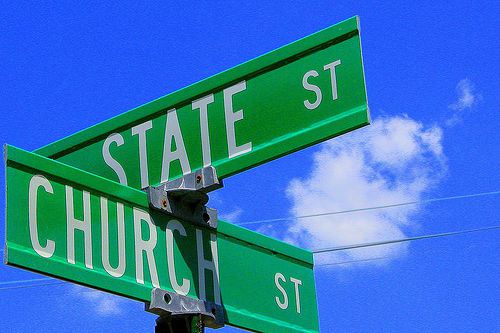
Let’s start with some political statements:church_state
“Jesus is Lord.”

Yes; that is a political statement.  You might think it’s pretty innocuous.  Perhaps you even think it’s a bit annoying (sometimes I find how this seems to be a catch-all answer for some annoying).  But, actually, for the ancient people in Palestine, this statement was scandalous.  Because they only had one Lord: Caesar.  And if you went around saying Jesus stands in the place of Caesar for you and your family…well…keep your politics to yourself.

“Prince of Peace.”

Yes; a political statement.  Want to hanker a guess as to who was the Prince of Peace in ancient Palestine?  If you chose Bill Murray, you were off by a few thousand years.  No, it was Caesar.  He was hailed as the one who kept the empire out of war.  He was the harbinger of peaceful times.

That is, unless, you were some of the occupied people under him.  The Roman Empire kept peace through military might and subjugation; through intimidation and economic sanctions.  Is that really “peace”?  The absence of war does not mean the presence of peace…

In fact, the opening chapters of the first three Gospels are chock full of political language.  But no need to just stick to the New Testament.  The prophets were certainly not quiet about politics, both domestic and foreign.  The whole book of Exodus was leaving one political reality for another, tackling immigration head-on.  The whole book of Leviticus was about how the people would organize themselves in the new land.

See, we have people who get pretty angry when they hear “politics” preached from the pulpit.  In fact, a colleague of mine recently noted that pastors should preach the Gospel and then shut up.

But, well, nothing happens in a vacuum.

(…I love that pun)

We aren’t people who are floating free in our own little religious world.  We must talk about politics from the pulpit.  The ancient texts compel it; the modern times call to us from the news programs and paper rags.  We are being pulled into it by the past and the present, and the preacher must put these two things together to comment on how God might be leading us into the future…

We should talk about how farm bills do or do not help feed the world.  We should talk about how, in Chicago, we are bankrupt and giving huge corporations billions in tax breaks while, just this last year, my housing tax went up, but my house value went down.  And if that’s the case for me, who lives in a pretty good neighborhood, what does that mean for my sisters and brothers who don’t?

Explain that to me, please.

We should talk about what it means to be able to carry on your person a weapon that is made only to kill other people.  What might God have to say about that?  What might the Christian world have to say about that?  Especially in Chicago where we don’t ranch cattle, but live in a concrete jungle.

See…your pastor has to talk about politics because you are enmeshed in political systems that have a spiritual dimension.  But we’ve been trained by the world to have a negative reaction to such talk because we see politics as divisive rather than unifying.

But, if there’s one thing that does unify the world, it’s that we are all under a political system of some sort.  And we should talk about it.  Your pastor should talk about it.

What she shouldn’t do, and here’s the rub, what she shouldn’t do is be partisan.

Sure, she has her own opinions.  And you might know them, too.  But her opinions aren’t the Gospel.  And you preachers…that’s important to remember.  God is not a Republican, nor is God a Democrat.  God is not in the Labour Party nor is God a Tory.

That being said, to pretend like the texts don’t say something about political issues is naive.  You follow the Prince of Peace, and yet you don’t think that God might have an opinion on war?  You say “Jesus is Lord” and yet your church is making most of it’s decisions based off of economics, putting money in the place of power?

Nothing happens in a vacuum.

Your church shouldn’t feel like a gathering of the Democratic Party.  That’s a church that would have a hard time saying “Jesus is Lord” and meaning it.  That’s a puppet platform.

Your church shouldn’t feel like a gathering of the Republican Party, either.  Or any part, for that matter.

So many do, though.

And I’ve been accused in my time of preaching politics…it’s a careful line the preacher has to walk, and hopefully it’s done with fear and trepidation.  Politics so easily turn partisan.

But let us not pretend that God might not have a word or two for the systems that surround us, for the systems we’re embedded in, for the systems we inhabit.

We can be careful how we speak, but we cannot not say anything.

Christian Ideas of “Controversial” are Screwed Up…

This poor homeless statue of Jesus is still having trouble finding a home without controversy.

Appropriate, I think.  It challenges our sensibilities in a way that I think only Jesus does.

But, here’s the thing: this is not controversial from a Biblical perspective.

index


If Jesus wasn’t actually homeless (for a dude who might have had a home, he doesn’t hang much there in scripture), he certainly was found with the homeless and destitute, probably sleeping many nights under a sheet with the sky as a roof.

But this?  This is absolutely controversial:

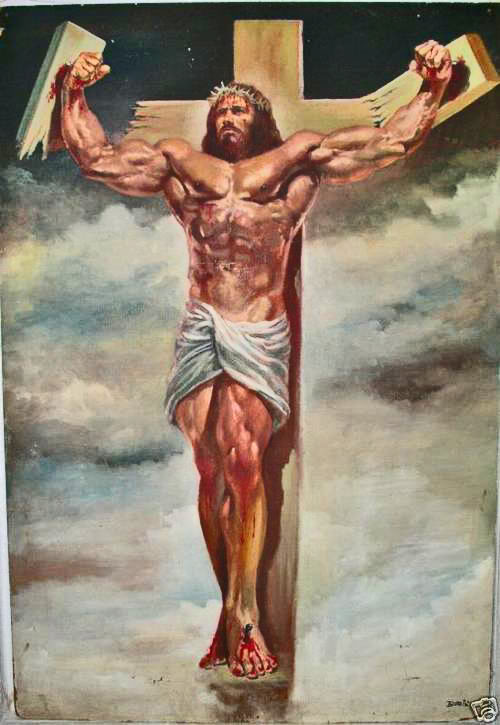
muscular-jesus-breaking-cross

OMG, Jesus! Where did you get those quads from? Biking?


I’d say it’s damn near blasphemous…and that’s coming from someone who doesn’t think much is very blasphemous.

This is pretty controversial, too:

jesusarm-wrestlingwithsatandemon

Ugh…dualisms make me want to punch someone. Exorcising them from Christianity is like arm-wrestling the devil. Wait a sec…


Look at how crazy creepy that really white Jesus is wrestling with the good-guy from the Hellboy comics…

An uproar over this statue…that’s screwed up.  We see Jesus as Jesus is and get all offended.  That’s a teachable lesson for those with eyes to see and ears to hear.  But I haven’t heard much said about those other pics or others like them that appear on bulletin covers, emails, Facebook memes, or bumper stickers…in fact, I’d dare guess that most Christians would see them and not think two things about them: their veracity, their message, their scandal.

And they’re far more scandalous…

Want to know what else doesn’t seem to cause much controversy?  The fact that people die of starvation in the city of Chicago, one of the wealthiest cities in the world.

Or the fact that farm owners are committing suicide because they can’t make a living anymore, what with our demand for everything cheap and mass produced and all.

Or the fact that $600,000 was stolen from smiley Joel Osteen’s mega church a few weeks ago, and that was just one Sunday’s offering from plate-giving. For some perspective, that is almost double my faith community’s total operating budget.

Don’t let Jesus be shown homeless, but it’s sure ’nuff OK for the imago dei to be starving and dying while hundreds of thousands are collected each week from one place…and the only thing we can say is that we can’t believe someone would have the nerve to steal that money from a “church”…

Where’s really-ripped abs Jesus when you need him?


“What Makes Things Holy?” or “Damn It!”

Today begins the long week of the church year that we call Holy Week.

485585_10151478304920983_1287496397_n

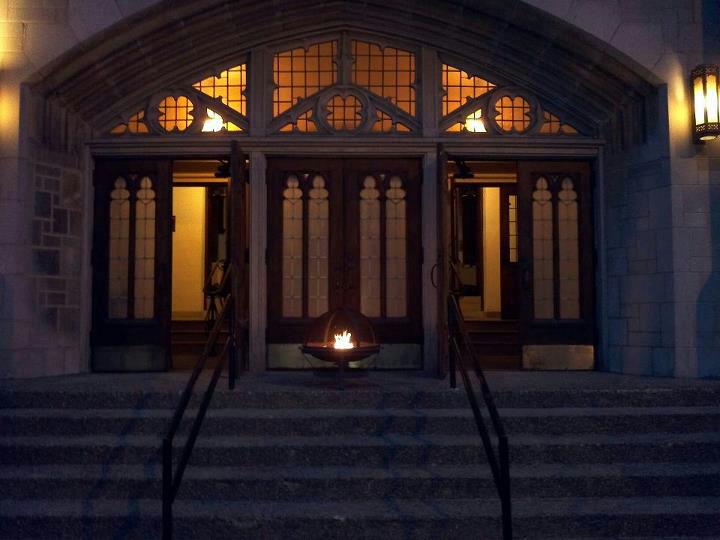
Our Easter Vigil fire at my faith community…a fire of sacred flame used for lighting candles for a profane/sacred people.

It’s the culmination of this walk toward Jerusalem that we take with Jesus every year…and every year it’s called Holy Week.

Even when some years the week seems holier than others.

I remember my first Holy Week as a pastor.  I spent most of every morning that first year coming early to the church to pray at the altar, with my prayer beads, being faithful to the hours as best I could.

This year, though, I spent this morning coming early to the crib of my son, with cheerios in hand, being faithful with breakfast as best I could.

And now, having been up for just as long but involved more in holy play than holy prayer, I’m reflecting on the difference.

Sure, I’ll keep the hours as best I can today, being mindful of Terce, Sext and None (though I’m a bit behind on Terce already), but I’ll do my best.

In college I took a course where we read a book called Holy Things by Gordon Lathrop, a premier Lutheran theologian, pastor, and scholar. I took exception to the title back then. Newly out of my atheist phase, “things” weren’t holy…only God was holy.

I was an idiot.

Now I see that things are, indeed, holy.  Bread, wine, water, yes…all of this.

And time mindfully spent.  And icons mindfully written.  Sermons, songs, prayers, hands, beads, stained glass, more prayers…mindfully said or not.

Holy does not mean “magical,” by the way.  That’s nonsense.  I don’t have time for nonsense…there are holy things to attend to.

No.  Holy means “set apart,” or better in the Latin, sacrum.  Sacred.

It’s funny, in my tradition we set things apart all the time.   But I meet so many with my college mindset who think nothing is holy; nothing is sacred.

And yet these are the people who I so often hear willing to damn people and things: that divorcee is in the wrong; that homosexual is an abomination; that movie, the song, that video is a disgrace to God.

So willing to damn things…so unwilling to lift things up as holy because it all seems so much hocus pocus.

That, actually, is most of us much of the time, I think.  As if our damning isn’t just as much the hocus pocus of personal opinion, prejudice, and the trappings of self-righteousness.

What makes a thing holy?  I’d say it’s purpose seen in light of the Divine.  The purpose of our time spent together, the bread, the wine, the water, the beads, the hands laid on to heal…

What makes a thing profane?  I’d say it’s probably us.  We so often take the place of God, damning people, places, and things in righteous indignation.

Progressive Christians do this, too.  You don’t get off the hook…no one does.  The sacred/profane line is thin.  So thin, in fact, that some might say it is imaginary…

But today, on this Holy Monday whose purpose it is to further our walk to Jerusalem as we lean toward Maundy Thursday, hear that time is set apart today for you to reflect on God’s work in your life, God’s purpose for your sacred existence, for the sacred existence of your neighbor, and this world.

And that purpose is not to damn you or any of it…

So spend a little less time doing that, and a little more time honoring things as sacred.

That, at least, is what I’m meditating on these hours.

The Seasons of the Church Year Aren’t Just for Decoration, Folks…


So, funny enough, liturgical-calendarone of the things that I think makes the most sense about the way the church does things has to do with the liturgical season.

The liturgical calendar.

I’ve written about this before, but we’re at the tail-end of our Catechumenate class here at my faith community, and it’s come up again as we discuss the church year.

See, when I was an atheist, the only thing that kept me in the pew was practicing this greater current that we call “the liturgical calendar”; this greater movement that connected all of life together.

Which makes me wonder why all corners of the Christian church don’t follow the church calendar.

Because even though I couldn’t believe, I could sense, I knew, that whether or not there was a God, there was definitely life.  And that life had seasons.  Not just the outside world, not just flowers and hibernating bears and all that stuff, but my life had seasons.

Has seasons.

In fact, in the winters of my life, the ability to practice the season of the church was one of the most important things in the world to me.

Even as someone who had broken up with Jesus as his boyfriend.

And there’s some good wisdom to the church year.  Like, for instance, that Lent is 40 days long, but Easter is 50 days long.  If that is not an implicit message that your life will laugh more than it cries, I don’t know what is.

Or how that season that we call “Ordinary Time,” the time in the church year of spiritual growth, takes up almost fifty percent of the calendar.  Take a look at your life.  About half of your life will be spent learning and growing.

Lord, that’s deep wisdom.

And see, the church year helps us to practice these seasons in our lives.  It gives us rhythm.

I like to talk about it as breath.  The seasons of the church year help me to breathe.  If you think yoga is good for your breath, dive deeply into the church calendar as a practice…

Because there are times in my life where I wait, and will have to wait: for diagnosis, for biopsy results, for birth, for a death.  Advent helps me wait.

There are times in my life where I’ll need to do some adjustment, some realignment: after a disgrace, after a significant relationship break, in a season of vocational or personal drought.  Lent helps me to do the introspective work necessary to live well.

There are times in my life of “Ah-ha” and “feeling most alive”: having a breakthrough, gaining insight, feeling zealousness over a cause.  Epiphany and Pentecost teach me to be on the look out for these moments and not pass them by.

And there are times in my life for rejoicing, for birth and re-birth: in reconciliation, after a literal birth, on holidays, after an illness has passed, “sittin’ on the dock of the bay.”  Christmas and Easter help me to celebrate well.

And the three days of that time we call “The Triduum,” Maundy Thursday, Good Friday, and Easter Vigil…well…that’s a whole life-span in one fell swoop.  A life of serving, of dying, and of rising.  And when it’s honored it is the most important gift of the church year.

It is Christ’s body emblazoned on a calendar.  And it helps me see my body and my calendar and how they mix.

There is just such wisdom to the church year.  It’s like a Mr. Miyagi for your soul: you “wax on” and “wax off” and think you’re not doing anything but refurbishing a car…and then, boom, you’re forced to wait or repent or celebrate or learn or grow.

And, as T.S. Elliot says, it’s like you “know the place for the first time”…and yet, you’ve been there before.  It’s that familiar/foreign experience that this journey with God always puts upon us when practiced well.

A lot of churches are getting away from the liturgical calendar.  And they do so at the expense of the Christians they serve.  It has deep roots, even deeper than the church itself.  The roots of marking time and specific periods goes all the way back to when our ancient mothers and fathers figured out that a dead seed will live again if planted, watered, tended, and nurtured.

And that the thing that grew from that would be good for you.

A friend of mine talked about going to a church on Easter Sunday one day.  They had all the attraction details down: welcoming people, if you signed up on a bulletin board as a first time visitor Krispy Kreme donuts would be delivered to your house the next week, the music was loud, the pastor had an engaging sermon.

But they didn’t talk about the resurrection.  They just talked about a personal relationship with Jesus Christ that was abstracted not only from Easter as a celebration day, but from the whole history of Christianity.

He said he left feeling…empty.

He had come for food, for deep roots, for a personal relationship in some ways, but also an historical relationship that lifted up so much more than just he and Jesus one-on-one time.

But he didn’t find it there because, Lord, if all we’re offering is shallow theology and Krispy Kreme donuts…well…skip the church service and just go to the coffee shop.

And many people, now, do.

And I think it’s probably because we haven’t really done a good job rooting them in this practice, this deeper rhythm.

Look, Christianity is nothing without Jesus.  But Jesus, and a personal relationship with Jesus, is not all there is to Christianity, either.  And the deeper undercurrent that speaks truth about the heartbeat of life, all life, that is made plain by the church calendar can and should be lifted up.

And it’s not just about changing church parament colors.  It is about living differently in different seasons of life.  It is about Ecclesiastes 3, and asking “what time is it?” for our lives personally and communally.

But instead we lift up an empty Jesus devoid of rootedness with my life, with the rhythms of life, a Jesus who is no more connected to the current of life than a Krispy Kreme donut.

And, let’s be honest, I love Krispy Kreme donuts.

But they don’t really feed me.

Progressive Christians: We Need to Talk About Jesus…

Glasses on Open Bible

Please note: Not all theological progressives wear glasses.

I’m a theological progressive.

When I fell away from faith, I fell away from a faith that was absolutely confused about its identity.  I was interacting in worlds that didn’t seem to speak the same language.  One world I lived in included people I knew and loved who were of intellect and not willing to take the Bible literally, people of different sexual orientations, people of different faiths.

And I also lived in a world of religion that didn’t seem to encompass that other world very well.  Or, if it did, it marginalized the people who didn’t fit well into certain categories, namely “Bible-believing,” “straight,” and “Christian.”

For a while my solution, then, was to leave the faith…at least in spirit.  I still moved in both worlds, but my heart was with the first world and turned against the second world.

And then I came back to faith…a faith re-figured.  A faith that could encompass the first world and still remain in the second.  In fact, it merged the two worlds so completely together that now, for me, they are one cohesive world.

I came out as a theological progressive.

To me this means a couple things:

I have a heart for justice.  Sometimes people call it “social justice,” but I think that phrase is laden with all sorts of issues and assumptions.  My justice is not just for society, though.  It’s for the world in sum.  Shalom is a better Biblical term for it.  I have a heart for Shalom, God’s good balance and peace.   Ensuring that people live with dignity, that the world we live in is respected, and that we keep an eye toward balance and harmony as we all eek out our God-given existence.

-I have a sincere respect for other faith traditions. The sincerity part comes from the realization that we are all trying to navigate life in a way that bends toward not putting ourselves at the center of it all.  We’re all trying to navigate life through the lens of deeper truth.

I talk about Jesus. Yes, I do.  Sometimes I call Jesus “the Christ,” or sometimes I refer to God as “the Divine,” but I do so because different language helps, not hurts, our understanding of God.  For a long time language has boxed God in…and we need to break God out of the box.  But that doesn’t mean, though, that I don’t talk about Jesus.  In fact, I think we have a lot of Christians who are afraid to talk about Jesus because they don’t want to be “that” type of Christian.  I get that.  But our silence isn’t doing Jesus’ rep any favors.  Why?  Because the Franklin Grahams and Glenn Becks (how did he become a Christian spokesperson, btw?) of this world do talk about Jesus.  And their Jesus does not look like my Jesus…

I want to be inclusive.  Lots of people are excluded from faith communities for things they’ve done or not done, or for things other people think are “sin,” usually things they do with their bodies.  In truth: I think we sin a lot more with our checkbooks than we do with our bodies.  Funny thing about the Jesus we find in the Gospels: he doesn’t spend a lot of time making people feel guilty for their sin, real or imagined.  In fact, Jesus doesn’t really talk a whole lot about specific sin if you read carefully.  What Jesus does talk about, though, are people who think they have no sin, or that they lead sinless lives.  “Because you say, ‘I am not blind,’ your sin remains,” Jesus says to the Pharisees, these archetype characters in John’s Gospel for those who think they’re above sin.  So, in modeling Jesus, I want to be inclusive.  Of everyone.  It’s dangerous; I know.  Try it out, though.  You might just find Jesus lurking in people you never thought possible…

To me being theologically progressive doesn’t mean:

I’m politically progressive. I know plenty of theological progressives who don’t fit into political categories.  Honestly, I’ve never been able to vote with a clear conscience.  And your church shouldn’t be a para-political organization, either.  Your church’s mission shouldn’t sound like a party platform.  Sure, faith is political.  My faith certainly informs and shapes my politics.  In fact, I think that pastors can’t help but be political.  After all, in the polis we deal with money, health, life, and death…all things Jesus talked about extensively.  But if Jesus were running for office, no party would claim him.

I don’t take the Bible seriously.  Actually, I take the Bible very seriously.  So seriously, in fact, that I take into consideration its origin, its writing styles, its editing, its historical conditioning…all of it.  I would claim that anyone who just takes anything at face value doesn’t take it seriously at all!  They’re ignoring so much in their quest for simplicity.  But life isn’t simple.  The books of the Bible aren’t simple.  God isn’t simple!  Let’s stop pretending that you have to be an idiot to be a believer. The only thing someone reading the Bible at face value takes seriously is their own desire for absolute certainty at the expense of their brain.

I’m a Communist.  Again, idiocy leads to this conclusion, or any other label of fear-mongering that people come up with to keep you from actually engaging with others in this world.  The best way to combat idiocy is to remove your head from your buttocks.

I have a church that won’t grow. Our church is growing.  We need not worry that fear and false certainty are the only ways to grow faithful Christians.  And as a parent, I want to help my son hold tension with faith, not inadequately resolve tension with easy answers and cheap grace.

So, theological progressives, here’s the deal: we have to talk about Jesus more.  Especially in this time of crappy Jesus movies and headlines of Christian charities being…well…uncharitable, and mega-church pastors claiming Jesus wants them to be wealthy, and Catholic bishops getting in hot water for building million dollar mansions.  Because Jesus is getting a bad rap.  And we shouldn’t be afraid to claim that we’re people of progressive faith.

And, sure, Jesus has a quiet way about him.  This is true.  Real Godly work doesn’t sound the trumpet in the temple, but locks itself in the closet.  And God sees in secret.

But, as a parishioner of mine recently said in a conversation about this issue, “We’re not doing Jesus any favors by being quiet.”

And she’s right.