
The Seasons of the Church Year Aren’t Just for Decoration, Folks…


So, funny enough, liturgical-calendarone of the things that I think makes the most sense about the way the church does things has to do with the liturgical season.

The liturgical calendar.

I’ve written about this before, but we’re at the tail-end of our Catechumenate class here at my faith community, and it’s come up again as we discuss the church year.

See, when I was an atheist, the only thing that kept me in the pew was practicing this greater current that we call “the liturgical calendar”; this greater movement that connected all of life together.

Which makes me wonder why all corners of the Christian church don’t follow the church calendar.

Because even though I couldn’t believe, I could sense, I knew, that whether or not there was a God, there was definitely life.  And that life had seasons.  Not just the outside world, not just flowers and hibernating bears and all that stuff, but my life had seasons.

Has seasons.

In fact, in the winters of my life, the ability to practice the season of the church was one of the most important things in the world to me.

Even as someone who had broken up with Jesus as his boyfriend.

And there’s some good wisdom to the church year.  Like, for instance, that Lent is 40 days long, but Easter is 50 days long.  If that is not an implicit message that your life will laugh more than it cries, I don’t know what is.

Or how that season that we call “Ordinary Time,” the time in the church year of spiritual growth, takes up almost fifty percent of the calendar.  Take a look at your life.  About half of your life will be spent learning and growing.

Lord, that’s deep wisdom.

And see, the church year helps us to practice these seasons in our lives.  It gives us rhythm.

I like to talk about it as breath.  The seasons of the church year help me to breathe.  If you think yoga is good for your breath, dive deeply into the church calendar as a practice…

Because there are times in my life where I wait, and will have to wait: for diagnosis, for biopsy results, for birth, for a death.  Advent helps me wait.

There are times in my life where I’ll need to do some adjustment, some realignment: after a disgrace, after a significant relationship break, in a season of vocational or personal drought.  Lent helps me to do the introspective work necessary to live well.

There are times in my life of “Ah-ha” and “feeling most alive”: having a breakthrough, gaining insight, feeling zealousness over a cause.  Epiphany and Pentecost teach me to be on the look out for these moments and not pass them by.

And there are times in my life for rejoicing, for birth and re-birth: in reconciliation, after a literal birth, on holidays, after an illness has passed, “sittin’ on the dock of the bay.”  Christmas and Easter help me to celebrate well.

And the three days of that time we call “The Triduum,” Maundy Thursday, Good Friday, and Easter Vigil…well…that’s a whole life-span in one fell swoop.  A life of serving, of dying, and of rising.  And when it’s honored it is the most important gift of the church year.

It is Christ’s body emblazoned on a calendar.  And it helps me see my body and my calendar and how they mix.

There is just such wisdom to the church year.  It’s like a Mr. Miyagi for your soul: you “wax on” and “wax off” and think you’re not doing anything but refurbishing a car…and then, boom, you’re forced to wait or repent or celebrate or learn or grow.

And, as T.S. Elliot says, it’s like you “know the place for the first time”…and yet, you’ve been there before.  It’s that familiar/foreign experience that this journey with God always puts upon us when practiced well.

A lot of churches are getting away from the liturgical calendar.  And they do so at the expense of the Christians they serve.  It has deep roots, even deeper than the church itself.  The roots of marking time and specific periods goes all the way back to when our ancient mothers and fathers figured out that a dead seed will live again if planted, watered, tended, and nurtured.

And that the thing that grew from that would be good for you.

A friend of mine talked about going to a church on Easter Sunday one day.  They had all the attraction details down: welcoming people, if you signed up on a bulletin board as a first time visitor Krispy Kreme donuts would be delivered to your house the next week, the music was loud, the pastor had an engaging sermon.

But they didn’t talk about the resurrection.  They just talked about a personal relationship with Jesus Christ that was abstracted not only from Easter as a celebration day, but from the whole history of Christianity.

He said he left feeling…empty.

He had come for food, for deep roots, for a personal relationship in some ways, but also an historical relationship that lifted up so much more than just he and Jesus one-on-one time.

But he didn’t find it there because, Lord, if all we’re offering is shallow theology and Krispy Kreme donuts…well…skip the church service and just go to the coffee shop.

And many people, now, do.

And I think it’s probably because we haven’t really done a good job rooting them in this practice, this deeper rhythm.

Look, Christianity is nothing without Jesus.  But Jesus, and a personal relationship with Jesus, is not all there is to Christianity, either.  And the deeper undercurrent that speaks truth about the heartbeat of life, all life, that is made plain by the church calendar can and should be lifted up.

And it’s not just about changing church parament colors.  It is about living differently in different seasons of life.  It is about Ecclesiastes 3, and asking “what time is it?” for our lives personally and communally.

But instead we lift up an empty Jesus devoid of rootedness with my life, with the rhythms of life, a Jesus who is no more connected to the current of life than a Krispy Kreme donut.

And, let’s be honest, I love Krispy Kreme donuts.

But they don’t really feed me.

“Some Corners of Christianity Have Turned Jesus into a Cult Leader” or “Jesus Was Not a Cult Leader, So Don’t Make Him One”

Jesus_cult_logoI finally got around to seeing Jesus Camp, or as I like to call it, “Children of the Corn.”

It’s well worth the watch.  And it made me sad.  And a bit embarrassed.

I get the criticism that the documentary makers are biased.  Bias will always exist; a purely objective perspective is a unicorn.

But this is scary.

It’s about as scary as the person who came up to me the other day and told me a story of how an individual from a neighboring church here in the city tried to convince him that we (as in, my faith community) were teaching him falsely, and that he should come and find the truth at this other faith community.

A “truth,” by the way, that doesn’t allow for questioning…because it is ultimate.  Apparently they have it over at that church.  Good to know…

In the book Narcissists Among Us, author Joe Navarro lists a number of traits that one should look for in a leader to tell if they’re a cult leader.  Unfortunately, many Christian churches have turned Jesus into a character that fits many of the descriptions.

For instance, at the top of the list is that a cult leader has “a grandiose idea of who s/he is and what they can achieve.”  Now, this gets fishy, of course, because of the Christian tenet that Jesus is both mortal and Divine.  I’m not questioning Christ’s divinity at all.  But when we look at the Gospels, we have a very quiet Christ in most instances, one who doesn’t lift himself up but rather lifts up those around him.

Fast forward two thousand years.  Today you’ll find in many places people who claim that Jesus can cure your broken bones, broken marriage, broken spirit, and broken bank account (all for $19.99) if you just believe.

Or take another example of a cult leader from Navarro, the fact that they are preoccupied with unlimited success, power, or fame.  Can we not turn on the TV most any evening and hear how God desires this for us?  Can we not read most “Christian” self-help books and read about how the right formula of life+belief+prayer=blessing?

How about the fact that many churches are now holding these bizarre “purity balls” where young women (notice that it’s only young women…sexism is alive and well, don’t you worry) pledge their virginity to their fathers?  Sexual exploitation is the sign of a cult leader and, despite the fact that Jesus says not a mumblin’ word about sex (though he does talk about divorce), much of Christianity has turned these purity rituals into a rite of passage as a way to control behavior.

Look, I think that the church has to come up with a good sexual ethic (please, Lord, let’s revisit this, yes?), but such manipulation a) doesn’t work, b) is slightly creepy and c) causes confusion in children with regards to sex, sexuality, and their bodies.

And what about the one I see most frequently: the need for blind obedience?  Cult leaders demand this of their followers.  In Jesus Camp, there’s a really telling scene at the end where Mike Papantonio, radio personality, is interviewing a woman named Becky Fischer, a self-proclaimed “children’s evangelist,” the leader and host of this crazy camp where  children come to be guilted, manipulated, and formed into “soldiers for Christ” (their term, not mine).  And in the interview Papantonio brings up the idea that Fischer is actually indoctrinating the children, to which Fischer responds that she’d like to see more parents and churches indoctrinate children.

When I teach Confirmation and encourage the youth to memorize the Apostle’s Creed, the Lord’s Prayer, and the Ten Commandments, we follow up every statement with the good (Lutheran) question, “What is this?”

And it’s an honest question to which I encourage honest responses.

The church should not be in the indoctrination business.  But it has been.  For years and years.

Christianity should be a religion, not a cult.  Jesus is central to the religion.  Jesus is not a cult leader.

There is a difference between a religion and a cult; a religious leader and a cultic leader.  I think that many religious leaders, Christian leaders, can become cultic personalities.  But, likewise, I think that many religious leaders have turned Jesus into the cultic personality.

A religion is meant to look after the well being of the family, encouraging health in all ways.  Cults break families apart, doing psychological harm.  Should I say how many people have mentioned to me that they’ve been told by a religious leader that their spouse is going to Hell because they don’t believe/haven’t been baptized/are of a different religion?  Need I note the anguish this causes over a subject that no one living has any firsthand knowledge of?

A religion allows freedom of thought. Cults and cultic leaders do not.  A religion works within society, even as it tries to change society.  A cult shelters people from the greater society, creating a bubble of influence.  A religion encourages leaders to be questioned (this is, I think, what the historical critical method does of Scripture as a leader of Christian religion).  A cult does not allow a leader, or basic tenets, to be questioned.

Sigh.

Jesus was not a cult leader. It’s clear from the Gospel accounts that he was a compelling personality.  It’s clear from the Gospel accounts that those who followed him did so passionately.  But the personality profile given there doesn’t fit a cult leader.

So why, then, have many in the church made him one?

“Jesus Christ is My Lord and Savior” or “Talk is Cheap”

I was asked recently why I don’t say “Jesus Christ is my Lord and Savior” more.index

That’s a good question.

I think I don’t use that phrase much because of my experience with that phrase.  In my youth that phrase was used as a litmus test of sorts, a shibboleth for those of you familiar with that term (or familiar with West Wing).

Saying “Jesus Christ is my Lord and Savior” was like the secret password into a club that I wasn’t so sure I wanted into.

Because usually the people that I heard using that phrase were also the people who were talking about “spiritual warfare” and being good “Christian soldiers” and “working blessings” and “praying away the pain.”

All that phraseology was just noisy gongs and clanging cymbals to my ears.

I wanted to know what they thought spiritual warfare was and if they’d be “fighting it” if they had never been introduced to the concept.  I wanted to know what they thought being a “soldier for Christ” meant in every day life.  I wanted to know what they thought they were doing when they were “working a blessing” or what conclusions we’re to draw when we pray and pray and pray and the pain remains.

I didn’t want talk to be cheap; I wanted it to mean something.  I want it to mean something.

Because, and this is the thing, Jesus Christ is my Lord and Savior.  But that sentence needs so much explanation around it for me, that just saying it to you or anyone else will not do, I feel.

Because just saying it to myself doesn’t do it.

And no doubt people say that phrase and say it with utmost sincerity and face value; I truly believe it.  And I can speak that language, too, with much sincerity.

So, is Jesus Christ my Lord and Savior?  Yes.   Am I going to start adopting that language?  Probably not.

But I will say that my trust in God is deeply rooted in the Christ event.

And, believe it or not, I think that’s approximately the same thing.

I could say it another way, but it wouldn’t be authentic to me.

And I prefer not to.  It’s not how my spirituality is formulated.  My spirituality is formulated with deep roots in experiences and connection that don’t lend itself very well to short phrases like this, I find.

I’m much more Richard Rohr than Rick Warren.

That doesn’t mean either of those spiritual realities are “better” than the other one (how could we measure that, anyway?).  But it does mean that they present themselves differently.

And with a Christian history that needed a St. Julian as well as a Thomas Aquinas, that needed a Martin Luther as well as a Meister Eckhart, why should the fact that I don’t express my faith with these phrases, and that you do, cause us dissension?

So many churches are full of just Julians or just Luthers, just Rohrs or just Warrens.

What if we actually practiced radical community where you could lift your hands in praise while I fold mine in reverence and neither got annoyed with the other?  What if we actually practiced radical community where you could claim Jesus as your Lord and Savior and stretched my comfort with that phrase, and I encouraged you to parse that a little more to go a bit deeper than just phrases.

Because, and here’s the biggest thing, I don’t want any of our talk to be cheap…even our talk about community.

Because if we all think the same things, talk the same way, use the same phrases, and embody the same spirituality, we have less a “community” and more of a “club.”

And Lord knows we don’t need more clubs in this world.

And I’m a reluctant Christian many times because our clubs dot the streets, and our communities are few and far between.

“Ash Kicking” or “Why I Don’t Think Ash Wednesday is a Good Day for Peddling Religious Goods”

I know this post might not be popular with many of my colleagues, but it is timely…so I’m going to put it out there.  ashes

I get why pastors and church people stand by the bus stop and the train stop and on busy thoroughfares for Ash Wednesday.  We “get out of the church and into the world” by doing this, right?  We “take the ministry to the streets.”

I get the rationale; I get it.  And I get that it probably can be pretty powerful for the ashers, and possibly the ashees, too.

But here’s my concern, specifically with Ash Wednesday: I fear it is cheap.

Yes, cheap.

Ash Wednesday is a day of solemnity when we hear the prophet Joel encourage people to “return to the Lord.”  The liturgy involves a movement from the Kryie (Lord, have mercy) to hearing Joel’s encouragement to Matthew’s prayerful penitent beat his chest, and then we take last year’s Hosanna’s, burn them as a sign that we’ve burned so much of our praise in pursuit of the dust of this world, and mark ourselves again as dust.

It is a movement of stark realism.  It is a movement, like a carefully put together album, that leads you from the realization of mortality to a hopeful life despite the fact that you are dust.

Beautiful stardust…but dust nonetheless.

But more than anything, it is a movement.  And it takes a bit of time.  Not much time, but some time.  Mortality does not sink in so quickly (without sudden tragedy, of course).  And we should allow the time.  Not much time, but time nonetheless.  As the beginning of Lent, a season of intentionality, it seems odd to me that we would start out with such slack intentionality…

It is much more than a simple smudge at the bus stop.  Sure, there are many who will also offer prayer in that time.  Sure, there are many who will also offer information about how the individual seeking to be “ashed” (or get the “ash kicking” as I like to say) can hook up with a faith community.

I’m not saying you shouldn’t do it.

I’m just saying why I’m not going to…and I want to ask the question publicly.

Because despite the prayer and the information on faith communities, I don’t think Ash Wednesday is the day to do it.

We don’t see people out on Easter passing out lilies.  Actually, that makes a ton more sense to me…

I don’t want Ash Wednesday…I don’t want my mortality…to be a gimmick.  And I worry that the church can turn it into that.

And there’s something important about having Ash Wednesday with other people of faith, all together, in one place.  There’s something important about me, the individual hearing “Memento, homo, quod pulvis es, et in pulverem reverteris” but then also having all of us, communally, hear it.

It’s not just about me; it’s about us.  All of us.  We are all stardust…and our systems of power and “isms” and phobias have reinforced it.

And there is something powerful about having a train full of cross-smudged commuters.  I won’t deny that.  But what does it mean that they got it running for the 8:05am?

Have an early morning Ash Wednesday service.  Or a noon one, where people can do it at lunch hour.  Or, have a full one at the bus stop, 20 minutes long.  Or point people toward a service that happens right as work gets out downtown.  I think these are good options.  But not as they’re running by…

Because I want to know: what do we think we’re saying when we’re offering a reminder of mortality on the fly?

I Want My Children to Know This About Faith

Having a kid changes your perspective.  I used to roll my eyes when I heard parents say that, but it’s true.Father-Son-Shadow

Like, for instance, how I’m much more willing than I used to be to just drop those last papers and emails and meeting notes to get home before bedtime.  I still work late…but I’m much more willing to let it all go to snuggle a snotty face, read Jimmy Buffett’s “Jolly Mon” storybook, and change a diaper before the little guy goes to sleep.

And as we’re raising this little guy, and as a pastor, there are a few things I want this little guy to know about faith.

First, faith and religion won’t give you self-esteem.  It’s not meant to.  It’s not meant to make you feel good.  It’s purpose is not to get you to love yourself.  Don’t stick with the faith because it makes you feel good.  If you’re doing it to feel good, you’re an addict, not faithful.  Get more vitamin K.

But…

But sometimes the faith can love you when you can’t love yourself.  Sometimes hearing that God chooses you can replace those moments in your life when you feel like you can’t choose yourself, don’t love yourself, can’t believe in yourself.  There have been times in my life where I’ve let the faith believe things about me that I couldn’t muster myself to believe…and it made all the difference in taking the next step the next day.

Secondly, faith isn’t about getting answers.  Faith isn’t about knowing certainty, “figuring it all out,” or attaining a perfect worldview that will put all the pieces together.  If you’re looking for your faith to do that you will be disappointed.

But…

But faith is intended to help you ask better questions about your life.  It is intended to provoke your thoughts about yourself, about purpose, about others around you in such a way that you see the world differently than the world tries to get you to see it.  It is provided to help you celebrate the life of the mind rather than the pursuits of greed, fame, and fortune.  It is the antithesis to a world that says “Success is the mark of a life well lived.”  No. “Pursuit of a purpose bigger than yourself, specifically the purpose shown in the life of the Christ in sacrificial love…that is the mark of a life well lived.”

While we’re on the subject of answers, the Scriptures are not meant to explain everything in this world.  They are not meant to explain how the world came to be, or how sexual orientation should be understood, or how psychology is understood.  No.  Faith is the quest for “why” not “how.” The Scriptures are inspired words by inspired people about the history of the quest for “why.”  Why is there something rather than nothing?  Why am I to love even if I don’t feel like I want to?  Why is humanity connected in such a way that makes me feel responsibility toward someone else?

Faith is meant to help you embrace mystery, hold tension, and walk well in a world that wants to polarize you into this answer vs. that answer.  Your dad is a reluctant Christian because this has been largely lost.  I want you to be a Christian, too (even if you’re reluctant like your old dad…)

Thirdly, faith isn’t supposed to make you feel superior.  There are no “poor souls…”  You are as poor as any soul out there.  And if your job in the world is to “save” someone, you better be a lifeguard.  Only the Divine can save.  All you can do is be Christ’s hands and feet.

But…

Faith is something that I think you should share.  Not in the “I think this and you should, too…” sort of way.  But rather, in the “Here’s something I find really true…” sort of way.  In the “Here is my hope…” sort of way.  In the “Here’s what moves me…” sort of way.  And never be afraid to ask someone else what moves them, either.  Their beliefs do not threaten yours.  There is much to learn from one another.  I want you to have friends who believe and think different things than you do, and I want you to talk to them about it.  Often.

Finally, I want you in a faith community.  Why?  Because I don’t know how else to help make sure that God doesn’t end up looking like you.  And I want you in a multi-generational faith community where you have to interact with lovely old ladies and hold little babies. Hopefully it can be racially and ethnically diverse, too.  I don’t care if it’s big or small, I just want it to be diverse.  I want you to be in a faith community where questions are encouraged, where mystery (specifically in the sacraments) are lifted high (because then maybe you’ll see how the Thanksgiving table in November is like the thanksgiving table on Sunday mornings, and live in response to that bounty).  I want you to remember that you are loved and redeemed and meant to be a light in this world that too often is full of shadows, and the only way I can think that you’ll be reminded of that often enough is when you gather with other people to read and hear ancient words, to shake hands, to eat and wash together, and to drink strong coffee (optional).

There’s more to say this morning to you, buddy, but the freezing temps outside have closed your daycare, which means I’m in charge of lunch.  But this is a good start…

An Argument for Keeping Churches Small*

12SmallChurchAdvantage_400_478515996*A quick qualifier before we begin: “small” has yet to be defined with precision.

Because I think small doesn’t have everything to do with numbers (although, I think that at a certain point it does).

So, I’ve been getting some push back for my last article on why I dislike mega-churches.  A lot of it is warranted.  I think that if you put something out there, people should be able to push back.  And please note, I also dislike a lot of small churches (also in the article).

But that piece was written in response to a piece by a colleague who says he doesn’t like “mega,” but then never actually digs into “mega” at all in a substantial way.  Perhaps that wasn’t his point.  But there is something to be said there…and I wish he would. I think there is a real argument to be had for keeping faith communities on the small side.  I really do.

Here’s a part of that argument:

Look, we have a depression problem in the communities of faith, by and large.  This is well diagnosed.

Little churches are depressed that they  aren’t mega, and I think mega-churches have depression as well, though not of the psychological nature.  Mega-churches are depressed, and depressive, in that the consolidation of resources, while seemingly allowing for unlimited amplification of good, actually depresses the good they can be and do.

I’ll get to that in a moment.

But first, let’s define “small.”

Small to me is manageable.  For every community the particulars of that will be different, I think.  Some of it will depend on the leaders (clergy and others), some of it will depend on other factors such as location and mission (locus and focus).

But small does not mean deficient.  And it certainly doesn’t mean “bad” or “not living into it’s potential.”

I think many churches are small in size because of unconscious choices they make: who the power brokers are, what the internal fights are, their ability to welcome and adapt to change, etc.  Very few of these choices have to do with Jesus, btw.

But I think that communities of faith can be small by choice for reasons that absolutely have to do with Jesus.  That is, they can take their own temperature and decide when their connections are becoming so strained that they need to send some folks to start new communities of faith.

Because Christ was about making connections and reaching the margins…not about consolidation.  The need to consolidate is the need to control.

Control is a nice little illusion.

Let’s go back to mega a bit.  Because I think mega is about control.  That’s how mega is depressive.

Here’s the thing:  mega churches are hierarchical…like most churches (there are some notable exceptions, like the Quakers).  And the broader the base, the smaller the top.  And although there may be many leaders in a mega church (there should be many leaders in any size church!), when message lies in the lonely top, when perspective lies in the lonely top, when generation and impetus lies at the lonely top, it depresses the ability for the people to grow out on their own.

It truly does.

And it creates rock stars rather than ministers which, to me, is a real problem.

And these rock stars then become the interpretive lens for the parishioner rather than Jesus, because, well, how can you challenge someone who obviously has so much influence and control? They must know what they’re talking about…

This is, I think, why mega-churches have a large rotation of regular attendees…people who come for a few years, and then move on.  Consolidation at the top doesn’t allow things to “trickle down” in the way people want it to. The inability to actually have agency, to grow together while challenging each other, is depressive.

My parishioners and I don’t all agree on every point, theological or otherwise.  But we have a relationship that allows us to continue to do mission together, even while acknowledging where we diverge.  That just doesn’t happen in the same way in the mega world, to the detriment of the church and individual spirituality.

And, by and large, I find that mega churches perpetuate that mega-mentality that “more is better,” but practice a “more is not better” when it comes to leadership and messaging, as the lead pastor’s sermon is video streamed into each campus regularly despite the availability of other pastors to craft other sermons.

This, I think, doesn’t connect people in the way it’s intended.  There’s dissonance there.

I think it actually depresses mission; it doesn’t expand it.

And finally, let’s talk about the big elephant in the room: ego.

We must always be on guard when it comes to the ego.

The ego of small-in-numbers churches is offended that they’re not bigger…and so sometimes they fall into patterns of behavior to keep themselves numerically small as a way to fulfill their doom-prophecy.

They call themselves “friendly.”

When I hear or see “friendly” on a church sign or on a church website, I automatically think “dysfunctional.”  Because they’re trying to make up for the fact that others aren’t in the room by proclaiming that they’re super-nice.

If they were truly welcoming, though, and open to change, others would be in the room, right?  Maybe.  Most likely.

In contrast, the ego of the mega church leader is never kept in check as the church begins to grow but is never sent.  As the base gets bigger, the ego gets bigger.  Things seem to be “working,” and there’s nothing more delicious for a hungry ego than to see things “work.”  And so how do we keep things working?  By keeping control.

And the ego of the mega church attender is, likewise, fed by size.  “I must be doing something right because I go to a successful church! Look how big it is and how many programs it has!”  Red Riding Hood did a similar comparison before being eaten by the wolf…

People at this point will say things like, “God never intended you to live a mediocre life,” or “God has big dreams, you should too” or start quoting Proverbs or other parts of scripture to lay a foundation for bigger and successful is better.  And this is, I think, a secret in the world of mega: self-help tidbits that we pass off as spiritual.  Make me feel good, and I’ll serve you forever.  Feed the mega-ego until it’s stuffed.

But Jesus rarely made people just “feel good.”

If we look at Jesus (and really, all scripture should be seen through the lens of Jesus), we don’t see that.  Abundant life didn’t have to do with numbers or feeling good.  It had to do with reliance on God.  Reliance on God keeps the ego in check.  Humility.  Passionate giving.  Love that is sacrificial.

Look, I don’t know if your church is too mega or too small.  And I, by no means, think I have it all figured out.  My ego is trouble…just ask my wife.

But I think a good beginning question a faith community could delve into would be, “Do we think more is necessary?  Is more better?  Or are we confident that God has equipped us with all that we need?”

And really ask it!  Wrestle with yourself, with your church.

Keeping a church small intentionally involves asking those question.

And, I should be clear, I think there are small churches with 30 on a Sunday morning, and small churches with 3000 on a Sunday morning.

Both will have difficulty staying small, though.  There seems to be an in-between that aids in this kind of work.

Because mega is so tempting.

So constant questions, checks and balances, and the ability to really ask if you’re depressed or depressive is necessary.

I guess I would say, let’s keep it small.  Seriously.

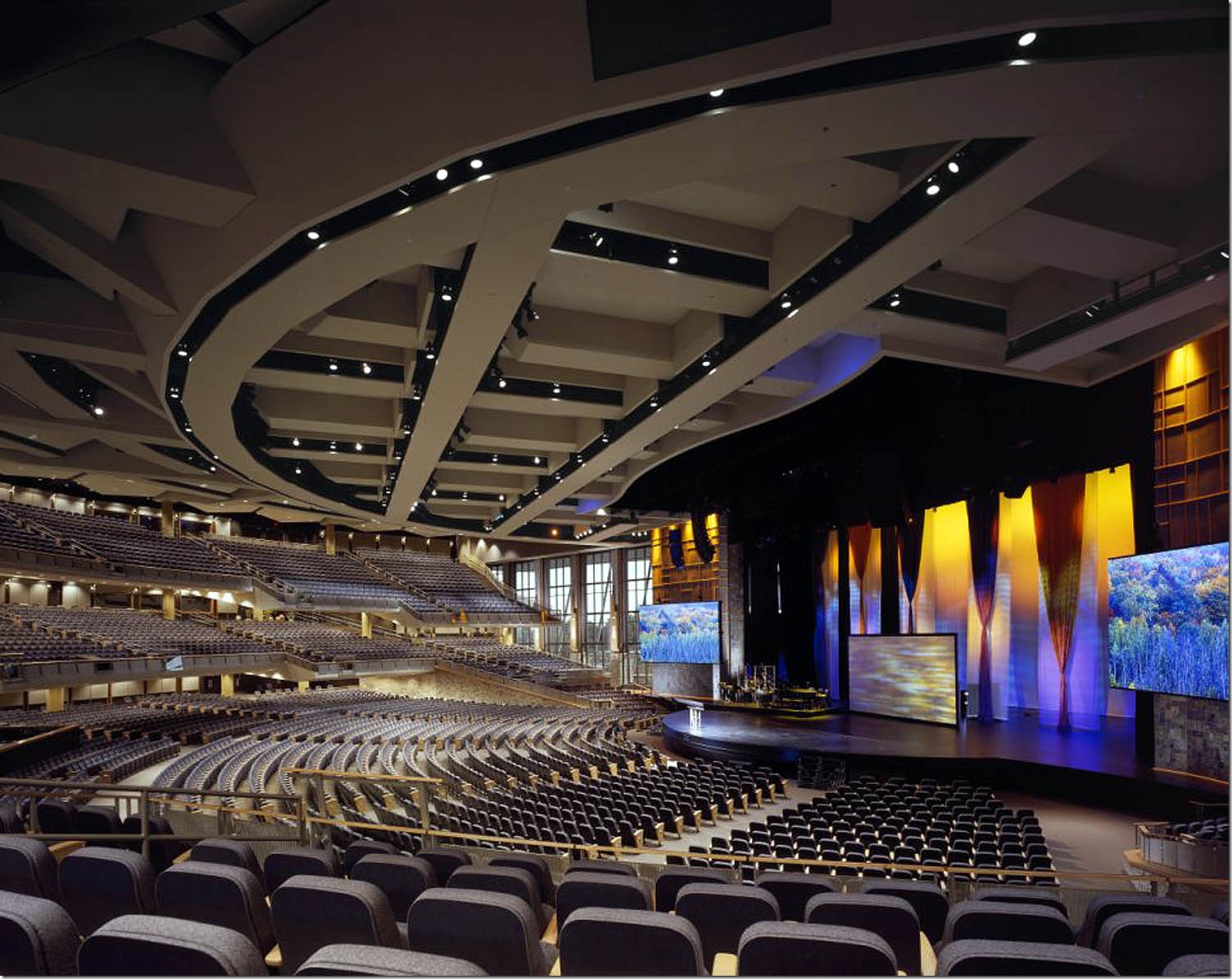
Why I Dislike Mega-Churches (No, Really…)

willowcreek-megachurch_thumb

A colleague of mine wrote a blog post today entitled, “Why I Hate Mega-Churches.”

But it’s a bait-and-switch (which he admits halfway through).  He likes mega-churches and, by his writing (in this and other pieces I’ve read), would probably like to lead one or build one.

Fine, I guess.  But when I look around the world, one thing I don’t tend to say to myself is, “Gosh, this world needs another mega-church.”

Just saying.

A good thing about mega-churches?  They have a lot of resources to do a lot of good in the world (should they choose to).

The consolidation of people and money under one mega-roof creates mega-possiblities (a quick qualifier: if one does some math to subtract the ecological and sociological impact from a mega-building, mega-pastors, mega-salaries, mega-parking lots, and mega-messaging-machines that often tout a message that I’d consider more damaging than helpful, the possible good shrinks considerably).

A bad thing about mega-churches?

They’re mega.

No, seriously, I think that’s a bad thing.  The anonymity that’s possible by slipping into stadium seating creates this wonderful silo-effect for the participant.  It makes you feel like the mega-speaker in the mega-space is speaking directly to you…and yet you never actually interact.

And there’s no need to!  You have thousands of others around you who can take up their time.  Why should you?

Also, I imagine it’s a little difficult to talk about giving yourself up for your neighbor when you’re sitting on a building whose footprint is effectively the size of a neighborhood.  Can we talk about the God who empties for the sake of humanity if we’re looking to fill our lives with mega?  Is there no cognitive dissonance there?

And, from my office, another problem with mega-churches is that it’s mega-taxing as a pastor to care for so many people…so, often you don’t.  It doesn’t happen.  The voice of Sunday morning is not the voice of the hospital or home visit. That’s not always bad, mind you.  Lots of people can and should do such care.  But there’s something about knowing the people you’re serving, and knowing them well.

Listen, I feel taxed enough keeping 300 people’s issues, concerns, schedules, and needs clear in my head. The possibility of 10,000 people sends me into convulsions.

Another problem I have with mega-churches is that I think  mega-churches teach, implicitly or explicitly, that mega-blessings and mega-sized programs and mega-sized hopes and dreams are what fuels the world and counts for success in life.

And they’re not.

My colleague says in his opinion piece that mega-churches seem to understand that God is found amongst the poor and the lonely because of all the good work they do for the poor and the lonely with their mega-resources.

If I may be so blunt: bull.

Such romanticizing of mega-sized resources  and mega-sized programs for the poor is a mega-sized dream.

If it is true that mega-sized churches really did believe God is best found amongst the poor and the lonely, the pastors would lead the charge there by putting the mega-sized buildings up for auction or, as a little church here in Wrigleyville (Chicago) has done, take out the pews and allow the homeless to sleep on the floor during the week.

That’s mega-voice with a congregation of 40 on a Sunday morning.

Finally, I guess I’ll also say that I don’t like mega-churches because it just feeds the mega-monster in the American (not exclusively, but largely) personality that bigger is better, success is godly, and fancy is freeing.

Again, bull.

Jesus, who had a large following but just over a dozen main players, who had no job, no home, and by any modern measure of success was, well, not successful, gives me no indication that mega-churches are anything but mega.

They are no more church than any other size gathering, no matter how you spin it.  And despite my colleague’s parsing of “God in mystery” and “God that repels” as motivating factors for church size,  I don’t think the argument for building church empires lies in how people relate to God.

By and large I think the truth lies in how people relate to egos, to money, and to what typical “success” is supposed to look like.  This is why we have mega-churches: because we like mega for all the wrong reasons.

But, lets be honest, I don’t like many small churches, either.

Mostly because I usually find that they think they should be mega, and get depressed because they’re not.  Or because they say they don’t want to be mega, but secretly do.

I like churches who are honest about themselves, who they are, and confident that in God, they can do all they are called to do in this world.

Mega is so attractive on paper…

Funny.  Nothing about Jesus is attractive on paper.

The Pews Stink (and So Do the Chairs)

There is so much going on in faith communities.girl-church-pews_8615_990x742

…and so much NOT going on…

Arguments pop up all over the place in mainline protestant churches (mpc’s) over the stupidest things: where an American flag is placed, where a baptismal font is placed, whether guitars or organs are appropriate in services.

By and large I look at these things and think, “Holy crap, folks.  We have enough dysfunction in our families outside of the church doors, we don’t need more inside.”

No wonder the rumor is that mpc’s are dying if these are the things they’re arguing about (I say “rumors” because, well, every bush needs some pruning to grow so all the fervor over “dying” is just anxiety over “changing”).

But it is true: I’m not interested in inviting spiritual dysfunction in my life.  I think spirituality is about me and about others and about the Divine.  Too often churches focus on just one of the three (“God loves YOU…it’s all about YOU and YOU’RE decision to invite Jesus into your heart (the physics of which boggle the mind)” or “God loves your neighbor and you must, too!  Community is God and God is community!” or “You owe God a hell of a lot…don’t you feel bad about that?  Don’t you want to ask forgiveness and be shown mercy? God is angry…”)

I mean, there is a lot in all three of those statements, but by and large I find most churches choose one to focus on and ignore the others.  Like churches who only mention “God” or only mention “JEEEHESUS” or only mention “Slain by the Spirit!” and forget about the other two.

As if faith can be parsed so crassly and simply…

But there is one argument I’m wanting to have, but it’s difficult to have.  I want to have it for practical reasons and spiritual reasons.

In short: I hate pews.

They’re uncomfortable.  They’re difficult to navigate (bump your knee recently?). They force you to face only one way.  They’re immovable.

But…I also hate chairs.

They take a long time to set up.  They’re sloppy looking when set up.  Their style doesn’t lend itself to formal settings (no matter how you gussy up that seat cushion).

The church I serve is a cathedral-style church.  A bunch of chairs in there looks like a mistake.  The pews, though, are immovable and too close together and breaking.  But we can’t just do chairs because it wouldn’t work. One of my marginally-churched friends noted one day that they’d far prefer a pew to a chair if given the choice because your butt can take up the room it takes up instead of being confined to a chair seat.

Plus, I don’t want to do just chairs.  They stink just as much as pews.

I know it seems like so much dysfunction to chat about how you sit in a worship service, but I actually think how our bodies are will impact how our spirits and minds are.

Flexible seating disorients us enough that we subconsciously begin to realize that it’s not all about us, or all about our neighbor, or even all about God.  Different arrangements highlight different foci…and that’s an important thing to acknowledge about faith that the church usually refuses to acknowledge: at different points in life faith takes on different foci.

And then I came across St. Peter’s Lutheran in NYC.

St. Peter’s has short pews that can sit three to four butts…and are moveable.

You have to sit close, but you can change the seating.  You can’t think it’s all about you sitting so close (the benefit of a pew), and yet you can use them flexibly (the benefit of a chair).  You can turn them for intimacy at times that call for intimacy.  You can face them all in the same way for times that call for that, too (and, yes, sometimes that is called for, I think).

And for mpc’s that are “dying”, often times the struggle is how to build intimacy in a cavernous space.  When our second service at the church I serve was launched, this was one of the problems for my community.  We had about 30 folks in a space that seats 200.

What to do?

We took out some pews to make some gathering spaces.  And we gathered.  We gathered around the altar for communion.  We gathered in the aisle for prayer.  We gathered around the font for baptism.

We got our butts out of the seats and into flex space.

And, lo and behold, the intimacy created energy…and now we’re at the point where we can’t do that anymore because there are too many people.

…but I still want to.  How to do it now?  I think I have an idea…but it’ll be a hard sell.  Because we like things we can rely on.  We like things the same.

And if there’s one thing most people rely on, it’s that church is a place where they won’t be confronted with discomfort.  It’s all about them, after all.  Or all about community, so they don’t have to deal with their own crap.  Or all about God, and God loves them but is tired of their crap and the community’s crap.

It’s not about the uncomfortable tension that all three of those things combined causes, right?

Pews stink.  Chairs stink.  I want a hybrid.  I want flexibility.  I want to acknowledge that faith in post-modernity must be more flexible than most places want to acknowledge.  The conservative churches want you to think they’re linking you into unmoveable truth tenants, and yet most of them use chairs because they think they can anchor you theologically as long as you can move physically.

A nice bait and switch.

The so-called liberal churches suggest that nothing is fixed and all is fluid…and yet most use pews because you can change your religious views, but God forbid we change how we view the front of the sanctuary.

Mixed signals galore.

In truth, faith is a mixed bag of all that and a lot more…and how our bodies are can affect and reflect how our minds and spirits are (thanks yoga and t’ai chi for reminding the West of this).

So, how about we chop up our pews, un-anchor them from the floor, and start acknowledging something different in our lives? How about we ditch our silo-inducing chairs and start sitting closer so that our neighbor’s faith might affect ours? It might be uncomfortable.

But, hell, I’ve never been in the presence of God and felt comfortable…

If Church Websites Could Talk

Hi. Welcome to our siindexte. Do you like my stock photos of people who don’t go here representing a diversity that isn’t actually present?

Hi. Welcome to our site. Check out the “Our Beliefs” section where, when you scroll to the bottom, you’ll see that we think people who don’t agree with the tenets above end up in an eternal hell.  It’s at the bottom of the section…because we’re hoping you won’t get there.

Hi. Did you check out the “Our Beliefs” section yet?  Because it gives you the impression that you should believe those things, too.  And if you don’t, we’re going to ask that you start believing them, especially if you want to hold any sort of position in church leadership.

Hi! Did you notice how many exclamation points we use in our text?!  That’s because it’s exciting to be here!  Much like the YMCA!  Or any summer camp!

Hi. Welcome to our website.  It’s true that over half of the buttons on the site are “under construction.”  We just kind of figured that having a site up would be enough.

Hi. Welcome to our church website.  Does it look like we’re selling something?  It’s because we’ve commodified Jesus as something you lack and need, and something we sell.

Hi. Welcome to our website. Did you notice that there are no women in leadership?  Please ignore that…we think women are important, just not authoritative.

Hi. Welcome to our website. You won’t find it said on this page, but if you’re gay we’re not OK with that.

Hi. Welcome to our website.  Do you like the pic of the silhouetted person looking up over the body of water with arms outstretched as if they’re having a spiritual experience at the edge of the ocean?  It’s neat, right?  That’s what every service is like.  Promise.  It’s like standing at the edge of the world reaching up toward God.  Promise.

Hi. Welcome to our website. We’ve decided to use background music on every page.  It’s digitized hymns and not annoying.

Hi. Welcome to our website. We haven’t really updated the announcements since Christmas.  Yes, we know it’s July.  Just think of it as Christmas in July!

Hi. Welcome to our website.  We’ve listed the heads of all the different committees on the “About Us” page.  Because we want to show you all the things we’re going to lobby you to join and/or head up when the person listed there gets burned out.  It’s not confusing or overwhelming, is it?  Don’t you know what the Evangelism Committee does?  They partly designed this website…

Hi. Welcome to our website. We’re going to say that you can believe whatever you want to come here, but really we’re going to insist that we and we alone hold the truths of the world.  And we have answers.  Lots and lots of answers.  In fact, we’ve got it all figured out!  And most of the answers to your problems include the words “Jesus” and the phrase “Have more faith.”

Hi. Welcome to our website.  What makes us different from the other church meeting in that other gym down the street?  What makes us different from that other big-box church the next suburb over?  What makes us different from the other church who uses these same stock images?

Good question.


I’m an Addict

I’m addicted to mapl2-imin1-20y cellphone.

I’m addicted to Ted talks.

I’m addicted to social media.

I’m addicted to being connected.

I’m an addict.  I imagine a not-so-distant future where we have TA meetings in churches.

I’m serious.

When I forget my phone at home, I feel naked.  Like missing my drivers license before a cross-country trip.  Or like forgetting my kid at the grocery store.

No really; the anxiety can be that bad sometimes.

It preoccupies my mind. No, that’s wrongly said.  It doesn’t preoccupy my mind.  It colonizes my mind.

I’ll call my wife from the middle of Target to find out where she is when we’re in the same store.

You laugh.  I laugh.  But it’s serious. It’s like laughing the way we do when a friend describes a drinking escapade that is obviously indicative of an issue.  It’s funny and we laugh because if we were to take it seriously we’d have to change our behavior.

And this is the thing: I know it’s a spiritual condition.

It’s a spiritual condition because my phone and my ipod and my computers prevent me from being present.  Oh, sure; I’m up to date.  I read the New York Times like it’s nobody’s business.  Back articles galore.

And I know exactly where folks are because of Twitter and Facebook and…

Except myself.  I’m not sure exactly where I am in those moments.

Because physically I’m in a room with my family, my boy babbling on the blanket spread out on the floor.

But mentally I’m in cyberspace.

And I don’t want to be.

The thing is, I don’t think that Christianity is talking about this addiction very much.  In fact, I often am encouraged in my addiction by other pastors and professional leaders and leadership gurus who encourage us to “up our presence” on social media, on web blogs and chat sites.

Our Klout scores must rise…

And as it rises, my spirituality falls.  Because I’m never present.

Sunday morning can be a time of presence, of course.  As I ring the meditation bell after the scripture readings at services, I fall into the present in a way that really is transcendent.

That’s the irony that I find in worship: it grounds me in the present by lifting me beyond myself.

And I pray for it at other times in my life.

But the bell of a new text calls me from my present into the anxiety of the digital words on my screen; a different scripture reading of sorts that lays claim on my time and attention.  And I worry some about introducing technology into sacred spaces.  I’m not totally against it…but I have mixed feelings about it.

And it has nothing to do with “old” and “new” styles of worship (whatever that means).  It has to do with breaking an addiction.  And I know I rarely listen to any one thing anymore.  Listen; really listen.  I know that meditation is pretty much the only thing I do in a day that doesn’t involve a computer chip (except that I do prefer old-school books to Kindles and Nooks…though I usually am listening to my ipod when I’m reading).

I don’t think we’re doing this very well, church.  We may be encouraging our people’s addictions.  I’m of mixed emotions on it.

I’m not saying the church should be anti-technology; I’m a blogger after all.

But, by God, we’re very much reinforcing the terrible addictions of so many by our deafening silence on this spiritual issue.  And it’s not only making me a reluctant tweeter, it’s making me a reluctant Christian.

And it’s killing me.  Killing us, I think.

Is technology to blame?

It’s interesting to me that technology intends, by profession, to connect the world, and yet by doing so it cuts us off from those right in front of us and around us. And I’m not complaining like the octogenarian who wishes things were “like the old days.”  The “old days” weren’t all that awesome from what I can tell.

I’m really just wondering if we should do something just because we can.

But, I digress.  No; technology is not to blame.

It’s my need to know. To constantly know.

That is to blame.

Perhaps we should stop texting about it and start talking about it as a faith community.  Because our addictions to know are preventing us from being, now.