On How We Don’t Have to Put Up With Bad Behavior

She came every month with a copy of the mailed newsletter in her hand, marked up with red ink. The office admin answered the door graciously every month, as she had been doing since before I arrived. She took the bloodied copy, said thank you, and put it on her desk, slumping down in her chair.

“Who was that?” I asked. I’d caught a glimpse of the woman out the window, and had never seen them before.

“Oh,” the admin said, “she comes every month to show me all the mistakes in the newsletter. She doesn’t go here anymore, but she used to I guess. She stopped coming because she said it’s too hard for her to get here…”

“But she can get here to critique the newsletter monthly? That makes no sense,” I said, shaking my head.

I looked at the copy. The editorial corrections she was suggesting (demanding?) were from an outdated form of writing, anyway. Her edits weren’t actual edits, just grammatical preferences.

“Why do we allow this?” I asked, honestly. “This is just bad behavior.”

A month went by, and one day I saw the car drive up. The woman stepped out, ink dripped copy in her hand. The admin sighed and got ready to head down to answer the door. “Let’s go together,” I said.

I opened the door before she rang, and she looked at me, surprised. “You must be the new guy,” she said, smirking at me.

“I don’t believe we’ve met,” I said extending my hand. “No, you won’t see me on Sundays. But I know the newsletter has a lot of issues and people care about that sort of thing, so I still edit it for you so, you know, you can see your mistakes.”

She held out the document.

“No thank you,” I said. “We don’t need you to edit it anymore.”

“You know,” she went on, “I used to be an editor for this church’s newsletter…”

“When was that?” I asked.

“I left in 1982,” she said.

“That’s a while ago. Why did you stop?” I asked, genuinely interested.

“I got mad,” she said with a smile, “you know how these things go…”

“I do,” I said, “which is why I’m not interested in letting it go on. You’re welcome here any time. But we won’t be accepting any more of your newsletter edits. Please do not show up here with this kind of thing ever again.”

Her eyes narrowed.

“I bet you have a family, don’t you?” she said with a smirk. “When you go home tonight, you tell your wife that today you met a WOW.”

“A WOW?” I repeated.

“Yes. A Wicked Old Woman,” she said, turning and walking back to her idling sedan.

She drove off. We never saw her again.

And we were better for it.

Popular Recluse

Today the church remembers the first official canonized saint of the Americas: Saint Rosa of Lima, Eccentric, Vegetarian, and Caretaker of the Sick.

Born Isabel Flores de Olivia, Saint Rosa’s name came from one of her nannies who claimed to have had a vision where Isabel’s little face bloomed into a rose. They started calling her Rosie and, well, as many childhood nicknames do, it stuck. Her family was wealthy for one born in the late 16th Century in a far flung colony, and she had many siblings. When she was Confirmed in 1597 she officially took the name Rosa as her new name, and then her real work began.

Rosa was strong-willed. It seemed whatever someone else wanted her to do, she did the opposite. Suitors started to admire her beauty, so she cut her hair and rubbed spices on her face to make it break out. She started to fast three times a week, despite her wealthy family wanting her to have a full figure. She took a vow of virginity, despite her parents wanting her to marry.

She was her own woman, and knew what she wanted out of life: to give herself away.

In the quiet hours of the night she would go and find sick people on the streets, bringing them back to her room to care for them. She refused to eat meat noting that it caused harm, and instead had a crown of silver created with spikes on the inside for her to wear, mirroring the crown of thorns. She took the sacrament daily, and only slept two hours a night, devoting the rest of her time to prayer and service. She sold flowers and embroidered pieces of art (she is also the Patron Saint of Embroidery!) to help her family survive, but gave most of the monies away to the poor.

Eventually her behavior caused her to shy away from the larger world, and she functionally became a recluse.

Despite her eccentricities, her parents never allowed her to join a religious order, though she desperately wanted this for her life. Instead she took what is known as “tertiary vows,” living the life of a monastic without the formal orders, following the way of Saint Dominic in seclusion.

She was known to have visions and dream dreams, and in fits and spurts would relate these to the church.

Saint Rosa of Lima died at the age of 31 on this day in 1617. She is the Patron Saint of Lima, and her likeness can still be found on their currency. Despite her reclusiveness, she was well known, respected, and loved, especially because she was known for giving of herself and her wealth for those who had nothing. At her funeral everyone, and I mean everyone who was anyone, attended to give homage to her self-giving love.

Saint Rosa is a reminder for me, and should be for the whole church, that sometimes people know what they want out of this life from an early age and, despite the stereotypes, young people want to give of themselves for others.

And we can let that happen, by God.

-historical bits from public sources

-icon written by Theophilia

A Very Good Boy

Today is a strange day in the feasting life of the church because in some pockets of the community, specifically Celtic and French pockets, a saint is not honored, but rather an animal considered saintly: Guinefort the Hound, Protector of Children and Martyr.

The story of Guinefort is one that can be found in many different cultures. In Celtic lore his name is Gelert. In east India he’s not a dog at all, but rather a mongoose (a modern adaptation is the much beloved children’s cartoon, “Riki, Tiki, Tavi”). But though the names, and sometimes animal species, changes in across cultures, the story is largely the same: a faithful pet saves the family newborn from a deadly viper.

The testimony surrounding Guinefort the Greyhound comes from a Dominican monk, Stephen of Bourbon, from the 13th Century. In his relating a hunter left his French cottage to bring back breakfast, and upon returning finds the nursery room a complete wreck, and his faithful hound meeting him with a bloody snout. Assuming the worst, the hunter dispatches of the dog, only to find the young child unharmed under an overturned bassinette, with a dead viper nearby.

The faithful Guinefort had not destroyed the child, but had destroyed the viper.

In their elation over their child and guilt over the mistaken identity, they buried the hound and made an altar of rocks there to always remember him.

In France the altar became a pilgrimage site of sorts for the townspeople, and Guinefort became a revered “saint” in their eyes, with them calling upon him to protect their children in their work and play.

This veneration of a dog obviously rubbed the church the wrong way, and many attempts have been made in the centuries since to tamp down this sort of animal reverence (the Celts had been doing it forever, though, and some habits die hard!). Try as they may, Guinfort’s memory, story, and yes, saintliness remains to this day in many pockets of the world. The tale is a reminder for us not to be too hasty with our assumptions and to give those we know and love the benefit of the doubt.

It’s also interesting to see how the fear of snakes has a through-line throughout human history. Truly our evolutionary-driven fear of what is sneaky, silently, and venomous is common across cultures. Instead of making us more interested in learning the differences between different kinds of snakes, though, this has usually just encouraged us to kill all snakes regardless of their bite.

Which is too bad.

Regardless, it is clear that Guinefort is a very good boy.

Guinefort is a reminder to me, and should be for the whole church, that no matter what you want the people to believe or do, or whatever you want them to stop believing and refrain from doing, people will do what they do because sometimes tradition is stronger than belief for humans.

It just is.

-historical bits from common sources

Seeker of Relics

Today the church remembers a saint who went on a search for lore and said she found what she was looking for: Saint Helena, Mother of Emperor Constantine and Seeker of Relics.

Saint Helena’s childhood is a bit of a mystery. She was probably born in the Roman empire to a poorer family, though this is unconfirmed. She somehow found herself wedded to power, however, in the form of Constantius Chlorus who would become co-regent of the Western portion of the Roman empire. They had a son in the late part of the 3rd Century and named him Constantine.

Not one to pass up a political power play, Constantius divorced Helena and married Theodora, the step-daughter of the then Emperor (Maximinianus Herculius), making him next in line.

Constantius died in 308, and Constantine took the throne. As he ascended those steps, he brought his dear mother along with him, making her one of the “in crowd” again. Constantine ordered the empire to revere his mother as much, if not more, than he himself did, and under his influence Helena slowly converted to Christianity.

Now that she was the Empress of the land once again (Augusta Imperatrix was her official title), a newly revitalized Saint Helena undertook Indiana Jones-like quests to explore the life of Jesus on foot. Constantine charged her with finding any relics that she can relating back to the life of Jesus.

In her search for relics, Saint Helena built churches on the “sites” where she believed Jesus did important things like, oh, get birthed and ascend into heaven. These churches are still there in Jerusalem, including the one on Golgotha. Emperor Hadrian had built a temple to Venus on the site, and Saint Helena ordered it to be demolished. Lore has it that in the excavation they found three crosses, the middle being the cross of Christ.

Saint Helena supposedly recovered the nails used in the crucifixion, parts of the rope that bound Jesus, parts of his tunic, and parts of what is called “the true cross.” She took these back to Rome with her, and you can see all of these supposed relics still, the pieces of the cross being held at the Basilica of the Holy Cross in Jerusalem.

Now, of course, this is all very fantastical, right? Truly is unbelievable…and yet some do.

One of the issues, of course, is that the search for the historical Jesus will always come up lacking. No amount of splinters or threads of yarn can patch together what is actually being sought in that journey: verification.

Faith can’t be verified.

One of the gifts that Saint Helena did do was provide the world with beautiful things. The churches she started at these “holy sites” are truly remarkable, even if they may built on wishes and hopes.

Sometimes that’s all we have.

Saint Helena is a reminder for me, and should be for the whole church, that even though we seek out verification regarding the matters of the faith, we won’t find them. But, seek we still do, and as we do it I hope we make some beautiful things along the way…

-historical bits from public sources

-icon is traditional Russian style

Not All Pastors Serve Churches

Today I would lobby hard that the church remember a contemporary saint who just recently was welcomed into eternity: Frederick Buechner, Pastor, Author and Imagination Specialist.

I should begin by noting that Buechner did not die on this date, and usually saints are remembered on their holy exits. But because he died on the Feast of Saint Mary (August 15th), it is sometimes customary to transfer a feast when it falls on a previous one, especially one of great importance. Because we honor Mary on the 15th and Saint Stephen of Hungary on the 16th, and the 17th really doesn’t have a special saint (in my opinion), Saint Frederick Buechner makes so much sense.

Frederick was actually born Carl Frederick in 1926 in New York City. His father was often searching for work, and so Frederick (as he preferred to be called) didn’t have a very stable home life, constantly on the move. This instability intensified when his father died by suicide in 1936 when Frederick was only 10 years old. His family immediately moved to Bermuda, where things were relatively stable for a few years until they had to evacuate at the outset of World War II. Regardless, Bermuda felt like home for this young one.

Returning to the mainland, Buechner enrolled in school with an interest in writing, going on to Princeton (which was briefly interrupted by service in the Army), and graduated with a B.A. in English. In his senior year he won an award for poetry and began work on his first novel, A Long Day’s Dying. Published in 1950 it was a critical success. Shortly thereafter he left teaching, moved to New York City, and resolved himself to being a writer full time.

In New York City he continued to have success and reaped awards, but his interests expanded from just writing to now including religion in the mix. Having gotten involved in his local Presbyterian parish, he heard one Sunday from Pastor Buttrick a sermon and call that would compel him to enter seminary.

Note to pastors: sometimes this happens…words matter.

He entered Union Seminary in New York and became a pastor without a parish, having been invited to start a religion department at Phillips Exeter Academy.

Saint Buechner would serve Exeter for nine years, honing his preaching and continuing his prolific writing. He moved to Vermont in 1967 and once again dedicated his life and time to writing.

Buechner had the amazing ability to create characters that were imbued with honesty, spirit, and a good dash of humor, never making the religious symbolism or subtext (found in a lot of his work) a stumbling block to just a plain, good story. I’m not in love with all of his work, but how could you be?! He wrote so much. And not just novels, but plays, poetry, essays…the man was a writing machine, and the world is better for it.

Sometimes it’s just nice to have a novel that is not “religious” and yet it is, you know? It plumbs those depths in interesting and inviting ways. Only a few writers can do this well, in my opinion, Buechner chief amongst them. He was never dogmatic, but always inviting you deeper and deeper into the existential-yet-hopeful shrug of what it means to be alive with other humans.

Saint Frederick died on August 15th, 2022 at the age of 96. Though he never served a parish, I have to think those of us who read his novels, spiritual writings, and poetry were his pew-sitters, marveling at the wonder of the characters and thoughts he brought into being.

Saint Frederick Buechner is a reminder for me, and should be for the whole church, that sometimes serving a parish isn’t the end-all and be-all of pastoral work. In fact, his own Pastor Buttrick once quipped, at the thought of Buechner serving a parish, “It would be a shame to lose a great novelist in exchange for a mediocre preacher.”

In other words: not all pastors serve parishes. And that’s ok. This is most certainly true.

-historical bits taken from public access sources

The Crown is Heavy

Today the church remembers a saint with an interesting, if sordid, legacy: Saint Stephen of Hungary, King and Confessor.

Saint Stephen was born into royalty in the second half of the 900’s, and was baptized with his father when he was just five years old. He ascended to his father’s title of Duke and, having brought the people of Hungary together and brought order to the area, he was given a crown by Pope Sylvester II and was crowned the first king of Hungary on Christmas Day, 1001 A.D.

This crown given to him proved a bit controversial. It disappeared in the 1200’s and a replacement crown, with a skewed cross, was manufactured and made its way to the United States at the end of World War II in 1945. In 1978 the crown was returned to Hungary after Communism in the country collapsed.

Ok, back to Saint Stephen…

So, Saint Stephen was at a crossroads as a king. Would he follow the Eastern Church whose prestige was waning and in-fighting causing it to be quarrelsome? Or would he go with Rome and methodically create a theo-imperial system of rule?

Having one foot in both camps, he eventually went with Rome and adopted the Western church as the rite of Hungary’s Christian expression. He was aggressive in his conversion tactics, however, and that aggression was met with aggression by the pagan inhabitants of his kingdom who really didn’t like to be forced to do, or believe, anything.

In the end Saint Stephen’s efforts would be hampered by his own family, as the infighting of his relatives over who would succeed him put a stain on his legacy, and the Hungarian expression of the church. His son Emeric, being cultivated for the crown, died in a hunting accident in 1031, and Saint Stephen himself fell into ill health in his last years.

All the same Saint Stephen is honored in Hungary as the first king and is remembered fondly in Hungary to this day.

Saint Stephen is a reminder for me, and should be for the whole church, that crowns are heavy. Sometimes you just have to do your best and let history decide.

-historical notes from Pfatteicher’s New Book of Festivals & Commemorations

Proud Mary

Today the church celebrates the life and work of probably the most influential saint, St. Mary, God-Bearer and Apostle.

Mary appears in fits and spurts throughout the different Gospels, getting the most ink spilled on her in the Gospel of Luke. This is not surprising, of course, as Luke has a heart for the ministry of women and people on the margins. Mary falls into both categories, Beloved.

Mary is so relatable.

She is a teen mother, pregnant out of wedlock, which put her at odds with societal norms.

She is a revolutionary, singing the Magnificat in the face of world powers destined to conspire against her and her family.

She is an immigrant parent, willing to do what it takes to keep her family alive, fleeing in the night to Egypt when Bethlehem was unsafe.

She is a proud parent, standing with her son through his peaks and valleys of life, urging people to listen to him when they are reluctant.

She is a worried parent, sometimes urging her boy to stay quiet in the face of opposition because she didn’t want to find him dead on the streets.

She is a grieving mother, not turning away even as her son was wrongly put on death row, dying in the hands of fearful power brokers.

While many revere Mary because she was Jesus’ mother, I revere her because she is me. She is my mother. She is the radical I aspire to emulate, and the parent I long to be.

(Artwork by Polish artist and LGBTQ activist in Częstochowa. A radical in the footsteps of Mary, he’s been widely persecuted for this icon.)

To Give Up One’s Life for a Friend…

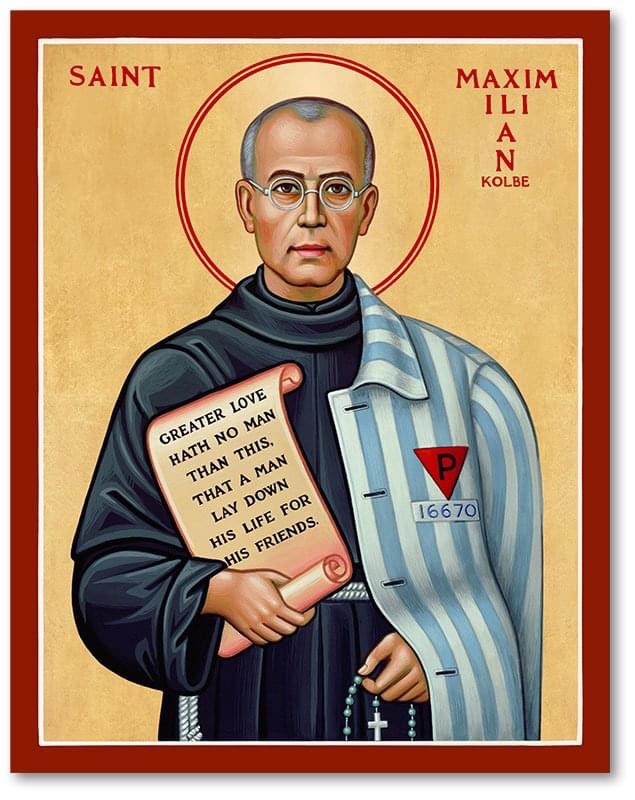
Today the church remembers a contemporary saint whose life was one of self-giving love: Saint Maximilian Mary Kolbe, Priest, Martyr, and Defender of the Defenseless.

Born in the last years of the 19th Century in Lodz, Poland, Raymond Kolbe joined a Franciscan order in his early teens, taking the names Maximilian and Mary, a testament to his devotion to Christ’s mother.

Saint Max (as I like to call him) left his Russian-ruled stretch of Poland to study in Rome, was ordained there, and taught church history for a time. Mission and evangelism caught his attention, and he began a movement to create friaries and publications for the propagation of Roman Catholicism throughout the world. His friaries in Poland, Japan, and India housed hundreds of Franciscans in the early 20th Century.

When Nazi Germany invaded Poland in 1939, Saint Max’s friary in Warsaw took in thousands of Polish citizens and fifteen hundred Jews, providing sanctuary from the occupying forces. Because he sheltered those being demonized, and because his publications encouraged people to be faithful to the church, not to Nazi nationalism, Saint Max was taken to Auschwitz with four of his fellow friars, and the friary was permanently closed.

At Auschwitz Saint Max continued to be a priest: hearing confessions and celebrating the Mass with contraband bread and wine.

In July of 1941 a prisoner from Kolbe’s bunk escaped and, as punishment, ten prisoners from the same bunk were selected for death as a deterrent to such action. One of the men, Sergeant Francis Gajowniczek, was married with a family on the outside. Having served Sergeant Francis communion for years, Saint Max knew this about him and offered up his life in exchange for his fellow prisoner.

The guards allowed it, as Sergeant Francis was young and strong and by now Saint Max was elderly and weaker.

The ten prisoners were thrown in isolation to die slow deaths by starvation. After two weeks the guards checked on the men, and only Saint Max and one other were still alive. Not waiting for nature to take its course, Saint Max was injected with carbolic acid on this day in 1941.

Saint Max is a reminder to me, and should be for the whole church, that when the powers want to force you to turn your back on your fellow humans, no matter their creed, you disobey…even if it costs you your life.

Let those with ears to hear, hear.

You can visit a shrine dedicated to this saint in Libertyville, IL called “Marytown.” There you’ll learn more about his life, his theological genius, and yes, his defiant death.

-historical bits taken from Pfatteicher’s New Book of Festivals & Commemorations

-icon is available for purchase at monasteryicons.com

Until the Last Patient is Home

Today the church honors a yet timely saint, Florence Nightingale, nurse and caretaker of humanity.

Born to wealthy parents, Florence was named for the Italian city in which she was birthed, though her parents formally lived in estates in Derbyshire and London. She was a quick study, and grew to know more than a few languages by the time she was twenty.

Unsatisfied with the kept and proper life, Florence said she heard God telling her to “complete her life’s mission,” though she couldn’t rightly determine what that specific mission was.

Her schooling made her an acknowledged expert on public health (and it appears that people listened to her!), and she became keenly interested in the Kaiserwerth Motherhouse of Deaconesses. She soon entered the school for training as a nurse, and in 1853 became the superintendent of the Institution for the Care of Sick Gentlewomen (brevity was not their strong suit when it came to naming organizations in those days).

Nightingale was dissatisfied with the hospital, however, and when the Crimean war broke out, she and 38 fellow nurses left for Turkey to lend their aid. There they found shocking conditions and misogynist doctors who treated them poorly. But as the war progressed, the pressing need of so many wounded forced the hands of the powers that be, and Miss Nightingale and her fellow nurses worked long and hard to tend to the injured.

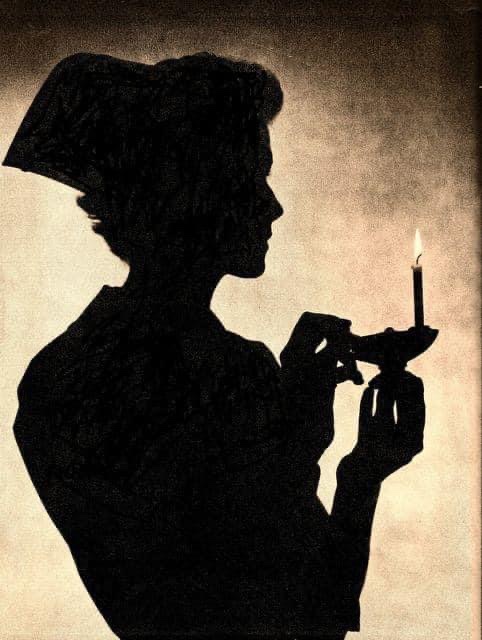
From this scene came the iconic “lady with the lamp” depiction.

She eventually would rise in rank to become the superintendent of the Female Nursing Establishment of the Military Hospitals of the British Army in 1856, and she wouldn’t leave Turkey until the very last patient left for England.

She was the last one in the field.

She worked against the political powers of the day to greatly improve the health and living conditions of the soldiers she worked so hard to heal.

Florence herself would eventually fall ill to chronic brucellosis, but even from her sickbed continued to advise and counsel nurses and doctors through letters and consultations. In 1860 she established the Nightingale School for Nurses at St. Thomas Hospital, and soon shifted her focus to changing the terrible conditions in the many workhouses in Britain.

In 1907 she was awarded the Order of Merit, the first woman to be given such distinction, and died in 1910 at the age of 90. Her grave marker simply states, “F.N. Born 1820. Died 1910.”

St. Florence Nightingale is a reminder to me that a life curved outward, rather than inward, can continually and forcefully change the situation of many in the world when consistently applied, especially in the face of the many “isms” of this world. The powers will pull out all the stops to thwart the efforts of those who would lift up the vulnerable in the world.

In these past few years of global pandemic, with so many nurses staying on the job until their last patient is sent home, she is not just worth remembering, but worth honoring and emulating.

One way to honor such a legacy is by following the advice of medical officials.

Let those with ears to hear, hear.

-historical bits gleaned from Pfatteicher’s New Book of Festivals & Commemorations