The Quiet Life

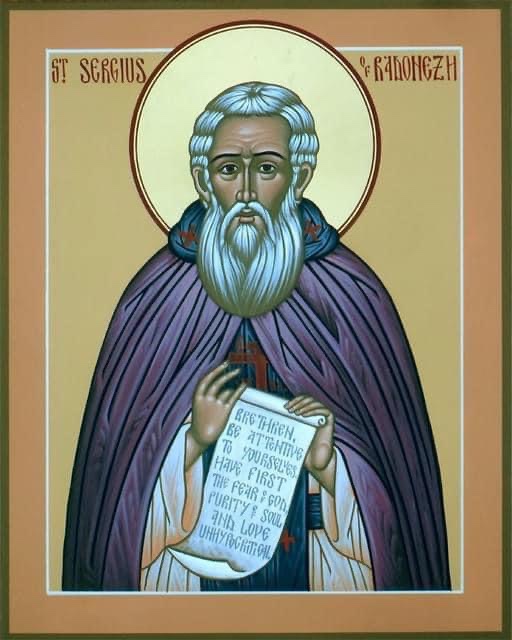
Today the church honors the most popular Russian saint, 14th Century St. Segius of Radonezh, Abbot and Teacher.

St. Serigus was given the name Bartholomew upon his birth. Shortly after he came into the world, the family was forced to flee the perils of the civil war, eventually making a home in the farming community of Radonezh outside of Moscow. Bartholomew was a poor student who bored easily with his studies, until…

Until he was taken under the wing of a local monk. Reading scripture, books on liturgy, and the writings of the Desert Fathers and Mothers (as well as church historians of all kinds), while also visiting local monasteries, Bartholomew longed for a life in the church that provided sacred solitude.

After the death of his parents, Bartholomew went deep into the woods surrounding Radonezh and built a chapel to the Holy Trinity. He continued to practice simple piety there, and eventually a neighboring priest-monk gave him a tonsure (the humble hairstyle of a monk) and renamed him Sergius. He was ordained a priest at the age of 30, and grew his little chapel into a full-fledged functioning monastery.

Eventually the Patriarch of Constantinople (or is it Istanbul?) deemed the monastery in the woods a monastic retreat center, elevating it to some prominence.

Personally, St. Sergius was not one for prominence. He, like his spiritual cousin St. Francis of Assisi, was known to love animals and shun worldly goods. He never sought recognition, and lived a quite austere life…which, ironically, helped him generate recognition. His retreat center became the locus for Russian spirituality in his day. He was known to have visions, and it was even reported that he could perform miracles.

He accompanied Russian princes on missions of peace, hoping to unify the region for mutual care and cooperation.

In 1378 he refused to be appointed as Patriarch of Moscow, wanting a quieter life for himself.

As a saint who left no writings, his teachings surprisingly reached far and wide throughout the area, and he was named as the inspiration for a number of monastic communities. He died in 1392, and was buried in the church his monastery constructed. It remains a place of worship and a theological academy to this day.

St. Sergius is a reminder to me, and to the church, that even humble persons can leave a lasting mark. In a world that urges people to publish, to be over-educated, to “make a name,” to relentlessly pursue the next opportunity to be known, St. Sergius calls to us from the past with a different message.

The quiet life.
The simple life.
The life seeking to make peace.

The life that intentionally passes up positions of esteem and power so as not to get trapped in a cycle of political games…that’s a life worth living, Beloved.

-Historical bits gleaned from Pfatteicher’s New Book of Festivals & Commemorations
On Sweet Rolls and Unity

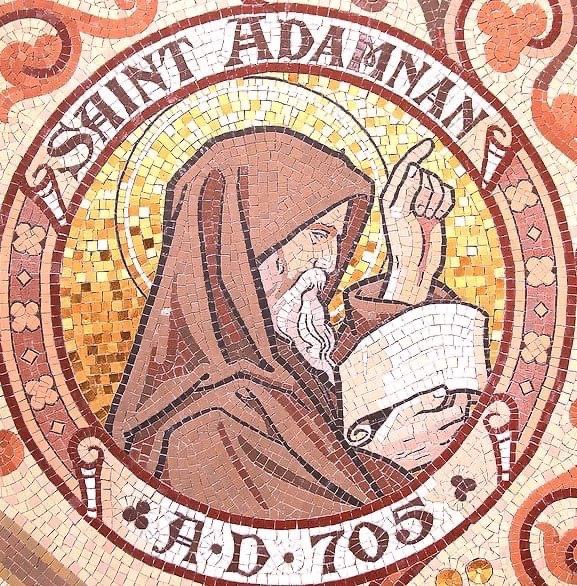
Today the church remembers a Celtic saint who, while kind of obscure, had an impact for generations to come: Saint Adamnan of Iona, Abbot, Law Writer, and Arranger of Calendars.

Saint Adamnan was born in the early 7th century in what is now County Donegal in Ireland, related to Saint Columba on his father’s side. He grew up in the Celtic expression of Christianity and was schooled far beyond most any Celt, average or noble, in his day.

Eventually, after entering the priesthood, ordination, and extensive education, he ended up at the famed Abbey of Iona, begun by his ancestor Columba himself. It was there that he eventually took over as Abbot and penned the most extensive work on Saint Columba, as well as the most in-depth work on the ancient Scots (the Picts) that we have today, The Life of Columba.

But that wasn’t all that he wrote.

He was very interested in justice and human rights, and proposed what came to be called, “The Rule of Adamnan,” essentially an argument that, in warring times, women and children should be spared, and that non-combatants should not be held prisoner. His “rule” sounds very similar to modern Geneva Convention rules of war.

In his role as Abbot, he traveled around what is now the British Isles, visiting different parishes as good Abbots do. In South Briton (Britain) he encountered a strict Roman adherence to custom and calendar, which chaffed a bit against his Celtic understanding of the faith. Nevertheless, he believed the church should be one, and while he was unwilling to give up much of his Celtic Christian practices, he argued that one thing the church should agree on was a common Easter festival.

See, the Roman expression of the faith celebrated Easter on 21 Nissan, but the Celtic expression had continued with the ancient way of celebrating Eoster, the “spring festival,” on 14 Nissan. Intermingled with the empty tomb they put their ancient symbols of spring and new life: eggs (often painted), hares, and sweet rolls (often a gift to the goddess of spring). These symbols were also seen in the spring festivals of many ancient peoples.

Those sweet rolls, by the way, became hot cross buns in the hands of the church…

So while the eggs, rabbits, and rolls could remain, St. Adamnan argued mightily that they Celtic Christian expression should adopt the same date for Easter that the Roman expression was using, further unifying the faith.

In time, his argument won out, and the festival date changed (though the Celtic traditions remain to this day!).

St. Adamnan is a reminder for me, and should be for all people, that compromise is not only possible, but often an important step in unity.

Unity does not mean uniformity, and we’ve forgotten that.

Balance

On the Autumnal Equinox, my mind is brought back to those ancient Celts who knew the Earth was not just alive, but provided us with secrets on how to live.

Balance, Beloved, is more than hard to find…it is also hard to keep. The Earth only finds it twice a year, and is only able to keep it for 24 hours at a time.

But when it does, everything changes!

At the Vernal Equinox the world springs forth with color and newness.

And today? Well, Camus said that Autumn is a “second spring,” where “every leaf is a flower” beginning to blaze.

For the Celts, with over half of the fields cleared by now, it was time to take stock of the harvest, both within the barn of the heart and the barn outback. They would prepare for winter, using what the year so far has given to plot the next phase of life.

Blessed Equinox! Lean into the balance a bit, and learn how to live.

What’s in a Name?

On September 21st the Church honors St. Matthew, Evangelist and Apostle.

Here’s the thing about St. Matthew: while this person appears in all of the Gospels, in Mark and Luke it is Levi, not Matthew, that is called into discipleship.

Oh, what’s in a name?

Well, quite a bit, actually. Some ancient scholars took these two people to be the same person, with “Matthew” being the name Levi was given after he started following Jesus (Jesus had a habit of giving nicknames, after all). Some regarded them as distinct individuals.

Regardless, two things are known about this person named Matthew: the ancient church knew him as a tax collector, and his name in Hebrew means “gift from God.”

Now, the above information is only ironic if you know how tax collectors were regarded in ancient Judaism and ancient Palestine. Often tax collectors were seen as puppets of the state, and were cut out of Jewish activities. But it’s worth repeating that Jesus had a tax collector in his trusted circle, this one whom others considered suspicious and untrustworthy.

Jesus was “big tent” before it was en vogue.

We don’t know much about St. Matthew. Tradition ties him to being the writer of the first Gospel, which we have no proof of and, because of when the Gospel was written, seems generally unlikely. Tradition also considered him, generally, as the oldest apostle…which makes it even less likely that he wrote the Gospel text.

Some legends have Matthew preaching throughout Judea after the ascension. Some have him going as far as Ethiopia with the Gospel. Some even claim he was a vegetarian (why this is important, I’m not sure, but no other apostle gets to claim this distinction).

We’re not even sure how Matthew died. Some say by old age, and some claim it was by martyrdom.

With all this confusion, I think it’s important to point out a key thing about Matthew: he was disliked in the ancient world, and yet he was in the inner circle.

Think on this: Jesus had St. Matthew and St. Simon in his inner circle. Matthew was a tax collector, a government agent. Simon was called “the Zealot,” and was a radical antigovernment activist. And both were in the Jesus camp. And both, we must imagine, had to give up some of their ideological purity to be there, right? And both had to give up some of their prejudices to entertain the presence of the other, right?

St. Matthew is a reminder for me, and for the church, that Divine work is larger than the small ideological crevices we hew out for ourselves in this life.

Let those with ears, hear.

-historical bits gleaned from Pfatteicher’s New Book of Feativals & Commemorations

Three Skills to Appreciate

As the weather began to cool, the Celts spent more and more time in doors telling stories and singing songs. As we approach the equinox, my noon thoughts landed here briefly today.

Songs, and instruments, were (and are!) very important to Irish and Scottish families. Many families employed a harpist full-time to be available for parties, dinners, and to compose and perform at weddings and funerals. As Gaelic culture waned, these professional harpers weren’t able to be privately employed any longer, and became wandering bards exchanging songs and stories for meals and a bed for the night.

It is said that Irish appreciate three skills in particular: the ability to compose a clever verse, music on the harp, and the art of shaving a face.

All seem worthy of some reverence.

God is the Thirsty One

Today the church honors a contemporary saint and scholar, one whose genius in theology and mysticism was only discovered after his untimely death: Dag Hammarskjold, Peacemaker and Mystic.

Dag was born in 1905 as the son of Sweden’s prime minister. He studied law and economics, and was a professor of economics in Stockholm for about three years. He soon joined the Swedish civil service in the Ministry of Finance, and became the president of the board of the Bank of Sweden.

As his popularity in the circles of government began to rise, so did his mystical leanings and visions…though in secret. He served in the Ministry of Foreign Affairs, and was responsible for dealing with international trade. This position well situated him to eventually be appointed as Minister of State as the deputy prime minister.

At that same time he was chosen as vice-chairman of the Swedish delegation to the UN, and eventually became chairman.

On April 10th, Hammarskjold was elected Secretary General of the United Nations, and during his tenure he dealt with the end of the Korean War, skirmishes in the Middle East, and the Suez Canal crisis. Due to his acumen, he was elected for a second five-year term.

With another term in front of him, Dag set his sights on helping the newly independent Belgian Congo, sending in UN troops to suppress the civil war. On his way to negotiate a cease-fire between the warring factions, Hammarskjold was killed when his plane crashed in Zambia in 1961.

Upon his death, his reflections and mystical visions were published in a fascinating book (that sits on my shelf), Markings. In this work Dag showed that he was not only a peacemaker for the world, but sought inner peace as well.

He was an active contemplate, or a contemplative activist…however you want to describe it.

My favorite line from his work (unsurprisingly) is this lovely mystical mix of beer and theology:

“I am the vessel. The draught is God’s. And God is the thirsty one.” (Markings)

St. Hammarskjold is a reminder for me, and for the church, that inner work is just as important (maybe more important?) in the life of the faithful, because the inner life is reflected in our outer actions.

Deep wrestling with life, mortality, the Divine, and the poetic ways they appear in our existence elicit a humanity that is geared toward the other more than the self.

It’s an interesting paradox, right? In doing our own inner work, seeing the outlines of our own shadows and light, wrestling with the tough questions within us, we become focused more on the health and healing of those around us.

This saint is a testament to this truth.

-Historical pieces from Pfatteicher’s New Book of Festivals & Commemorations

-commentary is mine

She Wrote a Musical

Today the 12th Century comes into focus as the church honors one of the most amazing and influential saints, Saint Hildegard of Bingen, Prophet, Musician, and Renewer of the Church.

St. Hildegard was born in the Rhineland Valley, and from early ages began having visions and dreams that rocked the world of her family and friends. She was of noble birth, and the 10th child born, and because of these two factors her family felt it was important to “tithe” her to the church for a monastic future.

This practice is odd, but was apparently widespread in the Middle Ages…which, coincidentally, might be why so many crappy church leaders appeared in the Middle Ages, having been “tithed” and not truly called.

Luckily for the church and the world (and, perhaps, annoyingly for church leaders in her day) Hildegard was called, trained as a Benedictine, and eventually became Abbess at Disibodenberg.

Under her watch the convent grew and grew, and in 1150 a new convent was built to keep up with the growth. Only 15 years later, another one had to be built…Hildegard was apparently all about growing disciples.

You want to know something else she was all about? Calling people out.

From Popes to peasants, Hildegard spared no words on the political and moral shortcomings of the day. She wrote a number of books ranging from apocalypses to expository pieces on the Rule of St. Benedict. She also found time to squeeze in a book on the natural sciences, body ailments, and a musical.

Yes…she wrote a musical.

She also wrote a number of hymns still preserved today, even with musical notation. She wrote hymns elevating nature, full of stunning imagery and apocalyptic language.

St. Hildegard died at the age of 81 having lived a life of purpose, prophecy, and prose.

St. Hildegard is a reminder to me, and to the whole church, that sometimes “church growth” doesn’t happen through fancy gimmicks and advertising tricks. Humans might like that, but they fade over time.

St. Hildegard attracted people to her way of being through her living, her honest work, her penchant for not suffering fools, and her reverence for nature.

Let those with ears, hear.

-historical bits gleaned from Pfatteicher’s New Book of Festivals & Commemorations

-critique on fancy-schmancy church growth strategies all my own

Guilty or Innocent?

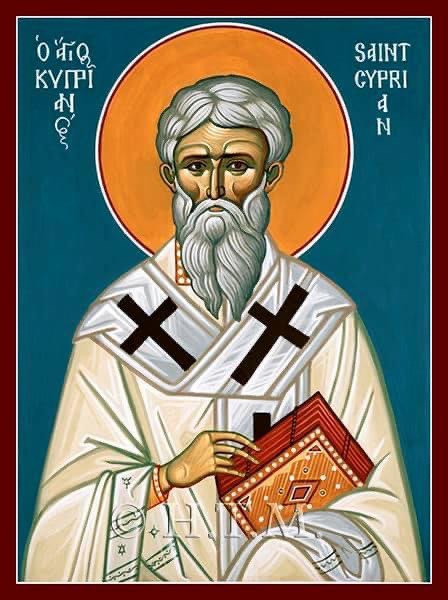
Today the church honors a Bishop who tended his flock during a plague, which makes him a bit relatable, no? Today is the feast day of Cyprian, 3rd Century Bishop and Martyr.

Hailing from Carthage in North Africa, Cyprian was a professor and lawyer by trade, only being baptized in his forty-sixth year of life. Amazingly, however, he was elected Bishop of Carthage only two years after ordination…hardly enough time to understand the ins and outs of parish ministry, me-thinks…but no one asked me.

Cyprian was a scholar and assumed the Bishopric when the church was rocked by schism and scandal. He used his office to gather the church together, seeing the office of Bishop as both encourager of the people and the anchor that holds disparate parts of the Body of Christ in communion with one another.

When emperor Decius began persecuting Christians, Cyprian went into hiding, a move for which he was much criticized. He felt that he had to continue to lead his flock through the persecution, and so his survival was paramount. History has taken a more cynical view of this move.

Soon after the persecution a plague broke out in the empire, and the Christians took the popular blame for it. When persecutions again resumed under emperor Valerian, Cyprian willingly and peacefully was arrested on September 14th in the year 258. He died a martyr’s death two days later.

His arrest and appearance before the authorities is well documented, and even appears to have been a peaceful exchange…even though it led to his death.

The charges?

He was accused of not bowing and acquiescing to the gods of the empire, of not siding with the powerful against the powerless, and not worshiping the emperors of the day. He spoke against their self-congratulatory ways of operating and their demands for prestige and accolades at the expense of the people they were supposed to serve.

He plead guilty and died by the sword.

St. Cyprian asks us a question from his grave in these days:

Would we be found guilty or innocent?

-history gleaned from Pfatteicher’s New Book of Festivals & Commemorations
Stuff of Lore

The church today also remembers a Celtic saint and Bishop after my own heart, Saint Ninian, Scotsman and the Stuff of Lore.

Not much is known about Saint Ninian, at least not much that can be proven by historical record. Most formal works regarding his life and deeds are dubious, the Life of Ninian penned by St. Aelred chief amongst him.

But that’s kind of why I like him.

The Celts believed that life was best lived in story form. Historical fact is cold; historical fiction is alive. When the two hold hands a great adventure follows, which is why the Celts hold tightly to story, a mix of fact and fiction.

Regardless, we know that Ninian was the first Bishop of Galloway, that he was a Scotsman who was Romanized by the conquering warriors, and that he was ordained in Rome but sent back to his homeland to preach to the stubborn Picts and Celts there. In 397 he established a white stone church at Whithorn in Galloway, and from there he spoke to his fellow Scots about the beauty of the Gospel, intermingling Christianity with the ancient Celtic ways.

While we don’t know much about the actual missionary work of St. Ninian, we do know that he laid the groundwork for St. Columba, of whose work we know quite a bit!

St. Ninian is a reminder for me, and should be for the whole church, that sometimes historical fact and historical fiction must hold hands for amazing stories to happen (looking at you, Scriptures!), and that the groundwork we lay now in our time prepares the way for others in their time.

Sometimes it Still Feels Like 1963

Today the church remembers with sadness and indignation a group of young saints martyred on the altar of racism and white supremacy: Saints Addie Mae Collins, Carole Robertson, Cynthia Wesley, and Denise McNair.

These young women, all under the age of fifteen, were killed when Robert Chambliss, Bobby Frank Cherry, Herman Cash, and Thomas Blanton stuck dynamite under the steps of Sixteenth Street Baptist Church in Birmingham, Alabama on this day in 1963. As Sunday School was beginning, the bomb went off and they were martyred while walking to learn about the Prince of Peace, himself a man of color.

In that blast, twenty others were injured.

The courts found Chambliss, Cherry, Cash, and Blanton not guilty of murder, but fined them $100 and gave them six months in jail because they illegally possessed dynamite, making a laughing stock of not only the legal system, but of every Alabama courthouse emblazoned with “In God We Trust.”

Ten years later, in 1973, the case was retried for this bombing, and they did eventually receive a life sentence. Regardless, Saint Addie Mae, Saint Carole, Saint Cynthia, and Saint Denise would not get a second chance at life, no matter how many years pass.

The public funeral for these saints was attended by 8,000 mourners, but no public officials in Alabama thought fit to have their face seen there.

These young saints are a reminder for me, and should be for all humanity, that we are not so many years removed from this tragedy to take for granted that people are safe regardless of their race.

If you drive from Raleigh to Asheville you pass by two Confederate battle flags the size of Buicks on route 40. They are lit up at night as a reminder for every driver on that stretch of land that bombs are liable to be found under every staircase when in the hands of racist, hateful people.

Indeed, sometimes it still feels like 1963.

-historical bits gleaned from Clairborne and Wilson-Hartgrove’s Common Prayer: A Liturgy for Ordinary Radicals