Today the church remembers another delightfully obscure saint who, because of her Celtic heritage and bent, has carved a nice niche in my own heart: St. Hilda, Abbess of Whitby, Sage of the Ages.
St. Hilda was a Northumbrian princess who was born in the early 7th Century. She was raised in the Christian faith and baptized at the age of thirteen in York. She lived her early years as a member of the King’s court, where she was respected for her insight, and eventually entered into monastic life at the age of thirty-three.
In the year 649 she was appointed Abbess of Hartlepool by St. Aiden, and a few years later went on to found a “double house” in Whitby, a monastery for both men and women, of which she became Abbess. The monastery grew in reputation due to the wise scholarship taught there.
It was here at Whitby in 664 that a meeting took place where the gathered religious elites argued on what to do with the divide between those following Celtic-Christian traditions (earth-oriented, feminine-friendly, wisdom-focused, egalitarian), and those who followed the Roman-Christian traditions (male-centered, punitive, dogmatic, strictly hierarchical, forced piety).
The Synod resulted in a union between the two philosophies, though Hilda remained favorable to the Celtic way of being.
Nevertheless, she was obedient to the decision of the council, and incorporated Roman thought into her official teachings. But, in her practice, she was Celtic to the core. She was known for being wise, and many people would come to her seeking sage advice. The Venerable Bede held her in extremely high regard. She insisted that those preparing for the priesthood study the scriptures, and felt that proper readiness for the office included extending peace and charity beyond the monastery walls.
The towns people, as well as her monastic companions, all called her “Mother.”
In the last years of her life a lingering illness festered and finally took her. She died on November 17th in 680, but due to the number of saints already honored on the 17th of November, St. Hilda received her own date, the 18th, her resurrection morning.
St. Hilda is a reminder for me, and should be for the church, that wisdom is not found in adhering to dogma, that peace and charity are necessary for clergy, and that while much of the church, and much of its history, has a problem with women in positions of power, they have always been there and should always be there.
-historical bits from Pfatteicher’s New Book of Festivals & Commemorations
Today the church celebrates the brief life of Saint Elizabeth of Thuringia, Princess of Hungary and Friend of the Outcast.
You’ve never heard of Saint Elizabeth of Thuringia? That’s not surprising. Nestled in the middle days of November, she’s not widely known. But this 13th Century royal made a great impact to those she cared for in her short twenty four years of life.
She was the daughter of King Andrew of Hungary, and was betrothed at the age of one to the son of a local noble whose name was Ludwig. This sealed the political alliance between the king and the count.
She was known to be serious and generous, and even at an early age showed a devout faith. Ludwig was fond of her, despite the forced marriage.
They were married when Elizabeth was fourteen (Ludwig was twenty one) and had three children. Their marriage, by all accounts, was a happy one, and Ludwig supported St. Elizabeth in her increasing generosity. For instance, during a regional famine, Elizabeth gave away most of her own fortune and grain to the local poor. She was heavily criticized by other nobles for this, but Ludwig approved.
St. Elizabeth founded two hospitals during her time as Duchess. She regularly tended the sick and the lame herself, and gave money for the specific care of the ill children, particularly orphans. Ludwig followed Elizabeth’s lead, and tried his best to find jobs for those in the area who had trouble earning a living.
In 1221 Franciscan monks came to town, and Elizabeth was immediately drawn to these kind, poor preachers. She came under the tutelage of Brother Rodeger who taught her the way of St. Francis. She took the example so seriously that she ended up taking a leper into her own home to stay the night when he was wandering aimlessly. Ludwig found him in their bed and, though at first startled, understood that Elizabeth was fulfilling her calling.
On September 11th Ludwig died of the plague while on the crusade. Elizabeth left the castle and went to live in Eisenbach where she found a cold welcome from the townspeople. She was eventually taken under the wing of her uncle the Bishop of Bamberg, and on Good Friday in 1228 she officially took her monastic vows, devoting herself to the way of St. Francis. She secured the safety of her children, built a small house near Marburg, and set up a hospice center for the sick, the aged, and the poor.
St. Elizabeth’s life ended in isolation and austerity. Her confessor, Conrad of Marburg, was not a kindly monk, and seemed to take pleasure in forcing Elizabeth to live in harsh conditions. Her health began to fail, and she died not having yet seen her twenty fifth birthday.
So many hospitals around the world are named for this saint.
The Wartburg castle, in which Elizabeth lived for most of her life, would later have a new resident. our own Blessed Martin Luther, who would pen his German translation of the New Testament there.
St. Elizabeth is a reminder for me, and should be for the church, that time is of the essence. We do not have to wait until tomorrow to make an impact, because we’re never confident how many tomorrows we will have.
So, make an impact.
-historical tidbits from Pfatteicher’s New Book of Festivals & Commemorations
Today the church remembers an 11th Century pillar of piety who is often overlooked, but deserves some attention: Saint Margaret, Queen of Scotland.
Born of German stock in Hungary because her father had been a victim of political exile, Saint Margaret was of royal lineage as her grandfather had been Edmund Ironside, King of England. In 1057 she was brought back to England in the court of Edward the Confessor, leaning back into her heritage apart from her family of origin.
In 1067 the whole family fled after the Battle of Hastings and were shipwrecked off the coast of Scotland. There King Malcolm III welcomed the family and took romantic interest in Saint Margaret.
They were married, and she effectively became a bridge between two royal lines.
Here’s the thing, though: Margaret didn’t want to be married to anyone but the Church. She longed to be a nun.
Nevertheless, despite this inner desire, all accounts show their marriage a happy one, and they had eight children together who would, for better or for worse, be released into the royal spheres of the world.
The Church of Scotland as Saint Margaret found it was an amalgamation of ancient Celtic ways and Christian ideas (as it still rightly is). Saint Margaret worked hard to reform some of the rougher edges of their practice in order to more seamlessly match the practices of the rest of the Western Church. She took to founding new churches and new monasteries, and was keenly concerned for the welfare of the poor, the sick, and the underclass in Scotland.
Her piety was legendary, and she helped curb her husband the king’s baser instincts, resulting in relatively good rule for the people of Scotland.
Saint Margaret died in Edinburgh Castle on this day in 1093. Some say she died of a broken heart because she had just recently learned that both her husband and her eldest son had been killed on the battlefield. She is buried alongside her husband and son in Dumfermline Abbey.
Saint Margaret is a reminder for me, and should be for the whole church, that appropriate piety is not a bad thing as long as it is focused not on scoffing and the “shalt-nots” too often found in the overly pious, but rather in taking care of the “least of these” in this world.
-historical bits gleaned from Pfatteicher’s New Book of Festivals & Commemorations
Today I would urge the church to remember with affection and curiosity a 16th Century astronomer and deep thinker: Johannes Kepler, Seeker of the Divine and Gazer of Stars.
Kepler was born in what is now Germany to a family of fading fortunes. He was technically nobility, but didn’t have the bank account to match the title. While he was sick as a child (having been born premature), he was intellectually curious and showed his obvious genius with numbers at an early age. As a young adult he attended University at Tubingen, studying theology under Jacob Heerbrand (who was, himself, a student of Melanchthon), but while his theological scores were so-so, his mathematical scores were off the (planetary) charts. This was back in the day when astronomy and astrology held hands, and while his numbers were solid, he would pass the time creating horoscopes for his fellow classmates based off of star charts he created himself.
A little side-show is always fun in college.
He would go on to teach mathematics in Graz, and took a fancy in a young widow, Barbara Muller. She was quite wealthy and, though he was of noble stock, was deemed unacceptable to her family. So what did Kepler do? He published a book on mathematics to woo her family into seeing him as worth something.
It worked.
Kepler than began to plot out his life’s publications, much like you might plot out planetary motion (because that would be his main subject). He drew connections between planetary motion and the nature of created order itself, and though through today’s scientific lenses we see many of his connections were nothing more than wishes and guesses, it should be noted that this is one of the ways that science moves forward: by making guesses and testing them.
It does not, however, move forward by ignoring data and replacing it with wishes…as many are wont to do today.
Kepler was using the best data that was available at his time, and he got into a number of discussions with other astronomers and mathematicians, testing one another and prodding each other to do more and do better.
Despite his genius, he wasn’t awesome at making money (probably because he was a teacher and no one was reading planetary physics for fun). He was also wrestling mightily with philosophical questions, particularly around the notion that planets might be “alive” things with souls which imbued them with purpose and reason in their courses.
He thought that the universe was created by a God who wanted to be known through reason, and all we had to do was figure out the logic to figure out the great eternal “why.”
Speaking of the Divine, Kepler refused to convert to Catholicism and, since his teaching appointment at Graz was in a Catholic territory, found his way to Prague (which, though officially Catholic did tolerate some Lutherans who they deemed intellectually valuable) and, through twists and turns and missteps and some crazy theories that didn’t hold water, eventually did find his way into his most productive years as the Imperial Mathematician to the Emperor.
Fortunately this gave him some stability and a place to do his greatest scientific studies. Unfortunately he was basically hired to tell the emperor’s astrological fortune. Regardless, it was a means to a scientific end for him. Through this appointment he came into contact with other great minds, and in 1604 Kepler observed a bright new star (SN 1604) in the sky, a Super Nova. His calculations of the star challenged the assumption that the night sky was essentially “fixed,” noting that new things could happen there all the time. He shrugged off any astrological importance, and leaned into the science encouraging the world to see space not as a tapestry, but as a dynamic system. This emboldened his groundbreaking idea that the planets moved around the sun in elliptical orbits, not straight circular patterns.
He was right about this, and the first to posit it in a way that had mathematical weight.
As a little side-quest, though, he also became obsessed with plotting chronology using the stars as a guide, and attempted to find meaning in the movement of the heavens and the events on Earth (like, oh, how a star just appeared above Bethlehem and was said to appear at the birth of Alexander the Great).
But his ideas weren’t exactly en vogue with a very traditional Lutheranism and Catholicism running around in that day (they thought he might be a secret Calvinist!), and he was eventually excommunicated from the Lutheran church and his mother was brought up on charges of witchcraft, a tactic used back then (and still today!) that tried to mar the reputation of those who disagreed with theological teachings.
Eventually the charges were dropped, though the excommunication stood. He moved to Linz and remarried after the death of Barbara Muller, and fell ill during travel on October 8th in 1630, eventually dying on this day of that year. He was buried in a Protestant churchyard, having been officially rejected by both Lutheranism and Catholicism and, as if to hammer home the reality that the time was politically and religiously fraught, his gravesite was completely destroyed in the 30 Years War.
Kepler was a person on the edge of two worlds. He straddled both imaginative fantasy and mathematical reality. In fact, these two worlds came together in a now lost book Somnium (The Dream) where he wrote about the planets from the perspective of other planets, perhaps the first sci-fi novel of modern history! I hold him with both curiosity and sympathy, with appreciation for his brilliance and a bit of disdain for his tangential side-quests to find the “mind of God” in his work.
In this way, I guess, he’s like most of us: a mix of steps forward, steps side-ways, and blowbacks.
One cool thing about him, though, is that when it came to religion he said very clearly that denominations of every stripe should be able to take communion together. “After all,” he said, “Christ was not a Lutheran, a Calvinist, or a Papist.”
Let those with ears to hear, hear.
Johannes Kepler is a reminder for me, and should be for the whole church, that science moves forward with intelligent guesses that are tested, not ignorant beliefs that are untested. We need to raise up leaders willing to think great thoughts and then test them, not just think untested thoughts and hold them as great.
Tonight as we enter the midway of the month, I’m remembering that in November the ancient Celts found themselves under the Reed Moon.
Each month has a moon, usually named after a tree, corresponding to the attribute that the month brought to the wheel of the year. Now, while reeds are not technically “trees,” November was illumined by the reed moon because reeds, when wound together, created tough blankets that would be used for both floor and roof, for both basket and rope.
They are tough as trees when braided.
Reeds were emblematic of how November was a weaving of worlds, ushered in by Samhain and All Saints, the ancestors and the babies creating a tapestry of existence that was most clearly felt as the shadows lengthened and the hearth blazed. For the ancient Celts life existed far into the past and far into the future, and the cycle of life was always rolling. Reeds reminded them of this: woven together to be one whole, and when wind blew over the open reed they believed they could hear the howling voices of the ancestors calling to them from the other side of the veil.
These, of course, became wind chimes and porch pipes.
The Reed Moon inspires us, with its long night-shine life, to remember those who have gone before, the ache in our bones a reminder of their unseen, but ever-felt, presence.
In these mid-November days, I’m reading about the importance of storytelling in Ireland and Scotland, and how it historically has shaped (and continues to shape) a Celtic worldview.
Stories were seen as so powerful that a storyteller invited into a home was said to bring good luck to the dwelling, and they were often paid well for their stories.
Entertainment. Knowledge. Skill and art. Stories and the tellers of them were seen to impart all of these.
But more than that, storytellers were the “keepers of the people.” They remembered the history and, when they told the story, re-membered those listening into that long thread of history.
It’s a shame that storytelling isn’t practiced much as a profession any longer. It’s one of the things that I love about preaching: it’s a chance to tell a (hopefully) good story.
And also a chance to re-member ourselves to one another around a common tale, if just for a moment.
In these November days, an “in-between-time” of the year wrestling with whether it is “fall” or “winter”, we honor perhaps my most favorite theologian and saint who embodied wrestling in his questioning of the struggles of human existence, St. Soren Kierkegaard, Writer, Theologian, and the Father of Existentialism..
Soren was born in Copenhagen in the early 19th Century, the seventh child of aged parents. His father, Michael, was a farm laborer who was born in abject poverty but, through toil and a good bit of luck, succeeded at business and became quite wealthy. There is a story that Michael, deeply unhappy with his life, stood on a hill and cursed God one day…which changed his business fortunes but, in his estimation, also gave him terrible heartache. He believed that God blessed him in business but cursed him in life. His wife and five of his seven children died quite early, and Soren only knew his father as a grieved and sad person.
Soren studied theology and quickly got the sense that God, in retribution for his father’s curse, had summarily cursed the whole family. He tried to cut ties with his father, and lived a quite wild life for a bit, but eventually had a religious conversion that sent him back to make amends. His father died in 1838 and left Soren a considerable fortune.
Kierkegaard eventually finished his theological degree (he was a brilliant student), but never sought ordination because, despite all his study, he could never fully make “the leap of faith,” a phrase he would come to coin and use throughout his work.
In 1849 Soren became engaged to the young love of his life, Regine, but following in the footsteps of his ever-grieved father, was troubled and broke off the engagement when he struggled making sense of inviting someone to share his unhappy existence, this “curse” he felt was still very present.
Breaking off his engagement sent Soren further into a deep and shadowed depression where he publicly (in writing) wrestled with how we know anything at all with certainty.
He began publishing thoughtful works in earnest, using a nom de plume: Either-Or, Fear and Trembling, The Concept of Dread, and many others. The public assumed these were works of fanciful, thoughtful, fiction, but in fact they were Kierkegaard wrestling with life.
As a writer, Kierkegaard became open to public scrutiny, and was engaged in more than a few public feuds with other publications who viewed his work as ridiculous or the mad thoughts of a rich kid who had too much time on his hands. Soren did not take to being mocked, and argued bitterly against his detractors…and all this sent him further into a pit of despair.
His final issue, though, came when Kierkegaard heard officials from the Danish church spout what he identified as sterile theology. Never being able to quite embrace an orthodox faith, Kierkegaard still knew a theology of smoke and mirrors when he saw one, and became quite critical of a church that he felt didn’t take anything seriously and looked to keep people quiet and tamed more than encourage them to adopt deep, thoughtful wrestling.
Soren, in his despair and distress, one day collapsed in the streets of Copenhagen at the age of 42. Doctors diagnosed him with some sort of bone disease, and a month after his collapse he died in November of 1855.
St. Kierkegaard’s big hang-up with the church, and with life, is the notion of how one could talk with such plain certainty about things that are so unexplainable. The inability or unwillingness of the church to faithfully wrestle with itself and its teachings, even core teachings of Divine existence and what constitutes morality in a world that seemed destined for rule by the privileged, troubled him. How does will, risk, and choice play into our life-trajectory? How can a theology that smacked of status quo even begin to mirror the sacrificial life of the Christ?
Kierkegaard always tried to point the church back to this “troubled truth”: you can’t be certain, so stop pretending you can be.
For Kierkegaard truth was experienced more than taught by scholars in a classroom, and in this way he embodied a very “ground-up” theological stance which, for obvious reasons, chaffed against the hierarchy of the Church.
I deeply resonate with St. Soren’s wrestling with faith and truth, and to say that his works Stages on Life’s Way and Fear and Trembling had an effect on me is to say too little. I continue to consider myself a follower of his particular vein of theological inquiry: questioning, uncertain, and yet always striving.
I also think he is an outstanding writer and that you should read him for that, if for nothing else.
St. Soren is a reminder for me, and should be for the whole church, that the people in our pews can be trusted with a bit of ambiguity, can be invited to a deep (and necessary!) wrestling with the faith, and should not be served the vapid theology and trite moralisms and “pie in the sky” escapism.
Wrestle, by God. It’s uncomfortable, it can even be painful, but it is worth the effort to live an examined life.
-the life of Kierkegaard cobbled together from my own work and Pfatteicher’s New Book of Festivals & Commemorations.
Today the church honors the start of an ancient feast, Martinmas, named in honor of St. Martin of Tours, Bishop, Conscientious Objector, and Gentle Bishop.
St. Martin was born in the early 4th Century in modern day Hungary. His family was not Christian, and his father was a distinguished Roman legionnaire.
In his childhood he came under Christian influence, and at the age of ten he took it upon himself to sign up for Catechism classes (imagine that happening today!).
As a young teen, though, his catechumenal exploration was put on pause as he was drafted into the Roman army, a common practice for children of Roman soldiers. He was a good soldier. Very good, in fact, and well-liked by his comrades.
This is a nice tie-in to Veterans Day, no?
But, as the legend goes, one winter night he was stationed in Amiens, and on night watch he saw a poor old beggar at the city gates shivering in the cold. St. Martin had nothing to give him, so he cut his cavalryman’s cloak, and gave the old man half to wrap himself in. That night St. Martin dreamt that he saw Christ wrapped in his cloak, saying, “Martin, still a catechumen, has covered me with his cloak.”
Well, this sent St. Martin into an existential crisis. Over a period of time he became convinced he could no longer be a soldier because he could no longer justify killing.
He decided to be baptized and asked to leave the army. He was twenty years old.
St. Martin went off to seek Bishop Hilary of Poitiers (see Jan 13th for his feast day) to learn from him. He met with him and decided he wanted to join him in his work in Poitiers, but first wanted to say goodbye (and convert) his family back in Hungary. While St. Martin was journeying back to Hilary after hanging with his family, he learned that Bishop Hilary had been exiled. St. Martin decided then that he, too, would seek a solitary life for a while, and lived a hermits life in a hut outside Poitiers.
The thing is, St. Martin was becoming famous for not wanting to be famous. And so his little hut grew into two, three, thirty…a thriving humble monastery had formed that was providing charitable work all over the French countryside. In 371 the Bishopric of Tours became vacant. St. Martin’s followers tricked him into entering the city, and then would not let him leave until he agreed to be their Bishop.
“Fine,” he said. “But I’m going to do it my way…” (cue Frank Sinatra).
St. Martin, now Bishop, set up his home in a cave on the cliffs of Marmoutier, two miles from Tours. The office for his Bishopric was a hut just outside the cave. And though he had an unusual lifestyle, and an unusual approach, he was unusually effective in reaching the poor countryside people of France with charitable love, good works, and the Gospel message.
He fought for the rights of peasants in front of Emperors, not afraid to advocate on behalf of the poor. He established centers of charity and teaching in places no one else cared about. And when the Church first used capital punishment as the sentence of heresy, as they did in 386, St. Martin strongly opposed the sentence and began to ask tough questions about mixing the church and state.
He thought government and the church should not hold hands too tightly.
St. Martin died in 397. Interestingly enough, his work set much of the foundational work for the Celtic Christian Church, as missionaries trained in his little outposts traveled to the British Isles.
Martinmas, much like Michaelmas, became a festival time in much of Christendom, perhaps even spanning ten days originally. After the Reformation, many Lutherans continued to celebrate Martinmas, but did so to honor both St. Martin of Tours and Blessed Martin Luther (whose birthday is November 10th).
St. Martin’s motto, “Non recus laborem” or “I do not turn back from work” has been the motto of many of the faithful throughout the centuries.
St. Martin is a reminder for me, and should be for the whole church, that catechetical study has been known to significantly alter how people live and work. It has been formative…and could still be.
-historical bits from Pfatteicher’s New Book of Festivals & Commemorations
-icon written by Aiden Hart depicting St. Martin’s formative experience
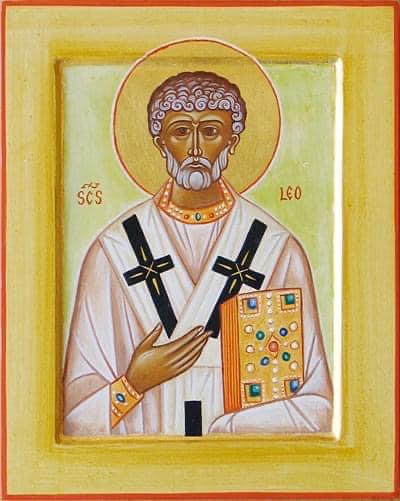
Today the church honors an important leader in the church that most church-goers have never even heard of, St. Leo the Great, Bishop of Rome and Mediator of the Church.
Long before the church was arguing about the nature of humans and their race and sexuality, the church set about arguing about the nature of Jesus. In the 5th Century, when Pope Leo was consecrated as the Bishop of Rome, the Catholic faith was being torn asunder by schisms over who Jesus was and how Jesus was.
Yes, you read that correctly: how Jesus was.
How was Jesus both Divine and human?
Pope Leo refocused the question on faith rather than nitty-gritty explanation. He affirmed the idea that Christ had two natures and, as he was enlarging the influence of the Papacy around the known world, issued his famous (at least to churchy-people) Tome to Flavian, the Patriarch of Constantinople that had the clearest articulation of Christ as human and yet Divine.
You still talk about this idea, by the way, every time you say the Nicene Creed.
At the time all sorts of schisms were going on inside the church, there were tons of wars being fought in real-time, too. St. Leo kept Rome safe from Attila the Hun in 452, and a legion of Vandals, whom he persuaded not to destroy Rome, in 455. He put restrictions on who (under what training) could enter the priesthood, and affirmed the goodness of “all matter,” rejecting the idea that the created world is evil and we need only wait for some heaven, lightyears away.
He was a devoted liturgist, and further developed the words of the Mass, shaping the words we say yet today.
St. Leo was wise, if not particularly brilliant. He understood how to use power effectively and for twenty-two years led with theological ability and personal resolve.
St. Leo is a reminder for me that wisdom and brilliance don’t always hold hands, and you can certainly be one without the other.
But of all the things that Pope Leo the Great is remembered for, the thing that struck me is how he looked at creation and without hesitation affirmed what Genesis had already said: “this is good.”
Why does it matter?
Because, Beloved, it articulates clearly that everything that is created, matters, and therefore we can’t just do what we want with it…
-historical bits from Pfatteicher’s New Book of Festivals & Commemorations
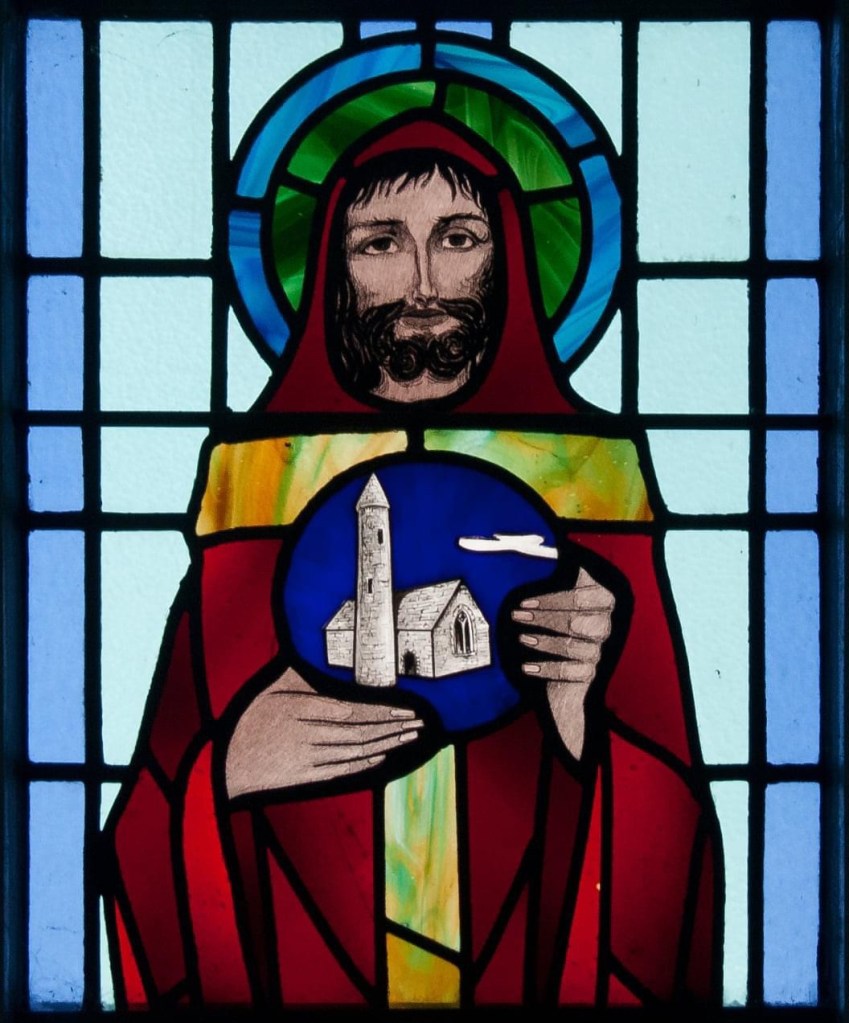
Today the church remembers an Irish saint said to have been baptized by Saint Patrick himself: Saint Benen the Gentle, Psalm-Singer and Friend of the Emerald Isle.
St. Benen was the son of clan chief, born in the early 5th Century. When Saint Patrick visited his clan with Celtic Christian teachings, young Benen was baptized and tutored by Patrick in language and theology.
As St. Benen grew he went on trips with Patrick and, while on the road with him, became known for his musical acumen and compositions, making him part of the Irish bardic tradition with Celtic-Christian flavor.
In adulthood St. Benen took a leadership position within the growing Celtic-Christian church, becoming the first rector at the Cathedral School of Armagh.
As it is with all Irish saints, St. Benen has some fun tales surrounding his life. One such tale was that, when tested by a clan chief arguing over religion, St. Benen was put in a flaming house and, like something out of the Hebrew scriptures, was able to sit in that “blazing furnace” with no problem (and he was probably singing).
He died in the year 467, having resigned his rectorship so that a younger generation could take the mantle.
St. Benen is a reminder to me, especially in these lingering pandemic days, of how central song, music, and the arts are to human spirituality. The church is one of the local conservatories of these things. The only place you sing in public is the church and the local bar (unless you’re in a choir).
If public singing is lost, we will be less whole.
-stained glass icon written for Kilbennan St. Benin’s Church Window






 Reluctant Xtian