We cozy up our homes, and our hearts, like a young one knitting something in a rocker late into the night, expecting something, someone, any day now.
Any day.
But it starts at night, and in the early morn. As the sun hides in these days and the shadows stick around longer, those who follow the church year ponder beginnings and endings by candle light, slowly adding to their number as the waiting intensifies.
Advent starts in the shadows because most of our waiting happens in the shadows, both literal and figurative, as we wrestle with difficult questions.
What does it mean to be another year older and missing those who have gone before?
What does it mean to wonder when we’ll see our last year?
What does it mean to wait for something new to happen…wondering if it will ever happen at all?
What does it mean to practice joy instead of happiness, peace instead of uneasy stalemates, hope instead of certainty?
What does it mean to be open to something new while missing what was?
This is the way of Advent. These are the angst days of joyful wrestling, prayerful pondering, and hopeful expectancy tinged with a good bit of refining doubt.
Christmas crooners croon away, and that’s all we’ll and good, but the true warbling in these days are the wonderful wonderings we wonder with Mary, pondering what newness lies ahead, and inside of us, this year. We cozy up our beings to welcome it.
Advent starts in the shadows of our “hopes and fears of all the years,” as the carol goes.
Today the church honors the person who is largely considered the “creator of the English hymn”: St. Isaac Watts, Hymnwriter and Inspirer.
St. Isaac was the first-born of nine children whose father was a nonconformist minister who was twice jailed for “heretical ideas.” He was an excellent student, particularly astute at rhyming, and many pushed him toward the priesthood.
Isaac wasn’t interested in a clergy life, though, and after a few years in higher education, set his brain to writing. He was not happy with what he considered to be “poorly arranged psalms,” and attempted to do better for the church. It was during this time in his early twenties that the majority of what would be published in Hymns and Spiritual Songs was written.
At the age of twenty-four, Isaac began informally preaching and, though he had rejected the offer to enter the priesthood, found a home as an independent minister. He assumed the pulpit of an independent congregation in Mark Lane, Britain, and soon after he began to lead the congregation his health began to fail.
He was forced to live his last thirty-six years of life in the home of Sir Thomas Abney, preaching and teaching only occasionally.
Despite his illness, his fame, as well as theological, and philosophical writings flourished abroad. Having read parts of these books in my University years, I can attest to his brilliance. His work Logic and Speculations on the Human Nature of the Logos come to mind.
He fundamentally changed the course of hymnody as well. Horae Lyricae and Psalms of David, as well as the afore mentioned collection of hymns and songs, became (and continue to be!) staple pieces in the liturgy of the church.
He even made an appearance in Carroll’s Alice in Wonderland as his book of children’s songs was parodied in those pages.
But the reason you know St. Isaac the best is because you sing him every year when you shout loudly, “Joy to the world, the Lord is come!” He penned that now famous Advent/Christmas hymn and our Decembers have never been the same.
St. Isaac finally succumbed to his illness and suffering, and was buried on this date in 1748. He never married, and is still called the Melanchthon of his day (a high honor in Lutheran circles!) for his learning, gentleness, and devotion.
St. Isaac Watts is a reminder for me, and for the whole church, sometimes the most brilliant minds are found in what many would consider challenging bodies. Watts spent much of his life ill, but the fruits of his relentlessly engaged intellect remain quite healthy.
Today the church remembers a 20th Century Mexican priest, St. Miguel Agustin Pro, Martyr of the Faith.
St. Miguel was born in 1891 in Zacatecas, Mexico, and was known as a happy, cheerful, and privileged child. Despite his relatively high-born status, he developed a deep love and kinship for the working class families around him, and began to spend all of his time and energy working alongside the poor.
He eventually became a Jesuit novice at the age of twenty, and was exiled during the Mexican Revolution. He went to Belgium, where he was ordained, and eventually returned to Mexico in the wake of the war. He found churches closed, priests hiding, and being a Catholic now illegal. Fr. Miguel would regularly dress up in disguises to conduct secret and underground ministry, especially offering pastoral care, comfort, and the sacraments to the afflicted.
In 1927 St. Miguel was accused of being a part of a failed bombing attempt, though it is widely believed that the charges were false. He was handed over to the police and sentenced to death without so much as a trial.
As he was put in front of the firing squad he cried out, “Long live Christ the King!”
Though the government forbade a public funeral, people poured out of their homes to line the streets as his body passed by.
St. Miguel is a reminder to me, and should be for the whole church in the United States, that it was not so long ago that real religious persecution so close to home was a thing, so we should be very hesitant to claim it over baking cakes, serving pizza, and performing weddings and whatnot today.
-historical pieces from Pfatteicher’s _New Book of Festivals & Commemorations
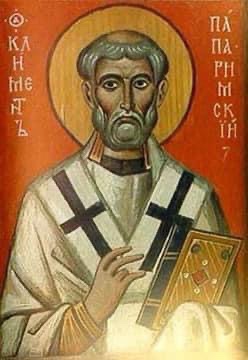
Today the church honors an apostolic pillar whose writings almost (and should have!) made it into the Biblical canon: St. Clement, Theologian and Bishop of Rome.
Little is known about the life of St. Clement, who was probably the fourth Bishop of Rome. He lived and died right around the year 100, and may be the same Clement written about in the book of Philippians (4:3). He was certainly the writer, though, of the Epistle of Clement I (though probably not the Epistle of Clement II).
Ordained by St. Peter, Clement was said to be banished to Crimea during the reign of Trajan, forced to work in the mines. It was there, it is said, that he was tied to an anchor and thrown into the Black Sea (the anchor is his saintly symbol).
But though so little is known about Clement, we certainly know much about his thoughts and his voice. In the year 96 Clement authored a letter from the Church at Rome to the Church at Corinth. This letter is the earliest Christian document we have in existence, with the exception of some New Testament writings, and was written to encourage the Church at Corinth to avoid a schism and remain steadfast to one another. It’s a letter of pastoral advice.
This letter was so widely known, and so widely revered, early manuscripts of the New Testament include it in the canon.
St. Clement is a reminder for you, and should be for the whole church, that not all that is holy is contained in the canon, Beloved.
-historical bits from Pfatteicher’s New Book of Festivals & Commemorations
Today the church remembers a masterful storyteller who wove a tapestry of tales that continue to teach: Clive Staples Lewis, Writer and Dream Maker.
St. Lewis (you know him better as C.S. Lewis, no doubt) was born in Northern Ireland to a barrister father and mathematician mother. After years of boarding schools, he attended University College, Oxford and, after graduation, was appointed as a Tutor and Fellow there, and eventually as Professor of Medieval and Renaissance Literature a Cambridge.
At his heart, he was a writer. Scholarly works, fictional works, essays regarding the state of humanity, C.S. Lewis was born with one pen in his hand and another in his mouth.
As a youth he had rejected Christianity, probably as a rebellion around the death of his mother when he was ten years old. In 1929 he had a conversion experience that eventually led him back to the church in 1931. This journey from atheism to theism to the church was recounted in Surprised by Joy, published in 1955.
As it is with many converts, C.S. Lewis spilled a lot of ink defending the faith. The Problem of Pain, Mere Christianity, and The Screwtape Letters. In these works for art…which they are…he eloquently and imaginatively honors various human realities through the lens of faith.
Most of the world, though, knows him not for his essays, but for his works of fiction and science-fiction. The seven book Chronicles of Narnia and his lesser known Space Trilogy present for humanity a fanciful retelling of Christian faith and morals through a lion who dies yet lives, children who are awake and yet dreaming, honorable mice pirates, witches, and distant planet explorations that are right in your backyard.
It’s widely known that he and his fellow writer, JRR Tolkien, often met to discuss their works over a pint or three. He thought Tolkien was too verbose (he was), and Tolkien thought Lewis was too “on the nose” with his allegories (he was). And yet we’re all better for it all, right?
The works of Lewis that most affected me, though, weren’t any of the above, but two works separated by time yet linked in theme: The Four Loves and A Grief Observed.
In The Four Loves Lewis mines the realities of human love, seeking to make a connection between these loves and the deep feelings of the heart. English is such a limiting language. We only have one word for “love,” and yet many ways of feeling it. Lewis goes deep into analysis around this, offering some clarity to what we feel when we say “I love you.”
In A Grief Observed, though, Lewis is at his most vulnerable, most bare, most thoughtful (at least in my opinion). He wrote this reflection on grief after the death of his wife, Joy Davidman Gresham, after they had only been married four years. Here St. Lewis is less apologist for the faith and more barrister with faith and fairness of life put on slow, subtle trial. Gone is the idealism of the new convert, and in its place we find an honest conversation between C.S. Lewis and a faith that he considered an old friend that kind of let him down (though the work does end on a hopeful note).
It is real. It is honest. And, in my opinion, is required reading.
St. Lewis died on this day in 1963 at his home in Oxford.
One of my favorite notions of his, which I believe to be totally true, is found in The Screwtape Letters where the young demon being tutored by penpal is told that “God only coaxes, and cannot coerce.”
God only coaxes, and cannot coerce.
St. C.S. Lewis is a reminder for me, and should be for the whole church, that story has always been a way that we learn about the Divine.
And always will be.
-historical bits from Pfatteicher’s New Book of Festivals & Commemorations
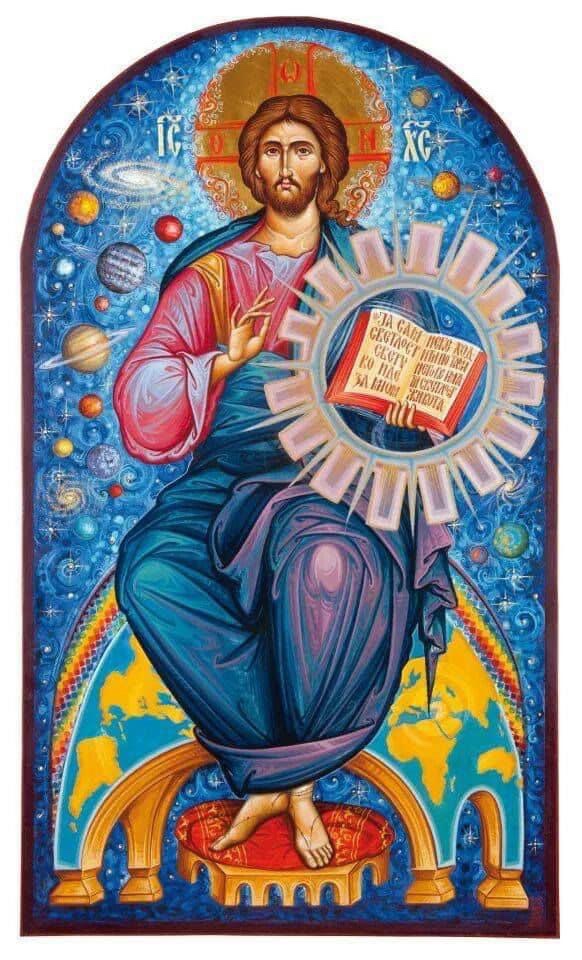
Today the church honors one of our moveable feast days, Christ the King Sunday, also known as Reign of Christ Sunday.
In 1922 the world was still reeling from World War I. Pope Pius XI, in his first official encyclical, said that while war hostilities had stopped, global tension was ever present. He decried the rise of nationalism across the globe.
Gonna say that louder for people in the back: the rise of nationalism across the world was seen as a real and present danger.
So Pope Pius XI, as a call for the church to take a stand against nationalism and extremism, instituted in 1925 that the last Sunday of the liturgical year would be a reminder for the world that our private ideologies and personal saviors will not, in the end, accomplish the peace necessary for humanity to thrive.
Only Divine peace can do that.
Now, I’m not a fan of this particular Sunday. To tag it on at the end of the liturgical year feels forced in many ways, and the readings are totally non-sequitur (though they fit with the theme of the day).
However, when seen through the lens of the original intent, especially in these days, it can be a corrective day for a humanity that is once again in the throes of nationalism, much of it housed in the pews of the church.
Nationalism is anti-Christ. There is no work around here; it just is. It puts hope in nativist ideology and not shared peacemaking.
Christ the King Sunday is a reminder for me, and should be for the whole church, that there was a time when the church took on the rise of nationalism with a full throat.
I happen to share my birthday with the saint day of a young British king, King Edmund of Anglia, Warrior and Martyr.
St. Edmund’s life was short but notable. He ascended to the throne at the age of fifteen. His lands were continually attacked by Viking raiders, and St. Edmund regularly led his soldiers in battle.
In 869 he led those soldiers for one final time against the Danish raiders and was summarily defeated. The Vikings offered peace on two conditions: that Edmund give the Danes half of his treasure and that he become a vassal prince.
St. Edmund agreed to give up half his treasure, but would only become a vassal if the Danes renounced their religion and were baptized.
The Vikings laughed, refused, and decided to use St. Edmund for target practice instead.
St. Edmund was the patron saint of Britain until the Third Crusade, when St. George became the patron protector. Still, he’s widely thought of as a good and brave leader, young as he was when he was killed.
St. Edmund is a reminder for me, and should be for the whole church, that sometimes a leader gets the short end of the stick when they stick to their convictions.
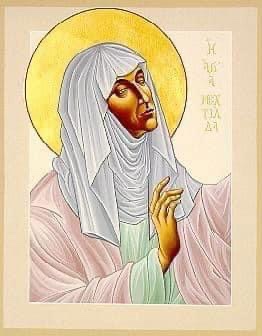
On November 19th three 13th Century German mystics are honored by the church, two Matildas and a Gert: Mechtild of Magdeburg, Mechtild of Hackeborn, and Gertrude the Great, Visionaries of the Church.
Mechtild of Magdeburg (“Matilda” is the Anglicized version of the name) was descended from nobility. She left home in her 20’s to join a Beguine community (a lay sisterhood leading religiously pious lives), and adopted a rigid austerity. She spoke harshly against the excesses of the church and the clergy, believing that greed was corrupting the message of the Gospel. She also believed the clergy were poorly trained and advocated for stricter requirements for the priesthood.
She began having visions and dreams, and wrote them down in a poetic work entitled The Flowing Light of the Godhead, one of the best examples of female authorship to survive the Middle Ages.
Mechtild of Hackeborn was the sister of the Baroness of Hackeborn, and in charge of the monastery school in the area. She was a fabulous instructor (and would instruct Gertrude the Great, mentioned below), who shared her spiritual insight, teachings, and experiences with her students. The work The Book of Special Grace, made public after her death, records these mystical visions as remembered by her beloved students. She loved to sing her visions, being called a “nightingale of Christ.”
Gertrude the Great was entrusted to the Cistercian foundation at Helfta a the age of five, and came under the tutelage of Mechtild of Hackeborn there. She quickly became fluent in Latin, was well educated in the liberal arts, and well read in literature and the sciences of the times. At the age of twenty-five she, too, began having mystical visions and dreams which continued throughout the whole of her life. At their onset she began to study Augustine, Bernard, and Hugh of Clairvaux (interestingly enough, our own Blessed Martin Luther favored these scholars as well). She went on to compose the Legatus Divinae Pietatis, widely considered one of the best products of Christian mysticism.
Gertrude the Great’s mystical visions almost all happened during the liturgy, and she felt that worship was the spring that fed her spirituality.
These three great mystics of the church are a reminder for me, and should be for the whole church, that sometimes the most obscure individuals hold the grandest insights. I’ve long said that the best sermons preached on any given Sunday are preached to less than fifty people.
It’s true.
-historical bits by Pfatteicher’s New Book of Festivals & Commemorations








 Reluctant Xtian