Patron Saint of Social Workers

Today the church remembers the yang to St. Vincent de Paul’s yin: St. Louise de Marillac, Patron Saint of Social Workers and Friend of Those With Depression.

Born in France at the tail end of the 16th Century, Louise encountered many challenges in life. She was born out of wedlock to a mother she would never know and a father who died when she was twelve. Despite the early hardships, she had received an exemplary education, and her uncle was part of the Queen’s Court, which gave her allies in high places…that is until the civil unrest of the time forced his untimely demise.

When her father died, St. Louise went to live with a kindly spinster in town her taught her herbal medicine (Louise was perpetually sick), and from a young age she felt the call to cloistered life.

Unfortunately, cloistered life did not feel the same about her. She was denied entry as a Capuchin, and had to pivot to a plan B for her life. Her family encouraged her to get married, and she stumbled upon Antoine, an ambitious young man whom she would, in time, grow to sort of love.

From their union one child was born, Michel, whom she loved dearly.

But in these days St. Louise still felt much inner turmoil. She had wanted to follow a life of devotion to God, and yet here she was with a husband and child. She felt like she had abandoned her call in life which, along with the failing health of her husband, led her into a deep depression.

Yet, like so many in life, she lived with the depression, tending her ailing husband and doting on her son. I think we would all be surprised to know the number of functioning people living with depression, doing what they must for those they love, even as their insides feel empty…

One day in prayer, St. Louise felt an overwhelming sense of calm. She realized that she must stay with her husband, though she felt a strong call to the cloister still, and should she outlive him, she would refuse to marry and then accept her vows. In this same clarity of purpose, she also said she felt a Divine assurance that a new spiritual director would enter her life.

Soon after she met St. Vincent de Paul, and that, as they say, is that.

Despite her excellent care, Antoine died in 1625. As a widow with a son and without income, she moved into a more modest home, and lobbied for St. Vincent to become her confessor. He eventually agreed, though he was already very busy giving his life away to the sick and infirm in France.

Over the next few years, under St. Vincent’s spiritual care, St. Louise came to see her life attain more balance. She joined St. Vincent in his care for the needy and sick in France, and found both joy and success in the work. At the age of forty-two she went on retreat and received a new vision for her life: she must lean into her vows and start the Daughters of Charity.

Part of the vision was a realization that social class and stigma prevented the upper class from aiding the lower class. Yeah, sure, they sent meals and provided some minor medical care, but the tension between the classes remained and made everyone hesitant to give, and to receive, care.

Plus, St. Louise realized the aristocracy didn’t like the work of caring for the needy…and they were kind of lousy at it, honestly.

So, St. Louise set up a system of care that leaned upon the aristocracy to raise funds, but left the practical hands-on work to a group of sisters who not only identified with those they were caring for, but were trusted by them, too. These women who would come to care for the sick and infirm were usually from rural areas of France, and their unique upbringing made them supremely capable of the task in a way that elite city-dwellers were not.

St. Louise organized these women into formational homes, teaching them practical care and spirituality. Being savvy with governmental regulations, St. Louise began organizing her work to have centralized places of care throughout the city where the medical and social needs of the poor could be handled. She enlisted the help of doctors, nurses, and politicians to have sites set up in hotels, hospitals, prisons, the battle field, and eventually orphanages and mental institutions.

In concert with those doctors and nurses, she created nimble teams of care-givers to provide comprehensive services to those in need.

She, in effect, created a modern-day social worker network.

At the age of 68, St. Louise breathed her last, having set up over 40 places of care throughout France.

St. Louise is a reminder for me, and should be for the whole church, that sometimes being in touch with the difficulties in your own life make you supremely qualified to walk with others through their own difficulties. And yet, it is often those people the church…like St. Louise…rejects at first.

Let those with ears to hear, hear.

In Like a Lion…

March is often a wet and blustery month. In primary school we learned that March comes, “In like a lion, and out like a lamb.”

Though that school was a very strict kind of Christianity, the deep truth that teacher (much beloved by me still) remains: March to the ancient Celts was known as a temperamental month. In fact, those born in March were known to be ones of swings in mood (and their mirror companions born in October are the same).

But with all the drenching wetness of March came a realization that all bodies of water, no matter how big or small, are of a sacred nature.

Water is life, Beloved. The ancient Celts knew this, and often named their waters after the godesses and gods they found gave life. There are still tons of rivers on those ancient islands named after Brigid (the feminine yang to Patrick’s yin) and others.

The amniotic fluid of birth, the well of life, the river of eternal life in scriptures: water was known by those ancestors, and still known today, as the thing that sustains.

This is why the atrocities in Jackson, Mississippi, and still in Flint, Michigan (and yes, Engineers, I realize you say their water meets standards, but the hell they had to go through to get there is still HELL…and it’s not yet all cleaned up), and Palestine, Ohio is just terrible.

Water is life.

It’s why we don’t baptize in whiskey or Coke.

The ancients knew this, and March is the season to embrace the truth.

The world needs to catch up to the ancient wisdom.

On Literalism

“So you’re not a literalist?” he asked me, a smirk on his face. He closed his Bible.

“I’m not,” I said, “and not a fundamentalist by any means.”

“Don’t have enough faith to trust the word of God?” he quipped. “Takes a lot of faith.”

“Actually,” I said, “I think I have too much faith to be a literalist or a fundamentalist. It takes no faith at all to believe something that is right in front of you. That’s easy. You’ll end up thinking nonsensical things, but it’s easy.”

He frowned.

“What’s not easy is trusting that, despite the flaws of the text, the history, and the context, it still has a Divine word stuck in there. What’s not easy is holding that the scriptures say something and that our intellect also has a part to play. What’s not easy is realizing that imperfect people wrote an imperfect document, and yet God stIll speaks through it…”

“But…” he said.

“That takes faith,” I interjected. “Literalism and fundamentalism are the least faith-filled expression of any religious tradition.”

On Dreams

“It’s just like I told you,” she said. “I feel like I’m behind in everything. I’m not where I thought I’d be at this age, at this stage, at this point in my life.”

“I see,” he nodded. “Well, sometimes dreams aren’t realized not because you did something wrong, but because the dream was just that: a figment of your imagination.”

“But it feels like I messed up. Like others are realizing their dreams, and I’m deficient.” She put her head down.

“The great thing about dreams,” he said, “is they’re new every night. Dream a new dream. That other one has grown stale. You’re not the same person who dreamed it long ago. You’ve changed.”

She sighed.

“It’s ok to dream a new dream,” he said, as he put his arm around her. “The important thing is to keep dreaming.”

O, The Lord is Good to Me…

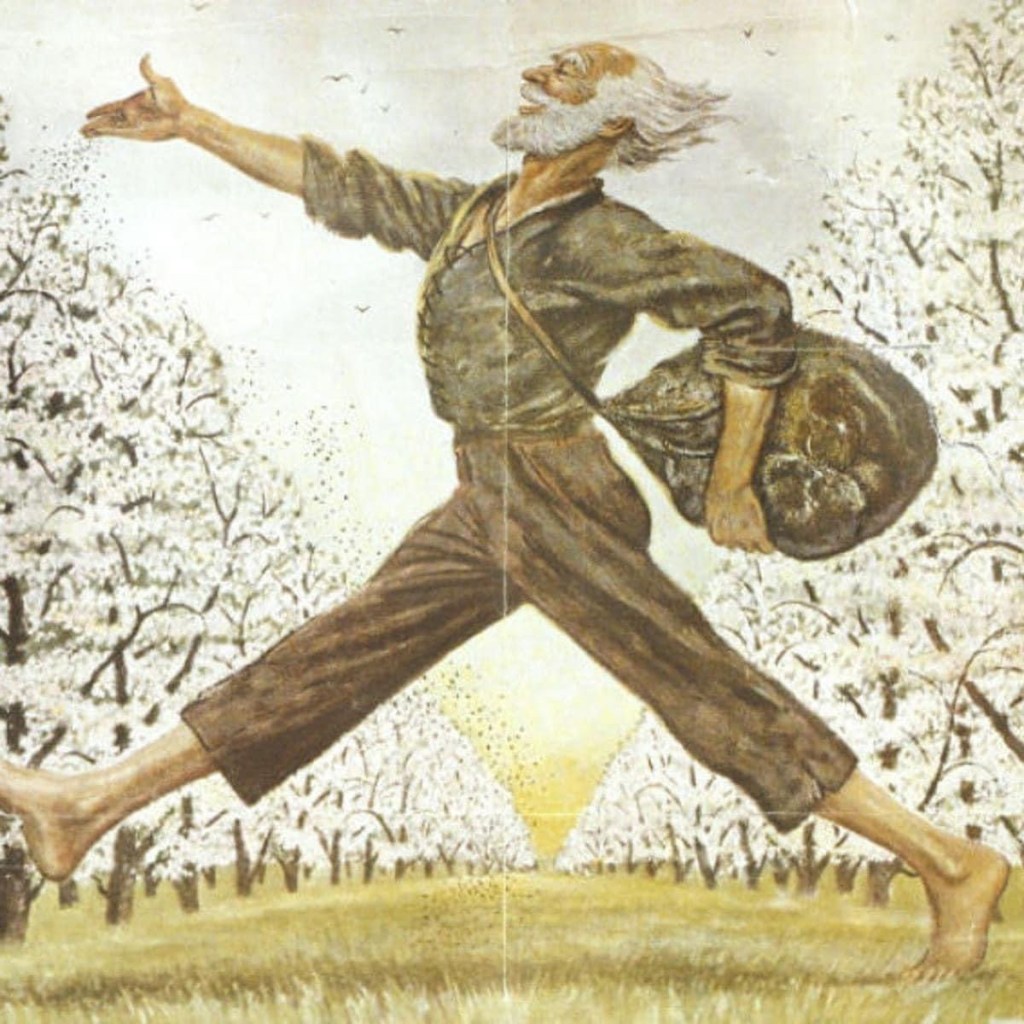
Today we remember a legendary (literally) character in Americana: Johnny Appleseed, Evangelist and Erstwhile Ecologist.

Born John Chapman in the late 18th Century, Johnny’s mother died at a young age leaving him and his infant sister in the care of their father, a Minuteman who fought at the Battle of Bunker Hill.

At the turn of the 19th Century a young adult Johnny shows up in Pennsylvania, tossing around apple and pear seeds like they’re confetti at a ticker-tape parade, espousing the philosophical and religious teachings of a certain Emanuel Swedenborg, a Swedish spiritual teacher.

Yeah. All you forgot about that, didn’t you?

Because he carried around these seeds and threw them everywhere, wanting to “provide shade for all travelers,” Chapman became known as Johnny Appleseed. But chiefly he was a religious fanatic (not in a bad way, just was), preaching the Swedeborgian philosophical beliefs as he went along. With a pack of apple seeds you also got a free religious pamphlet, as if to say, “Please, throw this away for me.”

As unusual as his journey was, his dress was just as odd for the times. Like a mirror of John the Baptizer, Johnny traveled barefoot with a broad-rimmed hat, to keep the sun out of his eyes. He traveled largely by horseback or canoe, and lived off of the extreme kindness of strangers who found a place for the young evangelist at their supper tables.

Though Johnny’s birthday falls in September (and some heretics honor him in that month), the sane Americana-lovers like myself prefer this March date because now is the time of planting.

Do yourself a favor and check out Swedeborgian churches. There are some still in the United States, though it’s a quickly-shrinking religion.

One final note, and this is worth remembering: though Johnny Appleseed dressed funny and espoused an unusual religious creed, most every legend or personal account of him notes his pure kindness.

Honestly: despite all our quirks, if we’re remembered just for that…that’s a pretty good life.

“Oh, the Lord is good to me, and so I thank the Lord,
for giving me the things I need: the sun, and the rain,
and the apple seed.
The Lord is good to me. Amen!”

Fierce Protector of Humanity

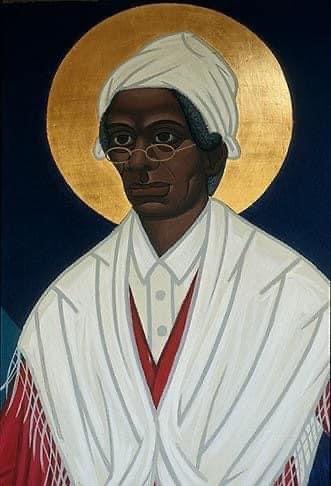
Today the church remembers a 19th Century saint who deserves to be remembered much more widely than she is: St. Sojourner Truth, Abolitionist, Voting Rights Activist, and Fierce Protector of Humanity.

Born in New York under the name Isabella Bomfree, St. Sojourner was bought and sold four times by people who thought they could own other people. At 15 she was joined with another slave and birthed five children, eventually fleeing slavery with her infant Sophia to take shelter with an abolitionist family. That family bought her freedom for $20, and helped her sue to have her son Peter returned to her after he was illegally sold to a family in Alabama.

St. Sojourner Truth moved to New York City and, joining the Black Church movement there, became a charismatic speaker and preacher, proclaiming in 1843 that the Holy Spirit had called her to be renamed Sojourner Truth. In New York City she joined forces with Frederick Douglass and William Lloyd Garrison in decrying the demonic pandemic of slavery that spread across the land. She also began speaking out for women’s suffrage, taking up the mantle with Susan B. Anthony.

In 1851 she went on a national tour in the North, famously delivering her “Ain’t I a Woman?” speech at a women’s suffrage conference in Akron, Ohio. At six feet tall, St. Sojourner brought the audience to attention by pointing out both her strength and femininity make her extremely powerful in equal measure.

St. Sojourner eventually settled in Battle Creek, Michigan to be near her three daughters and help them raise their families. From her outpost in Michigan she continued to preach, speak, and help fleeing slaves escape to the North by providing safe harbor. As the Civil War began, St. Sojourner encouraged soldiers to join the cause of freedom, and became a gatherer of supplies for black Union troops. Because of her efforts, many black regiments were outfitted in ways that the neglectful Northern Army reserved only for white regiments. After the war she was invited to the White House to meet President Lincoln, and began on a new course in life to help the freed slaves find jobs in a fractured America.

Having spent her life as an advocate for others, St. Truth died in 1883 having used up most of her physical faculties (she was both hard of hearing and legally blind at death), but retaining her mental tenacity.

St. Sojourner Truth is a reminder for me, and should be for the whole church (and all people), that the moral arc bends toward justice, but the Divine calls upon all of us to aid in the bending, by God.

Even if it takes a lifetime.

My favorite quote by St. Sojourner is,

“That man say we can’t have as much rights as a man ’cause Christ wasn’t a woman. Where did your Christ come from? From God and a woman. Man had nothing to do with it.”

-historical bits gleaned from entry in the National Women’s History Museum

-icon from St. Gregory of Nyssa Episcopal Church, San Francisco

Women Led the Way

Today the church honors Perpetua and Felicity, 2nd Century North African martyrs arrested just as they were preparing for baptism.

In Perpetua’s writings we have the earliest confirmed first-person account of a woman’s journey with the faith, especially her last days waiting for execution.

It’s poetic that her name means “unending,” and Felicity’s “articulate” as we see their story continue through the women who journey in the faith today, especially as Deacons, Deaconesses, and Pastors, who serve with distinction and articulation.

And using their life as a lens, we can also hear the cries of the women who are arrested or otherwise obstructed from obtaining those things they greatly desire and work hard for: promotions, border crossings, equitable pay, voting rights, and freedom.

Perpetua and Felicity are usually depicted together, often embracing, as they had a deep friendship, and perhaps even a partnership.

St Perpetua and St Felicity are another reminder for me, and should be for the whole church, that women led the way in the ancient church, and still do today.

Breakthrough Month

March is, for the ancient Celts, the second month of Spring.

It may be odd to see it as that, especially as so much of the Northern Hemisphere continues to be frozen, and much of it under snow. But the ancient Celts understood that growth happens even if you can’t see it, and that March would be the “break-through” month for much of creation.

It would literally break through the ground in bits and pieces.

I remember one March in Toledo, Ohio, listening to the radio as the snow fell on a Sunday night. Those wonderful words I had longed to hear finally came out of the announcer’s mouth, “No School for Trinity Lutheran Church and School,” and my brother’s and I cheered from our beds that we’d have a snow day that next day.

And as I lay in that bed and looked out the window, I saw the large tree next to my window, snow-covered, with small buds hanging off the branches.

It was ready to bloom, even as a blanket of ice and snow covered it.

And I remember feeling both glad for no school, but also quite sad for that tree that was ready for a break-through, and I resolved at that moment not to wish or pray for anymore snow that March, even if it meant no more snow days, so that tree could have a chance.

A quaint little story, for sure. But impactful for me. I had both extreme naivete (as if my prayers had caused or hastened snow), and some profundity, feeling connected with nature and a responsibility to allow it to do its thing.

March is the break-through month. The vernal equinox will balance life for a bit. The Earth will feel more and more alive with each day.

March is associated with the ash tree. In Nordic mythology Yggdrasil, the world tree, was an ash tree. It represented for the Celts the connection between the heavens and the earth, and in the month where the light and shadows balance for a moment, it makes sense they’d choose this tree.

We can meld our intentions with that of creation and allow each and the other to “do its thing.”

Plant the seeds you’re waiting to sow.

Stick daffodils behind your ear (a common practice for the ancient Celts to honor the Spring).

Embrace a new idea, aligning your inner life with the outer burgeoning life around you.

March is the break-through month.

What is breaking through for you?

On Methods

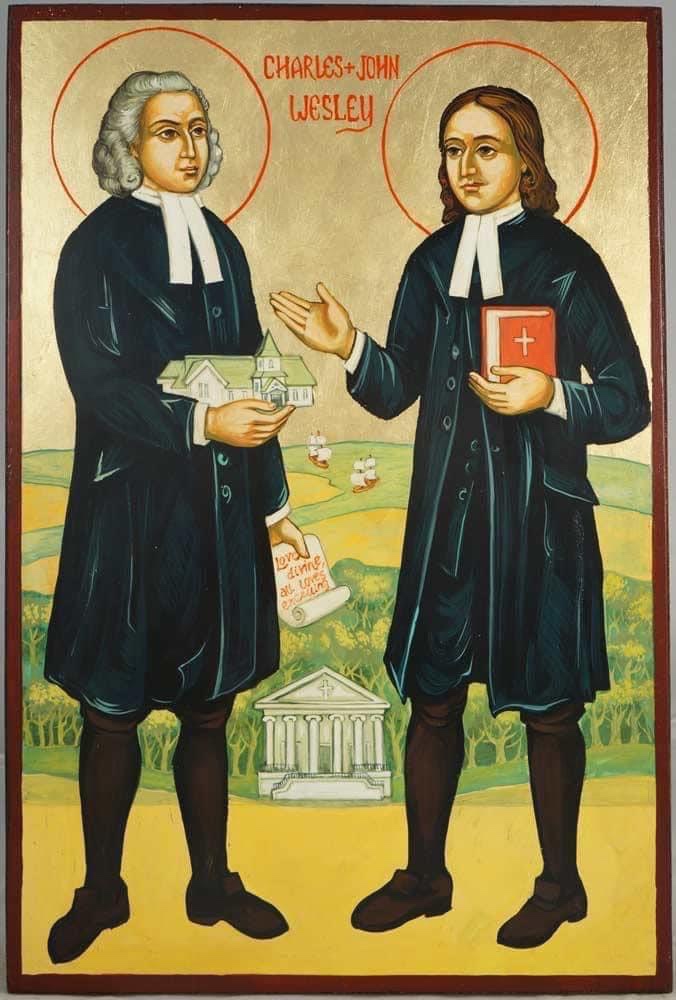
Today, March 2nd, the church remembers brothers John and Charles Wesley, renewers of the church.

John was the 15th child of Susanna and Samuel Wesley, and Charles was the 18th, born in England. Both were ordained as Anglican priests in the early 18th Century, in the midst of a serious decline in the Church of England, both in influence and conversion.

John and Charles grew dissatisfied with the religious life they were instructed in, and Charles started the “Holy Society” at Oxford comprised of those intent on finding a deeper and more meaningful way of spiritual living. They focused on frequent communion, prayer, spiritual practices like fasting, and service to the poor and disenfranchised.

This methodological way of doing things led others to disparagingly call them “methodists.”

The name stuck.

Charles and John were sent to evangelize in Georgia in the 1730’s, primarily to the colonists and the Indigenous Peoples. Their insistence on denouncing both slavery and gin, however, didn’t sit well with the colonists.

Both joined the Moravian church, having experienced an inner conversion. This sparked the 18th Century Evangelical revival, and the brothers eventually began their own order of Christianity, a “Methodist” way of being in the world.

Charles became an accomplished hymn writer; John an antagonistic writer and theologian, not unlike Martin Luther before him, pushing the church onward. Both were often met with hostility and derision for their thinking and work, which bucked the status quo of the church of the day.

They are a reminder to the church that what at first might seem unorthodox and detrimental may, at length, be just what the church needs for revitalization, renewal and, yes, reform.

-historical notes gleaned from Pfatteicher’s New Book of Festivals & Commemorations

Nothing Spectacular

On March 1st the Church remembers a saint who is notable for nothing spectacular…and in that, he is worth remembering: Saint George Herbert, Parish Priest and Poet.

George Herbert was born at the end of the 16th Century in Montgomery Castle. Raised by his mother (who was friends with the influential John Donne), he was handsome, witty and a wonderful scholar.

Befitting his skills, he entered Parliament but found political life to be, well, unsatisfying. Having befriended Nicholas Ferrar and the Little Gidding community, he took up studying Divinity and became a deacon of the church in short order.

In April of 1630 St. Herbert was instituted as the rector of the (very British-ly named) St. Peter’s Fugglestone, and also St. Andrew, Bemerton. These yoked parishes were small and full of salt-of-the-earth folks who not only loved “holy Mr. Herbert,” but received his tender care and attention, too.

Though his congregations were largely illiterate, he took to teaching them with fervor. The Mass, the Catechism, hymns, and spiritual songs, St. Herbert relished these people and they, him, often putting down their work tools at morning and evening when the bells tolled, knowing that St. Herbert would be in prayer (and they joined him from the blacksmith shop, the field, and the wash basin).

Unfortunately St. George was plagued with ill health his whole life, and on March 1st in 1633 he died of consumption and was buried under the altar at St. Andrew parish.

His poetry was published shortly after his death by his friend, Ferrar, under the instructions to publish them if they were any good, but burn them if they were lacking.

They were published and are considered 17th Century British works of art.

St. George Herbert is a reminder for me, and should be for the whole church, that sometimes just doing your work with care and attention is laudable enough. I still contend that the best sermons on a Sunday morning are heard by less than fifty people.

-historical bits from Pfatteicher’s New Book of Festivals & Commemorations