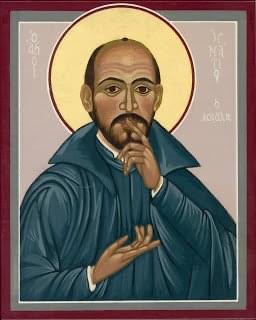
As the sun rises, it’s worth noting that the church honors a 20th Century saint on this day who worked hard to unify the quarreling factions of the body: Saint Nathan Soderblom, Archbishop of Uppsala, Unifier of the Church.
St. Nathan was born in Sweden at the end of the 19th Century to a family helmed by a pietistic pastor father. He was ordained a minister in the Church of Sweden in 1893, and served as chaplain to the Swedish legation in Paris until 1901. While in Paris he studied comparative religion, and his mind and heart was expanded.
Upon receiving his doctorate he taught History of Religion at Uppsala while also lecturing in Leipzig. He was known for being highly intellectual, highly liturgical, and highly progressive in his theology.
Despite opposition from more conservative pastors, he was elected the Archbishop of Uppsala and Primate of the Church of Sweden. In his leadership and his writing he sough what he called “evangelical catholicity,” encouraging different factions of the church to work together for the social good.
You might remember a similar agreement between St. Peter and St. Paul…
Through his leadership and efforts the predecessor bodies that would eventually become the World Council of Churches began to form and do their work.
During World War I he vehemently sought the freedom of prisoners of war and refugees, arguing for peace on behalf of the people. In 1930 he won the Nobel Prize for peace.
He died on this date in 1931.
St. Nathan Soderblom is a reminder for me, and should be for the whole church, that education not only expands the head, but also expands the heart, and a church that can agree to serve the poor is like a tree standing by the water.
It shall not be moved.
Now, if only it could agree to that…
-historical notes from Pfatteicher’s New Book of Festivals & Commemorations
Today is the saint day of a patron who is near and dear to my craft-beer loving heart: Saint Arnold, Beer Brewer and Savior of Humanity.
So, here’s the thing about St. Arnold: he is an unlikely saint, as most are, but not because he did things wrong, but because he did them correctly.
He started his career in life as a soldier near modern day Brussels, but ended up at a monastery in France, learning beer brewing from the brothers. He rose to become the Abbot of Medard’s Abbey, though he tried to flee from the responsibility. Lore has it that he ran from the cloister and wolf chased him, hunted him down, and convinced him to go back and serve the vocation.
That’s a fun call story if I’ve ever heard one…
Instead of being OK serving this monastery in France, he chose to found his own in Oudenberg, and there began brewing beer in force. The people of Oudenberg were being plagued by infested water, probably from human waste dumped too close to the local water source, and encouraging them to drink the beer rather than the water actually saved lives.
Plus, this beer was low gravity, giving them the ability to do their work well while also staying alive. A plus in my book.
This blessed saint is still honored in Brussels on the “day of beer,” as a reminder that sometimes when the local water source is contaminated, some boiling (and hops) will be the cure.
Saint Arnold is for me, and should be for the whole church, that no topic is as simple as “good or bad,” and sometimes science in the kitchen can lead to health in the streets.
Today the church remembers a saint who fought hard to move the needle of justice, especially for his poor neighbors in Turin Italy: Pier Giorgio Frassati, Social Reformer and Activist.
Saint Pier was born in 1901 to an agnostic father and artistic mother. His father would go on to serve in the Italian government, and his mother would go on to produce artwork that would be bought by royalty. Saint Pier, though, had his eyes set on adventure and advocacy.
As a young boy a mother and shoeless son came begging at the Frassti household. Pier answered the door and, so moved by the sight, gave the young boy the shoes off of his own feet. One night he witnessed a beggar come to his door intoxicated, and was horrified when his father sent him away with nothing. Sobbing Saint Pier ran to his mother who wrapped some food in a napkin for him, and sent him out into the night to find the hungry man.
For as big of a heart Saint Pier had, he also had a wonderful sense of humor. He would play practical jokes on his family and friends, and earned the name “Terror” for his wisecracks.
Though he was a smart boy, he was only an average student, and rather than find his home inside books, he found it inside the organizations working for justice. Especially dear to his heart was the anti-fascism work going on in the day, and those causes seeking to bridge the inequality gap. He spoke out against the regime of Mussolini, and was arrested for protesting alongside the Young Catholic Workers Congress.
“Charity is not enough,” he was known to say, “we must have social reform!”
His friends called him a “saint with a cigar,” as he marched, wrote (riffing off of Thomas Aquinas and St. Catherine of Siena), and spoke out against injustice.
In his leisure time he was an avid athlete, boating and mountaineering with his friends.
On one such boat trip in 1925 Saint Pier started to complain of a back ache. Returning home he was met with the death of his grandmother. Not wanting to add to the grief, he kept his pain largely to himself, though it grew in the following days.
Within a week Saint Pier found himself unable to rise from his bed, stricken at the age of 24 with Polio. He died in the arms of his mother, saying with his last breath, “May I breathe forth my soul in peace to you…”
Saint Pier is not a well-known saint, but is one who reminds me, and should remind the whole church, that moving the needle on social inequality often begins in the compassionate hearts of the young.
Which means we should listen to the young, as uncomfortable as that might make us.
-historical bits gleaned from 365 Saints by Koenig-Bricker
-icon written by Theophilia of Deviant Art (deviantart.com)
As we break into July I’m reminded that the ancient Celts always felt that they had two homes: the “inside house,” and the “outside house.”
In the winter months the hearth became their sun, and the family gathered around it to live well.
But from May-November, they didn’t need the false sun of the hearth, and their world (literally) revolved around the burning star that provides us life and light. The “outside house” was all creation, every living thing not within four walls.
They called this “outside home” the “house of light.”
In July they would sit in the house of light, outside, to learn: how to grow, how to use the light offered you free of charge, how to rise early, and how to retire as the sun retired.
We’d do well in these days to find ways to imagine our lives being between two houses, I think…and being able to learn what is taught in July.
Today the church honors a proto-Reformer who, had the printing press been available during his life, may have caused all of us to be called “Hussians” rather than Lutherans: Jan Hus, Martyr, Gadfly of the Church, and prelude to Luther’s Reformation.
Jan Hus was born “Jan of Husinec” sometime around 1373 to peasant parents in Bohemia. He was fortunate to attend the newly established Charles University in Prague, where students shortened his name to “Jan Hus”…which was funny because “hus” literally means “goose.”
St. Jan, that wild goose, would go on to receive his Masters Degree and eventually teach Theology at Charles University while also being named the preacher of the Chapel of the Holy Innocents of Bethlehem. In that church he preached in Czech, a drastic departure from the Latin used in the rest of Christendom. But in these days the church was in conflict (three Popes claimed the Chair of St. Peter), and reformation was in the air!
St. Jan had been greatly influenced by that other rascal, John Wycliffe, who had truly formalized much of the radical thinking that Luther would glom onto in the Reformation. Though Jan and John differed in many areas, St. Jan began to be more Wycliffian in his preaching and writing, including condemnations of the abuses of the church (and her lazy priests) in his regular sermons.
This, as you can imagine, was a problem for the Archbishop.
St. Jan did crazy things like, oh, suggest that the bread AND the wine could be provided to the laity in the Mass. He openly questioned the historic episcopate, and started to advocate for only two sacraments (baptism and communion) to be officially recognized.
Sound familiar?
Pope Alexander V condemned Wycliffe’s writings in 1409 and, in short order, excommunicated St. Jan in 1412. Interestingly enough St. Jan was not excommunicated for his own writings, but rather because he refused to travel to Rome to give an account of them. Basically, he didn’t show up to court…
St. Jan Hus refused to be quiet, though, and even as a heretic of the church preached against the avarice the local priests showed. He was summoned to the Council of Constance in Switzerland in 1414 and, though he had been promised safe travel back to Bohemia after his trial, was immediately arrested, held in the dungeon there, brought up on false charges, and burned at the stake.
It is said that he was praying the Kyrie eleison as he died.
St. Jan Hus is a reminder for me, and should be for the whole church, that sometimes not saying something is not an option, even if it costs you your job, your status, and yes, your life.
-historical bits gleaned from Pfatteicher’s New Book of Festivals & Commemorations
Today the church (should, in my opinion) remember one who has long been venerated as a contemporary folk saint, and is now remembered more broadly throughout communities both religious and secular: Saint Denmark Vesey, Carpenter, Community Organizer, and a Founder of Mother Emanuel Church.
Saint Denmark was born into slavery on the island of St. Thomas under Captain Joseph Vesey. Following Captain Vesey throughout the islands, Saint Denmark eventually landed in Charleston, SC and, having won a lottery option, was able to buy his freedom. Unfortunately he was unable to buy the freedom of his first wife, Beck, and their children out of slavery, despite being a very good businessman.
Saint Denmark made his living as a carpenter and was quite skilled. He also grew influential in the Black community both in Charleston and on the surrounding plantations. It should be remembered that by the early 1700’s the population of South Carolina was majority enslaved. Black power was kept in check by intimidation and violence.
Saint Denmark knew this. He saw this. He saw the potential for an uprising, and knew he couldn’t sit still and continue to let his enslaved siblings toil for riches they’ll never see and dignity they’d never be able to earn.
Saint Denmark became very involved in the Black Church in South Carolina, even founding a free African Methodist Episcopal church in the city now known colloquially as Mother Emanuel. Both within the church and through his business he gathered support for an uprising against the powerbrokers and plantation owners that was so massive both with influence and scope, it shook the status quo to its core.
In 1821 plans were made for a mass revolt. Using his skills as a lay preacher, Saint Denmark went over plans for the community action in the classrooms of churches throughout the city, primarily at Mother Emanuel and Second Presbyterian. In the churches the plans for freedom were made, Beloved. Saint Denmark invoked the story of the Exodus in his meetings, weaving the story of the enslaved person in Charleston with that of the enslaved person in Egypt.
Plans were put in motion and, being influenced by the French, Bastille Day (July 14, 1822) was chosen as the date. They would all converge on the Meeting Street Arsenal and, once they took control of the weaponry, would commandeer ships and set sail for Haiti freeing slaves along the way.
Because this planned revolt had gained so much support and attention, word slipped out regarding the details. Even after Saint Denmark moved up the date of the insurrection, the wheels of power were already getting set to crush the leaders, and crush them quickly.
Mayor James Hamilton of Charleston quickly formed a militia and rounded up the key conspirators. After his arrest and quick death sentence, Saint Denmark told his pastor, “I will die for a glorious cause.”
Saint Denmark Vesey died on this date, July 2nd, 1822, by hanging in Charleston, South Carolina.
In 1990 African-American residents of Charleston proposed erecting a monument to Saint Denmark, memorializing how he tried to overturn slavery in this city. Many white patrons balked at the idea, noting that they did not want to commemorate one who they considered “a terrorist.” I mean, let’s totally IGNORE the Confederate statues that dot the city landscape (confirmed terrorists), but, whatever.
Racism is alive and well, Beloved.
Saint Denmark Vesey is a reminder for me, and should be for the whole church, that liberation has always been talked about in the Sunday School rooms of our churches…
We just don’t like to talk about it and conveniently have amnesia when doing so makes us uncomfortable and we’re the ones who have to change in order for liberation to happen.
Let those with ears to hear, hear.
-historical bits gleaned from publicly accessible information and Illes’ work Daily Magic.
-statue of Vesey below was finally erected in 2014 in Hampton Park, Charleston, South Carolina. Ed Dwight was the American sculptor.
Today the church remembers a translator of hymns (and, particularly, one of my favorite hymns), Catherine Winkworth, 19th Century poet and hymn writer.
Born in London in the 1820’s, Catherine would grow up with a deep appreciation for music. Her first work would be published when she was in her 30’s, a translation edition of German hymns, Lyra Germanica. It was immensely popular, churning out five editions in just a few years. She was seen as someone with the rare ability to keep the spirit of the German lyrical genius even when translated into English.
Her skill in translating German into English while retaining the essence, not just the literal word of the text, would lead her to become one of the premier translators of her time.
She was also a staunch advocate for women’s rights in the 19th Century, eventually becoming the secretary of the Clifton Association for Higher Education in Clifton, England, and a member of Cheltenham Ladies’ College.
Catherine and her sister, Susanna, were delegates to the German Conference of Women’s Work, presided over by Princess Anne.
At the age of 51 Catherine died suddenly of heart disease on July 1st, and a monument to her was erected in Bristol Cathedral.
It’s interesting to note, especially for those of us from Reformation backgrounds, that while men are known to be the “great translators” of ancient Greek and Latin hymns, the authoritative translators of post-Reformation German hymns were almost all women, including Catherine Winkworth.
My favorite hymn of her translation, and one we sang often around Thanksgiving here in the States, is ELW 839, “Now Thank We All Our God.” The second verse reads:
“Oh, may this bounteous God through all our life be near us, with ever joyful hearts and blessed peace to cheer us, and keep us all in grace, and guide us when perplexed and free us from all harm in this world and the next”
Winkworth is a reminder to me, and should be a reminder to the church, that when it comes to theology, to scripture, to “God-talk,” the literal will never do. We must capture the essence, lest we lose ourselves in the particulars. God is found between the words, between the notes, between the letters even…not in them.
-historical bits gleaned from Pfatteicher’s New Book of Festivals & Commemorations
Calling all my Swedish friends! Today’s saint day is for you!
Today the church remembers a 19th Century saint who put pen to paper and out came some wonderful hymns and brooding poems: Saint Johan Olaf Wallin, Hymnwriter, Archbishop, and Restless Existential Wrestler.
Saint Johan was born in Stora Tuna in the late 1700’s and, despite being a sickly child, graduated from the University of Uppsala in 1799. He would go on to receive his doctorate of theology ten years later, and began serving as a parish priest in Solna.
Being a bright and capable pastor, he quickly became a bishop, a chief royal preacher of the King of Sweden, and then shortly before his death was consecrated Archbishop of Uppsala and Primate of the Church of Sweden.
Though he was a great pastor, he was an even better hymnwriter and poet. In 1805 and 1809 he was awarded the highest award for his poetry by the Swedish Academy, and during his life he composed and published a number of hymnbooks containing older hymns he adapted and new hymns he wrote. He was entrusted in editing the new Swedish hymnbook to replace the old one (which had been around since 1695…and people think we hang on to old texts!), and basically did the collecting, editing, and revising the whole thing because the committee assembled couldn’t agree on any drafts (sounds like church work).
King Karl XIV authorized the new Psalmbook (it’s name) in 1819. It included five hundred hymns, a fifth of which were written by Wallin himself.
The Church of Sweden used this hymnbook for over a century. In the next edition (1937) a third of the hymns were still written by Wallin.
On the personal side, Wallin was known as a brooding and rather “stormy-clouded” individual. He wrestled with life, and published an epic poem of restlessness, “The Angel of Death,” written during the cholera epidemic in Stockholm in 1834. He completed the poem just a few weeks before he died on June 30th, 1839 at the age of 60.
You’ve no doubt sung some of his words, and in the Lutheran Church in America’s hymnbook (SBH) his Christmas hymn “All Hail to Thee, O Blessed Morn” was put to Philip Nicolai’s (see October 26th for his saint day) well-sung tune, “Wie Schon Leuchtet.”
Saint Johan is a reminder for me, and should be for the whole church, that beautiful, wonderful, thoughtful people wrestle with life and death.
Indeed, without such wrestling we’d never have real poetry or music that speaks to the soul. Indeed, as Saint Elton of the John’s notes, “Sad songs say so much…”
-historical notes from Pfatteicher’s New Book of Festivals & Commemorations
Today is a Feast Day for the church unlike most others in that it is a day where the church has, in death, tried to reconcile two saints who didn’t get along well in life.
Today is the Feast of Sts. Peter and Paul, Apostles, Arguers, and Erstwhile Frienenemies.
Simon, later renamed Peter, was identified as the rock upon which Christ would build the church. He’s a clear leader from the start, though imperfect, and took the helm after Christ’s ascension. He would become the first Bishop of the church.
Saul, later renamed Paul, was a rogue leader from the beginning. He had a vision for the Gospel that was not bound by ethnicity, race, or creed, and he pushed the boundaries the emerging religious leaders were erecting around this new wave of spirituality. He would become the first superstar of the church.
Peter and Paul did not get along well. Their quarrels are documented in the Acts of the Apostles, as well as the book of Galatians, with varying degrees of agreement between the texts. Their back-and-forth is emblematic of the kind of push-and-pull that the church would face when love for others met the hard barriers of cold doctrine and group identity.
I mean, this still goes on today.
Paul and Peter eventually did agree on one thing: that they would each continue to serve the poor. And they each did secure their own, separate, feast days around specific events in their lives: Peter’s Confession (January 18th) and Paul’s Conversion (January 25th).
But the church would not let their feud last forever and, after their deaths, decided to reconcile them on a single feast day. Most icons even have them kissing, or at least embracing, imagining that their honest love for the faith would overcome their seemingly honest contempt for the other.
Their issues in life would not follow them past the grave.
Maybe that’s one of the most beautiful things the church can offer a world as divisive as this one in these days: the chance to continue to work on loving and being loved even past the grave.
-historical bits gleaned from Pfatteicher’s New Book of Festivals & Commemorations, the Book of Acts, and because I study.
Today the church honors a Second Century Bishop known for fighting dualism and promoting peace, especially between the Eastern and Western churches: Saint Irenaeus, Bishop of Lyons, Writer, and Wise Leader.
Saint Irenaeus was a student of Saint Polycarp (check out February 23rd for more info on him). This is significant only because Polycarp was a disciple of Saint John the Apostle. In other words, Irenaeus knew a guy who knew a guy who knew Jesus…which is kinda cool.
We don’t know a whole lot about Irenaeus as a young boy, but as an adult he finds himself in Gaul at the frontier of the Empire under Marcus Aurelius. He was eventually elected as Bishop of Lyons, a city seen as the gateway to the outer territories, and Christianity grew quickly amongst the Greek speaking population living there.
He was known as a wise Bishop, and fought hard against Gnostic dualism (light vs. dark/good vs. evil/revelation vs. secret knowledge), and fought hard to keep Pope Victor from excommunicating the Eastern Church because they chose to celebrate Easter according to the Jewish calendar.
He died just at the turn of the Century around the year 202 AD.
One interesting note about Irenaeus is that, unlike many of his contemporaries, when he wrote against a heresy or a theological tenet he thought was untrue, he did so by offering positive alternatives rather than scathing critiques. He also felt theology should steer clear of confusing insider language, and focus on the core basics handed down by the emerging tradition: scripture, good order, and the creeds still in development.
In this way he may be the first Lutheran, honestly.
Saint Irenaeus is a reminder for me, and should be for the whole church, that sometimes a positive construction goes much farther than a blistering criticism. History will hug the former and shake its head at the latter in due time.
My favorite quote of this wise and wily theologian is, “The glory of God is the human being fully alive; the life of a human being is the vision of God.” (Book 4.20.7)
-historical bits gleaned from Pfatteicher’s New Book of Festivals & Commemorations