As our days grow darker and colder, I’m drawn again to my Celtic past and the rituals of these days.
Have you ever bobbed for apples at a Halloween party?
This game is actually ancient, and hails from the Celtic Christians who married the practices of the past with the realities of the present.
The apple was known as the fruit of temptation in Christian circles, but was also a harvest fruit. In the ancient Celtic world, you’d bob for apples to determine who would be married next. The person with the fruit would be visited in their dreams by their true love.
When Christianity came to the Celts, the game took on a more festive Biblical character, as it was associated with the idea of temptation in the days of shadows. Lust, after all, was bad…right?
On the Autumnal Equinox, my mind is brought back to those ancient Celts who knew the Earth was not just alive, but provided us with secrets on how to live.
Balance, Beloved, is more than hard to find…it is also hard to keep. The Earth only finds it twice a year, and is only able to keep it for 24 hours at a time.
But when it does, everything changes!
At the Vernal Equinox the world springs forth with color and newness.
And today? Well, Camus said that Autumn is a “second spring,” where “every leaf is a flower” beginning to blaze.
For the Celts, with over half of the fields cleared by now, it was time to take stock of the harvest, both within the barn of the heart and the barn outback. They would prepare for winter, using what the year so far has given to plot the next phase of life.
Blessed Equinox! Lean into the balance a bit, and learn how to live.
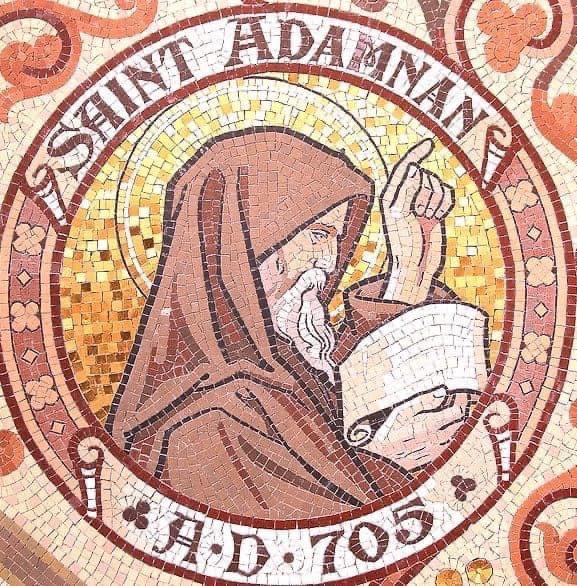
Today the church remembers a Celtic saint who, while kind of obscure, had an impact for generations to come: Saint Adamnan of Iona, Abbot, Law Writer, and Arranger of Calendars.
Saint Adamnan was born in the early 7th century in what is now County Donegal in Ireland, and was related to Saint Columba on his father’s side. He grew up in the Celtic expression of Christianity and was schooled far beyond most any Celt, average or noble, in his day.
Eventually, after entering the priesthood, ordination, and extensive education, he ended up at the famed Abbey of Iona, begun by his ancestor Columba himself. It was there that he eventually took over as Abbot and penned the most extensive work on Saint Columba, as well as the most in-depth work on the ancient Scots (the Picts) that we have today, The Life of Columba.
But that wasn’t all that he wrote.
He was very interested in justice and human rights, and proposed what came to be called, “The Rule of Adamnan,” essentially an argument that, in warring times, women and children should be spared, and that non-combatants should not be held prisoner. His “rule” sounds very similar to modern Geneva Convention rules of war.
In his role as Abbot, he traveled around what is now the British Isles, visiting different parishes as good Abbots do. In South Briton (Britain) he encountered a strict Roman adherence to custom and calendar, which chaffed a bit against his Celtic understanding of the faith. Nevertheless, he believed the church should be one, and while he was unwilling to give up much of his Celtic Christian practices, he argued that one thing the church should agree on was a common Easter festival.
See, the Roman expression of the faith celebrated Easter on 21 Nissan, but the Celtic expression had continued with the ancient way of celebrating Eoster, the “spring festival,” on 14 Nissan. Intermingled with the empty tomb they put their ancient symbols of spring and new life: eggs (often painted), hares, and sweet rolls (often a gift to the goddess of spring). These symbols were also seen in the spring festivals of many ancient peoples.
Those sweet rolls, by the way, became hot cross buns in the hands of the church…
So while the eggs, rabbits, and rolls could remain, St. Adamnan argued mightily that the Celtic Christian expression should adopt the same date for Easter that the Roman expression was using, further unifying the faith.
In time, his argument won out, and the festival date changed (though the Celtic traditions remain to this day!).
St. Adamnan is a reminder for me, and should be for all people, that compromise is not only possible, but often an important step in unity.
Unity does not mean uniformity, and we’ve forgotten that.
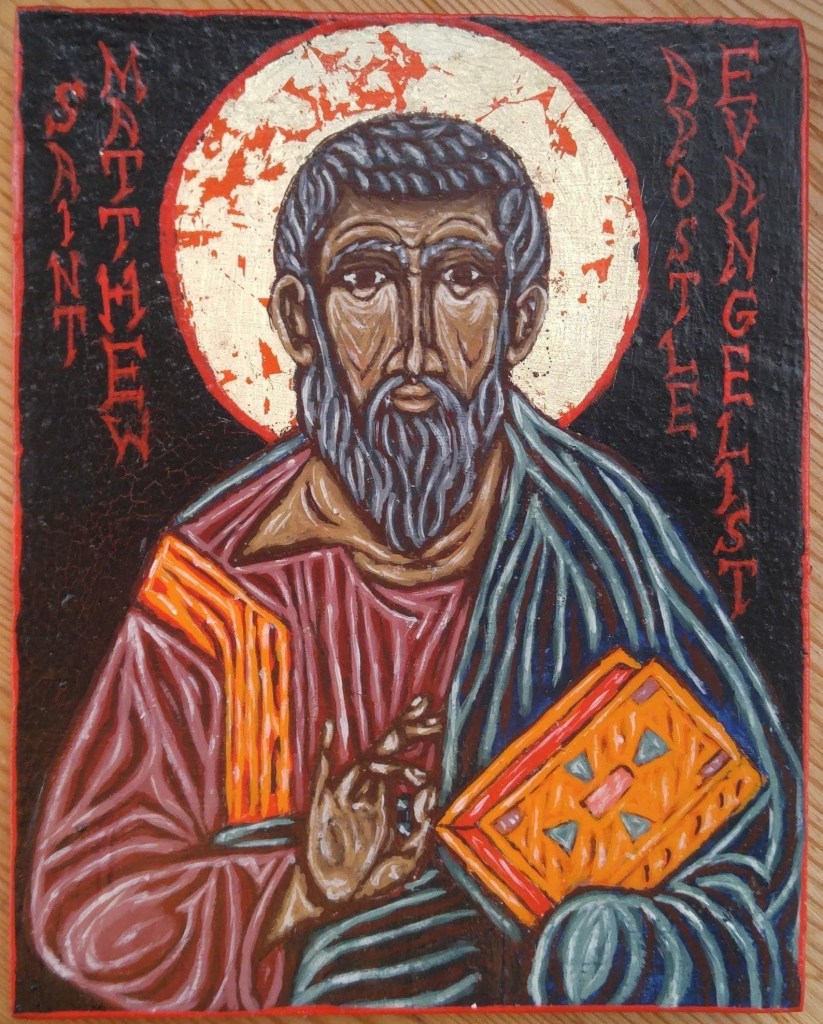
On September 21st the Church honors St. Matthew, Evangelist and Apostle.
Here’s the thing about St. Matthew: while this person appears in all of the Gospels, in Mark and Luke it is Levi, not Matthew, that is called into discipleship.
Oh, what’s in a name?
Well, quite a bit, actually. Some ancient scholars took these two people to be the same person, with “Matthew” being the name Levi was given after he started following Jesus (Jesus had a habit of giving nicknames, after all). Some regarded them as distinct individuals.
Regardless, two things are known about this person named Matthew: the ancient church knew him as a tax collector, and his name in Hebrew means “gift from God.”
Now, the above information is only ironic if you know how tax collectors were regarded in ancient Judaism and ancient Palestine. Often tax collectors were seen as puppets of the state, and were cut out of Jewish activities. But it’s worth repeating that Jesus had a tax collector in his trusted circle, this one whom others considered suspicious and untrustworthy.
Jesus was “big tent” before it was en vogue.
We don’t know much about St. Matthew. Tradition ties him to being the writer of the first Gospel, which we have no proof of and, because of when the Gospel was written, seems generally unlikely. Tradition also considered him, generally, as the oldest apostle…which makes it even less likely that he wrote the Gospel text.
Some legends have Matthew preaching throughout Judea after the ascension. Some have him going as far as Ethiopia with the Gospel. Some even claim he was a vegetarian (why this is important, I’m not sure, but no other apostle gets to claim this distinction).
We’re not even sure how Matthew died. Some say by old age, and some claim it was by martyrdom.
With all this confusion, I think it’s important to point out a key thing about Matthew: he was disliked in the ancient world, and yet he was in the inner circle.
Think on this: Jesus had St. Matthew and St. Simon in his inner circle. Matthew was a tax collector, a government agent. Simon was called “the Zealot,” and was a radical antigovernment activist. And both were in the Jesus camp. And both, we must imagine, had to give up some of their ideological purity to be there, right? And both had to give up some of their prejudices to entertain the presence of the other, right?
St. Matthew is a reminder for me, and for the church, that Divine work is larger than the small ideological crevices we hew out for ourselves in this life.
Let those with ears, hear.
-historical bits gleaned from Pfatteicher’s New Book of Feativals & Commemorations
As the weather began to cool, the Celts spent more and more time in doors telling stories and singing songs. As we approach the equinox, my morning thoughts landed here briefly today.
Songs, and instruments, were (and are!) very important to Irish and Scottish families. Many families employed a harpist full-time to be available for parties, dinners, and to compose and perform at weddings and funerals. As Gaelic culture waned, these professional harpers weren’t able to be privately employed any longer, and became wandering bards exchanging songs and stories for meals and a bed for the night.
It is said that Irish appreciate three skills in particular: the ability to compose a clever verse, music on the harp, and the art of shaving a face.
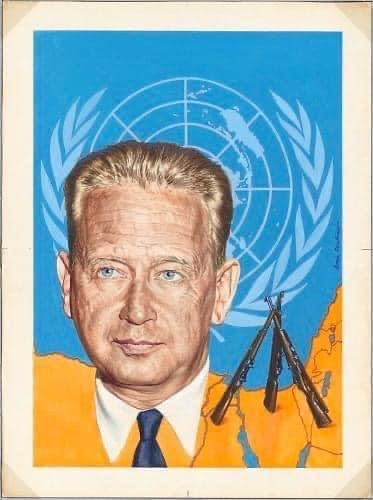
Today the church honors a contemporary saint and scholar, one whose genius in theology and mysticism was only discovered after his untimely death: Dag Hammarskjold, Peacemaker and Mystic.
Dag was born in 1905 as the son of Sweden’s prime minister. He studied law and economics, and was a professor of economics in Stockholm for about three years. He soon joined the Swedish civil service in the Ministry of Finance, and became the president of the board of the Bank of Sweden.
As his popularity in the circles of government began to rise, so did his mystical leanings and visions…though in secret. He served in the Ministry of Foreign Affairs, and was responsible for dealing with international trade. This position well situated him to eventually be appointed as Minister of State as the deputy prime minister.
At that same time he was chosen as vice-chairman of the Swedish delegation to the UN, and eventually became chairman.
On April 10th, Hammarskjold was elected Secretary General of the United Nations, and during his tenure he dealt with the end of the Korean War, skirmishes in the Middle East, and the Suez Canal crisis. Due to his acumen, he was elected for a second five-year term.
With another term in front of him, Dag set his sights on helping the newly independent Belgian Congo, sending in UN troops to suppress the civil war. On his way to negotiate a cease-fire between the warring factions, Hammarskjold was killed when his plane crashed in Zambia in 1961.
Upon his death, his reflections and mystical visions were published in a fascinating book (that sits on my shelf), Markings. In this work Dag showed that he was not only a peacemaker for the world, but sought inner peace as well.
He was an active contemplate, or a contemplative activist…however you want to describe it.
My favorite line from his work (unsurprisingly) is this lovely mystical mix of beer and theology:
“I am the vessel. The draught is God’s. And God is the thirsty one.” (Markings)
St. Hammarskjold is a reminder for me, and for the church, that inner work is just as important (maybe more important?) in the life of the faithful, because the inner life is reflected in our outer actions.
Deep wrestling with life, mortality, the Divine, and the poetic ways they appear in our existence elicit a humanity that is geared toward the other more than the self.
It’s an interesting paradox, right? In doing our own inner work, seeing the outlines of our own shadows and light, wrestling with the tough questions within us, we become focused more on the health and healing of those around us.
This saint is a testament to this truth.
-Historical pieces from Pfatteicher’s New Book of Festivals & Commemorations
Today the church honors a Bishop who tended his flock during a plague, which makes him a bit relatable, no? Today is the feast day of Cyprian, 3rd Century Bishop and Martyr.
Hailing from Carthage in North Africa, Cyprian was a professor and lawyer by trade, only being baptized in his forty-sixth year of life. Amazingly, however, he was elected Bishop of Carthage only two years after ordination…hardly enough time to understand the ins and outs of parish ministry, me-thinks…but no one asked me.
Cyprian was a scholar and assumed the Bishopric when the church was rocked by schism and scandal. He used his office to gather the church together, seeing the office of Bishop as both encourager of the people and the anchor that holds disparate parts of the Body of Christ in communion with one another.
When emperor Decius began persecuting Christians, Cyprian went into hiding, a move for which he was much criticized. He felt that he had to continue to lead his flock through the persecution, and so his survival was paramount. History has taken a more cynical view of this move.
Soon after the persecution a plague broke out in the empire, and the Christians took the popular blame for it. When persecutions again resumed under emperor Valerian, Cyprian willingly and peacefully was arrested on September 14th in the year 258. He died a martyr’s death two days later.
His arrest and appearance before the authorities is well documented, and even appears to have been a peaceful exchange…even though it led to his death.
The charges?
He was accused of not bowing and acquiescing to the gods of the empire, of not siding with the powerful against the powerless, and not worshiping the emperors of the day. He spoke against their self-congratulatory ways of operating and their demands for prestige and accolades at the expense of the people they were supposed to serve.
He plead guilty and died by the sword.
St. Cyprian asks us a question from his grave in these days:
Would we be found guilty or innocent?
-history gleaned from Pfatteicher’s New Book of Festivals & Commemorations
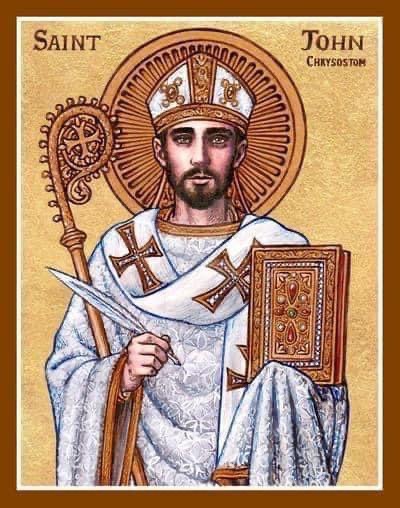
In the second half of the 4th Century the world was blessed with a preacher still unsurpassed in eloquence, and today is his feast day: St. John Chrysostom, Bishop of Constantinople.
St. Chrysostom (which literally means “golden-mouthed”) was born in Antioch and trained under the famous philosopher Libanius, who named him “brilliant,” and the biblical scholar Diodorus. Though Libanius wanted him to become a lawyer, John chose the more-secure-but-less-lucrative route of ministry, and was baptized at the Easter Vigil in ca 368 at the age of 18.
He lived as a hermit for a while, contemplating the life of a, well, contemplative, but was finally ordained into the priesthood and served the Bishop of Antioch, Flavian.
He became famous for his sermons as he preached with the “scriptures in one hand and the headlines in the other,” to borrow a popular phrase. His sermons were thematic and contemporary, addressing topics like social justice, the equality of women in society, his opposition to slavery, and emphasizing the role of laypeople in worship and the church.
He even did a whole series on “toppling statues” as the people of Antioch had rioted and destroyed some statues of the emperor. How’s that for timely?
In 398 St. Chrysostom was chosen (surprisingly) to become Bishop of Constantinople (or is it Istanbul?). This was an important and consequential post in the Church. He won people’s affections for his simplicity, honesty, clarity, and eloquent sermons. Unfortunately, these qualities also caused many people to despise him…if he were around today he’d have gotten many emails. He refused to play political games, and had no problem ousting clergy and Deacons for murder, adultery, and the like.
In 403 the empress and Theophilus of Alexandria conspired to take down this popular and principled prelate at a conference called the Synod of the Oak. There they condemned St. Chrysostom on false charges of heresy and he was officially banished from the city.
The people were outraged and riotous and, coincidentally, the empress herself had a personal tragedy. These events were taken by religious leaders as “signs from God” that they had made a mistake, and they brought St. Chrysostom out of exile. But, because he wouldn’t admit any wrongdoing, they prevented him from taking his seat in the cathedral. Still, John had enormous pull, and on the Easter Vigil, 3,000 converts came to the Baths of Constantine for baptism that year, which amounted to a riot itself. Soldiers broke up the service, and some were killed.
Unable to control the people with this golden-tongued popular prophet around, John was once again exiled, this time to Armenia. He continued to write, however, and was able to be enormously influential even in exile as he corresponded with friends back in Constantinople.
Pope Innocent I finally was prompted to get involved and, following the people’s lead, supported his Bishop. He condemned the Synod of the Oak as illegal, and when he sent papal envoys to Constantinople to investigate the ordeal, his envoy was treated poorly, some were even jailed, and sent back to Rome.
Now Pope Innocent was furious.
As retaliation for the Pope’s intrusion into his matters, the emperor had St. Chrysostom further exiled, and moved to an even more remote location. Having been given orders to vacate Armenia and move to isolated Pityus, John took up this cross on foot, bareheaded, and began the journey that would be his last.
He died at Comana in Pontus, never reaching Pityus. In his last breath he said, “Glory to God for all things.”
His grave is in the choir chapel at St. Peter’s Basilica. He is still remembered as the most eloquent preacher the church has ever produced, and his Christmas sermon is still preached by many faithful clergy every year.
St. Chrysostom is a reminder for me, and for the church, of a few things:
First, a sermon isn’t worth its salt if it doesn’t say something that connects God’s promises to the headlines of the day.
And, secondly, that every good pastor/prophet who does the above will have enemies. Sometimes, unfortunately, those enemies are close to home.
Indeed, it has always been so.
But the work continues, Beloved.
-historical pieces absorbed from Pfatteicher’s New Book of Festivals & Commemorations
-They Might Be Giants references are yours truly’s
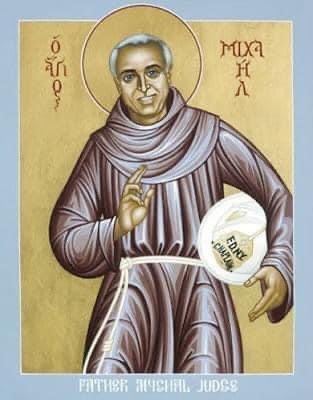
As dawn breaks on 9/11, a saint deserving to be held is brought to my mind: Saint Mychal Judge, Saint of 9/11 and Chaplain of Engine Co/1 and Ladder Co/24.
Saint Mychal was not the first victim of the terrorist attacks on 9/11, but he was the first identified victim: “Victim 0001.” He served as New York City Fire Department’s chaplain. A Franciscan friar and priest, Saint Mychal was known for going above and beyond for the women and men he cared for. He often made hospital visits. He was at most every funeral.
And he went to fires, keeping his radio nearby, which is how he heard about the World Trade Center attacks.
While others fled the scene, Saint Mychal rushed toward it in his priestly garb, following the steps of his fellow fire fighters. He immediately started administering last rites to those who were critically wounded, and when he saw his company rush into the North Tower he ran toward it, too, despite the evacuation order.
Outside that North Tower he helped people escape and, while standing there praying, was killed by flying debris as the South Tower fell.
Saint Mychal was more than just NYFD’s chaplain, though, he was also a gay priest (out to his friends) who openly counseled those suffering from AIDs in the 1980’s, performed funerals for AIDs victims when other shunned them, who admitted quite honestly his struggles with alcohol, and who showed up to New York City’s first gay-inclusive Saint Patrick’s Day Parade in his friar’s garb, taking interviews for the media despite the Archbishop’s warning against it.
Saint Mychal is a reminder for me, and should be for the whole church, that the true work is to walk with the people, especially when their lives are on the line, even as the world falls down around them.
-historical bits taken from Illes’ Daily Magic
-icon written by Br. Robert Lentz and can be purchased at Trinityicons.com
You do not have to be good. You do not have to walk on your knees for a hundred miles through the desert repenting. You only have to let the soft animal of your body love what it loves. Tell me about despair, yours, and I will tell you mine. Meanwhile the world goes on. Meanwhile the sun and the clear pebbles of the rain are moving across the landscapes, over the prairies and the deep trees, the mountains and the rivers. Meanwhile the wild geese, high in the clean blue air, are heading home again. Whoever you are, no matter how lonely, the world offers itself to your imagination, calls to you like the wild geese, harsh and exciting – over and over announcing your place in the family of things.






 Reluctant Xtian