Tonight as we enter the midway of the month, I’m remembering that in November the ancient Celts found themselves under the Reed Moon.
Each month has a moon, usually named after a tree, corresponding to the attribute that the month brought to the wheel of the year. Now, while reeds are not technically “trees,” November was illumined by the reed moon because reeds, when wound together, created tough blankets that would be used for both floor and roof, for both basket and rope.
They are tough as trees when braided.
Reeds were emblematic of how November was a weaving of worlds, ushered in by Samhain and All Saints, the ancestors and the babies creating a tapestry of existence that was most clearly felt as the shadows lengthened and the hearth blazed. For the ancient Celts life existed far into the past and far into the future, and the cycle of life was always rolling. Reeds reminded them of this: woven together to be one whole, and when wind blew over the open reed they believed they could hear the howling voices of the ancestors calling to them from the other side of the veil.
These, of course, became wind chimes and porch pipes.
The Reed Moon inspires us, with its long night-shine life, to remember those who have gone before, the ache in our bones a reminder of their unseen, but ever-felt, presence.
In these mid-November days, I’m reading about the importance of storytelling in Ireland and Scotland, and how it historically has shaped (and continues to shape) a Celtic worldview.
Stories were seen as so powerful that a storyteller invited into a home was said to bring good luck to the dwelling, and they were often paid well for their stories.
Entertainment. Knowledge. Skill and art. Stories and the tellers of them were seen to impart all of these.
But more than that, storytellers were the “keepers of the people.” They remembered the history and, when they told the story, re-membered those listening into that long thread of history.
It’s a shame that storytelling isn’t practiced much as a profession any longer. It’s one of the things that I love about preaching: it’s a chance to tell a (hopefully) good story.
And also a chance to re-member ourselves to one another around a common tale, if just for a moment.
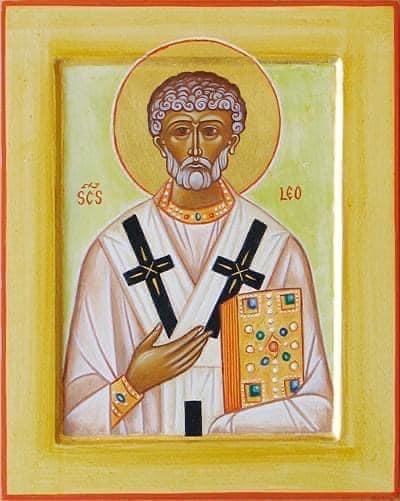
Today the church honors an important leader in the church that most church-goers have never even heard of, St. Leo the Great, Bishop of Rome and Mediator of the Church.
Long before the church was arguing about the nature of humans and their race and sexuality, the church set about arguing about the nature of Jesus. In the 5th Century, when Pope Leo was consecrated as the Bishop of Rome, the Catholic faith was being torn asunder by schisms over who Jesus was and how Jesus was.
Yes, you read that correctly: how Jesus was.
How was Jesus both Divine and human?
Pope Leo refocused the question on faith rather than nitty-gritty explanation. He affirmed the idea that Christ had two natures and, as he was enlarging the influence of the Papacy around the known world, issued his famous (at least to churchy-people) Tome to Flavian, the Patriarch of Constantinople that had the clearest articulation of Christ as human and yet Divine.
You still talk about this idea, by the way, every time you say the Nicene Creed.
At the time all sorts of schisms were going on inside the church, there were tons of wars being fought in real-time, too. St. Leo kept Rome safe from Attila the Hun in 452, and a legion of Vandals, whom he persuaded not to destroy Rome, in 455. He put restrictions on who (under what training) could enter the priesthood, and affirmed the goodness of “all matter,” rejecting the idea that the created world is evil and we need only wait for some heaven, lightyears away.
He was a devoted liturgist, and further developed the words of the Mass, shaping the words we say yet today.
St. Leo was wise, if not particularly brilliant. He understood how to use power effectively and for twenty-two years led with theological ability and personal resolve.
St. Leo is a reminder for me that wisdom and brilliance don’t always hold hands, and you can certainly be one without the other.
But of all the things that Pope Leo the Great is remembered for, the thing that struck me is how he looked at creation and without hesitation affirmed what Genesis had already said: “this is good.”
Why does it matter?
Because, Beloved, it articulates clearly that everything that is created, matters, and therefore we can’t just do what we want with it…
-historical bits from Pfatteicher’s New Book of Festivals & Commemorations
Today the church remembers an obscure saint, St. Willibrord of Utrecht, Missionary to Frisia.
Willibrord (b. 658) was raised in Ireland where he was ordained a priest in 688.
He was heavily influenced by the Northumbrian monk, Egbert, who told fantastical stories of his travels and work. Willibrord was enamored with these tales, and wanted in on the action. At Egbert’s invitation, Willibrord dedicated himself to exploration and missionary work.
He sailed to Utrecht in Frisia (the Netherlands) where he set up the first official see of the Roman Catholic church in that land (well, the Pope founded it, but gave Willibrord permission to do what he was doing: running it). Willibrord set to work founding schools, parishes, and monasteries. He was consecrated as Bishop by Pope Sergius I in 695, and did much to plant the church in the Netherlands.
In his old age he retired to a monastery he founded in what is now Luxembourg, and died there on this day in 739.
St. Willibrord is a reminder for me, and should be for the whole church, that stories inspire. Hearing Egbert’s tales enticed him to explore the world! The faith is full of inspiring stories, and telling them in such a way that they’re heard as the wonderful tales and testimonies they are should inspire exploration, not entrench people in trite moralisms, stilted orthodoxy, or make the faithful fearful of what’s on the other side of any fence.
A lovely historical development: as one so inspired by stories, he now has so many stories about him shared throughout the Netherlands. These tales of his accomplishments are richly embellished and fantastical, ensuring that this one so moved by stories is the subject of many moving stories himself.
-historical pieces from Pfatteicher’s New Book of Festivals & Commemorations
-also, it should be noted that I will probably look like this old Irish saint when I become an old Irish saint…
Today the church remembers a more recent saint, though many have forgotten him in the cloudy cloud of witnesses: Saint William Temple, Archbishop of Canterbury and Social Reformer.
Born in 1881, Saint William was the second born of Frederick Temple, another Archbishop of Canterbury, and he had a deep love for the Church of England despite his proximity to it growing up. He is considered by many to be one of the four pillars of post-Reformation Anglican thought, joining the ranks for Richard Hooker (whom we just commemorated), Joseph Butler (see June 16th), and Frederick Denison Maurice (honored on April 1st).
Saint William was brilliant. He forgot more philosophy than most philosophers knew. He genuinely cared about people. At the age of twenty-nine he became the headmaster at Repton School, and then rector of Saint James’ Church, Piccadilly, Bishop of Manchester, and Archbishop of York in quick succession. He was keenly atuned to the needs of the working poor, and sought social reforms, educational justice, and brought all of his leanings on the betterment of humanity back to the Doctrine of the Incarnation, saying concretely that everyone, regardless of sex or gender, was created in Divine likeness.
So, Beloved, when someone tells you you’re “socialist” for wanting social programs, remind them that you want social programs because everyone is a mirror of the Divine and deserves to be cared for.
That’s the reason.
In 1917 this pastor resigned his post to devote himself to the reform of the Church of England as it attempted to modernize, and then became quite active in trying to figure out how to reorganize Britain in a post-war era. He supported labor movements, and was a big fan of ecumenical efforts and dialogue that helped people eat, work, and live well.
In April of 1942 he was elected Archbishop of Canterbury, but the ongoing war and his ongoing health struggles kind of took the wind out of his sails. He died on this day in 1944, having only served in the seat for a scant few years.
Saint William Temple is a reminder for me, and should be for the whole church, that when the Doctrine of the Incarnation is taken seriously, the health and welfare of every human must also be taken seriously.
In fact, I dare say that this characteristic might set someone who actually lives out their faith apart from those who hold up Bibles for photo ops or to garner votes…
-historical bits from Pfatteicher’s New Book of Festivals & Commemorations
November is a “hinge time” in the life of the world.
The Celts knew this. As the bonfires they used to celebrate All Hallow’s Eve smoldered, they prepared themselves for the encroaching shadows as the sun turned in early.
They hung their herbs in the house to scent the place and prepare for winter meals, and began to bolt their windows against the wind. They’d unpack the candles they had made from the fat of the Fall slaughter, and would begin to do the hard work of nesting in.
They knew that November marked the hinge between Fall and Winter, between light and shadows, between dying and sleep, and they embraced it the way that you embrace that necessary fallow time we all encounter in our lives.
It’s good to realize that some times in our lives will just be fallow. Embrace the rest. Use the reserves. And remember that this time has a beginning and an ending, like all things in life, with rebirth on the far side.
And it feels like a very large hinge time in these days.
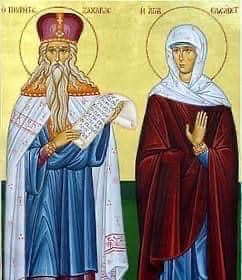
Today the church honors two ancient saints of the faith, perhaps the “Patron Saints of Waiting,” St. Elizabeth and Zechariah, the Parents of St. John the Baptizer.
This feast is honored in Palestine on this date, and honoring them begins to turn our collective faces toward the season of Advent, the season of hope and patience.
Zechariah is the pious priest in the line of Abijah, noted by St. Luke in his first chapter. Elizabeth, whose namesake is the wife of Aaron (the brother of Moses), was also of priestly lineage. This makes it, at least in the ancient world, an ideal marriage: pure and priestly.
By the time of Jesus, there were so many of priestly lineage alive that the duties of the temple were afforded by lot, as not all could participate. One day this privilege fell to Zechariah, as the story goes, and he was ordered to light incense in the Temple. As he was performing his priestly duty, an angel appeared to him and announced that he and Elizabeth would, in their old age, have a child.
By the way, if your Biblical mind isn’t brought back to the aged Abram and Sarai and their son Isaac at the mention of this story, you’re not paying attention…these stories are meant to invoke one another, Beloved.
If your Biblical mind isn’t brought back to Hannah and her son Samuel in the telling of this story, you’re not paying attention, Beloved.
Luke, in writing his Gospel, knew what he was doing with these lovely saints…
Elizabeth, that dear saint, did not, for whatever reason, have any children in her young age. In this way, she followed in the footsteps of Sarah and Hannah before her.
By the way, I note “for whatever reason,” because contrary to popular belief at that time (and even today), we have no biological indicators that note that anything was amiss with Elizabeth’s ability to conceive. Indeed, Zechariah could have had an ailment that prevented him from parenting. But, as with all history written by men, for some reason the fault falls on Elizabeth.
I love Saint Elizabeth, and St. Zechariah, too, because their struggle is so relatable to so many today.
Zechariah had a hard time believing that they could have a child, and for this reason he became both deaf and mute for a time being. This is a strange biological development…much like having a child in your old age would be…but the theological development is pretty clear: some things that the Divine makes possible are hard to talk about and hard to listen to.
Zechariah and Elizabeth named their dear child John, defying tradition. At the naming of their child (Zechariah wrote it down for those present), his voice was restored, and immediately he was blessed with a song that we still sing in the church today during the season of Advent, the Benedictus Dominus Deus. It is a song about promise fulfillment and echoes the Magnificat of Mary and the Hebrew Scripture song of Hannah in 1 Samuel.
St. Elizabeth and St. Zechariah are a reminder for me, and should be for the whole church, that sometimes Diving things take a little while to happen, and that patience and hope must continually hold hands in this life.
They are also a reminder for me that the church needs to openly and honestly talk about the difficulty of conception, a topic so few want to discuss because of its delicate nature. But, Beloved, this is such an important and wide-spread issue, the church must talk about infertility with honesty, and forget with the nonsense of “in God’s time” or any such mess that can be hurtful for those who want to be parents but have difficulty for whatever reason.
Today the church remembers an Anglican priest and eloquent writer who argued for a middle way between Roman Catholicism and the rising pietistic tide in the 16th Century: Fr. Richard Hooker, Apologist for the Middle Way.
Saint Richard was born in 1554 near Exeter in Britain in a time when the nation, and the church, was mightily confused. Though the Anglican church had embraced the Reformation, it was struggling with just how it fit into the sweeping changes rolling through religion and politics.
Roman Catholicism, on the one hand, saw the Anglican Church as having abandoned the one true faith. Puritans, on the other, thought the Anglican church had abandoned the Bible (which the pietistic movement saw as the only text with any authority at all).
Into this melee Saint Hooker was born, educated at Corpus Christi College in Oxford, and ordained. He served several country parishes early on in his priesthood, attending the needs of country people. Using his experience in the parish, in 1593 the good Father penned a seminal work, Laws of Ecclesiastical Polity, a roadmap for the Anglican approach to the faith.
In stark contrast to Martin Luther, Saint Hooker’s work was charitable and eloquent, meticulously laying out how Scripture, tradition, and reason (yes: reason) could provide a way for the faithful to organize themselves. The Puritans chaffed at the idea, thinking only the Bible provided any answers to any questions. Roman Catholicism could accept this trifecta in part, but thought that tradition trumped the other two, especially when it came to the Papacy.
Nevertheless, Saint Hooker plodded on, believing that the law of nature (reason) could help people organize themselves within a religious construct. His scaffolding became an overarching philosophical defense of Anglican practices where reason, scripture, and tradition all had a pillar in presenting a platform for encountering the Divine and interacting with one another.
Saint Hooker died in the year 1600, but his legacy lives on. He is a reminder for me, and should be for the whole church, that checking your brain at the church door and deferring reason to tradition or even to scripture is too high of a price for admission.
-historical bits from Pfatteicher’s _New Book of Festivals & Commemorations)
Today the church commemorates All Soul’s Day, or “The Day of the Faithfully Departed.”
This festival day is a product of the evolution of the church and its understanding of the departed and how they play into the eschatological and cosmological understanding of all things.
If saints were those who led extraordinary lives, what about the rest of us?
All Souls Day is an answer to that question. Indeed, many people who aren’t technically “saints” in the narrow definition of the term have led wonderfully beautiful and impactful lives. All Souls attempts to honor that fact. It became common practice, for instance, to lift up particular benefactors of parishes on this day, giving a nod to those who made the physical (and spiritual) structures of the faith possible.
In a more pedestrian sense, All Souls Day is, at least for me, a day where we can all embrace the reality that, saint or not, people deserve to be remembered.
In my first parish we had these magnificent stained glass windows put in decades earlier. In them you could see glimpses of not only the artistry of the day, but you could also feel a sort of timelessness that was pervasive, connecting those who had first stared into and through those windows with me and my own children who looked at them now.
Good art does that: it creates connective tissue between the past and the ever-expanding future.
But All Souls Day is a reminder that good theology does that, too. We stand upon the beliefs of the past, hauling some of them with us, and leaving some on the path behind us as signs and markers of thoughts discarded and avenues that were dead-ends.
All Souls Day lifts up the very practical, very pious, and very pedestrian people on whose shoulders we stand. In this way it is even more meaningful than the pomp and circumstance of All Saints Day.
If All Saints Day is the fine-dining establishment in your city, All Souls Day is the little cafe you frequent where you know the owner, have a favorite booth, and don’t need to glance at the menu because you know it by heart.
In other words, All Souls Day is really where most of us will find ourselves: in the ordinary annals of a life that tried its best, did some great things, fell short quite a bit, but is remembered by a small, but faithful, group of loved ones who know our names.
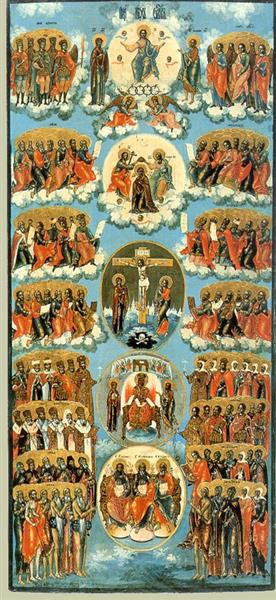
Today the church celebrates All Saints Day, the day in which the formal saints of the church (those canonized) are recognized and remembered as examples of the faith.
This celebration is very old, perhaps dating back to the 4th Century, though it is clear that earlier commemorations of this feast day were held in the spring, sometime between Easter and Pentecost. It was originally intended to celebrate not just any saints, but the martyrs of the faith.
The focus and the date of the day shifted sometime just before or in the early 7th Century. In the British Isles it had already been honored on November 1st, probably in response to the pagan autumn festivals that culminated at the end of October (which many of you participated in last night with ghosts and goblins at your door!). The date stuck for the whole church within the century, and came to have a deeper connection not only with the seasonal cycle on display in the northern hemisphere, but also with pre-Christian sensibilities. One example is this Celtic idea that the arrival of mists and frosts around this time were examples of ghostly/faery visitors, so it made sense to have a day remembering them when they started to make their presence known again.
In the 7th Century the date came to commemorate non-martyrs as well, probably in response to the fact that Christianity became dominant and was less-oppressed…resulting in fewer martyrs of the faith. The faithful who died both naturally and by martyrdom were recognized on this date every year, especially if they had died in that calendar year.
Today Orthodox, Roman Catholic, and Anglican branches of liturgical Christianity still keep this day to honor those canonized saints of the church, reserving the non-canonized dead to be remembered tomorrow on All Souls Day (more on that tomorrow). Lutherans, with our penchant for comingling the idea of “sinner and saint,” usually don’t make such a distinction, and just honor all those who have died in the faith, regardless of status, on this day.
Whatever your proclivity, today is a powerful day when honored with intention, even for those of you who don’t find yourself in any faith tradition. Honoring our ancestors, learning from their stories, embracing their goodness and foibles, is an important part of the human experience in my estimation. We all are, after all, an unwilling product of those who came before us, but we continually have a choice in deciding what we’re going to carry with us from those past ancestors, and what we’re not going to let continue into the next generation.
All Saints Day is a reminder for me, and should be for the whole church, that those who came before still speak into our present, and that the Divine who seems in love with continual creation also seems in love with some measure of continual, constant, though hidden and obscure (like through a mirror darkly?) preservation.
-historical bits from Pfatteicher’s New Book of Festivals & Commemorations







 Reluctant Xtian