In December the ancient Celts found themselves under the Elder Moon.
Known as Ruish (roo-esh) in Gaelic, the elder tree was known to protect against negative forces, including pests like fruit flies and mosquitos, and so elder was often hung from doorways or in kitchen windows throughout the year. It was also sought out as medicine for so many, and is said to have natural antiviral properties. The elder tree was one you sought when you needed help.
The elder tree is bruised easily, but also regrows quickly, which is why the ancients named this moon at this time of year for this tree. Everything feels fragile right now. But, as the Irish phrase goes, “Every beginning is weak” (bionn gach tosach lag). Fragility allows for birth.
December is about beginnings sprouting from endings. As we head closer and closer to the solstice, the days shorten almost to the point of non-existence (or, at least it feels like that). But the ancients believed that the sun that faded-but-never-abandoned them made a new covenant annually with the earth in these days.
When Christianity began to have an influence and decided to place the celebration of Jesus’ birth in this month at the time of the Yule celebrations, it made so much sense to the Celts that they didn’t bat an eye: a new covenant with the Son/sun was appropriate in these shadow days.
The ancient Celts felt that December was a time for wombing, anyway. The fields were fallow, the family tended to be physically lax but mentally focused. In December they did their “inner-work,” pondering how the shadows of their own being (as Jung would say) helped them live into their full selves.
We’d do well to follow that lead.
And we may find that, at the end of December, we, like the elder tree, find ourselves being birthed differently into a new year after doing the inner work under the Elder Moon.
Today is one of my favorite Feast Days for one of my favorite saints: Saint Nicholas, Bishop, Patron Saint of Sailors, and Gift-giver.
It is ironic that little is known about the life of Saint Nicholas, this Bishop of a seaport town in what is now Turkey, because he’s one of the most beloved and recognizable saints in popular culture. We know that he was born in the 4th Century, and that he attended the Council of Nicaea where he is purported to have socked Arius (considered a heretic at the time) right in the face. Anyone who has served on a church council understands that it can get a bit testy sometimes…
But other than the above (and the whole “punched Arius” thing may not even be accurate), all else that is said about St. Nicholas is lore and legend.
It is said of him that, as an infant, he refused to nurse on Wednesdays and Fridays, typically fasting days for the pious.
It is said that he aided a poor family once by paying the dowry of three daughters, saving them from a life of prostitution. On three successive nights he threw bags of coins through an open window. This act is how he became known as the patron saint of gift-giving.
It is said that he saved three boys who had been kidnapped by a butcher and returned them to their parents.
It is said that he aided sailors in trouble off the coast of Myra by calming a storm, and showed great courage himself while out on the sea. This is why he is the patron saint of seafarers.
Today around the world Saint Nicholas will be impersonated by many utilizing a long, white beard, parading around in Bishop vestments. In some places small children dress up like the saint to beg for alms for the poor.
In America the rituals of St. Nicholas Day have almost all been moved to December 25th and melded with other Christian-Solstice practices. Still, in some homes (like mine), children leave their shoes out by the fireplace or in the foyer of the home, hoping that St. Nicholas will come by on his horse and leave chocolate coins, oranges, and small trinkets as gifts. The coins are an homage to the legend of the dowries.
The festivities and legends surrounding Saint Nicholas have melded with Norse and Celtic winter legends and lore in these days. Looking more like Odin now than a short, brown-skinned Bishop (which he most certainly was), common depictions of Santa Claus bear little resemblance to this ancient priest from Asia Minor. Still, the practice of gift-giving and charity is certainly worth continuing in whatever form it takes, and in that way St. Nicholas is kept alive age after age in one form or another.
Saint Nicholas is a reminder for me, and should be for the whole church, that charity and love are languages that are universal and, in the form of Saint Nick, take on hands, feet, and a face every year. There is much to be learned about human nature and human connection from the fact that his appeal is so wide and varied!
It almost makes one hopeful, yes?
-historical notes gleaned from Pfatteicher’s New Book of Festivals & Commemorations and too many Rick Steves documentaries on Christmas
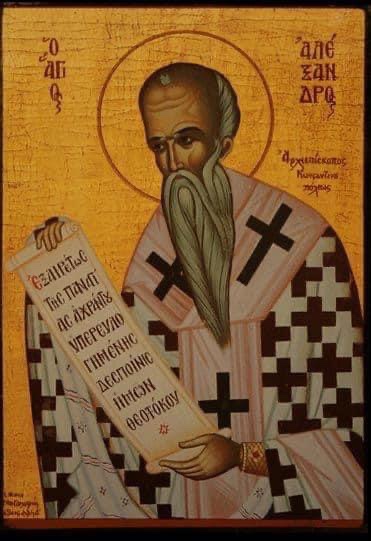
On December 5th the church honors an interesting Saint who sought to incorporate some pagan practices into the Christian faith and life (and, for that alone, he has my admiration): St. Clement of Alexandria, Priest and Scholar.
St. Clement of Alexandria (not to be confused with the Clement of Rome or any of the other many Clements of the ancient world) was a Greek philosopher born in the middle of the Second Century. He found himself making a home in Alexandria, the center of scholarship in the ancient world, and he headed up a school there that would eventually teach catechumenates about the faith.
St. Clement is noteworthy because he was a seeker of truth, and though a professed Christian he honored the truths and practices that other religious paths offered. He defended the faith in the midst of both his pagan friends and his Christian friends, trusting that melding certain practices was not only necessary, but good and human.
He believed that many of the ancient texts the church was using were wonderfully allegorical and applicable to life, and in this way he expanded the reach of the church in philosophical circles. Origen, the greatest biblical scholar of the early church, was his pupil.
His writings are some of the first systematics documents for the church.
St. Clement is a reminder for me, and should be for the church, that “purity” is a fiction we cannot afford in the world when it comes to practices, dogmas, and doctrines. It is appropriate that we honor St. Clement of Alexandria in the Advent-Christmas season because this time of year, in particular, is a beautiful bouquet of melded practices for humanity.
We need not run from this truth or try in vain to defend that it is not so. We must embrace it, revel in its particular beauties, and be at peace.
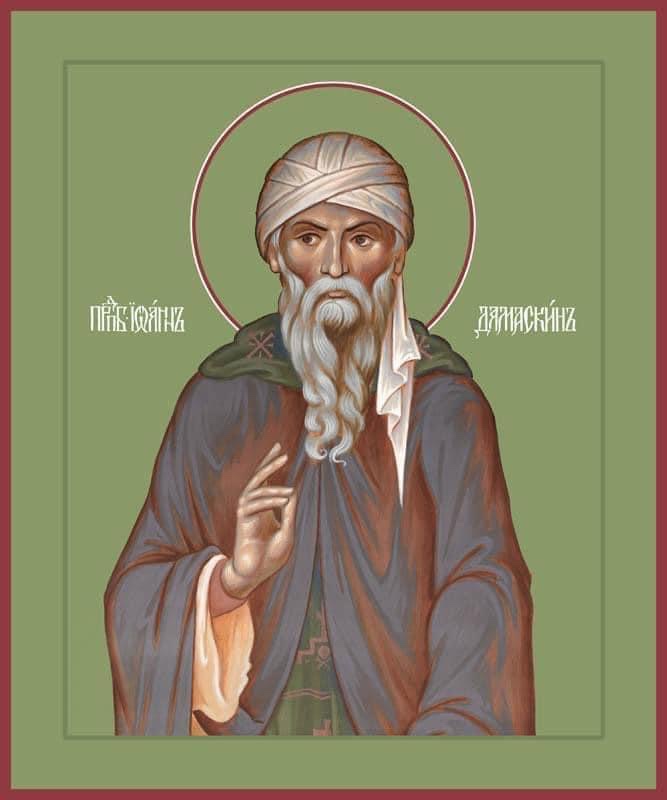
In the breaking days of December the church honors a Saint who found himself in a church at a breaking point: St. John of Damascus, Hymnwriter and Priest.
Born in 675, St. John was born into a wealthy family and was elevated to a political position of prominence at quite a young age when he succeeded his father as an official in the Court of the Caliph of Damascus.
He felt a call to the faith, and became a monk at the monastery of Mar Saba (still in existence!), a hermit colony founded in the year 484. It was there that he gave up his position in the Caliphate Court and devoted himself to simplicity, the study of the Desert Mothers and Fathers, and the priesthood. He was ordained in 725.
It was about this time that the church began to crumble under the weight of melding practices. The Eastern and Western churches were evolving drastically different approaches to faith and life. It would take another 300 years for the split to become official, but it is here in history that we can see the fault lines.
In these days the Byzantine emperor Leo III forbade the veneration of sacred images and icons, and ordered their destruction. St. John of Damascus wrote vehemently that icons and sacred images were portals and glimpses of the Divine, not Divine themselves, and should be saved and maintained. As part of his logic, he successfully defended the Real Presence of Christ in the Eucharist as well, against those who would dismiss it.
St. John of Damascus wrote great mystical treatises on theology, too, that are still foundational for the Orthodox community.
For all of the above, St. John of Damascus is considered by the Eastern Church as the last of its Fathers.
We still sing the writings of St. John, by the way. That wonderful Easter hymn sung every year that goes, “Come, ye faithful, raise the strain of triumphant gladness!” came from his golden pen. He authored a number of Easter hymns that still sing out the faith to this day every Spring.
St. John of Damascus died near Jerusalem around 760. He is a reminder for me, and should be for the whole church, that icons and objects can be glimpses of Divine presence in this world, and we need not take everything at face value.
Indeed, nothing is “face value” when it comes to the Divine. God is always more than they appear…and godly things can be, too.
-historical notes from Pfatteicher’s New Book of Festivals & Commemorations
For the ancient Celts, December was a month where they celebrated light being born from winter’s long shadows.
They believed that, on the solstice, the sun would jump up and retreat back down for just a moment, seemingly staying in roughly the same place, signaling that it would once again keep it’s promise to bless the people with its presence the next year.
Every year they believed the sun was born again.
They’d honor this birth with days and days of celebration, usually around twelve, and they would perform ritual acts of welcome including dancing, drama, music, games of feat, and above all, lighting fires that they thought would help the newly-born, fledgling sun gain strength. The “yule log” was both for heat and for fueling the sun back into its summer glory.
Also, interesting tidbit: “yule” is probably where we get the word “jolly” from in English.
Even after Christianity had overlaid its own festival onto the celebrations of Ireland and Scotland, the pagan roots shone (and shine!) through. The Scandinavian settlements of the area had dyed the yule practices in the proverbial wool of the people.
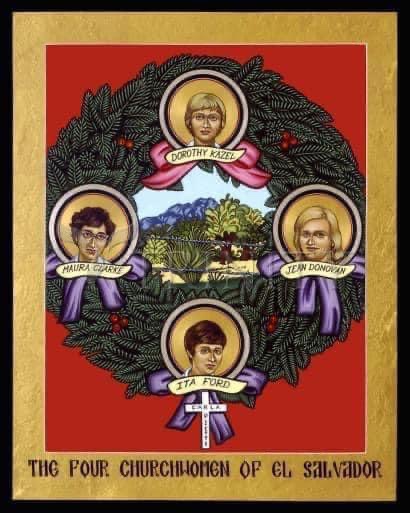
Today the church remembers the Martyrs of El Salvador.
Ita Ford, Maura Clarke, Jean Donovan, and Dorothy Kazel were Catholic Missionaries, Ursuline, and Maryknoll Sisters murdered in 1980 for their outspoken defense of the plight of the powerless and poor. Accompanying the people there, they were irritating the powers of the day with their theology of liberation and hope.
These four sisters were murdered on this day in the same year that Archbishop Romero was murdered, though he was killed in March.
Instead of recounting the details of their lives, I’ll just share a bit from a letter Sister Clarke wrote to her companion, Katie, just before she was murdered:
“There are so many deaths everywhere that it is incredible.
The ‘death squadron’ strikes in so many poor homes. A family of seven, including three small children, was machine-gunned to death in a nearby town just last week. It is a daily thing–bodies everywhere, many decomposing or attacked by animals because no one can touch them until they are seen by a coroner. It is an atmosphere of death.
I don’t know what tomorrow will bring…Write to me soon. Know that I love you and pray for you daily. Keep us in your heart and prayers, especially the poor forsaken people.”
The days surrounding Christmas are filled with Feast Days, some beautiful (like St. Nicholas), and some tragic like today. This is because the Divine entered into the world not as we would like it to be, but as it is: beautiful and tragic.
These martyrs today are a reminder to me, and should be for the church, that the first victims of any sort of violence are the poor and vulnerable.
If you need confirmation of that, just ask any medical professional who they treated most for COVID-19.
Those with means, good insurance, fewer health conditions (that are easily and often exacerbated by poverty!), and who can take off work to get treatment without fear of losing their job largely recovered.
Those without, did not.
It is a different kind of violence, a more negligent kind on the part of the powers of the world, but it is violence none-the-less.
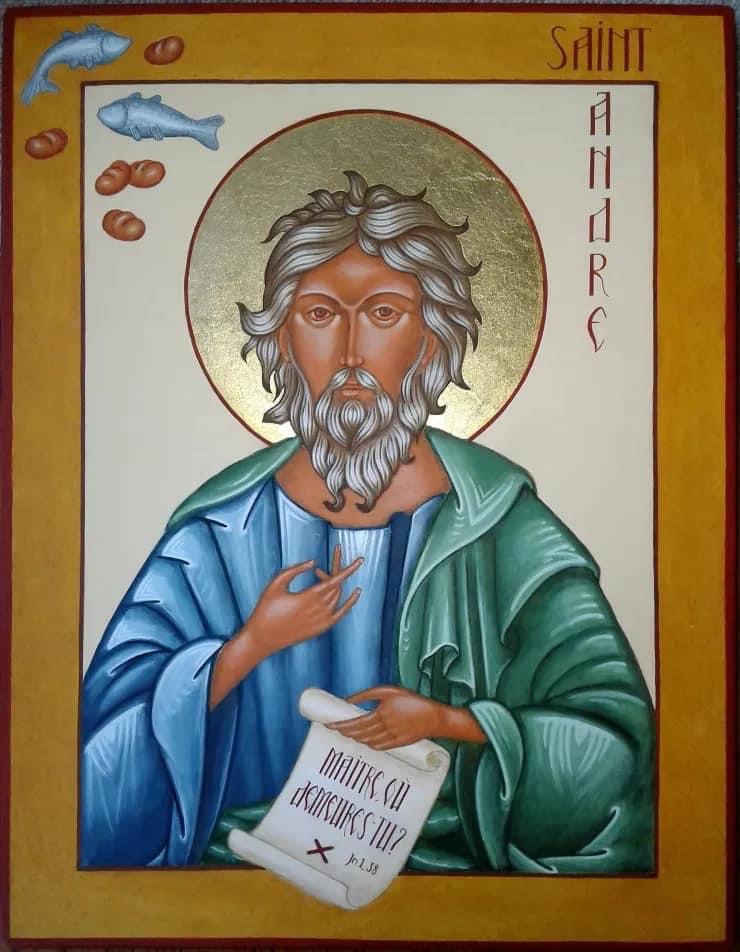
Today, November 30th, the church honors an often overshadowed apostle, Saint Andrew. He’s usually called “brother of Peter,” and rarely seen without that qualifier, making him, in essence, known to the world only in relation to his brother…which many people can probably identify with.
St. Andrew is the patron saint of sea-people, but also the informal saint of all who stand in the shadow of someone else.
He is the saint for the B-side of the record, the underdog sibling, the cobbler and the cooper who are no longer appreciated in their crafts.
Lore notes him dying in Greece, crucified because he refused to make sacrifice to the local gods and kept talking about Jesus.
And though he stood in the shadow of his brother his whole life, Andrew gets a place of prominence in the end: his feast day is the official marker for the start of Advent because the First Sunday of Advent every year is the Sunday that falls closest to St. Andrew’s day.
-icon written by Sister Nadine of the Sisters of St. Andrew in London, GB
Today the church honors Dorothy Day, Friend of the Poor and Antagonizer of the Privileged.
Born in Brooklyn just before the turn of the 20th Century, Dorothy worked for radical newspapers in her early years, mixing with the bohemian crowds of Greenwich Village.
She found herself living with a man she loved, and became pregnant in 1926. It was during this time that she experienced a life-changing conversion to the faith, and she made her home in Roman Catholicism.
She struggled to marry her internal passion for the Christ with her outer conviction to work for social justice. In 1933 she collaborated with fellow gadfly, Peter Maurin, to found the Catholic Worker Movement. Living simply and intentionally, this pseudo-monastic community took a vow to live collectively for the betterment of the poor and the outcast.
They set up hospitality houses in the city, collective living units in agricultural plots of land, and convened clarity councils to make decisions. They aimed to “create a new society within the shell of the old.”
St. Dorothy died in 1980. There is a story about her funeral that, as her casket was being carried through the street to the sanctuary for the funeral Mass, a person with severe mental illness pressed in on the crowd gathered around the procession. They made their way to the casket, and opened it, peering down upon Dorothy. The whole crowd stood and let it happen, knowing that it was precisely this human Dorothy had come to give her life to, and was ministering to them one more time.
St. Dorothy Day is a reminder for me, and should be for the whole church, that simple living is a calling for some, but not all. Poverty should be a choice, by God, and not the result of unfair economic, social, or political circumstances. The church is called to lift those trapped in poverty and to invite those with much to embrace a simpler life for the sake of their neighbor.
-historical bits from Claiborne and Wilson-Hartgrove’s Common Prayer: A Liturgy for Ordinary Radicals
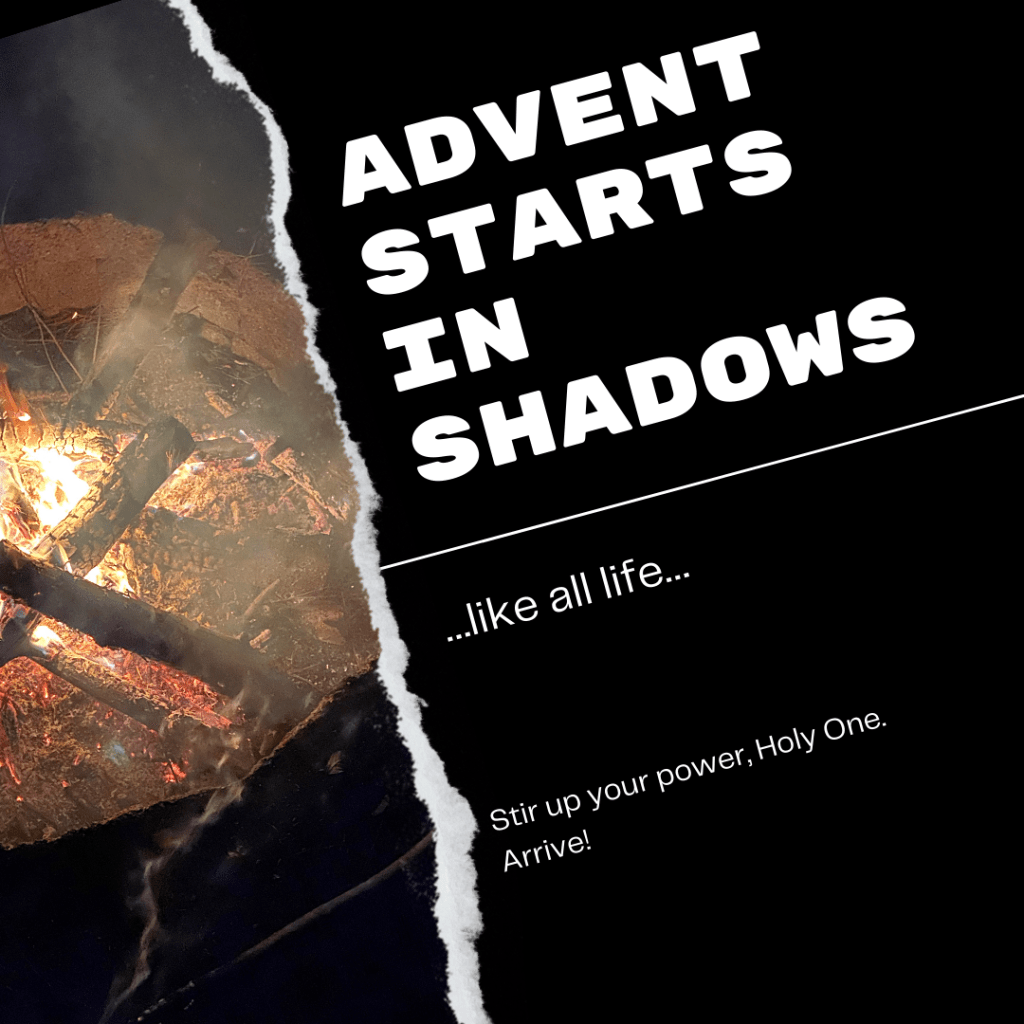
It’s an odd juxtaposition that happens when the secular and the sacred collide in these early Advent days. So many of us (at least, in America) are rushing to get that tree put up, the most ancient pre-Christian solstice symbol, and haul out the red and green decorations.
Meanwhile, the church is singing a bluer song and calling everything to hush for a bit, like you would when a baby is sleeping nearby.
Both responses to this time of year in this hemisphere are appropriate, of course. The ancient Celts would spend this time cozying up their indoor spaces, knowing they’ll be in the shadow of the fireplace for many hours in the coming months. They’d tie greenery to their door as an air freshener, and they’d make warm clothes, tell stories, and play indoor games. In this way, they’re not unlike all of us in our rush to decorate for the Christmas season.
But they’d do this other thing, too: they’d slow down. Their work would stop for a while, except for those necessary things needed to survive the winter. They’d rest longer, going to bed not long after night fell and waking late with the lazy solstice sun. They’d light candles in the morning and the evening, their new sun stolen from their fireplace outfitted with a huge log that, God willing, would last a good while.
They’d cozy and they’d slow.
The secular world is begging you to cozy at this moment. The sacred world is calling you to slow.
And, honestly, I’m not sure there’s such a thing as “secular” or “sacred.” Holiness pulsates through everything if our heartbeat is in rhythm with the Divine. So perhaps it shouldn’t be so much the “secular is calling you to cozy,” and the “sacred is calling you to slow,” but rather that the tensions pulling and pushing us in this world are felt forcefully in this moment, which is not a surprise.
We’re in a moment of change, evidenced by those last leaves falling to the ground.
Here’s a deep truth that all of these pushes and pulls point to: life begins in the shadows.
I don’t use “darkness” on purpose, by the way. As prophet and poet Nayyirah Waheed wrote in her collection Nejma,
“there is dark and there is anti light these are not the same things”
Language has evolved to the point where we can be careful and choosy with our words (as imperfect as it might be).
Shadows, like that in the Valley of Death that the Psalmist sings of, is a more appropriate description, I think. We’re not talking about a color, we’re talking about an absence of illumination.
All life starts with an absence of illumination.
The Big Bang began with a deep vacuum bereft of light.
The womb which was our first home pulsated with life, but no light.
The seed trying to do what it is meant to do in this moment is buried under the weight of too much earth, and yet it lives.
Life begins in the shadows.
This is why the readings in the church here at the beginning of Advent aren’t of Mary or Joseph or a baby in a manger, but ones of foreboding and nighttime.
The church knows, as does the Earth, as has humanity from ancient days, that life begins in the shadows, so if we’re going to talk about redemption and salvation and resurrection and new life, we have to start here.
There is an 8th Century hymn that often kicks off Advent in many spaces, “Creator of the stars of night.” The Latin version of this text is most beautiful, “Conditor alme siderum…” the chorister sings in simple chant tone.
Sidus, where we get siderum can mean just “stars,” and certainly it does mean that. But in this usage it also means all the cosmic bodies: planets, meteors, stars, galaxies.
The church sings to the creator who filled up the vacuum of space and, like the Mark text, invites us to gaze up at the shadows of space in awe and wonder. In the night times of life we ponder such mysteries. Who hasn’t stayed awake in bed with their mind racing?
The shadows are meant for such pondering, for from such ponderings comes imagination and new life and all sorts of things never before seen, as frightening as those moments can be sometimes.
And, as it is, we’re again plunged into such a night time of life in this Advent season.
Change happens in the shadows. Newness starts in the shadows.
Life starts in the shadows.
So Advent must start in the shadows.
So, Beloved, cozy up and slow a bit. Ponder the mysteries with the ancients.
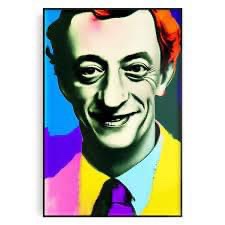
Today I would encourage the church to formally remember one who moved the needle on equal rights in America: Saint Harvey Milk of San Francisco, Politician, Activist, and Martyr.
Saint Harvey was born in 1930 in the outer-ring suburbs of New York City into a Lithuanian Jewish home. A bit awkward and goofy as a child, he loved being the class clown, played football in high school, and fell in love with the opera. He went on to major in mathematics as an undergrad, and eventually served in the Navy in the Korean War. His departure from the military would not be a kind one, though, as he was forced to accept an “other than honoerable discharge” due to the fact that his superiors found out that he was a gay man.
Saint Harvey drifted a bit after returning to New York from the war. He took positions where his mathematical acumen was helpful (a teacher, an actuarial analyst, a researcher), and through the help of the 60’s counterculture found his way to the Castro district of San Francisco where he opened up a camera shop on Castro Street. In this evolutionary period Saint Harvey’s very conservative political and social views also started to shift, which would spur on his activism in future years.
What might be largely forgotten to many is that in the 60’s and 70’s homosexual acts were often-times a felony, and anyone charged with these acts would have to register as a sex offender. In San Francisco the political elites were trying their level best to pander to a conservative voter base, and encouraged law enforcement to target these offenses above all else. These targeted hate tactics, along with skyrocketing taxes and an inefficient political environment, encouraged Saint Harvey to enter into the political arena with showmanship and blunt talk.
The gay political machine in San Francisco wasn’t particularly fond of Harvey Milk. They thought that he didn’t play well with them and wanted to blaze his own trail…which, honestly, was a fair assessment.
Having found his true calling in life, Saint Harvey would go on to run for different positions in San Francisco politics, starting with city supervisor. Though he gained many allies, especially from organized labor and business owners in the Castro, his showmanship was not enough to get him elected at his first go-round. In 1975 he decided to run again, and in a sea-change election the mayor, sherriff, and district attorney all shifted to the left, and Milk was offered a seat on the Board of Appeals for his role in changing the dynamics in San Francisco politics.
In 1976 Saint Harvey decided to run for the California State Assembly. Often bombastic and occasionally manic, Saint Harvey positioned himself as the underdog in the race, and though he was close to getting elected he found out that mere outrage and rhetoric wasn’t enough to cross the finish-line a victor. Having gay candidates who were out and running as their true selves, though, was stirring not just San Fancisco, but also a nation who was watching. Candidates standing for gay rights started running in races across the states.
This movement of gay rights candidates no longer hiding in the shadows of the closet caused a backlash, though. Christian conservatives started a counter-movement led by popular singer Anita Bryant with the horrible and unmistakably prejudice title “Save Our Children,” insinuating that somehow children are harmed by the mere presence of openly gay persons in their midsts.
These sentiments, unfortunately, persist today.
This Christian conservative movement led the repeal of many newly passed equal rights amendments. Gay rights protests popped up around the country in response, but the laws continued to be overturned and violence against the gay community skyrocketed, especially in San Francisco. Trying to capitalize on the anti-gay movement, California State Senator John Briggs introduced a bill that would ban out gay and lesbian teachers from teaching in California public schools. He hoped he’d be able to run for governor on his anti-gay ideas, and even called San Francisco a “sexual garbage heap” because of homosexuality.
At this time San Francisco reorganized how it elected its supervisor elections, allowing neighborhoods to directly elect their supervising representatives. Harvey Milk, already well-known and having learned from his political mistakes of the past, was a leading candidate to represent the Castro. He wasn’t only interested in gay rights, though. Milk saw the need for less expensive childcare, promoted free transportation in the city, and wanted the police to have an oversight board.
Saint Harvey became the first openly gay non-incumbant to win an election for public office in the United States.
Still kind of a thorn in the side of the political establishment, and not one for being a wallflower, Milk took on big business and the political elites, irritating most everyone. Despite his election, though, anti-gay sentiment continued to fester in the halls of power, and Proposition 6, a proposed law that would make firing gay and lesbian teachers (and any supporters of gay rights) mandatory was gaining steam. In response to Proposition 6, Harvey Milk went on a speaking tour, debating John Briggs at every turn. Briggs claimed that homosexual teachers were trying to “recruit” children, whereas Milk responded that if children were copying their teachers there’d be a hellava lot more nuns running around.
Ronald Reagan came out against Proposition 6. Jerry Brown came out against it. President Carter came out against it. It failed by more than a million votes.
On this day in 1978 a replacement for the newly resigned supervisor, Dan White, was to be announced. White had been at odds with Milk on a number of issues, and made the point of voting against any of Harvey’s initiatives on the Board of Supervisors. White had resigned claiming the salary was inadequate, but then sought to be reinstated. Mayor Moscone eventually refused to reinstate Dan White, seeking more ethnic diversity on the Board of Supervisors, better reflecting White’s district.
White snuck in City Hall with a police-issued relvolver, shot the mayor multiple times, reloaded, found Supervisor Milk, and shot him over five times.
He was 48.
Dan White’s trial gained national attention. The jury who would serve was not representative of the city population, and anti-gay sentiment continued to fester as many decided that White had done a good political deed in this double murder.
White was acquitted (!) of first degree murder, convicted of voluntary manslaughter, and with good behavior would be released within five years despite confessing to the shootings. His defense? He was confused by the machinations of the political elites of the day and had gone on a junk food binge the night before, causing a lack of mental clarity.
Riots and marches ensued, and the political landscape remained fraught for some time.
One might balk at the idea of a gay Jewish man being remembered as a saint of the church, and I understand that sentiment. However there are times when leaders have emerged who, like the Christ, have shown themselves to be on the right side of human dignity in the face of so-called Christian opposition, and Harvey Milk is one such example.
Harvey Milk was more Christ-like than the Christians when it came to human dignity, and his legacy should cause all of us to think honestly about where we are today when it comes to the growing list of anti-gay legislation being proposed and passed across this country.
Saint Harvey Milk is a reminder for me, and should be for the whole church, that sometimes non-Christians are more Christian than the Christians…which should make us honestly think and reform, by God.
-historical bits from publicly accessed resources
-icon written by the saints at Joy of Missing Out (note that Trinity Strores Icons has a wonderful Milk icon, but it’s watermarked and out of respect for their work I didn’t use it. However, I would encourage you to purchase Br. Robert Lentz’s icon if you’re looking for a way to honor Saint Harvey of San Francisco)





 Reluctant Xtian