Today the church remembers an obscure, but important saint, especially for those of us who find ourselves Lutheran in the Carolinas.
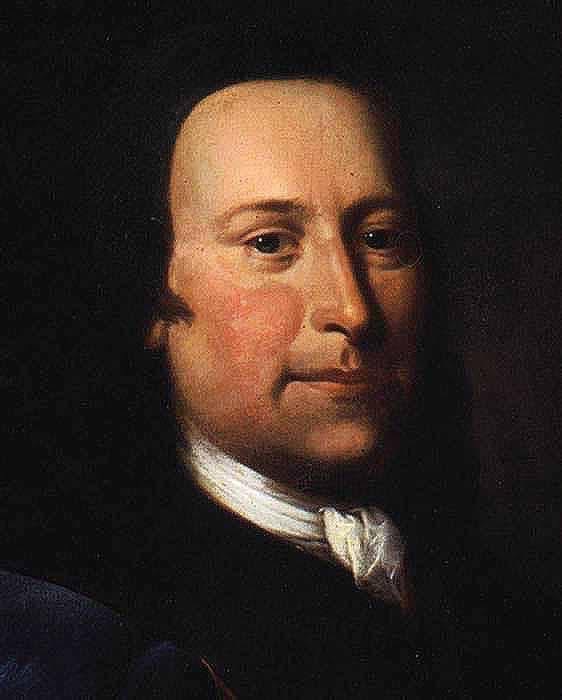
Today we honor Nicolaus Ludwig, Count von Zinzendorf, who may be considered the founder of the modern Moravian Church.
Zinzendorf was raised in an Austrian Lutheran family, and trained at Wittenberg University. Being of noble heritage, he took up a post in the court of King August the Strong of Saxony.
While there, he opened his home to Austrian Protestant immigrants, mostly of Bohemian descent. His hospitality, and the colony growing under his care, flourished, and he resigned his political post to attend to “the Lord’s watch,” as it came to be known.
He was a little too pious even for the Lutherans, but all the same was considered a Lutheran theologian. He was exiled from Saxony for his extreme piety, and founded communities in the Baltics, the Netherlands, England, the West Indies, and North America.
In 1737 he was consecrated a bishop in the Church of the Czech Brethren, a branch of the church that John Hus followers formed after his death. Because the church was founded around Moravia, it became known as the Moravian Church.
Zinzendorf also had great concern for social justice, a streak which continues in the Moravian Church to this day.
In the United States, and particularly Pennsylvania and the Carolinas, the Moravian Church and the Evangelical Lutheran Church in America maintain a special relationship. Here in Carolina it’s not unusual for families to have both Lutheran and Moravian members, and for churches close to one another to work together in mission. We are close theological cousins, and though there are certainly differences, we share pastors and are in full communion.
While many might know Moravians for their thin, wafer-like sweet cookies (and a pretty good thing to be known for!), they should be known more-so for their continued care for the poor and the oppressed around the world.
As Mothers Day approaches, I’m compelled to note that today the church honors the mother of mystics, 15th Century icon: St. Julian of Norwich, Enigma and Anchoress.
We know little about St. Julian, though she left us a treasure trove of writings from which to grow from. She became an anchoress of St. Julian’s Church in Norwich, a statement which means little to our ears, but explains that she lived in a shack adjacent to a particular church, in exile and voluntarily alone. She sought the contemplative life without distraction, and at the time this was seen as a benefit to her and her insights. We would later know it was certainly a benefit for our collective knowledge, but may have done her personal harm in the long run.
St. Julian called her insights “showings,” and she has recorded fifteen of them for the world. She was only around thirty years old when these visions happened to her, and they show both her admiration for the Divine and what she believes the Divine was showing her. In these experiences she recounts a God who is close, intimate, and “homely,” according to her description. She draws upon scripture and other medieval writings of the time to extrapolate on these extraordinary experiences.
St. Julian (sometimes called Dame Julian) was sought out for her wisdom. Though she lived as a recluse, others traveled far to hear her thoughts and seek her guidance.
St. Julian of Norwich died in the year 1417, and has long been honored on May 7th or May 8th by much of the church.
My favorite quote of hers, which was scribed while she was on her death bed, is, “All shall be well, all shall be well, and all manner of things shall be well.”
She is a reminder to me, and should be for the whole church, that insight into the Divine can happen to anyone, anywhere. And sometimes the most feeble amongst us holds the most acute lens.
-historical bits taken from Pfatteicher’s New Book of Festivals & Commemorations
All the sweetness of nature was buried in winter’s grave, and the wind sings a sad lament with its cold plaintive cry; but oh, the teeming summer will come bringing life in its arms, and will strew rosy flowers on the face of hill and dale.
In lovely harmony the wood has put on its green mantle, and summer is on its throne, playing its string-music; the willow, whose harp hung silent when it was withered in winter, now gives forth its melody. Hush! Listen! The world is alive!
Today the church remembers two of the original twelve disciples: St. Philip and St. James the Less, Apostles, Martyrs, and Friend of the Obscure.
While there are disciples of Jesus with fewer speaking roles than Philip and James the Less (lookin’ at you Simone the Zealot and Mattias!), St. Philip and St. James the Less are pretty obscure, with James taking the lion’s share of that cloud of mystery. Nevertheless, like many characters in the scripture, these two deserve remembering because they “were in the room where it happened,” and went on to work in the world even after it happened.
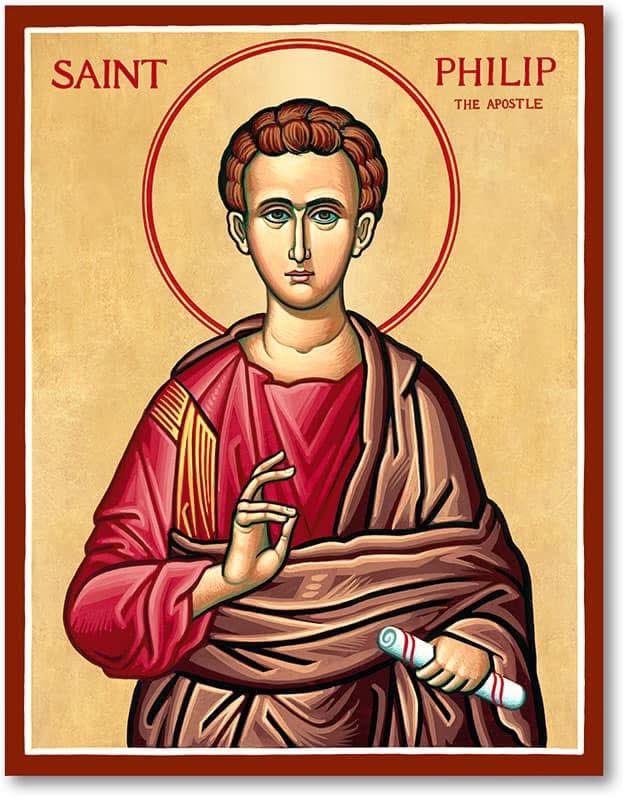
St. Philip is more well-known, hailing from Bethsaida, that fishing village that birthed St. Peter and St. Andrew. He’s remembered for two main stories in the scriptures: his call story in John 1:43-51, and the Feeding of the Five Thousand (John 6:5-7). He’s mentioned a few more times, but most people will recall these two tales more readily.
St. Philip is said to have traveled to modern day Turkey after the Pentecost story, preaching and teaching with reported success. Lore says that he was married and had two daughters who accompanied him. His death came at the hands of the townspeople of Hierapolis in Phrygia (Turkey), where he was either stoned or crucified, depending on which literature you follow. He was buried there and his daughters, who remained unmarried, survived him and are also buried there.
In iconography you’ll often find St. Philip depicted with a “Tau Cross” (T-shaped), and/or with two loaves of bread, referencing both his death and the Feeding of the Five Thousand.
St. James the Less (a moniker that distinguished him from James the brother of John), is simply noted as one of the disciples of Jesus and his mother may have been one of the Mary’s present at the crucifixion. Apparently they were at a loss for names in the ancient world, hence why there are so many named Mary and James…but I digress.
Post-Pentecost we don’t really have any stories of note about James the Less other than that he was said to have been martyred using either a saw or a “fuller’s club,” a large club with spikes or knobs. One of these two images usually appear in his iconography.
St. Philip and St. James are commemorated by the Roman church on this day, May 3rd, though Lutherans and Anglicans usually commemorate him on May 1st (which is more traditional). But in 1955 Pope Pius XII declared that May 1st should be a day dedicated to remembering the working class, and so he put St. Joseph the Worker’s feast day on that day, and transposed these two obscure apostles to May 3rd.
Honestly, it’s six in one hand and half a dozen in the other, because half of the church honors them on May 1st and the other half on May 3rd. Decide which candle to light and do your thing, Beloved.
St. Philip and St. James the Less are a reminder for me, and should be for the whole church, that sometimes in life all you get to be remembered by is your name.
And sometimes that’s enough, by God.
-historical notes from Pfatteicher’s New Book of Festivals & Commemorations
-it is worth noting that Pfatteicher encourages the church to adopt the older commemoration date of May 1st to honor these saints
Today the church remembers 4th Century Bishop St. Athanasius, who presided in Alexandria and was not known for brevity.
Athanasius is known as “the father of Orthodoxy,” arguing vehemently with the Arians who denied the full divinity of Jesus. Because of him the phrase “of one Being with the Father” became central to the Nicene Creed at the Council of Nicaea in 325.
He assumed the Bishopric as the successor of Bishop Alexander, but many opposed his selection and, like he with Arius, brought him up on heresy charges. He appealed to Constantine himself, and was mercifully exiled to northern Gaul.
After Constantine’s death he was allowed to return to Alexandria and resume his duties. Yet, it wasn’t before long that he was charged again by those who disliked him. Pope Julius I convened a council in the late 330’s and declared Athanasius innocent.
He would be brought up on heresy charges again, of course, and by his death he would see exile from the church five times.
The Athanasian Creed, named after Athanasius (though not written by him) is still sometimes recited on Holy Trinity Sunday in some parishes. It is yet a further “circling of the wagons” of the creeds of the ancient church, leaving less room for interpreting God’s work in the world.
Athanasius is seen as a great “doctor of the church,” but he should also be seen as a case study for what happens when our search for what is “correct” overwhelms the church. The one who cried heresy against others was quickly charged of heresy himself…and it would mark his whole life.
The schisms in our own Lutheran legacy are a testament to this deep and unfortunate truth.
If the faith is contingent solely on right and inerrant interpretation, you eventually end up with a church of one: yourself.
-historical bits from Pfatteicher’s New Book of Festivals & Commemorations
Today the ancient Celts would celebrate the festival of Beltaine, welcoming May as a month where the increasingly hot sun (the “tene” part of the word above) would warm the greenery enough to produce harvest. The “bel” portion of the word is a mystery, as it could stand for an ancient Celtic sun-god, Belanos, or could just be a form of the ancient word for “brilliant”
At dusk, having let their own hearth fires die out (which they only let happen once a year), the whole clan would ascend a nearby hill to get as close to the setting sun as possible. They’d set up huge poles and dance around them with flowers in their hair. They’d drink, and feast, and sing. They’d create flower garlands to adorn their doors or trees near their houses.
They’d create huge fires which they believed would help warm the sun, and they’d jump over the fires as a way of emboldening themselves for summer work, and if you were planning to be married soon, you’d do it three times for good measure. The elderly would circle the flames reciting prayers, and mothers would carry newly born infants near the coals as a way to ensure they’d be protected in childhood.
Fire, for them, purified the air of disease, and they believed that a bit of the hair from the same dog could be the cure, as they hoped setting these fires now would protect the unborn harvest from lightening strikes or other natural fires in the hot days.
As the fires smoldered each family would take a coal home to start their new hearth fire, and the rest was scattered throughout the crops for good luck.
If you stayed up all night on May-day, those who observed the sun rise would swear it danced for joy three times upon the horizon before jumping up in summer glory.
While the Lutheran church doesn’t officially commemorate anything on April 30th, I’d lobby hard that we (especially in these days) collectively remember that today is the day when the Vietnam War officially ended in 1975, bringing unification to that war-torn country once again.
This unification brought an end to waiting up for the evening news to hear if your number is called.
It brought an end to waiting for that letter to arrive, that proof of life.
It brought an end to waiting for that military vehicle to drive up one fateful afternoon and change your family forever…
And yet, even though the war officially ended, we know that it continued to rage in the minds and bodies of so many soldiers.
Even though the war officially ended, we know that it continued to rage in the hearts of so many who lost their son, father, brother, cousin, friend.
Even though the war officially ended, we know that peace is fragile and an absence of violence is not the same thing as peace, and that wars and rumors of wars persist.
But on this day when this particular piece of humanity’s bloody history was silenced, perhaps we can look with hope on this one fact:
If that violence ended, perhaps the wars raging even as I type this can, too.
The end of the Vietnam War is a reminder for me, and should be for the whole church (and everyone!) that wars can cease, by God…they can.
Today the church honors the feast day of a number of saints in the mystic tradition including St. Catherine of Siena, Johannes Tauler, and Blessed Henry Suso.
But I’d like to lift up one of my favorite 14th Century mystics, Meister Eckhart.
Eckhart, whose formal name is Johannes, was born sometime around the year 1260 in Germany. He was trained as a Dominican, and true to form was known as a wonderful preacher.
His teachings were not only deeply mystic and spiritual, but were also seen as being on the fringe for his day (and still may be considered so, today!). Because of this, he was brought up on heresy charges by the Archbishop of Cologne, and died before the matter was settled.
Years after his death a papal bull was distributed that named some of his writings as heretical, noting that “he wished to know more than he should.”
My favorite quote of the great Meister is:
“What good is it to me that Mary gave birth to the son of God fourteen hundred years ago, and I do not also give birth to the Son of God in my time and in my culture?
We are all meant to be mothers of God. God is always needing to be born.”
Eckhart is a reminder for the church, and for each of us, that the quest to “know more than we should” is one to be risked.
It’s important to note that on April 25th, the most perfect day in the whole calendar (not too hot or too cold, just enough for a light jacket in the morning) the church remembers the writer of what many consider to be the perfect Gospel account: Saint Mark, Evangelist and Friend of Brevity.
In the ancient days the church would take to the hillside on April 25th singing the Greater Litany in an attempt to neutralize any mildew that might even think about affecting the budding wheat harvest, a nod to the many agrarian examples that dot the Gospels, including the Gospel of Mark.
Mark’s Gospel is, as far as we can tell, the oldest Gospel in the canon (though certainly not the oldest writing in the New Testament). He is usually associated with John Mark, mentioned in the book of Acts, though the name “Mark” in ancient days was kind of like the name “Mary” back then: everyone and their brother seemed to bear the name (in fact, John Mark’s mother was named Mary).
Speaking of John Mark’s mother, if the Gospel writer is the same Mark as the one written of in the Book of Acts, then his mother hosted one of the first house churches recorded in the scriptures (check out Acts 12:12). Some even think it was perhaps this house, Mark’s house, where the disciples met for the Last Supper.
The John Mark of Acts went with his cousin St. Barnabas and St. Paul in their first missionary work (with St. Barnabas taking the lead…we forget that Barnabas taught Paul, not the other way around). Somewhere on this journey St. Mark and St. Paul became frienemies (Paul had a way of making enemies of those who would be his friends), and Paul decided that St. Mark would not be joining him on his other missionary journeys. Though they eventually made peace with one another, it’s interesting to note that the early church leaders were often butting heads.
Especially the loudest ones.
Saint Mark is often called the “interpreter of Saint Peter,” mostly because tradition holds that Saint Mark wrote his Gospel using the memory banks of that sage and salty Apostle. It is said Saint Mark went on to become the Bishop of Alexandria (though this may be mostly lore), and that he was martyred in 64 C.E. because he attempted to keep people from worshiping the god Serapis. In the mid 9th Century the remains of Saint Mark (or, at least what was called his remains) were moved from Alexandria to Venice, and are now in the cathedral there.
In many places throughout the world April 25th has been a “rogation day,” marked by processions through crop fields and prayers for a good planting season. In the 7th Century the church coopted this pagan processional meant to keep biological pests at bay through prayer and purification, and made it a liturgical act. In fact, once the church coopted this practice, the legend grew that it was on April 25th that Saint Peter entered Rome for the first time, and since Saint Mark is Saint Peter’s interpreter…well…they gave Mark the feast day and he forever became associated with both the litany and rogation festivals.
Saint Mark’s apostolic symbol is that of a lion. This figure, borrowed from the prophet Ezekiel, gives a visual to what Mark’s Gospel account is: fierce and loud, striking hot and fast. In Mark Jesus is always on the move. In Mark little details are swiped over in deference to big picture ideas. In Mark Jesus is the most human, seemingly glib to his Divine appointment in many instances.
All of the above makes Mark my favorite Gospel by far. I’m not big on Matthew’s attempt to fulfill prophecy, Luke’s penchant for inane details, or John’s flowery words and tortured imagery.
Mark gets the point and invites the reader/hearer to draw their own conclusions.
I like that.
Saint Mark is a reminder for me, and should be for the whole church, that sometimes brevity says more than tortured details can ever say. May everyone who writes a sermon hear.
-historical bits gleaned from Pfatteicher’s New Book of Festivals & Commemorations
For Spring, some Celtic wisdom on stewardship from a medieval Irish tale:
“A very old man went out one day on the land beside his house, and began planting fruit trees.
A young man walked by. “What are you doing?” the young man asked.
“Planting fruit trees,” the old man replied.
“But you will not see fruit in your lifetime,” the youth said.
“The fruit that I have enjoyed in my lifetime,” the old man answered, “has been from trees that people before me have planted. So to express my gratitude of them, I am planting trees to give fruit to those who come after me.”





 Reluctant Xtian