On the Summer Solstice the ancient Celts would give thanks for our star.
They’d build fires on the tops of the hills, believing these fires would further fuel the sun. They’d bring their babies close to the fire as a blessing, and they’d dance and sing and daring couples would hold hands and leap over the flame for good luck.
Midsummer was a day of indulgence with shared feasts and partying and plays and dramatic re-enactments of all kinds. As the sun indulged the Earth on this day, so the people took the minute here as summer was half gone (summer on the Celtic wheel is May-July) to bask in the House of Light, as they called the summer fields and hills.
Tonight is a very appropriate night to light a bonfire, enjoy some food outside, and give thanks for our star without which none of us could live.
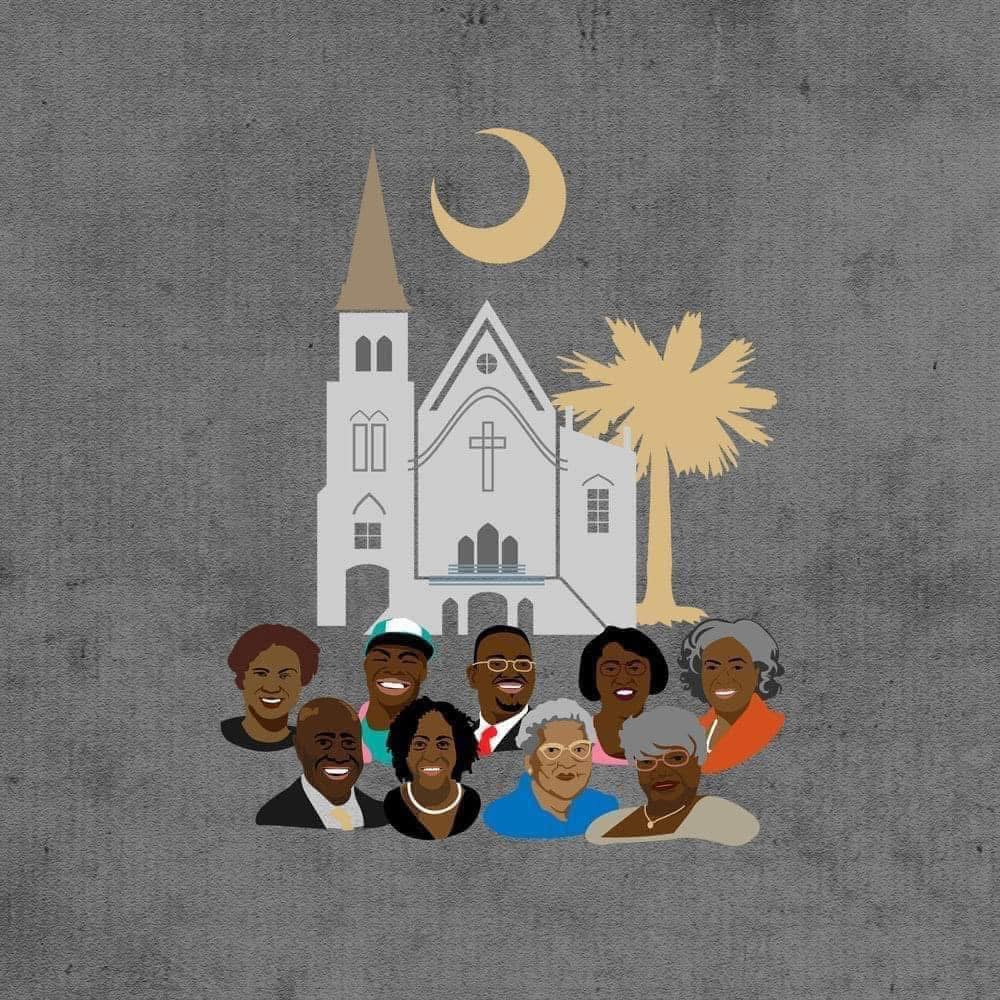
It laments of white privilege which, by the way, I’ve had more than a handful of “good, God-fearing church members” tell me is fictional. What an ignorant pleasure it must be to ignore truth.
It laments of racism, in which it is (not has-been, is) complicit.
And it honors the Emmanuel 9, gunned down in Bible Study and prayer, after they welcomed the stranger, Dylann Roof, in their midst, a boy taught in a Lutheran church and raised on a supposed diet of grace and peace.
There are no fail-safes in this world, Beloved, not on guns nor gospel perversions.
Today I am reminded of the words of the Reverend William Sloane Coffin, my spiritual mentor and muse, when he said,
“Believers know that while our values are embodied in tradition, our hopes are always located in change.”
So as the Confederate monuments (real and metaphorical) continue to topple around us, as Mary predicted they would in Luke 1:52, we also today lift up our voices in confession for having erected too many racist monuments in our lives by the things we have done and left undone.
Indeed, in many cases the cross, our symbol, has become a racist monument, twisted into the swastika, burned in front of hanging bodies, a barrier between peoples.
But not just those literal monuments. Most especially we repent of all of the figurative ones we erect, too.
Today we cry and lament and work for that change which is the currency of our hope.
Today many parts of the church remember a duo of 4th Century saints, a mother and son: Saint Cyricus and Saint Julitta, Family of Fortitude.
Saint Julitta was of noble birth, living in Asia Minor. During the persecution of Christians during Diocletian, she is said to have fled to Tarsus with her young son, Cyricus. To avoid detection, she hid her noble status, and tried to pass as a typical citizen, but having been widowed early on in her life, had little protection in the eyes of the law. As she fled, Saint Julitta was captured by the governor of Tarsus, along with her child, and tortured and interrogated until she admitted she was a follower of The Way. Her son was said to have called for his mother even as she was being hurt by the system that sought their demise.
Legend has it that St. Cyricus, when grabbed by the murderous governor, scratched his face and screamed. They both were reportedly martyred for the faith, victims of state-sanctioned violence against the vulnerable.
So, here’s the thing Beloved: I make note of these two saints of the faith, obscure as they are, because I believe we are still witnesses to state-sanctioned violence against the vulnerable and the weak.
Saint Cyricus is a patron saint of children, one we need to lift up in these days where schools are still shot up. Saint Julitta is the patron saint of single mothers and, unfortunately, is the unwitting saint of mothers whose children are victims of state-sanctioned violence.
Black and Brown citizens are gunned down shopping for their daily bread, just two years ago. Babies were killed learning their ABC’s, just a year ago. And lest we think this happens occasionally: gun violence happens every day in this country.
Every day.
A unique occurrence here in America. Perhaps this is “American exceptionalism” at it’s most raw.
And it’s not like other nations do not have mental health crises. They do. What’s the difference?
Access to assault weapons.
Saint Julitta and Saint Cyricus are reminders for me, and should be for the whole church, that the state is absolutely willing to put up with violence, especially at the expense of the weakest amongst us.
But the church? The church cannot be willing to put up with it…and neither should the larger citizenry.
Let those with ears to hear, hear.
-historical bits gleaned from publicly available sources and from Judika’s Daily Magic.
-icon written in the traditional Greek Orthodox style
Today the church remembers a recent spiritual hero, Saint Evelyn Underhill, teacher of mysticism within the church.
Born in England and taught at King’s College in London, she was already a promising writer when she underwent a spiritual conversion. Initially drawn to Roman Catholicism, she eventually was unable to make the Catechumenate oath due to the church’s rejection of modernism.
Instead, she turned to the mystics, of all denominations, for spiritual guidance.
She devoted her time to compiling and anthologizing the writings and lives of saints and mystics, resulting in her tome Mysticism (1911). She then came under the influence of Baron Friedrich von Hugel, a spiritual director who led her to her own mystical experiences. This led to her second major work, Concerning the Inner Life, which incorporated the the life of the saints with her own reflections, ponderings, and insights.
She eventually joined the Anglican church, and led retreats for spiritual seekers. After her death various letters of hers were published, indicating that she cared for her retreat attendees long past their individual retreats.
A lovely quote she’s known for is, “A certain wise Prioress said, ‘Most books on religion have thousands of words–we need only one word, GOD–and that surrounded not by many words but by silence.'”
Saint Underhill is a reminder for the church, and for me, that the spiritual quest need not be found in one doctrine or under one umbrella but a seeker, in the end, should at least anchor themselves to one as a way of rooting and grounding. That rooting and grounding doesn’t prohibit you from exploring, but rather keeps you solid as you spiritually stretch.
-historical notes from Pfatteicher’s “New Book of Festivals & Commemorations”
Today the Church also celebrates one of our moveable, and most confounding, Feast Days: The Feast of the Holy Trinity.
Here’s the thing about the Holy Trinity: it is a mystery to be held, not a problem to be solved…so we should stop trying to solve it, already.
At its best this doctrine, and this Feast Day (which has been celebrated on this Sunday after Pentecost since at least the 10th Century), honors the ineffable nature of the Divine. Using ancient numerology and a mystic mindset, it acknowledges that some things are unknowable, always spinning, and that this can be comforting for a humanity that longs to peg everything down.
A God who cannot be pegged down is endlessly possible.
At its worst this doctrine has become a (primarily masculine) box that explains in ways that don’t make any sense who God is and how Jesus and God are related, and then throws in a bird (or are they all the same and not related at all? See what happens when you think about it too much?!).
The Trinity is a Divine whirlwind of creativity and love.
The Trinity is a thought that is foundational to all other thoughts.
The Trinity is mother of all, the stream in which time is caught up, the hovering mist that covers existence.
And it is also none of this.
The Holy Trinity is a reminder for me, and should be for the whole church, that any effort to peg the Divine down is a fool’s errand (thank God).
-Icon is Crow Trinity written by Fr. John Giuliani
Though not an official saint day, I would lobby hard for it to become one.
Today the church (should) honor the 49 pulses stopped too soon in the Pulse Nightclub shooting, an act that was both domestic terrorism and hate crime wrapped into one bloody night.
In the days following I remember giving blood, and upon entering the waiting room, finding a number of young adults in tears, waiting. A young woman walked up to the attendant, asking, “How old do you have to be to give? If I bring my mom in, can she sign for me? She’ll give too.”
So much blood. On the dance floor. On the hands of a country that refuses to adequately deal with the scourge of gun violence. In vials filled to help the 53 victims wounded in the act.
And especially now when it seems to be increasingly dangerous for LGBTQIA+ folks due to hateful legislation being passed around the country targeting their representation, their stories, their families, and their dignity, we need to hear the call of the Saints of Pulse and act. We must not remain silent.
Pride month is a month of celebration; yes. But even more so it is a protest against the powers and principalities that seek to harm the splendid diversity of humanity through intimidation, violence, and laws that target rather than protect.
This now includes the Southern Baptist convention who recently lobbied to encourage the overturning of legal gay marriage in America.
The Saints of Pulse remind the church, and all of us, that until we tackle both the hate of the heart and the lack of regulations that allow people to wantonly act on that rage in mass murder, we’re not done.
Today is one of my favorite feast days because an early apostle, who doesn’t get a lot of play, gets a nod from the church.
Today the church honors St. Barnabas, a Jewish-Christian from the Diaspora. His name means, “child of encouragement,” probably because he was such a dynamite preacher.
He has long been thought to be one of the seventy that Jesus sent out in Luke 10, and he was a staunch defender of Paul in the courts of the early church, believing that Paul had indeed had a conversion.
His early work was in Antioch, where the church was thriving, and he asked Paul to assist him there…yes, you read that correctly, Paul assisted Barnabas in his early career. Eventually Paul would take the lead, but he learned how to lead from Barnabas. This little tidbit has been lost in history due to Paul’s enormous influence and ego, but it’s worth remembering.
In the early church arguments over the inclusion of Gentiles, Barnabas sided mostly with Paul, calling for Gentiles to be accepted into the fold. Barnabas eventually took John Mark under his tutelage, leaving Paul to travel with Silas, and as Barnabas headed toward Cyprus, we lose track of him in the fog of history.
Lore states that Barnabas was stoned in Cyprus around the year 60.
The Epistle of Barnabas, supposedly written by the apostle, was widely used in the early church and almost made the canon, and some think Barnabas is the author of Hebrews (I don’t buy this).
Barnabas is a reminder for the church, and for all of us, to look just behind the shining stars to see who made them shine. He was Paul’s mentor and defender in Paul’s early days, and like every good teacher, encouraged Paul to outshine him one day (for better or for worse).
-historical bits gleaned from Pfatteicher’s “New Book of Festivals & Commemorations”
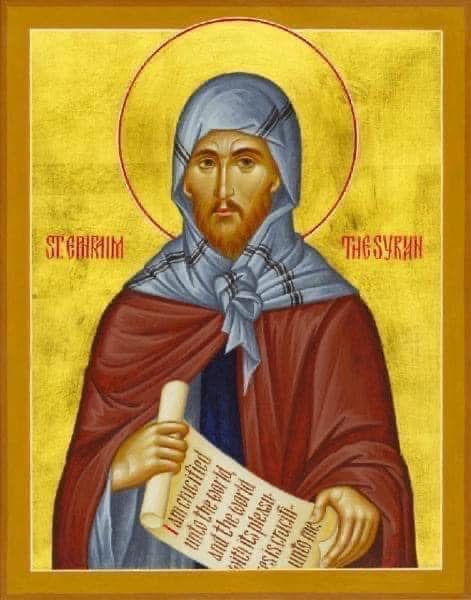
Today the Church honors a Deacon, hymnwriter, poet, and foundational theologian, 4th Century Ephrem of Edessa.
Syrian Christianity is one of the most ancient strains of the faith. Lore has it that Thaddeus of Edessa was one of the seventy sent out by Jesus (Luke 10), and he planted the seeds for Orthodox Christianity in the region. We have no proof of this, of course, and it may be the case that Thaddeus himself is entirely fictional, a pragmatic hagiography used to explain the origins of such an important branch of Christianity.
Whether or not this is true, though, Syrian Christianity was started early, and Ephrem was born a Christian in the early 300’s, and was a student of James, Bishop of Nisibis.
From there he became head of a successful theological school at Edessa, and began writing biblical commentaries, essays on dogma, biographies, historical records, homilies, and early Christian hymns that have remained a part of the Syrian Orthodox liturgy.
Syrians refer to Ephrem as “the harp of the Holy Spirit.”
Ephrem is a reminder to the whole church that Diaconal leaders have, since the early formation of the faith, influenced and guided the faithful all over the world.
Indeed, through our Deacons (and in many traditions, Deaconesses), the church continues to have many “harps of the Holy Spirit.”
-historical notes gleaned from Pfatteicher’s “New Book of Festivals & Commemorations”
Because two Irish saints are commemorated on June 9th, I’d lobby one of their feasts be transposed to tomorrow and one retained today as this good Abbot of Iona kept the lamp of learning and love alive in the toughest of times: Saint Columba, Rebuker of Monsters and Community Organizer.
Those with a Gaelic tongue would call him “Colum Cille,” or “Dove of the Church,” but you may call him Columba. He was born into a royal Irish dynasty (yes, there is such a thing) in the early 600’s, educated at the finest monasteries of the day, and eventually ordained a deacon and a priest for the people of the Emerald Isle.
At the ripe old age of 42 he left Ireland with twelve fellow travelers (you know, that old chestnut) to establish a community on Iona off the coast of Scotland. This little outpost would become the center for Irish missionaries serving the Scotch-Irish (those Irish who had settled in Scotland) and the Picts (the original Scots), as well as those living in Northumbria.
Saint Columba lived at Iona for more than thirty years, preaching and teaching both on the island and on the mainland.
One fun story about Saint Columba is that he took on the Loch Ness monster face-to-face after it had killed a young Scot. Saint Columba said, “Whoa, buddy!” and made the sign of the cross in front of it, calming it before it attacked another. The monster became docile and has never since attacked another human. This miracle was said to have converted King Brude, leader of the Picts, bringing many Scottish to the faith.
A powerful preacher with an imposing personality, Saint Columba was a force to be reckoned with and his footprints dot the literal landscape as well as the figurative landscape of the faith. He died on June 9th at the age of 77 (according to the Venerable Bede) and was buried on Iona (though his bones have since been moved to Kells).
Iona still remains a contemplative pilgrim destination for so many today; a sacred, thin space. In thin places there is very little separating you from God…Iona is considered one of the thinnest.
Saint Columba is a reminder for me, and should be for the whole church that sometimes we find thin places.
And sometimes we create them, by God.
Let those with ears to hear, hear.
-historical bits gleaned from Pfatteicher’s New Book of Festivals & Commemorations
Today is also one of the church’s moveable feast days, and used to be the second-most honored feast day, only second to Easter: Pentecost, Fire Hazard and Freedom-Giver.
Pentecost highlights the “shy person of the Trinity,” the Holy Spirit. She is unleashed upon the disciples as they are scared and huddled in an upper room, unsure of what to do.
At this same moment it just so happened that people from all the known world were gathered in Jerusalem for a festival…and the symbolism here should not be overlooked.
The Holy Spirit will infuse the world.
The disciples are described as appearing as if they had “flames on their heads.” It’s kind of akin to that time Moses was descending from Sinai and his “face was shining,” or that burning bush moment earlier in Exodus where the flame didn’t consume the shrub. The idea here is that they were glowing with Divine power and wisdom, and it doesn’t consume them, but rather sets them free.
And in this moment, which is a Divine reversal of the Tower of Babel story in Genesis, everyone understands that God is for them in their own language and context, everyone thoughout the known world gathered there.
Pentecost is not a story of God empowering a few to give to the many what they don’t already have, but a story of God unleashing herself upon humanity so that Divine wisdom and saving grace is seen and known in every nook and cranny of creation.
Which should, I think, make us more open to the experiences and ideas of others, especially because they glow with what the Celts called “the spark of Divine life,” just like those disciples glowed that day.
Pentecost is a reminder to me, and should be for the whole church, that Divine grace and wisdom shows up everywhere, like new wine surprising us at every sip.








 Reluctant Xtian