Nothing is Face Value

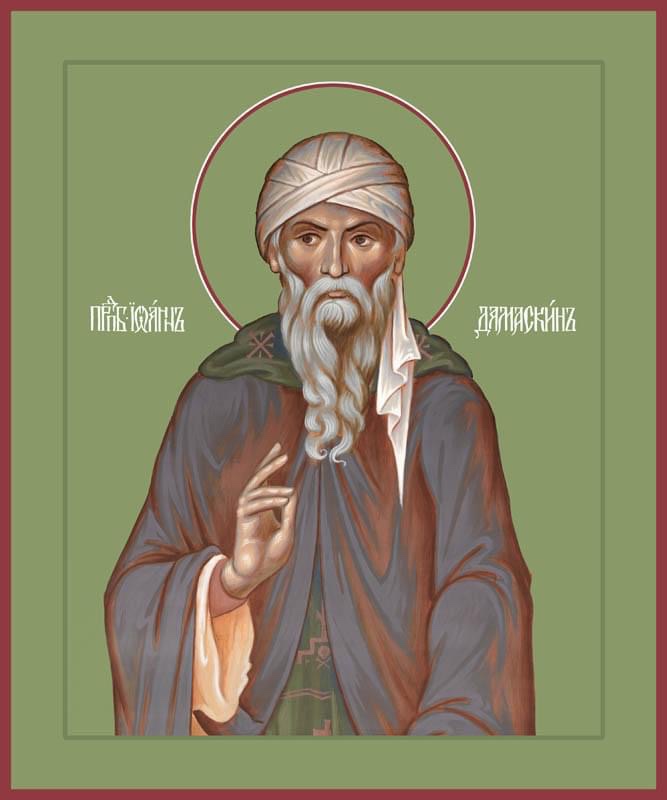
In the breaking days of December the church honors a Saint who found himself in a church at a breaking point: St. John of Damascus, Hymnwriter and Priest.

Born in 675, St. John was born into a wealthy family and was elevated to a political position of prominence at quite a young age when he succeeded his father as an official in the Court of the Caliph of Damascus.

He felt a call to the faith, and became a monk at the monastery of Mar Saba (still in existence!), a hermit colony founded in the year 484. It was there that he gave up his position in the Caliphate Court and devoted himself to simplicity, the study of the Desert Mothers and Fathers, and the priesthood. He was ordained in 725.

It was about this time that the church began to crumble under the weight of melding practices. The Eastern and Western churches were evolving drastically different approaches to faith and life. It would take another 300 years for the split to become official, but it is here in history that we can see the fault lines.

In these days the Byzantine emperor Leo III forbade the veneration of sacred images and icons, and ordered their destruction. St. John of Damascus wrote vehemently that icons and sacred images were portals and glimpses of the Divine, not Divine themselves, and should be saved and maintained. As part of his logic, he successfully defended the Real Presence of Christ in the Eucharist as well, against those who would dismiss it.

St. John of Damascus wrote great mystical treatises on theology, too, that are still foundational for the Orthodox community.

For all of the above, St. John of Damascus is considered by the Eastern Church as the last of its Fathers.

We still sing the writings of St. John, by the way. That wonderful Easter hymn sung every year that goes, “Come, ye faithful, raise the strain of triumphant gladness!” came from his golden pen. He authored a number of Easter hymns that still sing out the faith to this day every Spring.

St. John of Damascus died near Jerusalem around 760. He is a reminder for me, and should be for the whole church, that icons and objects can be glimpses of Divine presence in this world, and we need not take everything at face value.

Indeed, nothing is “face value” when it comes to the Divine. God is always more than they appear…and godly things can be, too.

-historical notes from Pfatteicher’s New Book of Festivals & Commemorations

The Poor are the First Martyrs

Today the church remembers the Martyrs of El Salvador.

Ita Ford, Maura Clarke, Jean Donovan, and Dorothy Kazel were Catholic Missionaries, Ursuline, and Maryknoll Sisters murdered in 1980 for their outspoken defense of the plight of the powerless and poor. Accompanying the people there, they were irritating the powers of the day with their theology of liberation and hope.

These four sisters were murdered on this day in the same year that Archbishop Romero was murdered, though he was killed in March.

Instead of recounting the details of their lives, I’ll just share a bit from a letter Sister Clarke wrote to her companion, Katie, just before she was murdered:

“There are so many deaths everywhere that it is incredible.

The ‘death squadron’ strikes in so many poor homes. A family of seven, including three small children, was machine-gunned to death in a nearby town just last week. It is a daily thing–bodies everywhere, many decomposing or attacked by animals because no one can touch them until they are seen by a coroner. It is an atmosphere of death.

I don’t know what tomorrow will bring…Write to me soon. Know that I love you and pray for you daily. Keep us in your heart and prayers, especially the poor forsaken people.”

The days surrounding Christmas are filled with Feast Days, some beautiful (like St. Nicholas), and some tragic like today. This is because the Divine entered into the world not as we would like it to be, but as it is: beautiful and tragic.

These martyrs today are a reminder to me, and should be for the church, that the first victims of any sort of violence are the poor and vulnerable.

If you need confirmation of that, just ask any medical professional who they are treating for COVID-19.

Those with means, good insurance, fewer health conditions (that are easily and often exacerbated by poverty!), and who can take off work to get treatment without fear of losing their job largely recover.

Those without, do not.

Looking at you Joe Rogan and Aaron Rodgers.

It is a different kind of violence, a more negligent kind on the part of the powers of the world, but it is violence none-the-less.

Guns Don’t Kill People and Other Lies I’ve Been Told…

So, we have another shooting at a High School in Michigan.

And it’s clear we think there is “nothing we can do about it!”

Lies.

When I was pastoring a church I spoke out the Sunday following the the Pulse nightclub atrocity.

I spoke out by having us sing a hymn against murder.

I spoke out having us sing about imagining a world where guns used for killing people…and some guns are meant for hunting (which I’m cool with) and some meant for murder (which I’m not cool with) …was not a thing.

And I got emails.

All the emails.

About how “guns don’t kill people, people kill people,” totally dismissing that people with guns kill people.

It was a total appeal to what philosophers refer to as “plausible deniability.” As if guns designed to kill people are benign.

They are not.

I am all for people having rights. I am all for people who have rights exercising them.

Powder muskets for all who want them!

But guns designed to kill people should not be available to everyone who wants to buy them, Beloved.

I want my babies to go to school without fear of being shot up. They’re already afraid of this viral contagion that too many people refuse to get inoculated against, do we need another factor?!

Apparently so.

What the hell kind of people are we?

The B-Side

Today, November 30th, the church honors an often overshadowed apostle, Saint Andrew. He’s usually called “brother of Peter,” and rarely seen without that qualifier, making him, in essence, known to the world only in relation to his brother…which many people can probably identify with.

St. Andrew is the patron saint of sea-people, but also the informal saint of all who stand in the shadow of someone else.

He is the saint for the B-side of the record, the underdog sibling, the cobbler and the cooper who are no longer appreciated in their crafts.

Lore notes him dying in Greece, crucified because he refused to make sacrifice to the local gods and kept talking about Jesus.

And though he stood in the shadow of his brother his whole life, Andrew gets a place of prominence in the end: his feast day is the official marker for the start of Advent because the First Sunday of Advent every year is the Sunday that falls closest to St. Andrew’s day.

Antagonizer of the Privileged

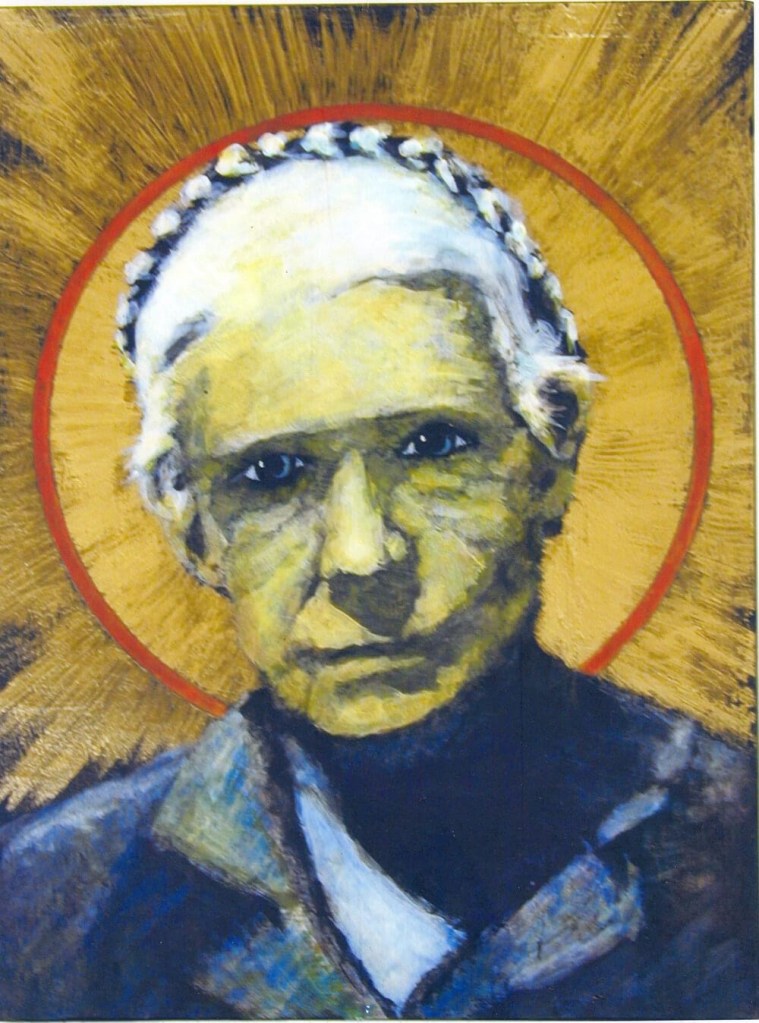
Today, as we begin our Advent journey in 2020, the church honors Dorothy Day, Friend of the Poor and Antagonizer of the Privileged.

Born in Brooklyn just before the turn of the 20th Century, Dorothy worked for radical newspapers in her early years, mixing with the bohemian crowds of Greenwich Village.

She found herself living with a man she loved, and became pregnant in 1926. It was during this time that she experienced a life-changing conversion to the faith, and she made her home in Roman Catholicism.

She struggled to marry her internal passion for the Christ with her outer conviction to work for social justice. In 1933 she collaborated with fellow gadfly, Peter Maurin, to found the Catholic Worker Movement. Living simply and intentionally, this pseudo-monastic community took a vow to live collectively for the betterment of the poor and the outcast.

They set up hospitality houses in the city, collective living units in agricultural plots of land, and convened clarity councils to make decisions. They aimed to “create a new society within the shell of the old.”

St. Dorothy died in 1980. There is a story about her funeral that, as her casket was being carried through the street to the sanctuary for the funeral Mass, a person with severe mental illness pressed in on the crowd gathered around the procession. They made their way to the casket, and opened it, peering down upon Dorothy. The whole crowd stood and let it happen, knowing that it was precisely this human Dorothy had come to give her life to, and was ministering to them one more time.

St. Dorothy Day is a reminder for me, and should be for the whole church, that simple living is a calling for some, but not all. Poverty should be a choice, by God, and not the result of unfair economic, social, or political circumstances. The church is called to lift those trapped in poverty and to invite those with much to embrace a simpler life for the sake of their neighbor.

-historical bits from Claiborne and Wilson-Hartgrove’s Common Prayer: A Liturgy for Ordinary Radicals

-icon written by Dan Smith

All Life Begins in the Shadows

It’s an odd juxtaposition that happens when the secular and the sacred collide in these early Advent days. So many of us (at least, in America) are rushing to get that tree put up, the most ancient pre-Christian solstice symbol, and haul out the red and green decorations.

Meanwhile, the church is singing a bluer song and calling everything to hush for a bit, like you would when a baby is sleeping nearby.

Both responses to this time of year in this hemisphere is appropriate, of course. The ancient Celts would spend this time cozying up their indoor spaces, knowing they’ll be in the shadow of the fireplace for many hours in the coming months. They’d tie greenery to their door as an air freshener, and they’d make warm clothes, tell stories, and play indoor games. In this way, they’re not unlike all of us in our rush to decorate for the Christmas season.

But they’d do this other thing, too: they’d slow down. Their work would stop for a while, except for those necessary things needed to survive the winter. They’d rest longer, going to bed no long after night fell and waking late with the lazy solstice sun. They’d light candles in the morning and the evening, their new sun stolen from their fireplace outfitted with a huge log that, God willing, would last a good while.

They’d cozy and they’d slow.

The secular world is begging you to cozy at this moment. The sacred world is calling you to slow.

And, honestly, I’m not sure there’s such a thing as “secular” or “sacred.” Holiness pulsates through everything if our heartbeat is in rhythm with the Divine. So perhaps it shouldn’t be so much the “secular is calling you to cozy,” and the “sacred is calling you to slow,” but rather that the tensions pulling and pushing us in this world are felt forcefully in this moment, which is not a surprise.

We’re in a moment of change, evidenced by those last leaves falling to the ground.

Here’s a deep truth that all of these pushes and pulls point to: life begins in the shadows.

I don’t use “darkness” on purpose, by the way. As prophet and poet Nayyirah Waheed wrote in her collection _Nejma_,

“there is dark
and
there is anti light
these are not the same things”

Language has evolved to the point where we can be careful and choosy with our words (as imperfect as it might be).

Shadows, like that in the Valley of Death that the Psalmist sings of, is a more appropriate description, I think. We’re not talking about a color, we’re talking about an absence of illumination.

All life starts with an absence of illumination.

The Big Bang began with a deep vacuum bereft of light.

The womb which was our first home pulsated with life, but no light.

The seed trying to do what it is meant to do in this moment is buried under the weight of too much earth, and yet it lives.

Life begins in the shadows.

This is why the readings in the church here at the beginning of Advent aren’t of Mary or Joseph or a baby in a manger, but ones of foreboding and nighttime (Luke 21:25-36 kicks off this Advent cycle, and it’s a doozy!).

The church knows, as does the Earth, as has humanity from ancient days, that life begins in the shadows, so if we’re going to talk about redemption and salvation and resurrection and new life, we have to start here.

There is an 8th Century hymn that often kicks off Advent in many spaces, “Creator of the stars of night.” The Latin version of this text is most beautiful, “Conditor alme siderum…” the chorister sings in simple chant tone.

Sidus, where we get siderum can mean just “stars,” and certainly it does mean that. But in this usage it also means all the cosmic bodies: planets, meteors, stars, galaxies.

The church sings to the creator who filled up the vacuum of space and, like the Luke text, invites us to gaze up at the shadows of space in awe and wonder. In the night times of life we ponder such mysteries. Who hasn’t stayed awake in bed with their mind racing?

The shadows are meant for such pondering, for from such ponderings comes imagination and new life and all sorts of things never before seen, as frightening as those moments can be sometimes.

And, as it is, we’re again plunged into such a night time of life in this Advent season.

Change happens in the shadows. Newness starts in the shadows.

Life starts in the shadows.

So Advent must start in the shadows.

So, Beloved, cozy up and slow a bit. Ponder the mysteries with the ancients.

New life is starting.

Launch and an Invitation: Anam Cara Community is Rethinking Thanksgiving

Many have been asking about Anam Cara Community, a new digital-first church plant that’s being organized.


We’re doing it in stages, like all good things should be done. Scaffolding is important.
Today though, on the cusp of Thanksgiving, we’re launching our first invitation.


You can sign up to get regular information regarding Anam Cara and what we’ll be about, and we invite you to join us in rethinking Thanksgiving this holiday, and donating to a First Nations mission here in the mountains of North Carolina.


Get rid of the Americana kitsch around this holiday, and practice thanks giving by supporting this ministry that feeds over 700 families a month on their home land in Cherokee.

Click below. You’re welcome to be a part of it all.


Real Religious Persecution

Today the church remembers a 20th Century Mexican priest, St. Miguel Agustin Pro, Martyr of the Faith.

St. Miguel was born in 1891 in Zacatecas, Mexico, and was known as a happy, cheerful, and privileged child. Despite his relatively high-born status, he developed a deep love and kinship for the working class families around him, and began to spend all of his time and energy working alongside the poor.

He eventually became a Jesuit novice at the age of twenty, and was exiled during the Mexican Revolution. He went to Belgium, where he was ordained, and eventually returned to Mexico in the wake of the war. He found churches closed, priests hiding, and being a Catholic now illegal. Fr. Miguel would regularly dress up in disguises to conduct secret and underground ministry, especially offering pastoral care, comfort, and the sacraments to the afflicted.

In 1927 St. Miguel was accused of being a part of a failed bombing attempt, though it is widely believed that the charges were false. He was handed over to the police and sentenced to death without so much as a trial.

As he was put in front of the firing squad he cried out, “Long live Christ the King!”

Though the government forbade a public funeral, people poured out of their homes to line the streets as his body passed by.

St. Miguel is a reminder to me, and should be for the whole church in the United States, that it was not so long ago that real religious persecution so close to home was a thing, so we should be very hesitant to claim it over baking cakes, serving pizza, and performing weddings and whatnot today.

-historical pieces from Pfatteicher’s _New Book of Festivals & Commemorations

-icon by Iknu Arts (https://displate.com/displate/2513912)

Almost Made It…

Today the church honors an apostolic pillar whose writings almost (and should have!) made it into the Biblical canon: St. Clement, Theologian and Bishop of Rome.

Little is known about the life of St. Clement, who was probably the fourth Bishop of Rome. He lived and died right around the year 100, and may be the same Clement written about in the book of Philippians (4:3). He was certainly the writer, though, of the Epistle of Clement I (though probably not the Epistle of Clement II).

Ordained by St. Peter, Clement was said to be banished to Crimea during the reign of Trajan, forced to work in the mines. It was there, it is said, that he was tied to an anchor and thrown into the Black Sea (the anchor is his saintly symbol).

But though so little is known about Clement, we certainly know much about his thoughts and his voice. In the year 96 Clement authored a letter from the Church at Rome to the Church at Corinth. This letter is the earliest Christian document we have in existence, with the exception of some New Testament writings, and was written to encourage the Church at Corinth to avoid a schism and remain steadfast to one another. It’s a letter of pastoral advice.

This letter was so widely known, and so widely revered, at early manuscripts of the New Testament include it in the canon.

St. Clement is a reminder for you, and should be for the whole church, that not all that is holy is contained in the canon, Beloved.

-historical bits from Pfatteicher’s _New Book of Festivals & Commemorations_

A Lion, a Pen, and Apologies

Today the church remembers a masterful storyteller who wove a tapestry of tales that continue to teach: Clive Staples Lewis, Writer and Dream Maker.


St. Lewis (you know him better as C.S. Lewis, no doubt) was born in Northern Ireland to a barrister father and mathematician mother. After years of boarding schools, he attended University College, Oxford and, after graduation, was appointed as a Tutor and Fellow there, and eventually as Professor of Medieval and Renaissance Literature a Cambridge.


At his heart, he was a writer. Scholarly works, fictional works, essays regarding the state of humanity, C.S. Lewis was born with one pen in his hand and another in his mouth.


As a youth he had rejected Christianity, probably as a rebellion around the death of his mother when he was ten years old. In 1929 he had a conversion experience that eventually led him back to the church in 1931. This journey from atheism to theism to the church was recounted in _Surprised by Joy_, published in 1955.


As many it is with many converts, C.S. Lewis spilled a lot of ink defending the faith. _The Problem of Pain_, _Mere Christianity_, and _The Screwtape Letters_. In these works for art…which they are…he eloquently and imaginatively honors various human realities through the lens of faith.


Most of the world, though, knows him not for his essays, but for his works of fiction and science-fiction. The seven book _Chronicles of Narnia_ and his lesser known _Space Trilogy_ present for humanity a fanciful retelling of Christian faith and morals through a lion who dies yet lives, children who are awake and yet dreaming, honorable mice pirates, witches, and distant planet explorations that are right in your backyard.


It’s widely known that he and his fellow writer, JRR Tolkien, often met to discuss their works over a pint or three. He thought Tolkien was too verbose (he was), and Tolkien thought Lewis was too “on the nose” with his allegories (he was). And yet we’re all better for it all, right?
The works of Lewis that most affected me, though, weren’t any of the above, but two works separated by time yet linked in theme: _The Four Loves_ and _A Grief Observed_.


In _The Four Loves_ Lewis mines the realities of human love, seeking to make a connection between these loves and the deep feelings of the heart. English is such a limiting language. We only have one word for “love,” and yet many ways of feeling it. Lewis goes deep into analysis around this, offering some clarity to what we feel when we say “I love you.”


In _A Grief Observed_, though, Lewis is at his most vulnerable, most bare, most thoughtful (at least in my opinion). He wrote this reflection on grief after the death of his wife, Joy Davidman Gresham, after they had only been married four years. Here St. Lewis is less apologist for the faith and more barrister with faith and fairness of life put on slow, subtle trial. Gone is the idealism of the new convert, and in its place we find an honest conversation between C.S. Lewis and a faith that he considered an old friend that kind of let him down (though the work does end on a hopeful note).


It is real. It is honest. And, in my opinion, is required reading.


St. Lewis died on this day in 1963 at his home in Oxford.


One of my favorite notions of his, which I believe to be totally true, is found in _The Screwtape Letters_ where the young demon being tutored by penpal is told that “God only coaxes, and cannot coerce.”


God only coaxes, and cannot coerce.


St. C.S. Lewis is a reminder for me, and should be for the whole church, that story has always been a way that we learn about the Divine.


And always will be.


-historical bits from Pfatteicher’s _New Book of Festivals & Commemorations_
-opinions mine
-icon written by Claudia Kilby