
The Greatest Lutheran Hymnwriter (IMHO)

Today the church honors three 17th Century musicians for the ages: Philipp Nicolai, Johan Heermann, and Paul Gerhardt.

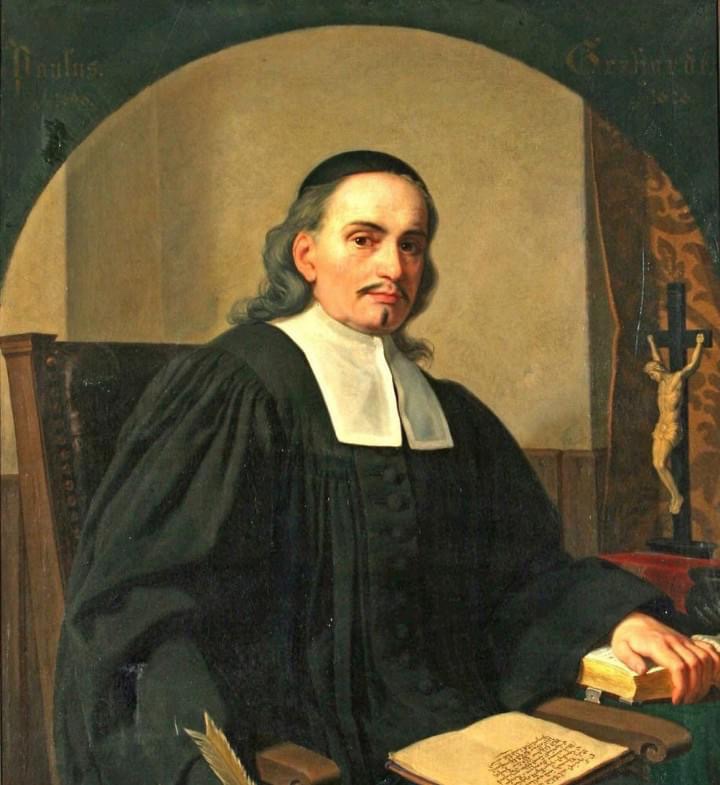
This year I’m going to focus just a bit on Paul Gerhardt because he is, in my estimation, not only the best Lutheran hymnwriter to date, but a superb theologian.

St. Gerhardt was born in 1607 near Wittenberg, and he studied theology there in the mid 17th Century even while the Thirty Year’s War was a plague upon the land. He got work out of University as a tutor, and ended up marrying one of the daughters of the family he taught (kind of a no-no today, but back then was not unheard of).

Being of great skill both in writing and composing, St. Paul’s hymns appeared in a music publication of the day compiled by the cantor at St. Nicholas’ Church in Berlin, one Johann Cruger.

At the ripe old age of forty five, Gerhardt finally formally used that theology degree, was ordained, and entered the pulpit as the Senior Pastor at Middenwalde, near Berlin. From there he moved on to St. Nicholas in Berlin as an associate pastor, but quickly became the congregational favorite because his sermons were wise, witty, and relatively short.

Pastors: take note.

Unfortunately Reformation strife was continuing throughout Germany, and in-fighting and back-biting were common as the theologians tried to figure out what was, and wasn’t, orthodox from the Lutheran lens. To his credit, Paul refused to sign a pledge not to discuss controversial things from the pulpit.

The Gospel is often controversial. Congregation members: take note!

Because he refused to promise not to say tough things from the pulpit or bring up doctrinal issues, he was removed from St. Nicholas and went without a parish for some years.

Side note: lots of pastors find themselves in a similar situation today, no?

To add tragedy to tragedy, during this tough period his wife and a son died (three previous children had already died). He only had one son left.

In May of 1669 he was appointed as archdeacon of Lubben, a really harsh parish who didn’t really care for how wonderful he was, and he lived there with his only remaining son for a few years until he died in 1676.

Saint Paul Gerhardt wrote 113 hymns in his day, translating difficult doctrines for the modern ear with modern (for his day) melody.

Finally, I want to reinforce what I said in that first thought: that all three were not just hymnwriters, they were theologians. The theology we sing affects the theology we trust, Beloved. The tune is the hook, but the words are the bait, the thing we swallow, the thing we start to subconsciously believe.

In other words: be careful what you sing because it will become what you say you believe.

Out of the three of these hymnwriters, Paul Gerhardt is the one you’ll know the best if you grew up in a Lutheran church. While we sing the works of all three of these giants of the hymnic faith, Gerhardt is no doubt the greatest Lutheran hymnwriter.

He also, no doubt, had the most unusual facial hair.

Want to look up some of their tunes?

In your Evangelical Lutheran Worship you’ll find Nicolai on hymn 308 (“O Morning Star, How Fair and Bright!” sung at Epiphany), 436 (“Wake, Awake, for Night is Flying” sung at Advent), and 786 (“O Holy Spirit, Enter In” Nicolai only wrote the tune for this one, and I’ve rarely sung it).

Heeraman’s work can be found on 349 (“Ah, Holy Jesus” sung every Lent), 675 (“O Christ, Our Light, O Radiance True” sung in Ordinary Time), and 806 (“O God, My Faithful God” sung in times of crisis).

And the seminal Gerhardt tunes can be enjoyed on 241 (“O Lord, How Shall I Meet You” sung at Advent), 273 (“All My Heart Again Rejoices” sung at Christmas), 340 (“A Lamb Goes Uncomplaining Forth” sung during Lent), 351 and 352 (“O Sacred Head, Now Wounded” sung during Holy Week…a favorite of mine!), 378 (“Awake, My Heart, with Gladness” an underappreciated Easter hymn), 568 (“Now Rest Beneath Night’s Shadows” a very sweet evening hymn), 761 (“Evening and Morning” a lovely song on trust), and 788 (“If God My Lord Be for Me”…sung in times of trial).

-historical bits from Pfatteicher’s New Book of Festivals & Commemorations

-painting of Paul Gerhardt by Herrmann Schwender

On the Forms We Fill

He asked me to fill out the form.

He wanted his child to go to a very conservative Christian school, and the school required that their pastor fill out a form.

Two of the questions had to do with an eternal hell for unbelievers. Another had to do with the exclusiveness of Christianity as whole truth.

I filled it out honestly. It came back with “red flags.” I was asked to fill it out differently…which I would not.

A month later they left the congregation and joined one where the pastor could fill out the form without any “red flags.” No reason given. No goodbye.

Just gone.

A Flawed Gift

Today is the feast day of a giant of theology and philosophy, Saint Augustine, Teacher.

Fun Fact: Augustine was voted by his classmates, “Most Likely Non-Disciple to Get Lutheran Churches Named After Him.”

Augustine was born in Algeria in 354 to a Christian mother (Monica) and a pagan father. He was a good student, and in his early years practiced Manichaeism, a dualistic religion of Persian origin that was very “in the now” of his day.

He fathered a child early on in his life, and he named him Adeodatus which means “Gift of God.” History is quiet on the kind of father he was, but it’s important to note that this happened because all of this early material would lay the basis for his most famous work, Confessions.

Eventually Augustine ended up in Rome where he taught rhetoric and was wooed into the Catholic faith. There he was catechized under St. Ambrose and was baptized at the Great Vigil of Easter in 387.

Shortly thereafter Augustine returned to North Africa and lived a monastic life with friends. In 391 while visiting Hippo, he was chosen by the small church there to be their pastor.

All indicators point to his reluctance to take up the role, but eventually he was ordained into the priesthood and consecrated Bishop of Hippo, a role he kept for 35 years. He traveled extensively in the ancient world, and wrote volumes while he did so.

His book The City of God contains his reflections on society and the body politic in the aftermath of Rome’s collapse. In it he also defends Christianity and sets forth a vision of an ideal Christian society.

Spoiler alert: it looks nothing like America.

He established a Rule of Life and an order, Augustinian, was begun in his name. Martin Luther would adopt this Rule and this order.

Augustine died after he came down with an intense fever in the year 430. His remains, well, remain in the Church of San Pietro in Pavia, Italy.

Augustine is the model of the “second chance” life. And, quite honestly if you read Confessions, a third and fourth chance, too.

He is one of the most human of the saints because his foibles and misadventures are documented for all to see. He remains a gift to the church, even with all his flaws, and is a constant reminder that contrition and confession enable us to be born again.

And again.

And again.

-historical tidbits from Pfatteicher’s New Book of Festivals & Commemorations

On the Ego

“They either hate me or praise me and I can’t deal with it,” he said, half laughing to himself.

“Are you serious or just joking?” she asked in a tone more serious than not.

He stopped laughing and became reflective for a moment.

“Well,” he said slowly, “both tend to throw me off kilter. The criticism tears me up and makes me eager to prove it wrong. The praise puffs me up, but secretly I know it can’t last. We all disappoint.”

She nodded. “They both manipulate your ego. I get it.”

They were both quiet for a moment.

“How about this: hold both praise and criticism loosely. And then,” she said, staring into his eyes, “you can’t be controlled. By them, by your ego, by anything.”

we are not to be passive…

“There are times when I wonder if the world is even getting any better,” he said, toeing a crack in the floor, staring at the ground.

“Yeah,” she agreed, “but remember that the moral arc of the universe bends towards justice.”

He looked up at her, eyes wide, serious. “Do you even really believe that? Because I don’t think it’s bending steeply enough.”

She nodded. “I do believe it,” she said. “But it can bend more.”

“How?” he asked, looking back down.

She held his face and raised his eyes to meet hers.

“If it’s not bending steeply enough,” she said, “then let’s grab a hold of it and start hanging on. The moral arc of the universe might naturally bend toward justice, but we can do some bending, too. We are not to be passive.

We are not to be passive.”

Father of Orthodoxy

Today the church remembers 4th Century Bishop St. Athanasius, who presided in Alexandria and was not known for brevity.

Athanasius is known as “the father of Orthodoxy,” arguing vehemently with the Arians who denied the full divinity of Jesus. Because of him the phrase “of one Being with the Father” became central to the Nicene Creed at the Council of Nicaea in 325.

He assumed the Bishopric as the successor of Bishop Alexander, but many opposed his selection and, like he with Arius, brought him up on heresy charges. He appealed to Constantine himself, and was mercifully exiled to northern Gaul.

After Constantine’s death he was allowed to return to Alexandria and resume his duties. Yet, it wasn’t before long that he was charged again by those who disliked him. Pope Julius I convened a council in the late 330’s and declared Athanasius innocent.

He would be brought up on heresy charges again, of course, and by his death he would see exile from the church five times.

The Athanasian Creed, named after Athanasius (though not written by him) is still sometimes recited on Holy Trinity Sunday in some parishes. It is yet a further “circling of the wagons” of the creeds of the ancient church, leaving less room for interpreting God’s work in the world.

Athanasius is seen as a great “doctor of the church,” but he should also be seen as a case study for what happens when our search for what is “correct” overwhelms the church. The one who cried heresy against others was quickly charged of heresy himself…and it would mark his whole life.

The schisms in our own Lutheran legacy are a testament to this deep and unfortunate truth.

If the faith is contingent solely on right and inerrant interpretation, you eventually end up with a church of one: yourself.

-historical bits from Pfatteicher’s New Book of Festivals & Commemorations

-icon can be purchased at monasteryicons.com

All You Need is Love?

Today the church remembers a 17th Century Saint who was as stubborn as he was prolific: St. Francis de Sales, Bishop of Geneva and Thwarter of Assassins.

Born in Chateau de Sales and educated in the grand cities of France, this St. Francis was ordained a priest (despite his father’s displeasure with the profession), and served for twenty-nine years amidst the uneasy marriage of the Catholics and Calvinists in the Chablais countryside.

He was known around the area for great love for all the people in the land, regardless of their faith. Unfortunately, many others did not regard him with such love, and he had to contend with a few assassination attempts by those who took issue with his Catholicity.

His effective love and preaching did turn many hearts on to the Roman Catholic expression of the church, much to the chagrin of the Calvinists who had worked hard to evangelize in the area.

In 1602 he was appointed Bishop of Geneva, and through this same outlook of love began to slowly change and restructure the diocese, known for being quite difficult and unruly. He gave away almost all of his private money, and lived a simple life. The King of France tried to persuade him to move to Paris, but he opted to skip the pomp of the huge city and remain where he was.

Children are said to have adored him. He took great pains to teach the laity of the church about the faith, something often overlooked by other clergy who preferred to focus on their own scholarly pursuits.

He wrote a number of books, including his twenty-six volume tome, The Love of God.

With Jane de Chantal he founded the Order of the Visitation in 1610 which worked to instruct young women in the faith.

He was stubborn in his love for all people, stubborn in his refusal to live the “high life,” stubborn in his ability to keep living despite the attacks on his life, and stubborn in his belief that God is best known through the eyes of the heart rather than the cold eyes of the head.

Unfortunately St. Frances de Sales died of a stroke at the age of fifty-five. After his death a local Calvinist minister remarked, “If we honored any man as a saint, I know no one since the days of the apostles more worthy than Bishop Frances.”

That kind of love, the love that shines bright enough to cut through animosity and political tension, is rare…and much needed in this world.

St. Frances de Sales is a reminder for me, and can be for the whole Church, that doctrine without love is little more than trite moralism and vacuous philosophical games on parade. Perhaps St. Paul and St. John (and St. George and St. Ringo) were correct: All you need is love.

St. Frances de Sales might have agreed.

-history helped along by Pfatteicher’s New Book of Festivals & Commemorations
-Icon written by Theophilia (www.deviantart.com)

The Magi

Today the Church celebrates the Feast of the Epiphany.

This is much more than just a story of Magi visiting the Christ child.

This day is all about awe and wonder. It is about recognizing the cosmic impact that the Divine incarnation has, as even the heavenly bodies testify to the greatness of God through the stars.

It is about the global impact that the embodiment of the Word of God would have, as people from the far corners of the Earth are embraced by God’s holy in-breaking, compelled to seek it out.

It is about Christ’s nature: precious as gold, fragrant as frankincense, and self-giving as the myrrh used to wrap the dead in that final act of love.

The journey of the Magi will be echoed by the journey of those women who walk with spices to the empty tomb on Easter morning.

The symmetry is striking. The whole arc fills you with awe.

In these days between Epiphany and Transfiguration the church will continually ask, “Who is this Jesus?” And with story after story we’ll hear a variety of answers to that question.

But today we just get this one answer: the embodied Word is worth searching for, worth giving things up for, and worth defying the powers of this world for.

The Magi, like Jesus himself, will practice civil disobedience in an effort to keep their conscience intact, by God.

That truly is awesome.

-icon written by Puero Rican artist Fernan Mora

Names Matter

Today, as most of the world celebrates New Year’s Day, the church officially honors an odd festival (which was created in opposition to the New Year’s Day revelries): The Holy Name of Jesus.

To understand why we have this feast day at all you have to go back, way back, to when there were differing calendars, and therefore differing ideas of when a new year actually begins.

For much of secular recorded history, the new year began on March 1st (or at least in March) with the ushering in of meteorological Spring (note: this is not astronomical Spring, but rather just the date when Spring starts to show off in many places). The names of the later months of our current calendar, September, October, November, and December still harken back to this reality, as September is the seventh month (Sept), and October the eighth (Oct), etc. if you start the year in March.

If you care nothing else about this festival or this day, the above is a feather in your cap for 2022. Bet you learned something new.

There was, at the same time, a persistent thought that January 1st marked the beginning of the year, as it honored the god Janus who looked forward and backward and immediately followed the Winter Solstice.

When Julius Caesar reorganized the calendar for Rome, he made it the beginning of the year, and it made sense because the Roman Senate convened in January. The first day of that month became the official “Saturnalia” celebration day, though the weeks prior and weeks after were included in the festivities.

This date as the start of the new year began to spread throughout the centuries, and eventually landed in England and the American colonies who were late adopters to the idea (it took them until 1752).

But, as the Church was birthed in Rome and the Saturnalia festivities were in full swing with drunken parties and dancing and theater tournaments, influential clergy (like Augustine), though they would have rather have had no part in marking the day at all, decided that worship and fasting would be good practices to keep the Christians from the pagan celebrations.

This practice, btw, is still held in some parishes on New Year’s Eve until the wee hours of New Year’s Day, and is called “Night Watch.”

So the church, feeling it needed to keep Christians from getting too boozy and too happy around the pagan feast, went with a more Biblical understanding of the day. Using Christmas Day as a marker (which, again, was reluctantly placed on the calendar…Christmas wasn’t a thing for Christians in that early church) they saw that eight days later would be the circumcision and name-day of Jesus, and they decided, “Yup! That’s what we’ll call it.”

And so, this feast day was born as a reaction to the outside world and a coopting of other feasts at the time. In this way the church showed great ingenuity, in my opinion. After all, people don’t like it when you take things away from them, for whatever reason, so they’d much rather you add or shift things for them.

The above is interesting, but for those of us who are more interested in seeing these holy/holidays differently rather than understanding them as purely a reaction to the outside world (which makes me not want to honor them at all, to be honest!), I present to you this idea:

The Feast of the Holy Name of Jesus presents for the church, and for all of us, an opportunity to honor the importance of names for humans.

I remember one time as a young, smart-mouthed kid, that at a Cuban restaurant in Hialeah, Florida, I forgot to note something that I wanted to order and said, “Get Jose back here! I forgot something.”

My grandfather looked at me with a mixture of anger and disappointment and said, “Tim, that is not his name. He is proud of his name. You cannot change it without his permission, and you need to respect it.”

I was obviously (and rightfully!) put in my place. Indeed it was not his name, and I was making a terrible, racist joke that attempted to take that away from him.

Names are important.

This is why it is, in fact, racist to not learn how to pronounce the names of people of color (this tactic has long been used as a way to degrade people). This was recently seen in a prominent Georgia Senate election rally this year.

It is racist to deny people job interviews because they have names that are not “traditional” or are specifically ethnic.

Names are given in love, usually in honor, and mean something.

This is also why when our trans brothers and sisters offer to the world a name that best fits them, we need to honor it.

This day is a reminder for me, and can be for the church, that names matter, by God.

-historical bits from Pfatteicher’s New Book of Festivals & Commemorations
-icon of Our Lady of Czestochowa
-editorials by me